Whitehot Magazine
October 2026
"The Best Art In The World"
"The Best Art In The World"
October 2026
Rajni Perera Conjures Future Worlds Charged with Magic at the 2026 Venice Biennale
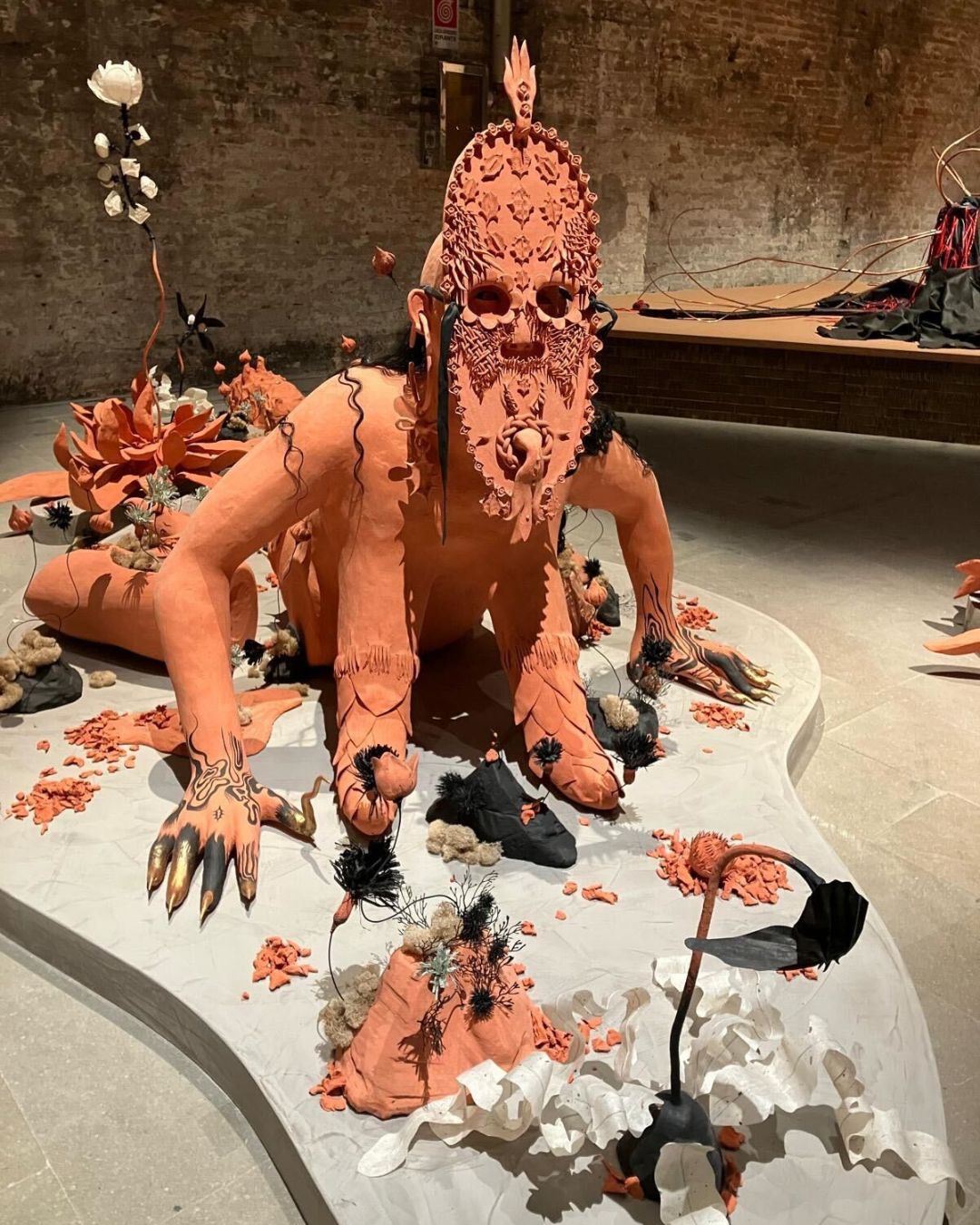 "Efflorescence/The Way We Wake" (2023). Rajni Perera and Marigold Santos | Polymer clay, styrofoam, paint, metallic powder, synthetic hair, pearls, steel, aluminum, floral foam, paper, plastic, 152.4 x 243.8 x 121.9 cm. | Photo Credit: Mikhail Mishin.
By BYRON ARMSTRONG June 8th, 2026
“I generally use my practice to world-build in a hopeful fashion,” says Rajni Perera, currently part of the Canadian pavilion at The 61st edition of the Venice Biennale. World building is something Perera does in, and outside of her personal artistic practice. Aside from being internationally in demand for her “world-building” and the futuristic figures that have spun out of that, she is also the cofounder of artist Capsules Artist Resources, an artist hub in downtown Toronto providing studio space, workshops, and gallery space for local artists. Spaces for artistic practice and appreciation come at a premium in her home city, and Perera is now paying it forward on a grassroots and global level. It’s also a fertile ground for thought leadership; a place where moderated discussions around gender equity in arts leadership can happen. Art and politics, just not politics as usual.
The Venice Biennale is now learning all about that.
Unfortunately, the curator of this year’s Biennale, Koyo Kouoh, is no longer here in the physical to speak to Perera’s (and collaborator Marigold Santos’) selection “Efflorescence/The Way We Wake.” However, Kouoh’s curatorial statement implores viewers to go beyond the cacophony of our current world, “In Minor Keys”, with art that interprets “the social and psychic condition and catalysts of new relations and possibilities.” This aligns perfectly with Perera’s practice, as it does the mood of a world caught in the throes of a shifting global order, and I had the opportunity to speak to her about some of this just a few weeks before Venice.
How would you describe your situation as an artist?
I'm a single parent with art as my career. I don’t have a 9 to 5 and it’s been that way for a really long time. All this to say, I withstand the labor pains that I go through to make these works that go between painting and sculpture and installation, without any single medium that I stick to. I research new materials and mediums all the time and don’t really want to make the same thing to satisfy the demands of a gallery who wants to sell it like a factory product.
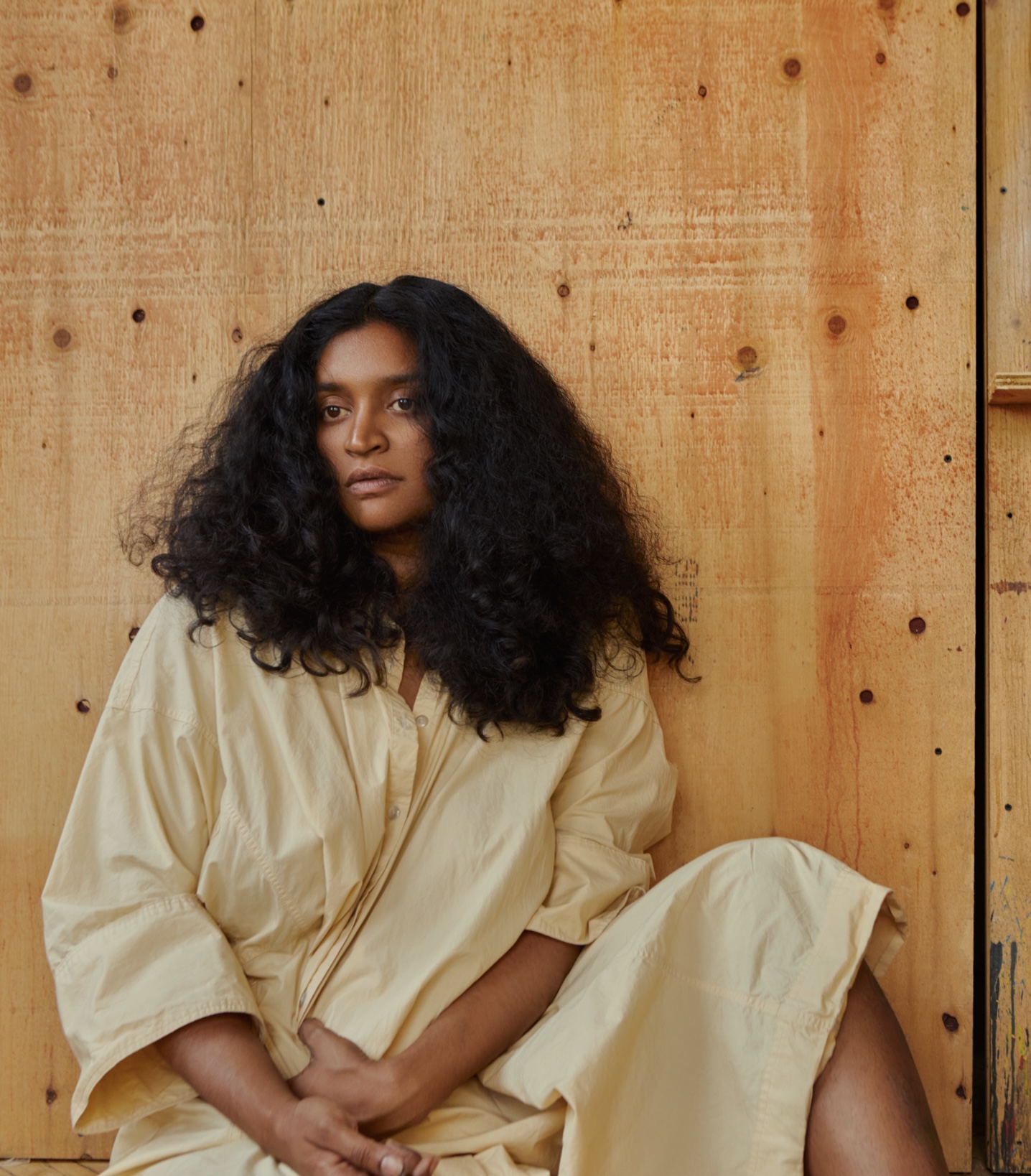 Rajni Perera | Credit: Ted Belton
How does that impact your relationships with galleries?
As a result, my gallery relationships, or my commercial gallery relationships, are very dynamic. I engineer them so that they're fruitful to me, meaning I can still open that floodgate of the different kinds of things I want to say with my practice, even while operating within the commercial realm. Although I’m successful commercially, which is not something that a lot of artists can say, that didn’t happen overnight and it’s very difficult to do. It’s not something I learned to do in a classroom. That said, my aversion to the assembly line of making within a commercial context or with restrictions has led me to be very explicit with my dealers about the fact that I'm going to be changing what I make, and the way that I make things over time. Some of them can accommodate this, others have a harder time dealing with it.
What does that tension look like…dealing with dealers who want the factory?
It's very funny, right? It's like a marriage, and I'm a very polyamorous artist. I'm very slutty, to use that expression. There's a lot of open communication, and while I've never really had experience within a polyamorous relationship, business-wise, this is the best way to go about it for me. I'll just openly say, ‘yes, I want to work with you, let's do a show.’ But I have many other prospects or galleries, and I'll entertain all of them—or at least the ones that seem interesting to me. Going with a particular gallery or dealer doesn't have to do with how much money I can make there because I’ve proven that I can do that myself.
I mean, in the beginning, no one wanted to show my work. I was just on my own, putting up my own shows, knowing the work was good but also understanding that no one really knew how to talk about it yet. I was in the beginning of radical identity-based work, but also working technically at a high level. So eventually, I’d garnered enough press that galleries came around. It's so funny, that myth of galleries wanting to discover artists. That's not actually true. They want to kind of see some kind of bona fide situation first.
So what are you looking for in your partners?
I’m looking for openness and to work with people with interesting minds. For them, the parameters of commercial success slide as much as mine do. It allows me to straddle the line between commerce and community or public projects that make me feel fulfilled. So, I'll go with galleries that can just, like, open doors for me that aren’t necessarily about access to money.
I've noticed this also extends to the music industry, right? There used to be people who went out to find undiscovered talent. And when they found you, they would build a whole thing around you; stage performance, media training, all the things, and now it's like you already have to have that in place.
Yes, very good observation. That has become worse over time. You have to package yourself, brand yourself, and fit yourself within a commercial prospect. I've always resisted being categorized, which has been great, and I think all artists need to consistently and exhaustingly do that. But when they came around, I was like, ‘what can you offer me?’ There was nothing like, what am I about to do for you? I was already selling work out of my studio and building my collector base. So I was able to shift that power dynamic from the outset, after a few very bad experiences.
What's a vague example of that? A vague, anonymous example.
I graduated from art school (OCAD University) 8 ½ months pregnant. I had just won all the medals and everything and graduated very well. Of course, a gallery picks me up. I never learned how to negotiate the terms of things like discounts, placement of artworks, or just the ability of the gallery to make decisions on my behalf. This gallery just figured they were representing me because I’d given them one solo show with like 8 or 9 works. They began telling people that they represented me. The representational relationship between gallery and artist is fraught with injustice. And even now, going into the Venice Biennale, there's problems with the way that some gallerists express themselves, specifically in relation to me and my practice. Europe is the birthplace of the artist-gallerist relationship as we know it today but circumstances are very different between how it was at the time of its conception to now, where gallerists used to give us our apartments and pay for our lives in return for half of the sales. Then, there was an actual exchange that made sense. Now it does not make sense. They've got rosters of 40, 50 artists, and we're supposed to only have one dealer to represent us. I'm still at odds within these things, but yeah, in the beginning, there were a lot of things that I didn't know to bring up. And then after those decisions or discounts had been given, or things had been done, it was too late. So the amount of business chops you truly need as an artist going into it, it's much more than what anyone would let on. You really need to know your shit, otherwise, you're out thousands of dollars and numerous opportunities.
So you're at a level you're at now, and you're saying, there are still shady things happening. Is there a certain level as an artist you would need to get to be able to work with whoever you want, when you want?
I don't think you need to come to any stage. I think if you stipulate it from the beginning, they'll just know what's up. Then it’s up to them. It's really good for both parties, this kind of polyamory. Having multiple sources of income and then determining whether this is a long term relationship or just a fling. That works for the artist and the gallery. There are many galleries who much prefer a quiet and demure artist who's very shy and is happy to sit back and let the gallery make decisions and cut deals.
Your "Traveller" series presents hybrid human beings in a sort of futuristic fashion. Can you tell me a bit about the meaning behind the travelers?
Traveller is a series about migrants in the future. It speculates on a time after white supremacy and empire has buckled. All empires must rise, and they must fall. We can see it happening before our eyes now. But the end of one thing is the beginning of another. It’s a multiverse where the unbordered and the displaced form a great ‘super nation’ in the future, with all the various cultures, ethnicities, technologies, spiritualities, and sociologies. I grew up between immigrant epicenters all over Toronto. My work is a macrocosm that shows the future of the displaced and the immigrant person on this planet. The Traveller series are snapshots painted in a style that was used to paint portraits of royalty, aristocrats, and people who really made a difference in this world. There are works envisioning a United Nations, not the UN as we know it today, but like a united immigrant planet space program, where we're starting an off-world civilization, and then we begin to change and mutate. Mutation is a beacon of science fiction storytelling. For me, it’s something which is very beautiful. I think it's a revolution of the body, of the biological self to mutate, rather than go extinct as a species, and I really like that conversation between the notions of mutation and evolution. Within the Anthropocene, we're only going to see mutation. There's no time to truly evolve. So to me, it really mirrors the efforts, resilience, and the innovation of immigrant communities, especially when a few of them come together.
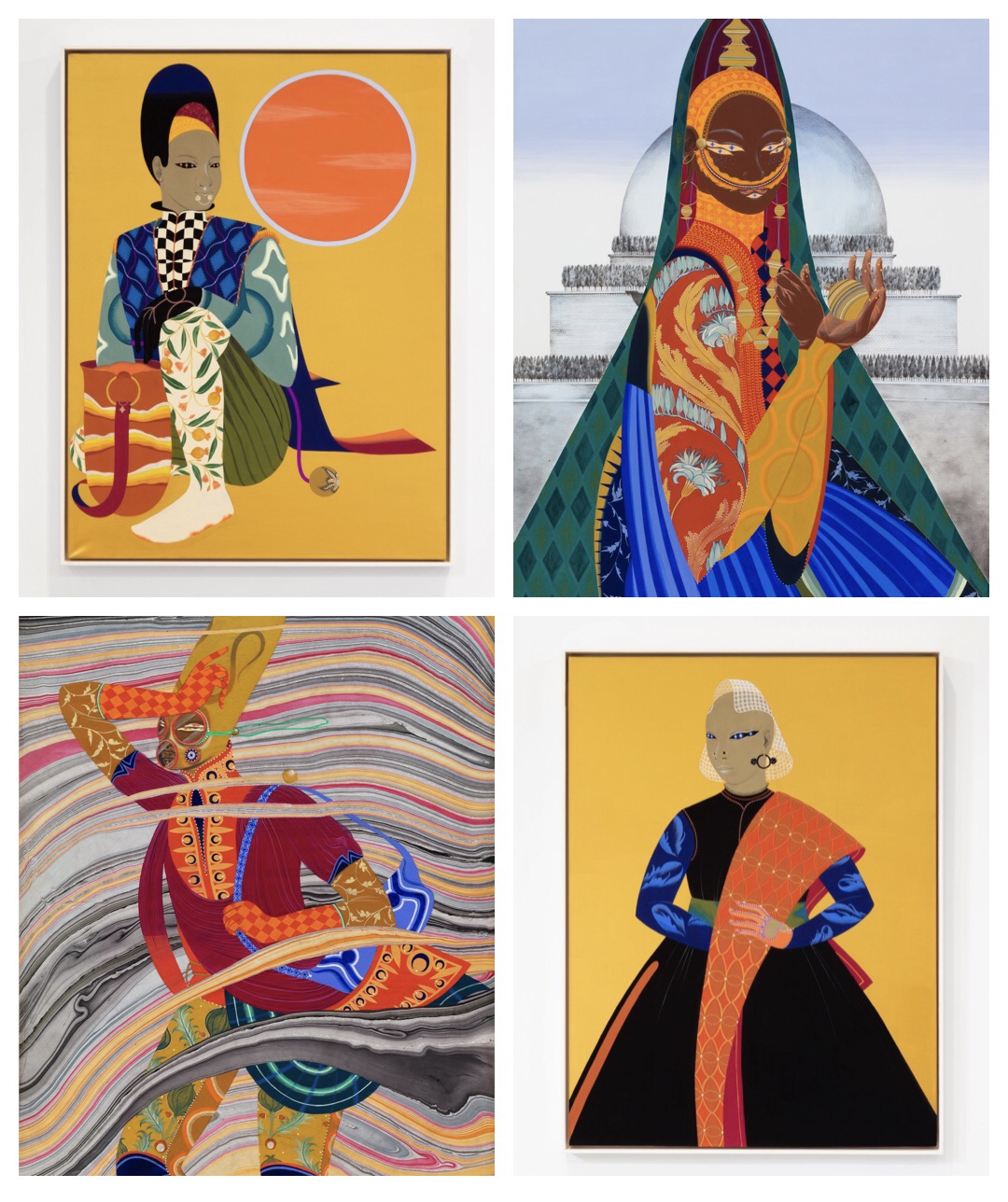 Traveller Series works (Bottom l to r/clockwise): "Storm" (2020), mixed media on marbled paper, 76.2 x 61 cm | "Ancestor 1" (2019) Giclee print on metallic archival cotton rag stock | "Traveller 5" - Commission for the Royal Bank Of Canada 40” X 60” mixed media on paper | "Ancestor 1" Giclee print on metallic archival cotton rag stock 35 × 38 in | Credit: Rajni Perera
So you brought up the survival piece. What is it that the travellers or the future folk need to mutate against in order to survive?
I mean, massive extraction of resources at the expense of entire nations of people? Religious wars and the way that the corporate world has used the veil of religious war to displace and eradicate entire nations of people, their children, cultures, books and language. I'm vehemently against the notion of the border as it stands today. I mean, the notion of the border was formed for a reason, which was tribal, and it signaled a certain culture or ethnicity of people. Now, a border means that you can't access clean water, and it may mean that the Nestle Corporation controls access to that resource instead. So I pay a lot of attention to the changes within the meaning of the word ‘border’ now. Traveler holds a microscope to that. Climate change caused by the colonizers of the world and the uprising of the colonized.
There's some technologies of revolution within the Traveller series. I play around with the idea of spaceships and immigration and taking people from one place to another. Where nature is technology, mirroring the seed as a technologically superior object that allows us to think about cryosleep and moving through space. There are wearables, like fully functional, opulently decorated gas masks and technologies like the Ring for Truth, a long solid brass ring that reaches into the body of someone who's lying and pulls the truth out from them. You'll notice that a lot of these portraits are very opulent and extravagantly decorated. Although there are many things going on with the Traveller series, one of the main things I want to talk about is the right of the displaced to enjoy opulence. In the west, we’ve created an image of the displaced immigrant as someone who doesn't have access to beauty, whether that be garments, jewelry, or any of the signifiers of wealth.
Why is it important to you to reflect that?
I'm someone displaced by a civil war, and even though I'm Sinhalese, not Tamil, the nature of civil war is that it's dangerous for everybody, so we had to go anyway. My experience living between immigrant communities here in North America proved that myth to be completely false. We're just as glamorous as ever, even while living in a colony that continues to oppress us, often using the same forces here that were used ‘over there’... but we continue to be fabulous.
Obviously, science fiction or speculative fiction, heavily influence your work. Do you have any specific influences you can nod to where this futurist bent is concerned.
I was a big reader as a kid. I really loved science fiction from its golden age of the 20s and 30s, and read a lot of short story anthologies. I prefer that sci-fi to this day because it was a lot less tainted by science fact. We love to know things so much as human beings, and we've got to have some finality of our discoveries like ‘This is how gravity works and there's no other way to explain it.’ As science fiction entered the 80s and 90s, there was a lot of this data that I think kind of dulled the blade of science fiction a little bit. In the 20s and 30s, whether it's American, British, or Soviet science fiction, now we've got these thoroughly imaginative, outlandishly speculative, world-building exercises. It’s not all about tech either. I remember having a book called A Bestiary of Science Fiction, and it was short stories all about the flora and fauna on other planets in other galaxies, like an off-worlding expedition. The characters have an adventure, and they leave, or they don't. In one of them, a woman becomes a plant or a tree at the end, against her will.
Your work also tends to be very political in the sense that it speaks to current themes. But also, a word you keep using a lot is magic. There are many people who would say a sort of magic goes into the making of art. Is there a line that travels directly from your love of science fiction to actually making artwork?
When I started making sci-fi-ish work in OCAD University, the student work that got good marks or was praised by the professors was devoid of actual content. It was extremely conceptual and academic. My work was often referred to as a subgenre. Like, ‘oh yeah, I can see you like comic books, haha, that's so cute.’ Science fiction is not a subgenre, it’s actually a very mainstream part of the way we think about the world. When you make things with your hands, I believe you charge them full of magic or power. That can be exhausting, depleting yourself to give birth to these ideas in a tangible way again and again. But I'm a big fan of parallel universes and multi-dimensional speculation, so I often think about myself in another time or another universe where the hurricane of capitalism doesn't have such an effect on my practice or my survival. I think that sci-fi is given the same rap as political artwork in that it can be sharp satirically while also being prophetic, which makes it potentially very dangerous. It’s a really effective way to tell a story and get people to understand something, and fortunately, I didn't buy into any of the negative things being said to me about my work. I’ve brought science fiction with a political lens into the contemporary art gallery.
So there’s still hope for the art school kids whose professors don't understand them.
Yeah, and it's just very funny the way that elite academia likes to kind of negate the efficacy of anything working class. Science fiction isn’t pop culture, but it’s so in touch with people because it responds to our fears about our future, and the insecurities that we are currently living with.
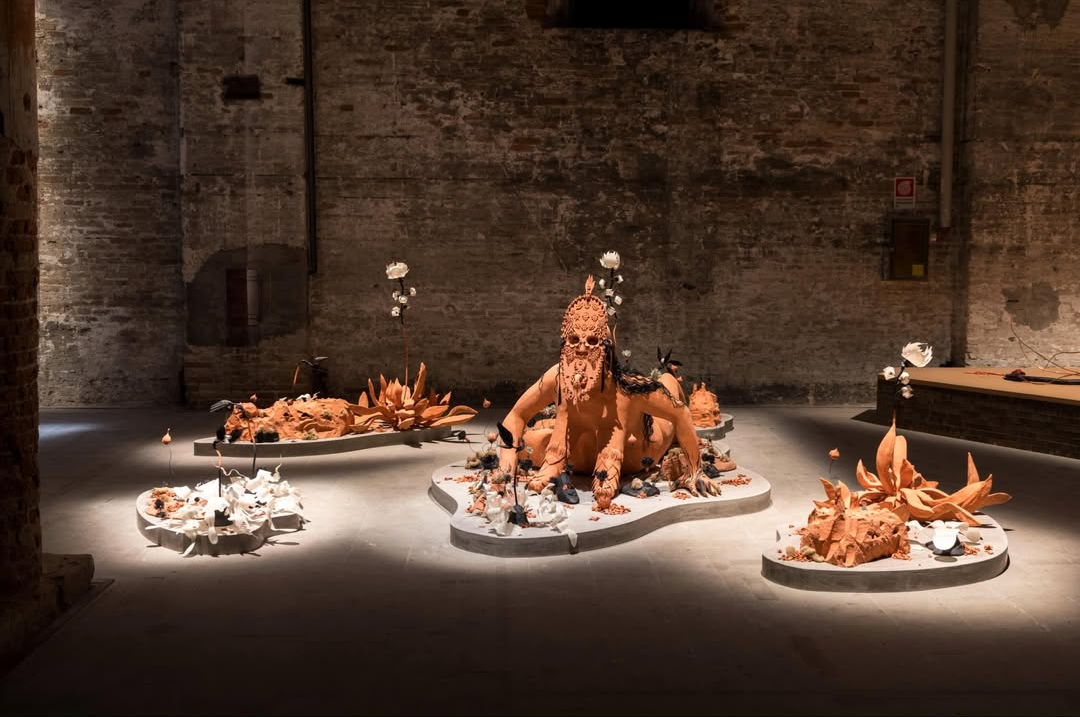 "Efflorescence/The Way We Wake" (2023), Rajni Perera and Marigold Santos | Polymer clay, styrofoam, paint, metallic powder, synthetic hair, pearls, steel, aluminum, floral foam, paper, plastic, 152.4 x 243.8 x 121.9 cm. | Credit: @Galerie_hughes_charbonneau (Instagram)
So, I have to ask you about the Venice Biennale. When did you find out?
We all know about this months before, and then we're not allowed to speak about it. But I have to say that it's probably one of the worst-kept secrets in the entire art world, because they will tell your gallery first. Then the gallery will make a bunch of decisions on our behalf, including when to tell the artist. I don't like that part. I really wish they would just reach out to us directly. Then there's a certain amount of funds that, as artists, we need to raise. So one of the things that I think the Biennale, or its curator, will look out for is artists with a significant support network. The Venice Biennale doesn't really pay for a lot. They pay for a few things, but for example, they're not necessarily going to pay for all your installation costs. Then there's a certain amount of funds that, as artists, we need to raise. So one of the things that I think the Biennale, or its curator, will look out for is artists witha significant support network. The Venice Biennale doesn't really pay for a lot. They pay for a few things, but for example, they're not necessarily going to pay for all your installation costs.
Final question: Do you have any thoughts on the Biennale this year, or any of the political "stuff" happening?
I have a complicated mix of feelings around participation in this rendition of the Biennale. On the one hand In Minor Keys is a stunningly beautiful exhibition. The curatorial team was very successful in realizing the vision of the late curator Koyo Kouoh, who formed this eloquently harmonious but very full bodied show around themes of subtle human experience such as rest, invigoration, collecting yourself from the land, and coming together in collective intimacy. It was amazing to be able to install ‘Efflorescence / The Way We Wake’ and I’m glad myself and Marigold (Santos) were able to expand on and present this special work in response to the curatorial note.
I flew in and installed the work with a knee injury, with kind help and patience from my collaborator and our project assistant. The injury kept me from attending a lot of the social events built around the Biennial, as well as the protests against war-crime pavilions, which I normally would, in case they became violent — which they did. My circumstances made me slow down and reflect on the labour of artists outside of the act of creation; we enthusiastically and continually take up the tasks of healing, starting conversations, and worldbuilding in times of censorship, institutional bulldozing and political dissonance. I don’t mean martyrdom - I mean the willingness to do this difficult work for many many years. The great effort of artists to reach for a better world moves me really deeply. Because of this I was also left wondering about the efficacy of the concept of national pavilions when the concept of borders and their dynamics clearly keep us from peace, the truth, and thoughtful, conscious societies.
“Efflorescence / The Way We Wake” Rajni Perera’s collaboration with Marigold Santos is on view at The Canadian Pavilion at The 2026 Venice Biennale May 9th to November 22nd, 2026.

Byron Armstrong
Byron Armstrong is an award-winning freelance journalist and writer who investigates the intersections between arts and culture, lifestyle, and politics. Find him on Instagram @thebyproduct and on Linkedin https://www.linkedin.com/in/byron-armstrong
view all articles from this author