Whitehot Magazine
November 2026
"The Best Art In The World"
"The Best Art In The World"
November 2026
Yoshitomo Nara: The Radical Vulnerability of Being
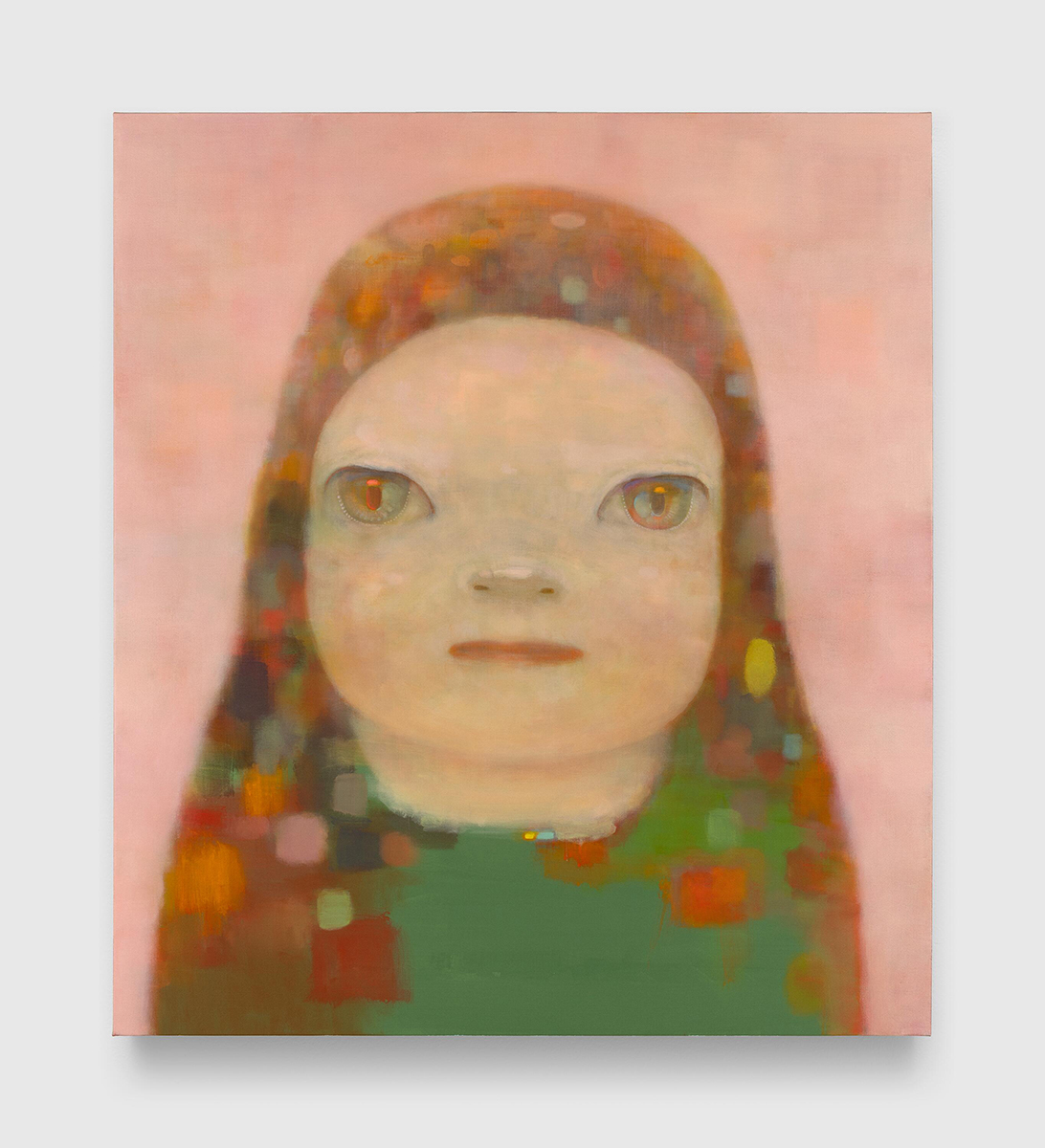 Yoshitomo Nara, Matryoshka, 2026. © Yoshitomo Nara 2026, courtesy of the artist, Equivalence Art Agency, and David Zwirner
By MARGHERITA ARTONI, November 10th, 2026
Yoshitomo Nara’s children are instantly recognizable. Their oversized heads, compressed bodies, and unsettling gazes have entered a visual language circulating far beyond the exhibition space. Beneath their apparent simplicity lies an inquiry into childhood as an autonomous condition, endowed with its own intelligence, imagination, and capacity for resistance. Nara’s figures challenge the adult world’s authority to define what childhood should mean.
At David Zwirner in New York, across the galleries at 533 West 19th Street and 537 West 20th Street, nearly one hundred works bring together new paintings and drawings, recent sculptures, and earlier pieces selected by the artist. Across periods and materials, the exhibition asks what it takes to preserve a form of being that social structures continually seek to discipline and appropriate.
In Nara’s work, childhood offers a position from which the world can be perceived otherwise. The ideal of the innocent child often serves adult desires for reassurance and control, obscuring the child’s exposure to violence, ideology, and inherited conflict. Nara’s figures express psychological independence through defiance, withdrawal, suspicion, and silence. Their vulnerability becomes a form of exposure, carrying the possibility of refusing identities imposed from outside.
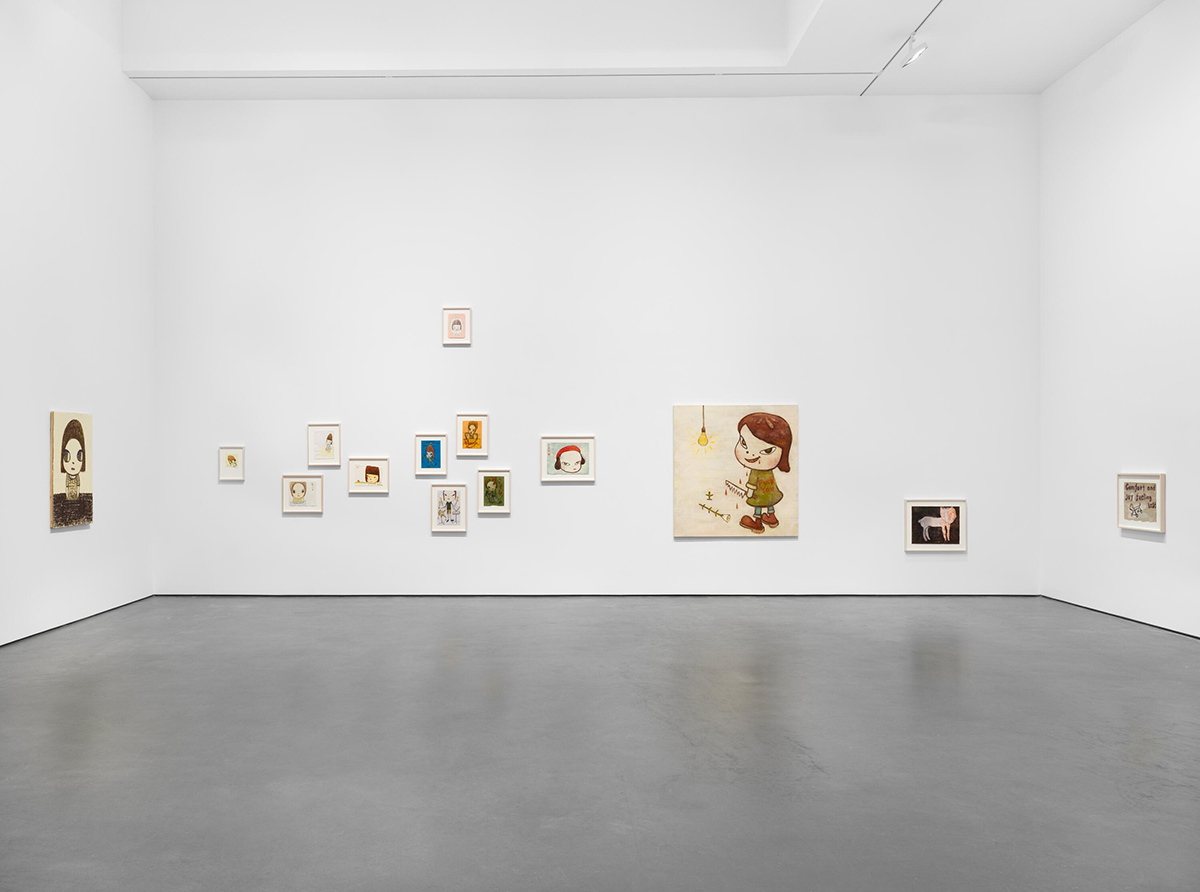 Installation view, Yoshitomo Nara, David Zwirner, New York, November 5—December 12, 2026.
Walter Benjamin’s reflections on childhood illuminate this alternative relation to experience. His account of the child’s capacity to discover affinities between seemingly unrelated things helps explain the imaginative freedom in Nara’s work. Objects and images remain open to unexpected associations, beyond established systems of meaning. His figures inhabit this unsettled territory: their opacity protects an interior freedom that the viewer cannot simply claim.
The chromatic language of Nara’s recent paintings gives this conception material presence. Subtle superimpositions, translucent layers, and shifts in tonal density allow colors to emerge from beneath one another, retaining traces of previous applications. The surfaces acquire an atmospheric depth beneath the apparent simplicity of the figures. Color functions as an emotional measure, establishing the temperature and intensity of an experience still taking shape. Muted pinks, ivories, greens, and oranges bring tenderness into contact with unease, luminosity with melancholy. Emotional states remain suspended, resisting definitive names.
In Foggy Tale (2026), closed eyes and softened contours intensify this suspension. Ivory and cream merge with the pale surrounding field, while the orange clothing and muted hair colors introduce a quiet movement. The face almost dissolves into its chromatic environment. Withdrawing from the viewer’s gaze, the figure suggests an inward attention that preserves its interiority.
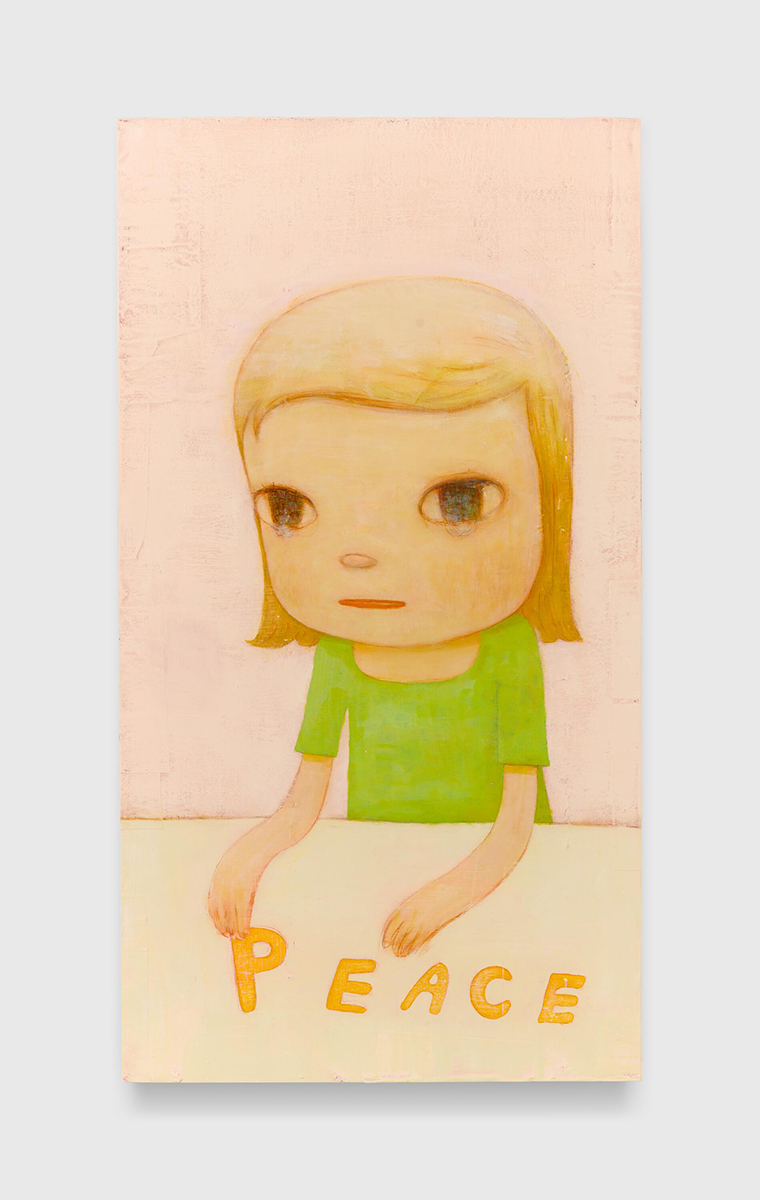 Yoshitomo Nara, Peace, 2026. © Yoshitomo Nara 2026, courtesy of the artist, Equivalence Art Agency, and David Zwirner
In Peace (2026), a pale pink atmosphere and luminous green shirt establish a delicate tension between figure and background. The child’s hands rest near the individually arranged letters spelling PEACE. The word appears as an idea being assembled, an aspiration whose realization remains uncertain. The combination of colored pencil, acrylic, and paper collage on styrene board reinforces this sense of construction. Peace emerges as a fragile possibility, dependent on the capacity to imagine another world.
Matryoshka (2026) introduces a more intense chromatic field. Multicolored patterns surround the face, whose frontal gaze establishes a direct encounter with the viewer. Its composed expression contrasts with the shifting sensations of the surrounding colors. The title evokes nested identities and an interior life exceeding outward appearance. Across these paintings, color gives form to a mode of perception suspended between emerging consciousness and discovery.
This attention to vulnerability finds an affinity with Louise Bourgeois, whose engagement with childhood memory connected psychic experience to bodily exposure and fear. Henry Darger offers another comparison: his endangered children inhabit an alternative universe where imagination becomes a means of survival against overwhelming violence. Nara’s figures share this precarious relation between vulnerability and resistance, while retaining their own visual economy and psychological ambiguity.
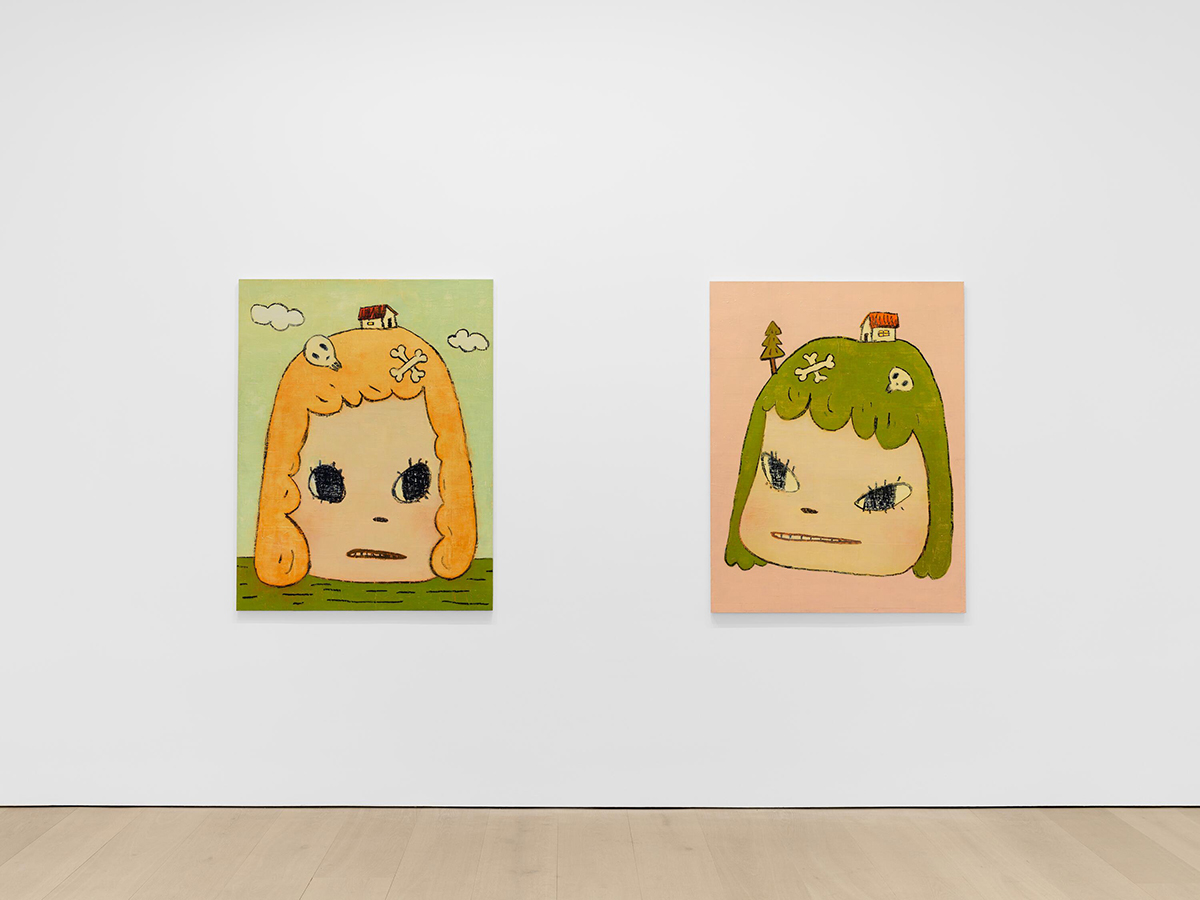 Installation view, Yoshitomo Nara, David Zwirner, New York, November 5—December 12, 2026.
Nara’s childhood in rural Aomori provides an important context. Solitude, snow-covered landscapes, and proximity to nature fostered an attentiveness to distance, silence, and nonhuman life. Music also played a formative role. Through the Far East Network, the radio service operated by the US military in Japan, Nara encountered folk, country, and soul music. Although he understood little of the lyrics, he absorbed their rhythms, melodies, and emotional registers. Merleau-Ponty’s account of embodied perception offers a useful parallel: experience takes shape through the body’s sensory engagement with the world. In Nara’s paintings, color, rhythm, and surface address this pre-reflective dimension, reaching the viewer before interpretation settles.
The exhibition’s political dimension emerges in titles such as Little Patriot, Little Leader, From the Bomb Shelter, Guns in Hands, War Birth, Eve of Destruction, World Peace, Freedom, and Some Small Hope. Childhood is already implicated in history, made to inherit its divisions and violence. Patriotism, leadership, war, and peace shape the conditions under which a life develops. The child’s vulnerability becomes a measure of adult responsibility and its failures.
A further tension concerns the global circulation of Nara’s images. His figures have become icons across art, fashion, design, and popular culture. Their recognizability has expanded their reach while placing them within an economy of endless reproduction, where images are detached from context and rapidly consumed. This raises a question about artistic meaning and its conditions of reception.
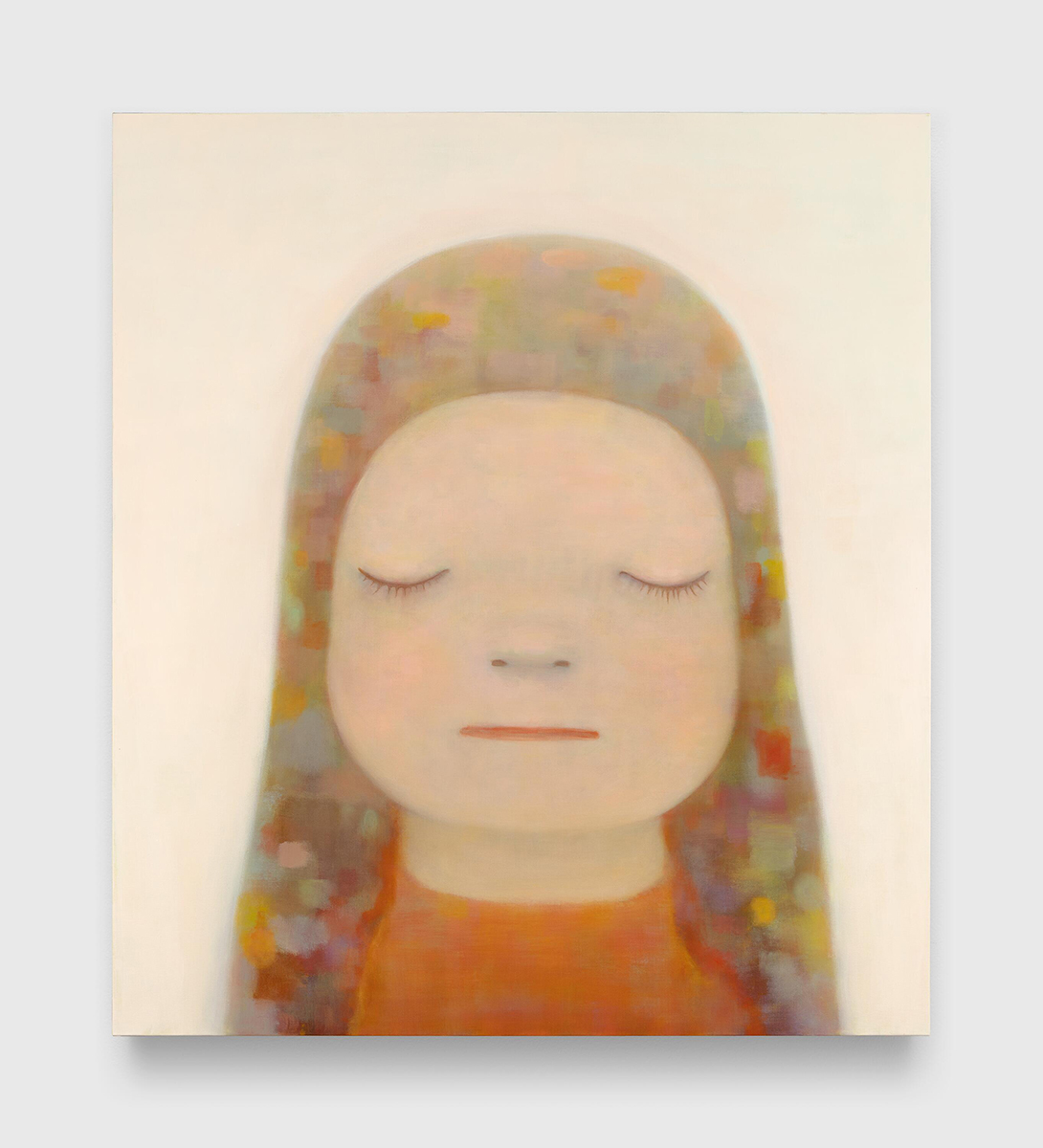 Yoshitomo Nara, Foggy Tale, 2026. © Yoshitomo Nara 2026, courtesy of the artist, Equivalence Art Agency, and David Zwirner
The icon exceeds judgment. Its circulation cannot establish its neutralization, just as commodification cannot exhaust its meaning. An image may become familiar, reproducible, and collectible while retaining something resistant to possession. Nara’s figures are widely recognized; the experience they embody remains more difficult to appropriate. The distinction lies between the image as an object of consumption and the image as an event of encounter.
In a culture that consumes appearances at speed, visibility easily replaces attention. Nara’s popularity neither guarantees nor cancels his work’s critical force. The viewer is implicated: looking becomes an ethical act when it requires sustained attention to another subject’s vulnerability, beyond the desire to possess or sentimentalize it.
The exhibition’s material dimension further complicates the relationship between image and object. Nara’s works incorporate wood, fabric, printed paper, styrene, and corrugated cardboard, preserving traces of use and transformation. Their surfaces register accumulation and revision. The thirteen bronze-and-urethane sculptures from 2024, finished in white, evoke the snow-covered forms of Mount Hakkōda. Their relationship to the landscape invites an animistic reading of Nara’s practice, in which mountains, trees, water, and stones participate in a wider network of relations.
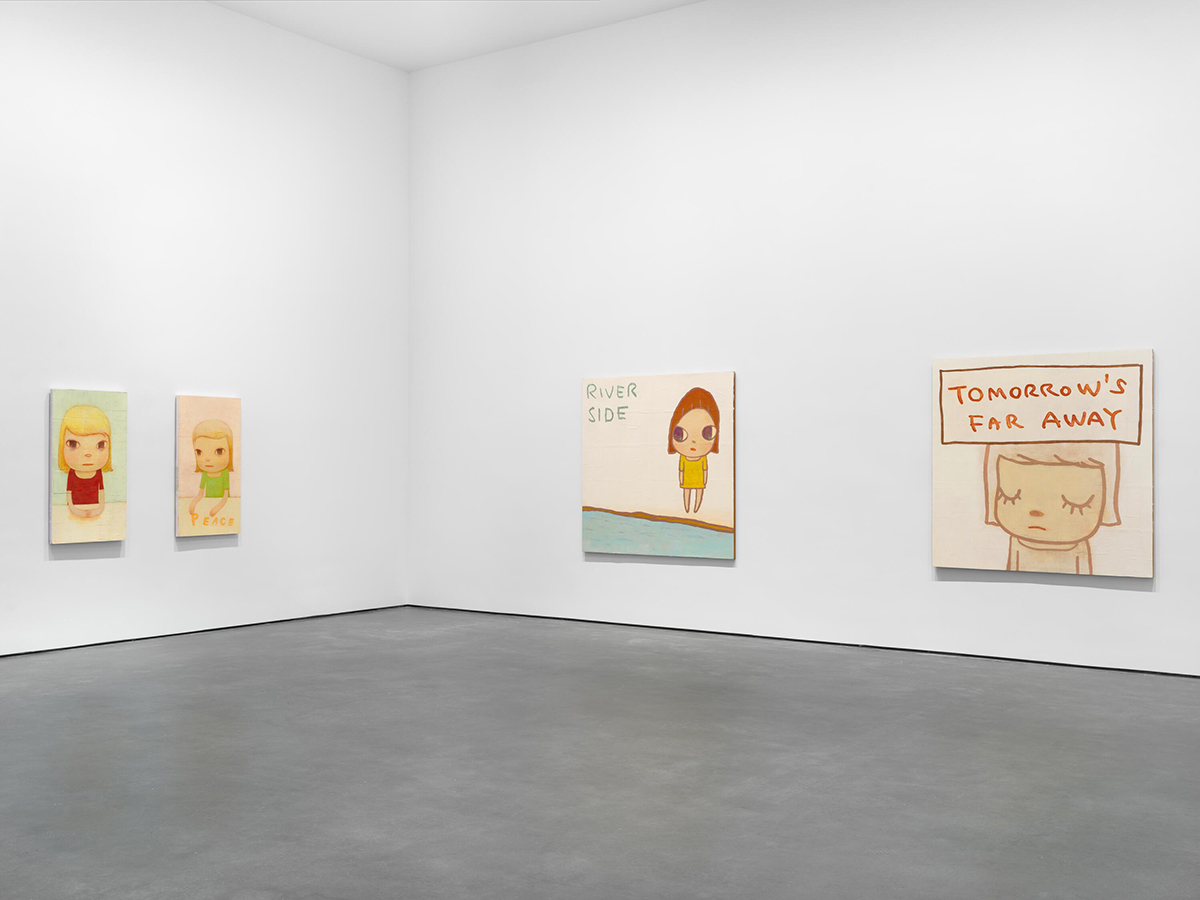 Installation view, Yoshitomo Nara, David Zwirner, New York, November 5—December 12, 2026.
Ultimately, Nara’s work concerns childhood’s right to remain irreducible. His figures ask us to recognize vulnerability without turning it into sentiment, and to encounter an image without assuming that recognition amounts to possession. Their faces may circulate indefinitely; their meanings remain open.
The exhibition leaves a question extending beyond the representation of childhood. If freedom begins with the right to remain undefined by another, what structures of power must be challenged to preserve that possibility? And, more urgently, what kind of world allows these children to remain free?
Margherita Artoni
Margherita Artoni is a contemporary art critic and curator working between Italy and the United States. She began her career collaborating with Flash Art and currently writes for Segno, Juliet, Artribune, Exibart, Inside Art, ArteIN, part of cult(ure), The Art Fuse, and Whitehot Magazine.
She has directed galleries in Turin — including NEOCHROME and EDGE Art Space — and in New York at TEAM Gallery. Her curatorial work has included exhibition programs with international artists such as Rashid Johnson, Theaster Gates, Ali Banisadr, Angel Otero, Tim Rollins & K.O.S., Laura Owens, and Mika Tajima.