Whitehot Magazine
October 2026
"The Best Art In The World"
"The Best Art In The World"
October 2026
The Veiled Analyses of Monika Baer
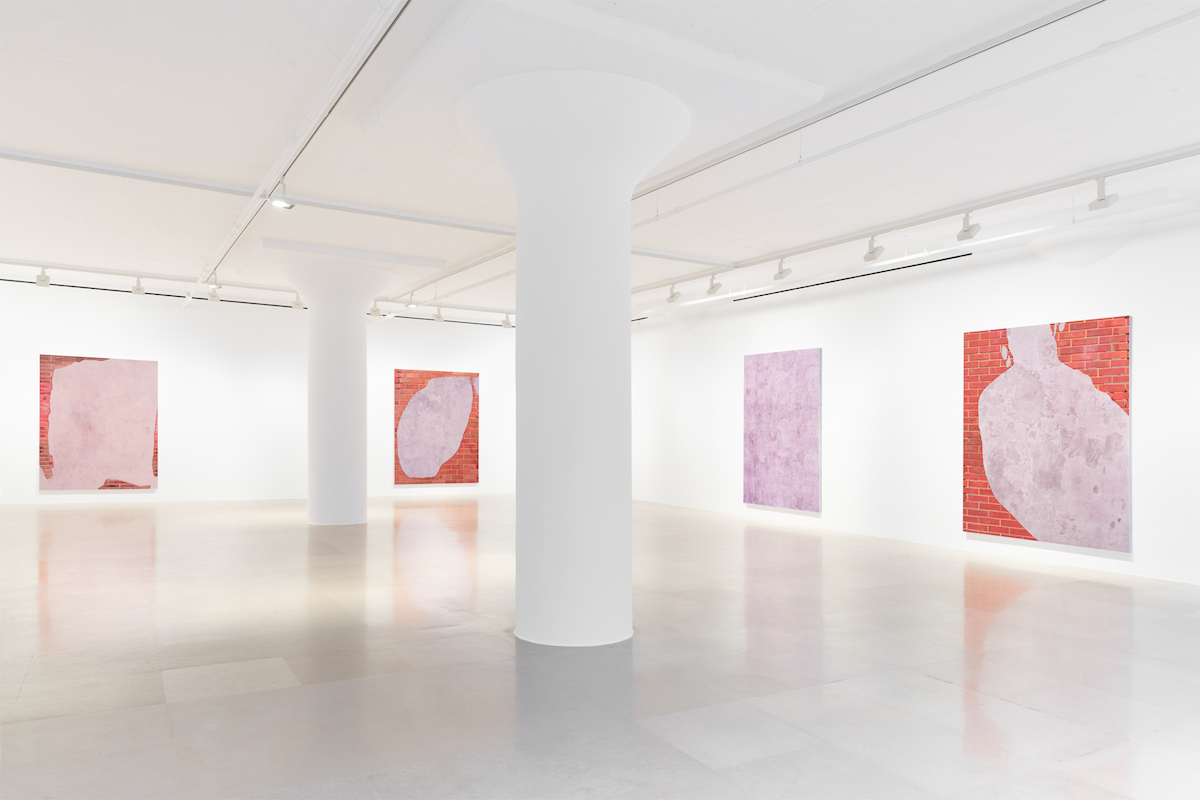 Monika Baer: “Schweine Stein Scherben”, installation view, Greene Naftali Gallery, New York. Photo: Júlia Standovár
By EDWARD WAISNIS December 4th, 2025
Being held under a German banner–that is also utilized in the titles of half of the works in the show–which translates to English as Pigs Stones Shards, Monika Baer’s third exhibition at the gallery continues the painters analytical explorations in an oeuvre as confounding as it is alluring. The Ionesco-esque credo points to a disconnected juxtaposition, probably reading with a sing song poetry in it's native language, giving off exquisite corpse correlated vibes, underscoring Baer's project.
Baer, indebted to experimentation associated with a Northern locus of significant philosophical and aesthetic achievement, embodied in the ethos of the School of Düseldorf exemplified by Sigmar Polke with his distinctly agnostic sense of remove and to the skewed significance of Gerhard Richter.
Given to working in series Baer has applied these influences here with a bit of an odd stimulating conjunction with Surrealism. Rene Magritte, mixed with the Art Brut of Jean Dubuffet, makes an appearance. The eight substantial canvases are uniformly vested in Baer’s favored vertical format. Setting up something of a rub given that, historically, this orientation holds association with portraiture and Baer’s inclination toward subject matter, in conjunction with composition; an instance subtle subversiveness for which the artist is known.
Baer has been aligned to Edward Ruscha and Jasper Johns* in the past. While comparison with the former has some validity, due to visual deployment that reads with a clean sardonic aloofness, the latter parity has been copped by rudimentarily connecting the tendency of attaching extracurricular objects of various status and provenance to the canvas. With regard to Baer, I would ascribe the impulse to a contemporary strain that has seeks to skew Johns’ bent towards Cubism and Dada with a contemporary, tempered by Postmodernist attitude.
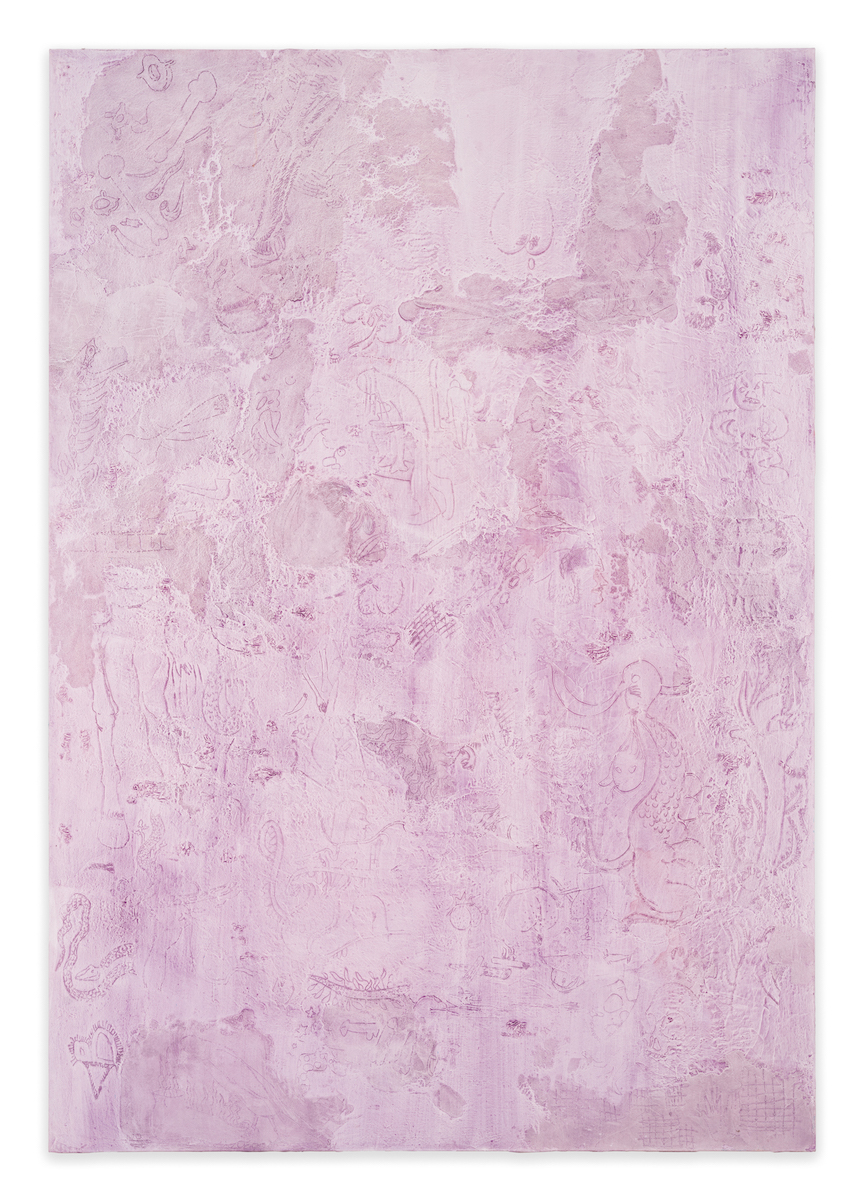 Monika Baer, “Lavender wall (2), 2025, acrylic, pigments and sand on canvas, 90 5/8 x 63 inches. Photo: Júlia Standovár
Three of the paintings–Lavender Wall (1), 2024, Lavender Wall (2) and Lavender Wall (3), both 2025, kick things off with all-enveloping scapes of an inflected surface covered with a myriad field of glyphs, pictographs and doodles–ranging from Aztec-inspired to “kilroy was here” elan (from Laxcaux cave to anime)–scratched into it. A sense of quiet stillness, despite the cacophony of memorialized signs and messages cast across the expanses, presides.
Baer has applied a custom mix of brown and violet to constitute a lavender slurry overlay as a consistent coating. This all-invasive scrim serves as sly acknowledgement to the gay rights movement for whom the tone, having been used as a term of derision, was reclaimed as a symbol of resistance and pride. † Perhaps, also analogous to a vaporous veil of choking smoke from a man-initiated disaster given the toxic nature of the counter-movement alluded to.
 Monika Baer, “Schweine Steine Scherben (smoking)”, 2025, oil, acrylic pigments, and sand on canvas, 86 5/8 x 67 inches. Photo: Júlia Standovár
Akin to broadsides, the incised expanse of palimpsest morph into rudimentary patches of spackle applied on brick walls, in the remaining five paintings. These stretches of trompe l’œil is where Baer's ode to Magritte comes in. Receding into the background, in spite of the awe of reproduction they emit, these passages luxuriate in a supporting function.
 Monika Baer, “Imprint”, 2024, oil, acrylic medium, and pigments on canvas, 74 7/8 x 41 1/4 inches. Photo: Júlia Standovár
Imprint, 2024, the narrowest canvas here bears the titular stamp in rich purple as a laissez faire cluster of condensed marking that gravitate around a chubby cartoonesque handprint. Recalling the flutter of spiny flourish in a previous work, from the alcohol series, Überlieferung verpflichtet, 2014. These skittish passages, one senses, mean something intensely personal to the artist beyond their formal qualities.
__________________________________
* Baer has denied any influence garnered from Johns, stating that she was not really fully aware of his work during her development.
† The term "Lavender Menace" was used pejoratively by some feminists in 1969 to describe lesbians they felt were a threat to the women's movement.
Monika Baer: Schweine Steine Scherben
Greene Naftali
508 West 26th Street, New York, NY 10001
Through January 10, 2026

Edward Waisnis
Edward Waisnis is an artist and filmmaker. Additionally, he is the Producer of two Quay Brothers films, Through the Weeping Glass and Unmistaken Hands, as well as having overseen the facilitation of their 2012 MoMA retrospective. His writing has appeared in Art New England, COVER, ARTextreme and STROLL.
view all articles from this author