Whitehot Magazine
October 2026
"The Best Art In The World"
"The Best Art In The World"
October 2026
Claire McConaughy, Uncultivated, at The Painting Center.
By JONATHAN GOODMAN April 11th, 2026
Claire McConaughy is a strong representational painter whose work can be considered both traditional and innovative. It is traditional in light of its themes, which include flowers, forest sites, and other natural phenomena. It is innovative in the sense that, unlike so many people working today, the artist is re-interpreting and reconnecting history in contemporary ways.
These days, we spend little time appreciating figurative art based on the landscape. But in New York, an environment that accepts most anything as an expression, McConaughy does not have much of a problem invigorating the past. Too often, we dismiss work that feels like its origins derive from the early 19th century. But fine art speaks to everyone today in every way, and the artist’s thematic understanding of nature is very strong indeed. She looks back to a time when nature was not in threat and could be enjoyed for its richness. Now the work inevitably functions both as a description and a warning; it is not always easy to tell the difference between the two.
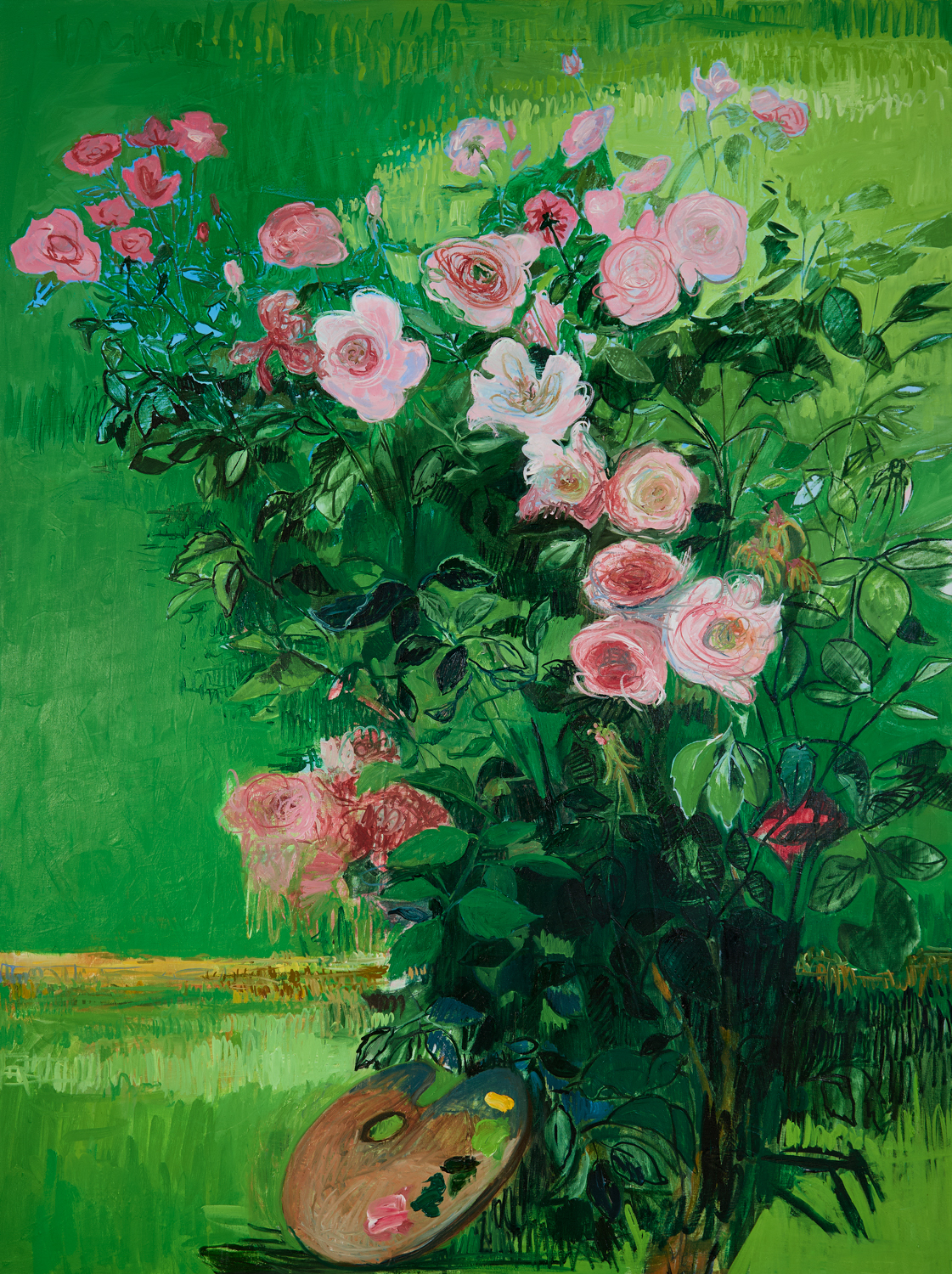 How Do I Paint a Rose?, 2025, oil on canvas, 64 x 50in
McConaughy’s beautiful work resumes an attitude that salvages the increasing vulnerability of flowers, trees, and other plant life. In “How Do I Paint a Rose”, (2025), a gathering of roses, mostly whitish pink, stand up next to each other as if to decorate an interior but what counts is the presentation of the flowers themselves. To remind us that the artist is at hand, at the bottom of the composition, there is a painter’s palette. And in the distance, it is clear that we are a part of the outside world, although the real emphasis is on the roses themselves. Deliberate beauty is always a strength in McConaughy’s work, and ends up stronger because of the artist's botanical accuracy.
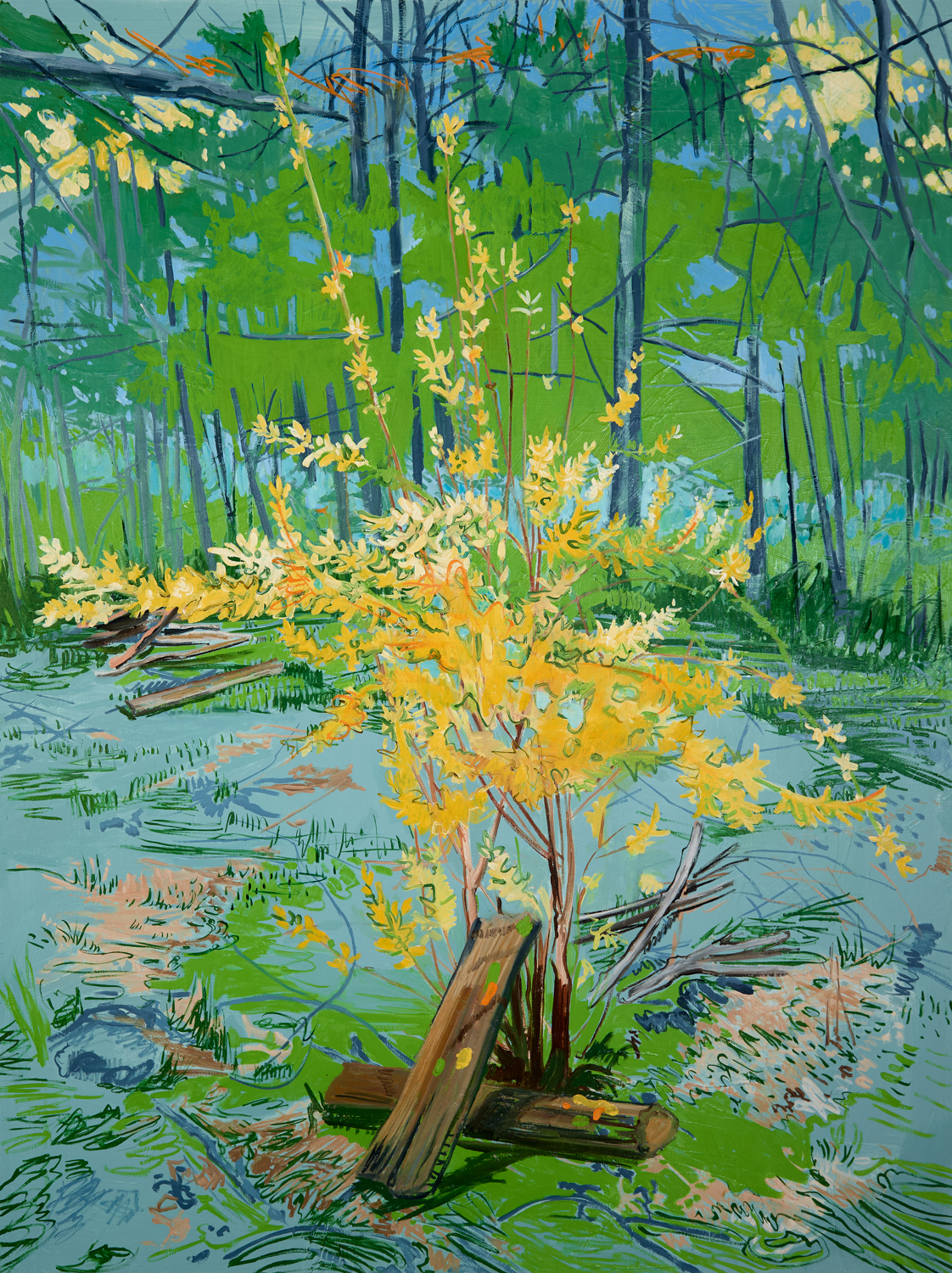 Forsythia by the Woodpile, 2025, oil on canvas, 64 x36 in
“Forsythia by the Woodpile” (2025), is a striking study of yellow flowers, set in a ground that seems to have received recent rain. Two cuts of wood sit beside the flowers on the ground, perhaps supporting them. In the background is a beautifully rendered forest of thick trees with light foliage. It is a lyric statement that stands in attractive contrast to the bright yellow of the Forsythia. Most of us hope that this kind of scene will remain lively and persistently energetic; perhaps sadness occurs due to the fact that one can not salvage a scene that is vulnerable for environmental reasons. But little matter, we are looking at art, not the actuality! McConaughy is communicating a deep seeded affection for the way the world continues to be despite the ecological devastation we are prey to.
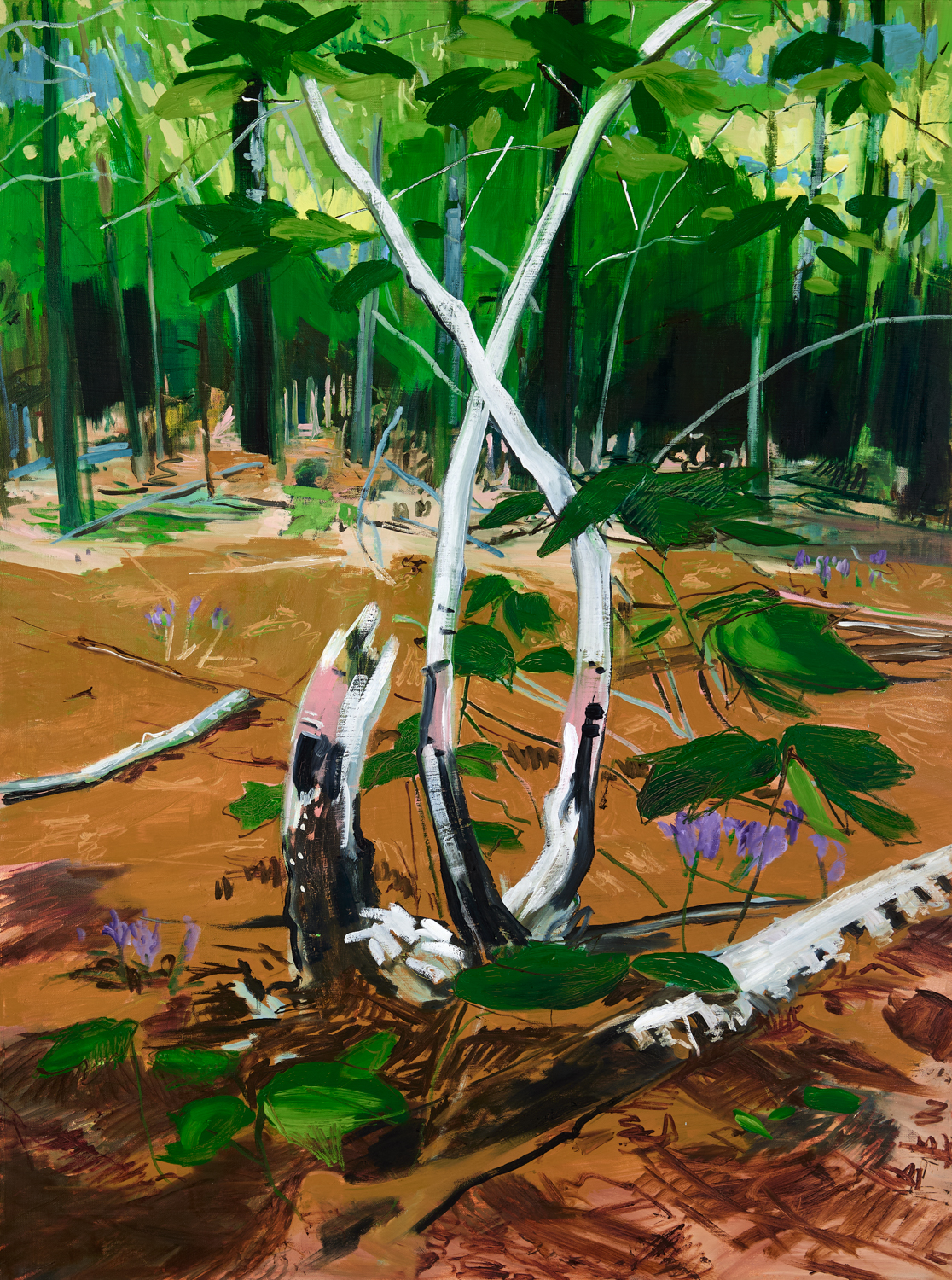 Birch Bones in Spring, 2025, oil on canvas, 48x36 in
“Birch Bones in Spring” (2025), consists of a crossed pair of birch limbs and one or two white limbs on a brown ground. In the back is a thick forest. It is hard to say whether these “ bones” are the result of a downpour or stronger storm, or if they simply embody a simple process of decay. This work is not so deliberately beautiful in the way McConaughy’s paintings are in the show. But the contrast in tones are memorable; Birches are hard to forget due to their bright white color. It is easy to read the composition as a simple declaration of natural processes. But it is also true that we are reading a description of seeming decay. The contrast is what gives the painting its interest and force, and as time goes on, we don't know what will happen to the scene. Most likely, a slow decay will take over, leading us in the direction of either visual concern or apathy. Given the way the artist paints, it seems concern will come first, McConaughy is an artist who has developed a language that corresponds to the way our natural world is slowly eroding. She leaves us though, with images that describe the natural world in ways that forgo deep concern. Somehow, we know that our visions will carry us into places where flowers and trees survive. The difficulty surrounding this knowledge is that our habitat grows smaller and consequently more desperate as the years advance. We may not be able to always keep alive the virtue we see in these paintings. But it is very much our job to try to do so. If McConaughy is right, the future can be held at bay given the short scenarios she paints so well.
The Painting Center.
March 3 – March 28, 2026

Jonathan Goodman
Jonathan Goodman is a writer in New York who has written for Artcritical, Artery and the Brooklyn Rail among other publications.
view all articles from this author