Whitehot Magazine
October 2026
"The Best Art In The World"
"The Best Art In The World"
October 2026
Antoni Tàpies at Pace Gallery
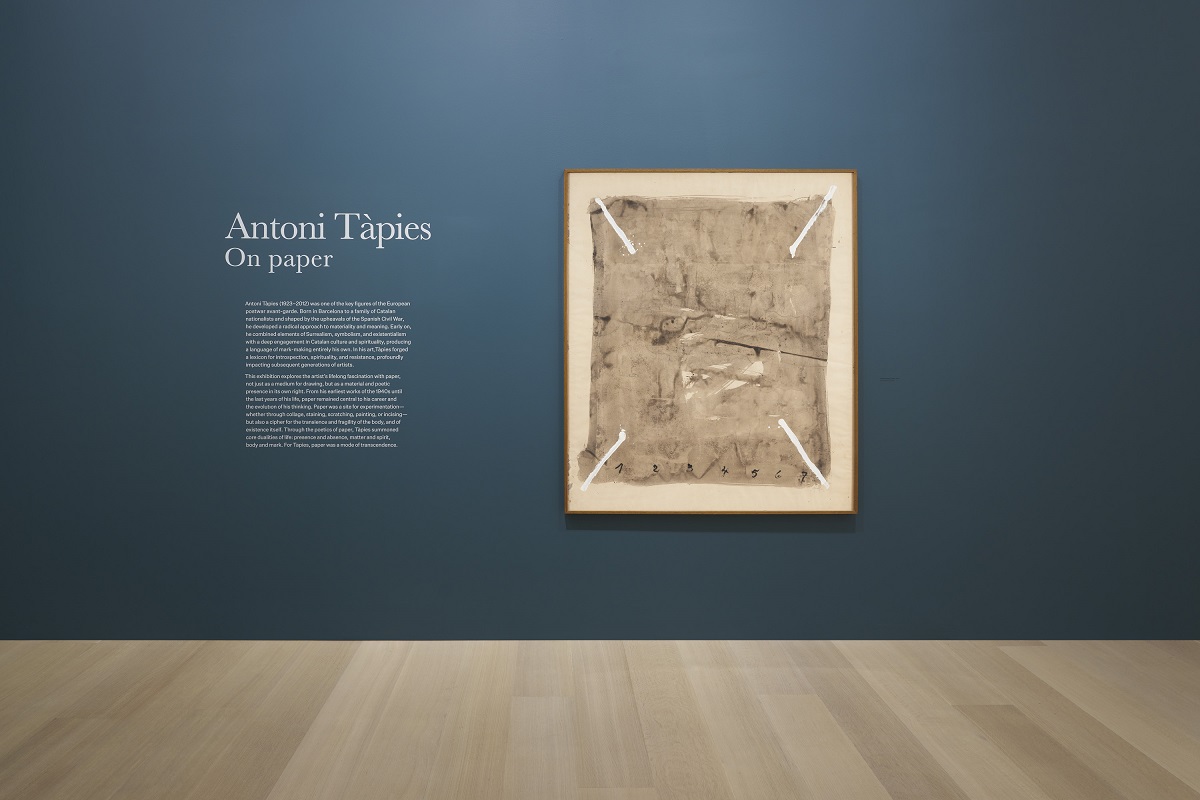 Antoni Tàpies: On paper, 540 West 25th Street, New York, NY 10001 November 7–December 20, 2025 Photography courtesy Pace Gallery
By JONATHAN GOODMAN February 15th, 2026
Antoni Tàpies the Spanish surrealist and to some extent the gifted post modern draftsman, is not quite as well known as he should be in America. Better recognized in Europe than in the United States, his combination of lyrical abstraction and visions of natural beauty express originality and independence.
Tàpies works within a language of forceful abstraction, his art is not easily compared to people of his generation especially the art of Americans of the same time.
So much art today is linked to repetition and sometimes confusion. This show, a collection of works on paper (ink), indicates the extent to which fine art can be entirely expressive even within a supposedly limited genre.
Tàpies, influenced by the important Spanish surrealist Joan Miro, installed a fine self portrait of black strokes at the entrance to the show. The similarity of style and genre reminds us that even with the influence of Miro the self portrait remains close to Tàpies himself. We should remember that Tàpies was neither a fully figurative artist nor a fully abstract one.
One beautiful abstract drawing consist of three rough horizontal bands. The top is light and offers different shapes, some of them astronomical, there is a dark crescent and light sphere that are installed in the upper left. In the middle band, which is darker in tone, a group of semi-abstract forms take over. The lowest part of the drawing, the bottom space, is the darkest, and is filled with shapes that tend toward the abstract and are harder to read. As a wonderful demonstration of shifting forms, the drawing indicates the extent to which differing visions can be shaped together.
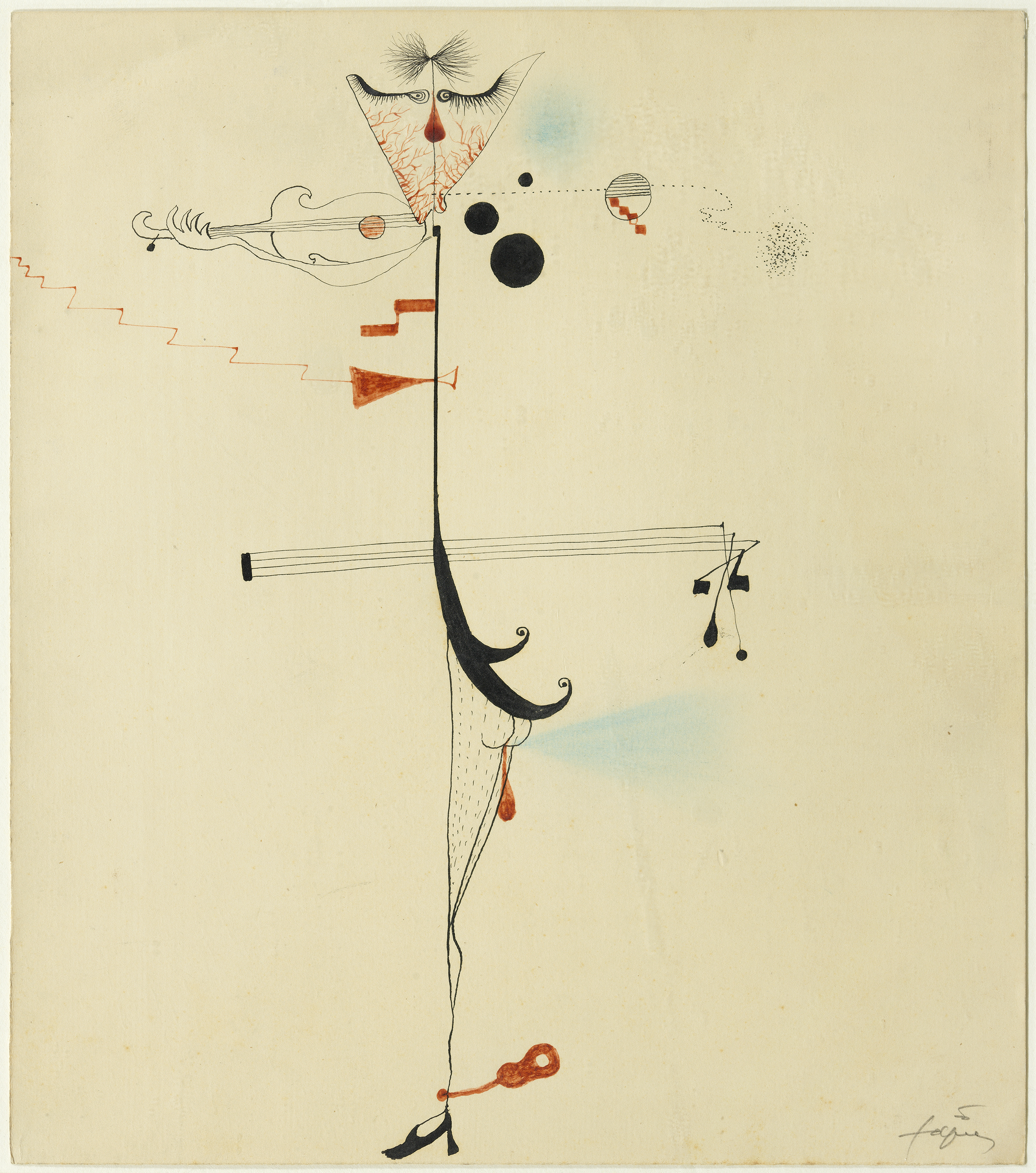 Antoni Tàpies, Musiqueta, 1949, Chinese ink on paper, 28.5 cm × 25 cm (11-1/4" × 9-13/16") framed, 54.3 cm × 41 cm × 3 cm (21-3/8" × 16-1/8" × 1- 3/16")
Two of the nicest pieces in the show have rough ties to both abstraction and nature. In one drawing the left is taken up by a swirling form of black smoke; next to it is a white vase with two handles with a design in the front, likely the result of Nobel Interest. It is a highly likable composition, set together, one abstract and one humanly made. The other drawing suggests a figure with four long black bent legs, its darkness of tone contrast with the light abstraction that takes over the center and upper left of the composition.
The center space is taken up by curving loops creating intensity and enjoyment. Like most of Tàpies’ work, here and elsewhere, his originality transcends any easy reading of his art. In the long run we see patterns and design that do not necessarily cumulate in quick understanding, but that is of little matter; what is important is that we have some sense of rhythm and newness. The audience maybe slightly confused with the mixture of abstraction and figuration but that is one way of keeping the viewers connected to the drawing. Tàpies here, and throughout the exhibition manages to build idiosyncratic forms into strikingly well maintained, if also roughly handled realities.
In this show at Pace gallery, the curator Oliver Schultz, has made the creativity of Tàpies clear. It is not easy work to necessarily make sense of. But the demands we face in his art keep us attentive. The installation matched museum-quality setups as we see in other major institutions devoted to contemporary art. Tàpies may have been slightly eccentric in his combinations of forms, at the same time building a highly independent imagination. His reputation, as strong as it is in Spain and Europe, needs to be supported more effectively in New York City. In Tàpies’ case he presents a world that is very much his own, so that we can make use of it in our own way. This is a time when under-known personae become visible in profound and necessary ways. We can only hope that as time goes on Tàpies will have as strong of an effect here as he had in Europe during the last century.

Jonathan Goodman
Jonathan Goodman is a writer in New York who has written for Artcritical, Artery and the Brooklyn Rail among other publications.
view all articles from this author