Whitehot Magazine
October 2026
"The Best Art In The World"
"The Best Art In The World"
October 2026
THE RESURRECTION OF MAVIS PUSEY
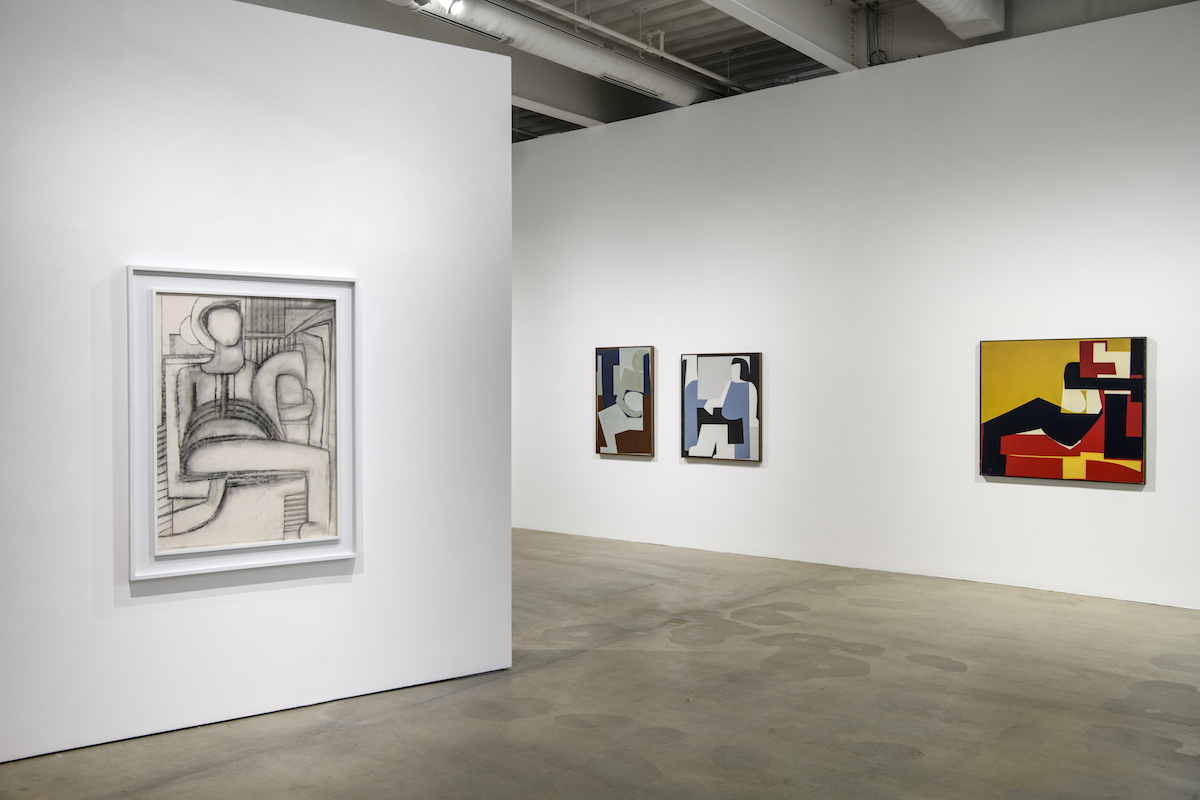 “Mavis Pusey: Mobile Images” Installation View, Institute of Contemporary Art, University of Pennsylvania. Photo: Constance Mensch
By EDWARD WAISNIS August 9, 2025
Given the height of summer-to-early winter time slot given to this comprehensive retrospective one might expect something breezy and lite, or amber and introspective. I am happy to report that neither of these is the case thanks to the quality of the work, coupled with the exemplary work of the curatorial staff led by Hallie Ringle*, that has brought us this resuscitation of Mavis Pusey.†
The precepts of milieu–from her native Jamaica, on to North America and Europe, and culminating in a return to the States–spurred by opportunity, fueled Pusey’s career trajectory physically and spiritually. Her migratory hopscotching is paid homage in the show’s title: Mobile Images.
 Mavis Pusey, Courtesy the Pennsylvania Academy of the Fine Arts Archives, Pennsylvania.
As a parentless child, subject to the challenges and duress a person of color could be subject to during the height of the fight for civil rights, saddled with innate talent, Pusey is one of a number of artist’s with parallel storied lives who have been the subjects of redressing slights in acknowledgement of unbalanced scales. In light of the current political and cultural shift, one can only posit that this noble impulse my be dampened.
Armed with experience of working with her Aunt, at dressmaking, and a first job in a clothing factory in Kingston, and inn a sort of reverse Gauguin move, Pusey immigrated from the Caribbean to the United States. Leaving a family behind in pursuit of a degree in fashion at the tender age of 18 years old.
Pusey moved her studies to The Art Student League, aided by a Ford Foundation scholarship, where her attention was diverted to painting under tutelage of Harry Sternberg and Will Barnet.
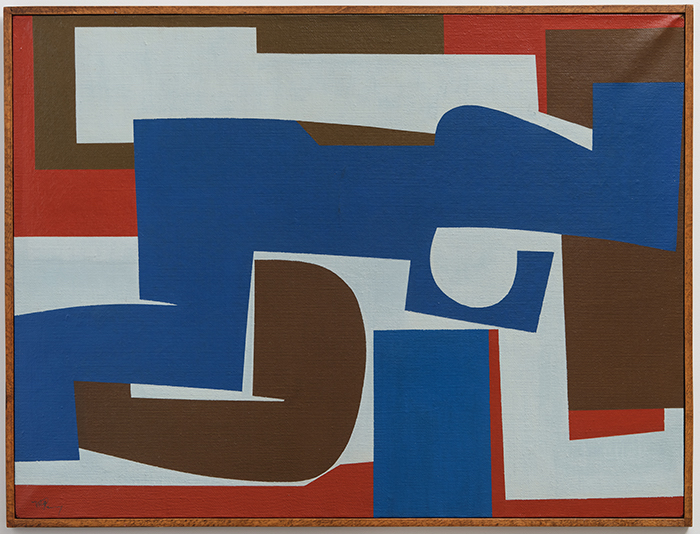 Mavis Pusey, “Nuvae”, mid-1960s, oil on burlap canvas, 30 x 40 inches. Private collection.
The work from the early-to-mid 60s share a neo-plasticity that shares something with the Purist/shape-shifter/Neo Ecolé de Paris strains of Amédée Ozanfant, Francis Picabia, and Serge Poliakoff filtered through Henri Matisse. Her expertise as a pattern-maker is put to service in the laying out of the repeating motif of a recumbent figure, as in Nuvae, 1964, for example. Then there is the obvious ode to her pattern-making background.
Upon the expiration of her student visa, London beckoned where, while plying her skills in the garment industry working at the Singer Corporation, she came under the influence of Brigit Skiöld, who ran a print workshop. Taking up the gauntlet of the discipline, which becoming proficient in printmaking under the guidance of master Robert Blackburn. This came to be a pivotal development. Round about half of the works in this exhibition of nearly one-hundred consists of her work in print medium.‡
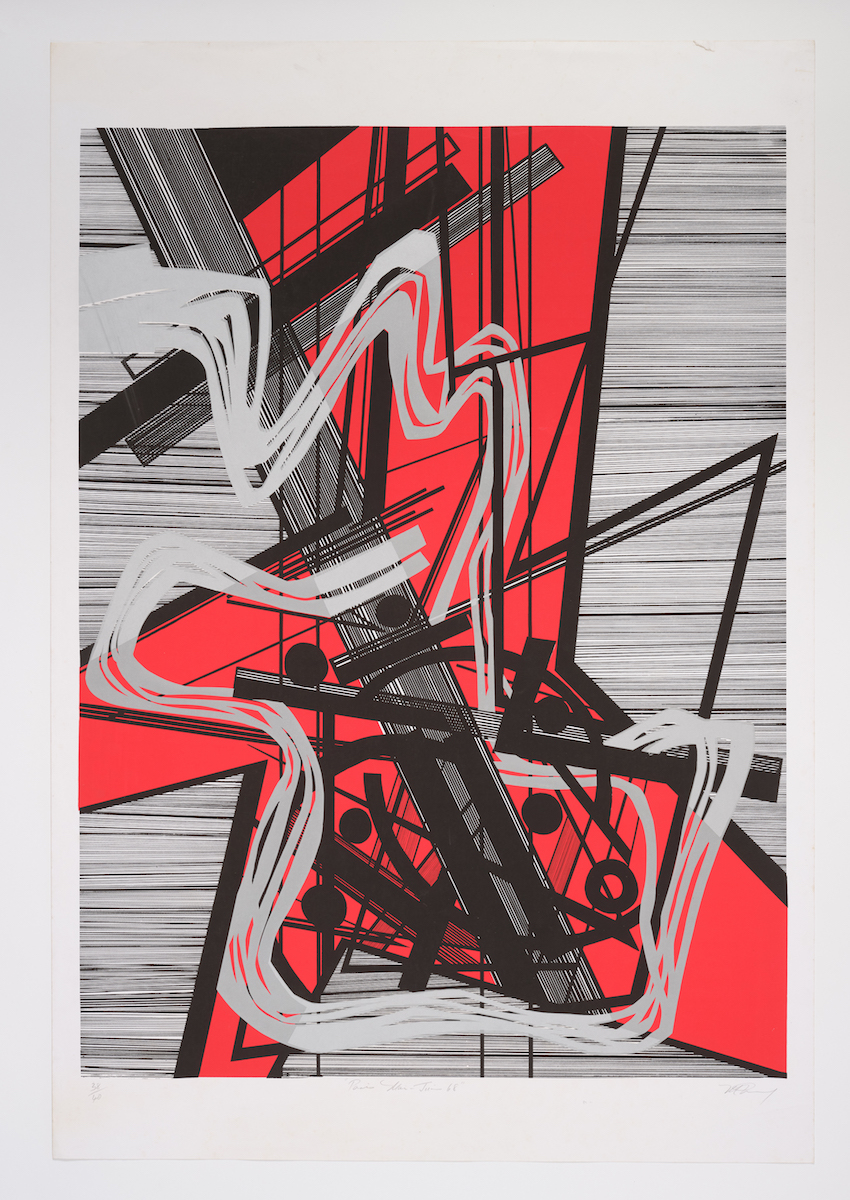 Mavis Pusey, “Paris, Mars – Juin”, 1968, screenprint, 33 x 24 1/2 inches, full margins. Private collection.
Hoping across the channel, to Paris, Pusey created the iconic screenprint. Paris, May-Juin, 1968 encapsulates, in it’s stridency, an image of a time and place at it’s very moment. This urgency exists in the compositional incorporation of the outline of a guitar form together with agitated fluid line work that breathes the confrontation of dissent, emblazoned by a standard of revolution black and red palette. Given it’s captivating melodic constructivism the work deserves to stand as a banner of the French uprising, both it’s struggle and it’s joie de vivre.
In a way, Pussey’s two major periods are married with the large charcoal on canvas work, Untitled (Charcoal Study of Seated Figure), n.d., not only by it’s placement in the exhibition, but in it’s temper. Evocative of Matisse the architectonic depiction of a faceless seated figure–built from tubular volumes similar to signature Fernand Léger–delivers on the essence of the monolithic in the manner of the huge Mies van der Rohe drawing in the collection of MoMA.§
Another instance of serendipity provided Pusey with significant inspiration. With her move back to the New York on the brink of bankruptcy. What piqued Pusey’s interest was the deflated cityscape; semi-, or wholly, abandoned, properties holed up under barricades of planks and plywood. The textures of these streetscapes spoke volumes to Pusey due to her graphic acumen.
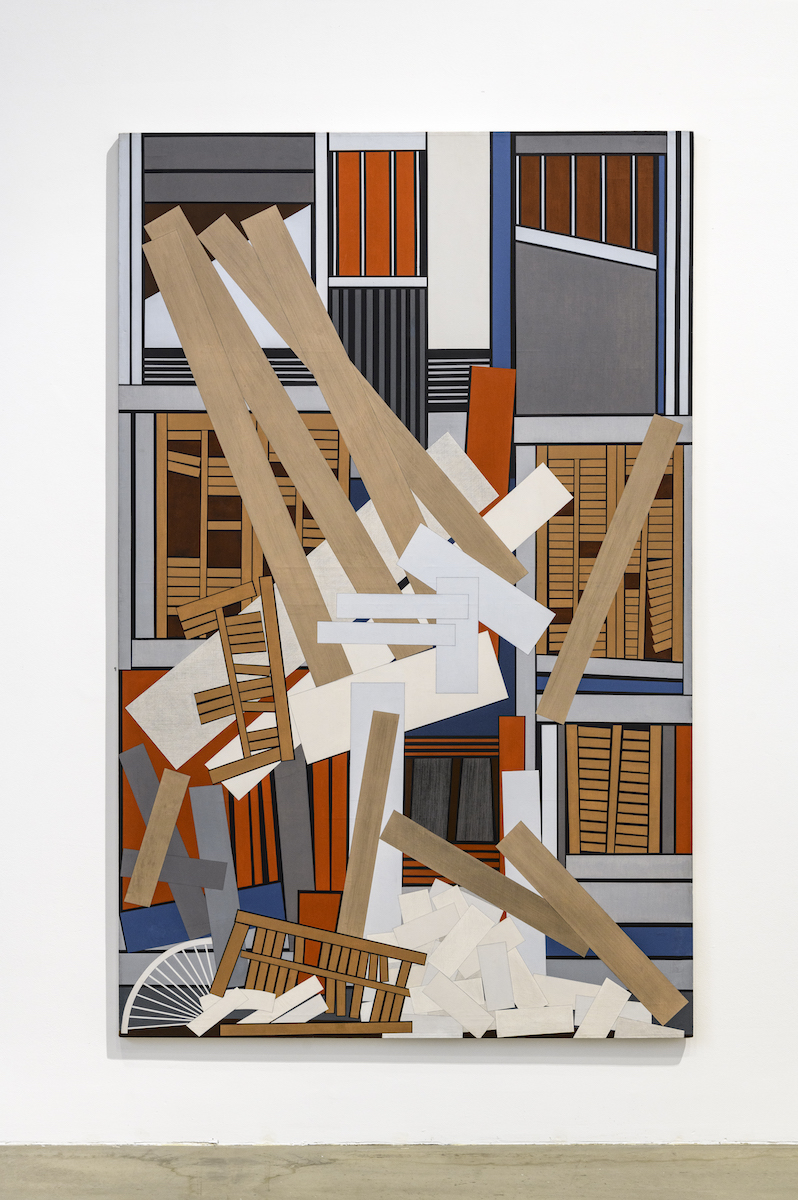 “Mavis Pusey: Mobile Images” Installation showing “Within Manhattan”, n.d., oil on canvas, 73 x 96 inches. Private collection. Institute of Contemporary Art, University of Pennsylvania. Photo: Constance Mensch
Within Manhattan, 1977 represents the summit of this direction. The buzz it exudes is palpable, in particular the ‘planks’ that Pusey has opted to cover with pocks of incident rather than the triteness of a woodgrain pattern. In their stead Pusey has transcribed incidents of pocking, shading, and other attributes of the froth as vibrant ethers that tingle the senses; a testament to her finely honed graphic sensibilities.
Pusey's strengths reached their summit during this period in which a captivation with ramshackle structures that captured her metropolitan surroundings as well as harking back to the essence of structures in her Caribbean home, all decked out in a high late-Modernism. Shifting gears, so to speak, from the sway of mid-century precepts to closer alignment with the lingerings of the then on the wane Pop–specifically, the work of Roy Lichtenstein–not only in perspective toward subject, but in what may be a Greenbergian influenced flattening of the picture plane, serves to Pusey's advantage.
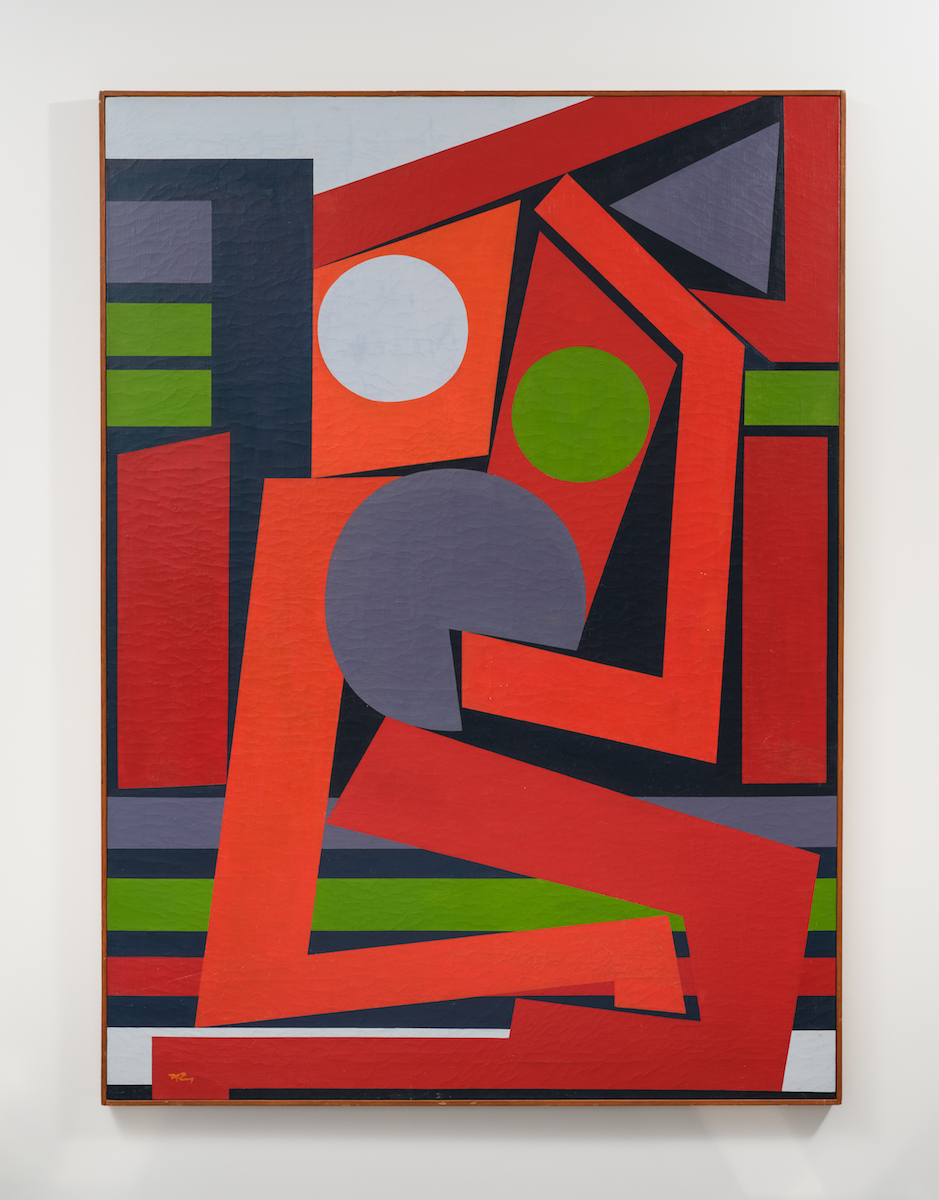 Mavis Pusey, “Personante”, n.d., oil on canvas, 53 1/2 x 75 inches. Private collection.
Succumbing to pure color, in ranges between Fauvism and Stella’s neon phase, Personate, 1990 that draws the viewer in whilst stopping one cold. The hypnotic hold is packaged in a elementally diagrammatic fractured portrait. Here, as in the superb twinned undated marker drawings Untitled (Pineapple) Blue and Untitled (Pineapple) Orange Pusey is operating in a highly constructed proto-Cubism; something that Howard Hodgkin worked with, and through.
Pusey expands on seriality in a series of prints in acid variants, Untitled (Pink; Orange; Orange and Green; Blue and Green; Orange Multi; Raised Key Lime; and Raised Orange) that has astutely been installed in a grid evoking a Warholian systematic series vibe.
Vitrine cases are peppered throughout the galleries containing archival ephemera, including a selection of newspaper clippings, exhibition announcements, and a faculty ID, serving to sketch out some of the highlights of Pusey’s career. Supplementally, a couple of outfits, designed and worn by Pusey contribute another level of presence by displaying Pusey’s handiwork as well as surrogate effigies of the artist.
Pusey ended her journeying in Virginia, where Ringle located her through diligent sleuthing. Given it’s concise, and enlightening, first-hand accounting of Pusey’s final chapter (as well as elucidation on how the exhibition came to be), I am choosing to end here by quoting directly from the press release at length:
"Pusey resisted pressures to create figurative, overtly socio-political work and remained committed to working in abstraction, retaining a focused thematic vision of her work throughout her career. However, discriminatory hiring practices that barred her from tenured teaching positions, and a late-in-life illness further contributed to the fragmentation and near-loss of her artistic archive. Starting in 2015, Ringle, who at the time served as Assistant Curator at the Studio Museum, worked closely with the artist; Thelma Golden, Ford Foundation Director and Chief Curator of the Studio Museum; and the team at the Studio Museum to painstakingly reassemble her body of work before her death in 2019, including the acquisition of a large portion of Pusey’s work for the Studio Museum’s collection. With her appointment at ICA, Ringle continued to advance her research, prompting a close collaboration between ICA and the Studio Museum on comprehensive conservation and research initiatives to preserve the artist’s legacy."
________________
* Interim Director and Daniel and Brett Sundheim Chief Curator of the ICA Philadelphia Hallie Ringle has been aided by the diligent research of Kiki Teshome, Curatorial Assistant, Studio Museum in Harlem..
† The exhibition will travel to the recently re-opened Studio Museum in Harlem in Spring 2027.
‡ Earlier Pusey had worked at Robert Blackburn’s Printmaking Workshop (1969–1972), which was frequented by significant figures such as Emma Amos, Jacob Lawrence, Romare Bearden, and Melvin Edwards, among others. During the 1970s, she participated in a community art space called Communications Village operated by printmaker Benjamin Leroy Wigfall in Kingston, NY.
§ Mies van der Rohe, Friedrichstrasse Skyscraper Project, Berlin-Mitte, Germany (Exterior perspective from north), 1921.
Mavis Pusey: Mobile Images
Institute of Contemporary Art - University of Pennsylvania
118 South 36th Street, Philadelphia, PA
Through December 7, 2025

Edward Waisnis
Edward Waisnis is an artist and filmmaker. Additionally, he is the Producer of two Quay Brothers films, Through the Weeping Glass and Unmistaken Hands, as well as having overseen the facilitation of their 2012 MoMA retrospective. His writing has appeared in Art New England, COVER, ARTextreme and STROLL.
view all articles from this author