Whitehot Magazine
August 2026
"The Best Art In The World"
"The Best Art In The World"
August 2026
Postcard from North Carolina
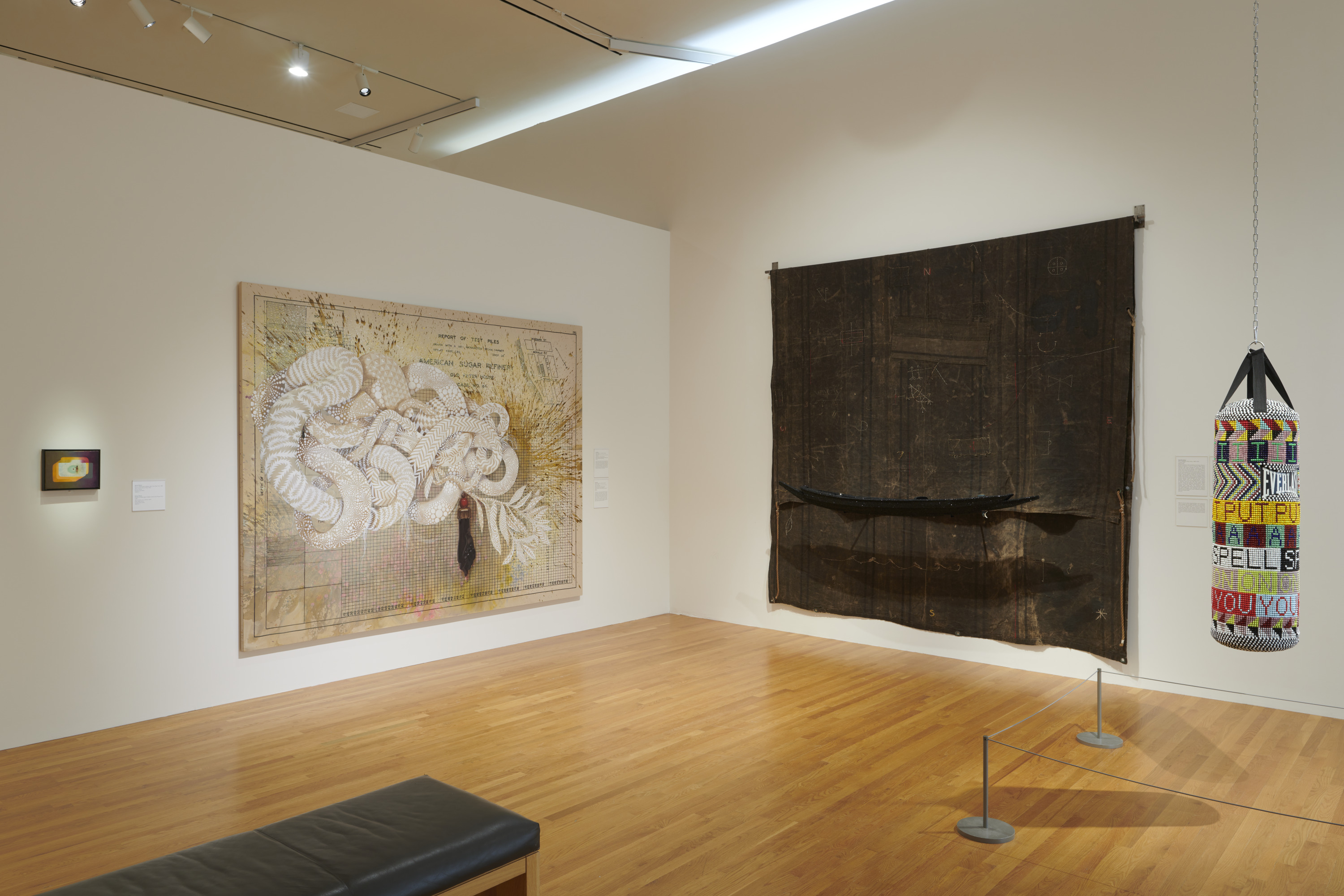 Installation view Everything Now All At Once at the Nasher Museum, August 21-November 1, 2026. Image courtesy of the Nasher Museum.
By NINA MDIVANI May 23rd, 2026
Filtered through the diffuse light of the Nasher Museum of Art at Duke University galleries, Everything Now All at Once gathers landmark works from the museum’s contemporary collection in celebration of its twentieth anniversary. On view through November 1, 2026, the exhibition unfolds within the densely verdant landscape of North Carolina’s Research Triangle, where the proximity of Duke University, University of North Carolina at Chapel Hill, and North Carolina State University has long positioned the region at the intersection of technological innovation, academic production, and cultural exchange.
Rather than presenting the collection as a fixed institutional archive, the exhibition operates more like an evolving visual mixtape: a constellation of works whose textures, temporalities, and conceptual dissonances accumulate through proximity. Each selection carries its own cadence of memory, political resonance, and material presence, while the relationships between works generate a broader rhythm that reflects shifting cultural narratives across Durham and beyond.
Since its founding in 2005, the museum has cultivated a pioneering contemporary collection centered on artists and perspectives historically excluded from dominant narratives. Through strategic acquisitions, commissions, and long-term support of artists at pivotal moments in their careers, the Nasher has established a collection that is both critically engaged and future-oriented. As the Museum director, Trevor Schoonmaker said in our conversation on the ground the positioning of the Nasher Museum was never approached through scale, spectacle, or competition with larger coastal institutions, but through the careful construction of a distinct curatorial identity.
He describes how, from the museum’s earliest years, the institution “organically grew into this identity” centered on supporting artists of color and global contemporary practices, particularly contemporary African art, long before such work became institutionally widespread. Rather than attempting to “do everything,” the museum intentionally narrowed its focus in order to create a meaningful contribution within the broader museum landscape. This positioning was deeply personal as well as intellectual for Schoonmaker: shaped by formative experiences in Nigeria and Ghana, immersion in international Black cultural communities, and early scholarly engagement with contemporary African art at a time when the field had little institutional support.
Importantly, the museum’s direction was not built through abstract strategy alone, but through relationships, networks, and sustained engagement with artists over decades. Connections formed in New York through the Studio Museum in Harlem, independent curatorial projects, and exhibitions such as Black President became foundational to Schoonmaker’s later programming, allowing the institution to bring artists like Wangechi Mutu and Barkley L. Hendricks into the museum’s orbit long before they achieved their current canonical status.
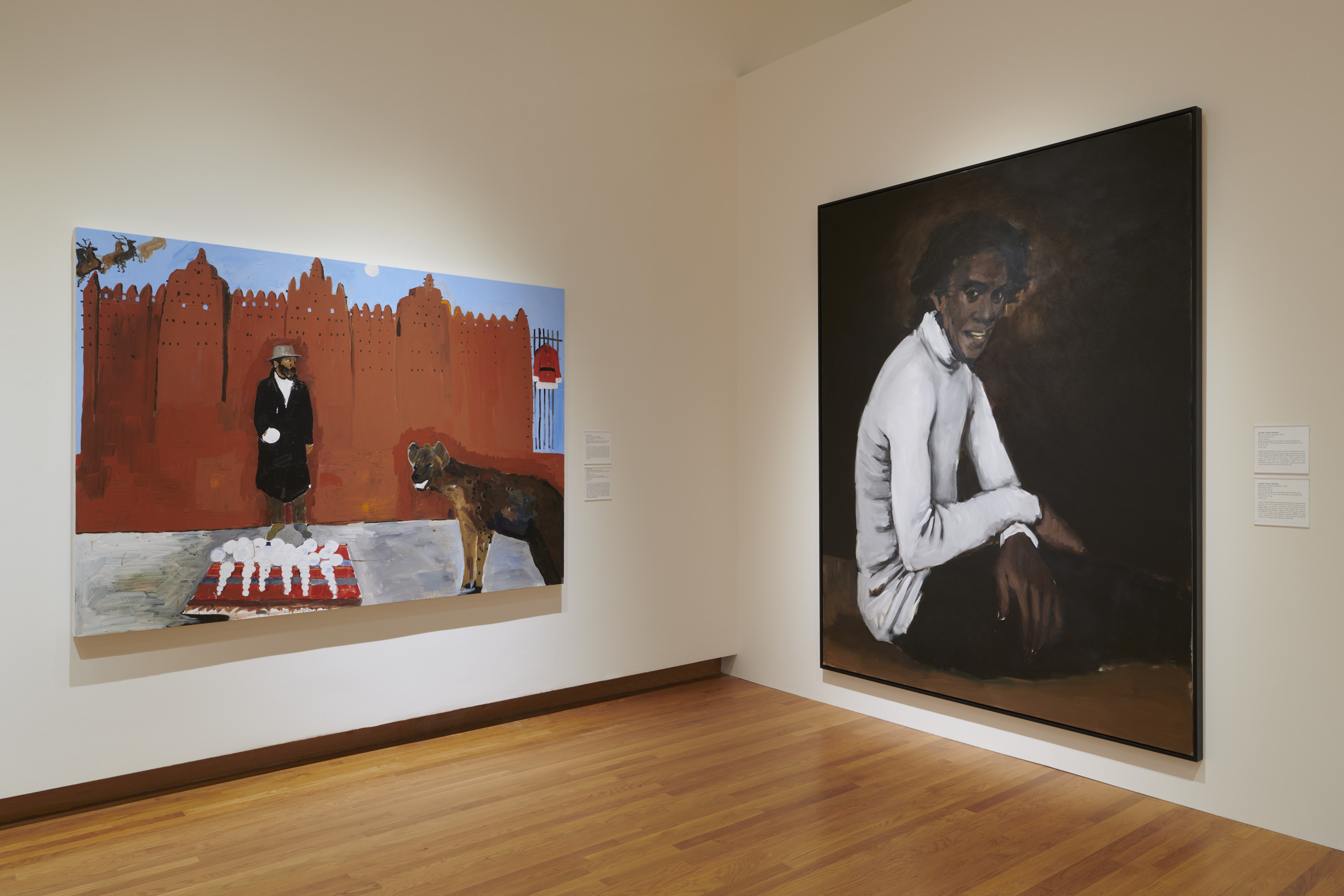 Installation view Everything Now All At Once at the Nasher Museum, August 21-November 1, 2026. Image courtesy of the Nasher Museum.
More than a reflection on the past twenty years, Everything Now All at Once also gestures toward the museum’s future. Recent acquisitions underscore the continued relevance of its founding principles while signaling new directions for the collection in the years ahead. A fact emphasized by the Nasher Museum curator, Dr. Xuxa Rodriguez, Everything Now All at Once serves not simply as a presentation of the collection, but as a declaration of the Nasher Museum’s role within the broader American cultural landscape. She describes the exhibition as positioning the museum “as part of the avant-garde,” likening it to a “lighthouse” signaling where audiences should direct their attention.
Built through relationships with artists, collectors, and communities, the exhibition reflects the institution’s longstanding commitment to supporting artists early in their careers and creating space for voices often overlooked by larger museums. For Xuxa, curating carries a profound public responsibility: exhibitions should expand the viewer’s understanding of the world, foster empathy, and encourage audiences to recognize themselves as part of a larger collective experience.
In this sense, Everything Now All At Once operates as both an aesthetic and civic proposition—a space where contemporary art becomes a tool for imagination, recognition, and social connection. At the same time, Xuxa situates the exhibition within the political realities of the present moment, emphasizing that art is not a luxury but a necessary space for imagining alternative futures.
The Nasher Museum building itself was designed by the Uruguayan architect Rafael Viñoly and opened to the public in 2005; it is angular and airy, bathed in natural light and surrounded by greenery everywhere. One way to look at what is presented is to trace the main themes, such as canonical Black and diasporic modernisms, socially engaged conceptual practices, regional lineages, and emerging artists positioned as heirs to those histories. At the foundation of Everything Now All At Once are canonical figures whose work is already embedded within museum history narratives.
Artists such as Barbara Chase-Riboud, Sam Gilliam, Barkley L. Hendricks, Nick Cave, Alfredo Jaar, and Ai Weiwei function as historical anchors within the exhibition ecology. Their practices span postwar abstraction, conceptualism, politically engaged art, social practice, ceramics, architecture, and Black figuration, establishing a lineage through which younger artists can be understood.
The inclusion of figures like Charlie Lucas, Mark Hewitt, and Maud Gatewood also broadens the exhibition’s material and regional vocabulary beyond the dominant language of global contemporary art. Jeffrey Gibson’s vividly decorated, with blue, yellow, black, and brown beads, punching bag has the words “I put a spell on you” embroidered on it, creating a cognitive dissonance. Do we punch someone for spiritual violence, or do we venerate a unique object in front of us that sounds vaguely criminal?
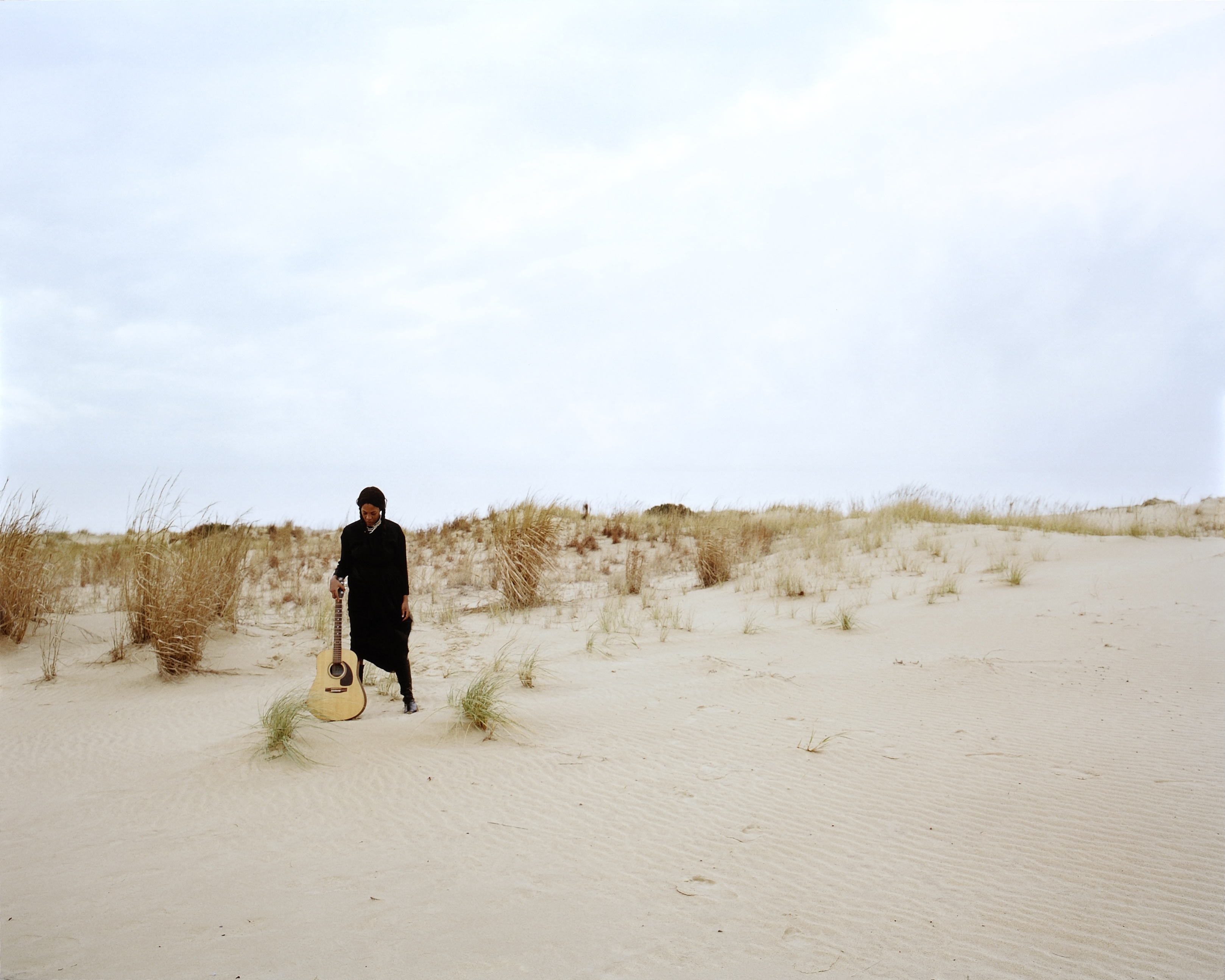
Xaviera Simmons, Session Six: Kitty Hawk from the project Thundersnow Road, North Carolina, 2010. Chromogenic print, edition 1/3, 40 1/8 x 50 x 1/8 inches (101.9 x 127 x 0.3 cm). Collection of the Nasher Museum of Art at Duke University, Durham, NC. Commissioned by the Nasher Museum of Art at Duke University, with support from Duke University’s Council for the Arts,2010.6.4. ©Xaviera Simmons. Courtesy of the artist and David Castillo, Miami.
A second tier of artists represents what might be considered the institutional core of contemporary art: mid-career figures who emerged prominently during the 1990s and 2000s and now occupy central positions within museums, biennials, and academic discourse. Artists including Glenn Ligon, Isaac Julien, Wangechi Mutu, Mickalene Thomas, Paul Pfeiffer, Amy Sherald, and Henry Taylor have become defining voices in conversations surrounding race, representation, gender, diaspora, and image-making in the twenty-first century.
Their practices reflect the maturation of identity-centered discourse within institutional contemporary art. At the same time, artists such as Jeffrey Gibson, Odili Donald Odita, Pedro Lasch, and Laurel Nakadate extend those conversations into questions of indigeneity, migration, abstraction, performance, and media culture. Wangechi Mutu’s simultaneously menacing and majestic figure, MamaRay, reigns over the Museum's main hall, synthesizing organic and human-made power.
The exhibition also foregrounds a younger generation of artists who rose to prominence during the post-2010 expansion of the global contemporary art market. This ascendant cohort includes Njideka Akunyili Crosby, Firelei Báez, Amoako Boafo, Jadé Fadojutimi, Derek Fordjour, and Nina Chanel Abney, among others. Many within this group work through the languages of diasporic identity, Black portraiture, speculative history, spirituality, and material hybridity.
Their rapid movement from emerging status to institutional and market prominence reflects a larger transformation within contemporary art over the last decade, in which museums and collectors increasingly centered artists whose practices address questions of visibility, historical repair, and transnational identity. Artists such as Kevin Beasley, Xaviera Simmons, Anthony Olubunmi Akinbola, Genesis Tramaine, and Kenny Rivero further demonstrate how contemporary figuration and material experimentation have become deeply intertwined with questions of cultural inheritance and collective memory.
Alongside these highly visible names, the exhibition includes several emerging and early-to-mid career artists whose inclusion signals a curatorial investment in future art-historical narratives. Figures such as Clarence Heyward, Sherrill Roland, Shaqúelle Whyte, Raheleh Filsoofi, and Jim McDowell occupy a transitional space between regional recognition and broader institutional visibility.
Their presence expands the exhibition beyond established market logic and introduces practices rooted in community engagement, craft traditions, social history, and localized cultural experience. One of the most memorable works in the exhibition is Raheleh Filsoofi’s plate titled BITE after the performance by the same title. For it, Filsoofi gathered native clay from the Museum grounds, transforming it into a plain, round plate, which she beat down on in a circular pattern, leaving bite marks all around. Commenting on memory, migration, and the body’s relationship to land Filsoofi underscores how connected we are to our ecosystems.
Taken together, the exhibition reads as an interwoven narrative of the evolving canon of contemporary art— one shaped by diasporic experience, institutional revision, historical recovery, and the globalization of contemporary culture. The result is less a neutral survey than a carefully staged portrait of the values currently defining major museum practice in the United States.
Nina Mdivani
Nina Mdivani is Georgian-born and New York-based independent curator, writer and researcher. Her academic background covers International Relations and Gender Studies from Tbilisi State University, Mount Holyoke College and Museum Studies from City University of New York. Nina's book, King is Female, published in October 2018 in Berlin by Wienand Verlag explores the lives of three Georgian women artists and is the first publication to investigate questions of the feminine identity in the context of the Eastern European historical, social, and cultural transformation of the last twenty years. Nina has contributed articles to Hyperallergic, Flash Art International, The Brooklyn Rail, JANE Magazine Australia, NERO Editions Italy, XIBT Magazine Berlin, Eastern European Film Bulletin, Indigo Magazine, Arte Fuse. As curator and writer Nina is interested in discovering hidden narratives within dominant cultures with focus on minorities and migrations. You can find out more about her work at ninamdivani.com