Whitehot Magazine
October 2026
"The Best Art In The World"
"The Best Art In The World"
October 2026
Dhewadi Hadjab in conversation with Margherita Artoni. Painting, perception, and the unstable image.
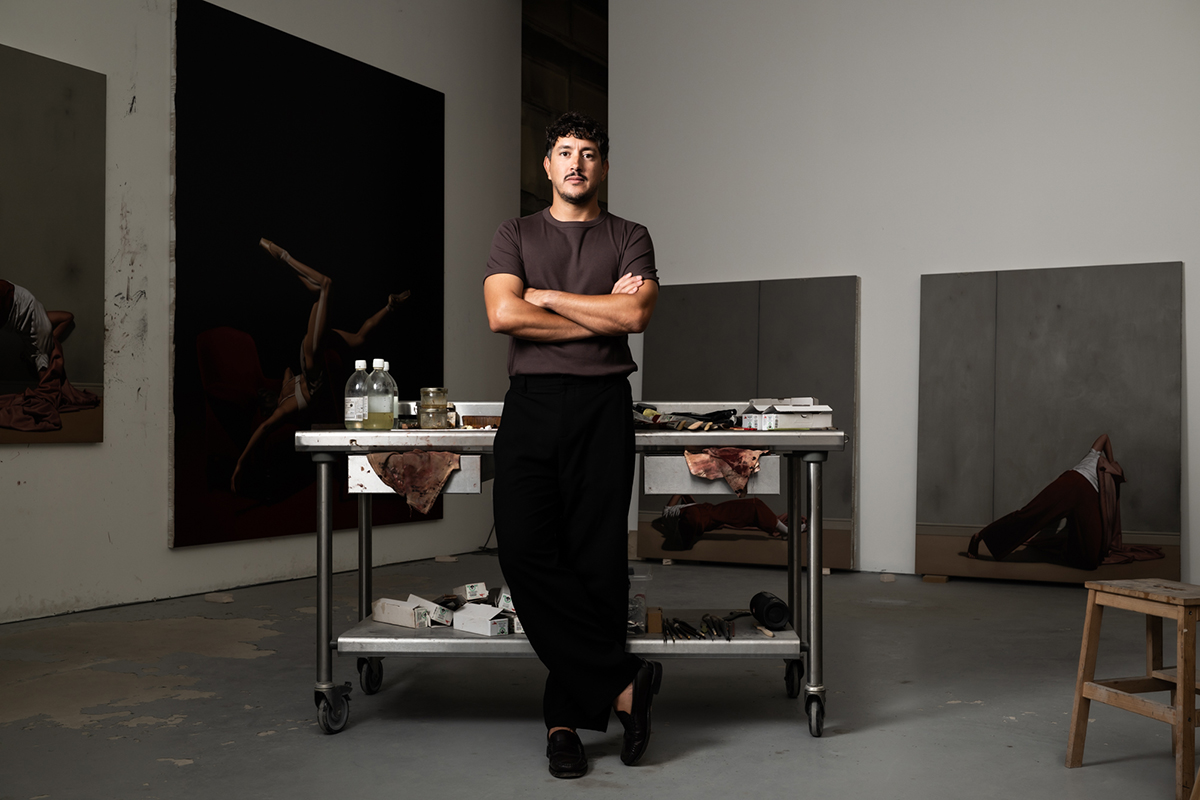 Dhewadi Hadjab in his studio. 2026. Photo by Julien Benhamou.
By MARGHERITA ARTONI October 6th, 2026
Dhewadi Hadjab's paintings explore the threshold between appearance, perception, and the uncertain nature of the image. Beginning with photographic constructions, he transforms bodies, gestures, and domestic environments into suspended scenes where reality becomes layered, ambiguous, and open to interpretation.
Through the dialogue between photography, painting, and material presence, Hadjab investigates how images are constructed, experienced, and transformed through the act of looking. His recent work has developed a sustained reflection on the body, movement, fragility, and the relationship between presence and absence.
In this conversation, Hadjab reflects on painting as a space where physical reality, imagination, and contemporary visual experience converge.
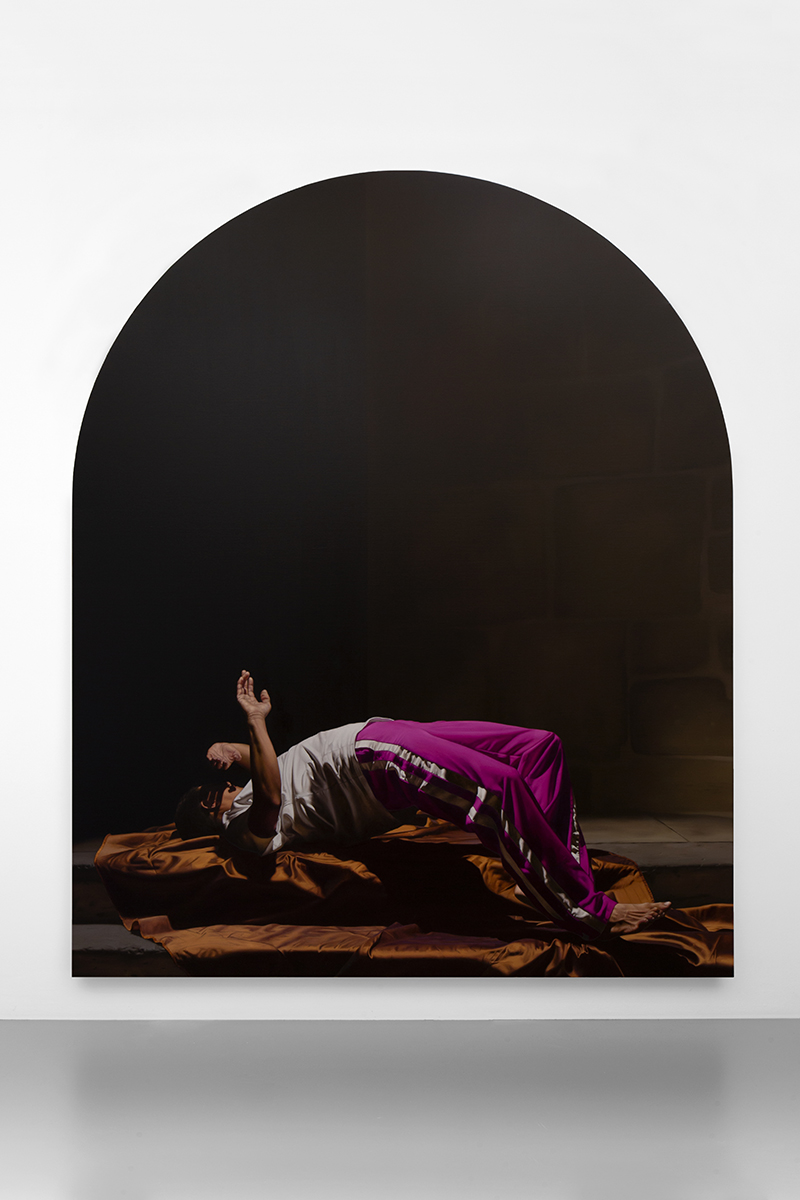 Dhewadi HADJAB, Je tombai à terre et j’entendis une voix, 2024 Huile sur toile / Oil on canvas, 310 x 256 cm, 122 x 100 3/4 in. © Dhewadi Hadjab Photo. Archives Mennour, Courtesy the artist and Mennour, Paris.
Margherita Artoni (MA): Photography functions as a tool in service of painting in your practice, often leading toward situations that appear simultaneously real and impossible. Walk me through what happens in that passage — from a constructed photograph to a painted reality. What survives the transformation, and what gets lost or added along the way?
Dhewadi Hadjab (DH): First there’s a change in medium. Photography is present at the beginning as a reference point. Then I convert it into painting, which is completely different and essentially relies on our ability to transpose or to convey that image.
By using a photograph as a model, I’m not trying to reproduce it identically, but to translate it into painting up to the moment the image completely changes status. In the end, what survives that transformation is the initial idea, the reason behind my desire to create that image. Photography makes permanent that first intention before the intervention of painting which transforms it, interprets it and, at times, takes it to a considerable distance from the original. The idea of the subject always remains, but it evolves with the medium.
MA: The sofa keeps returning in your work — a stage where figures hover between support and instability. Why this object, specifically? Is it the domestic banality of it that interests you, or something closer to a psychological trap?
DH: I won’t just mention sofa or sofas but furniture, and more broadly, daily life objects. Things that can be very common, but that nevertheless force us to put ourselves in motion. Let’s take a chair, for example. It’s made at the scale of the body, and implies a series of movements like sitting, getting up, pulling it closer, moving it, lifting it, etc. Ultimately, it’s an object that makes us dance.
In my paintings, sofas, chairs, armchairs and even the drapes are there to communicate with the characters and create some kind of confrontation, contrast. The banal aspect of the objects leads to that of the gestures, and I find extraordinary the thought that the ordinariness of an object can produce almost unintentionally some movement.
MA: The body is where you start, yet in recent works it shows up fragmented, partial, sometimes nearly gone. What does removing parts of the body let you say that a whole figure couldn't?
DH: Fragmentation appeared as quite a natural evolution in my relation with the body. Making this series, I felt the need to break with the representation of the entire body, and to only paint it partially, or fragment it. It almost automatically resulted in a breakdown of the body that I didn’t necessarily seek at the beginning, but which in the end met very well with the restraint found in my paintings.
Fragmenting the body and its image was also a way to make it incomplete. I think it takes us away from an image that’s too obvious and places us in front of something that leaves more room for interpretation. This incomplete image is also less affirmative, it forces the viewer to mentally reconstruct what they don’t see. It opens up a space for interpretation that’s much wider than a figure given whole.
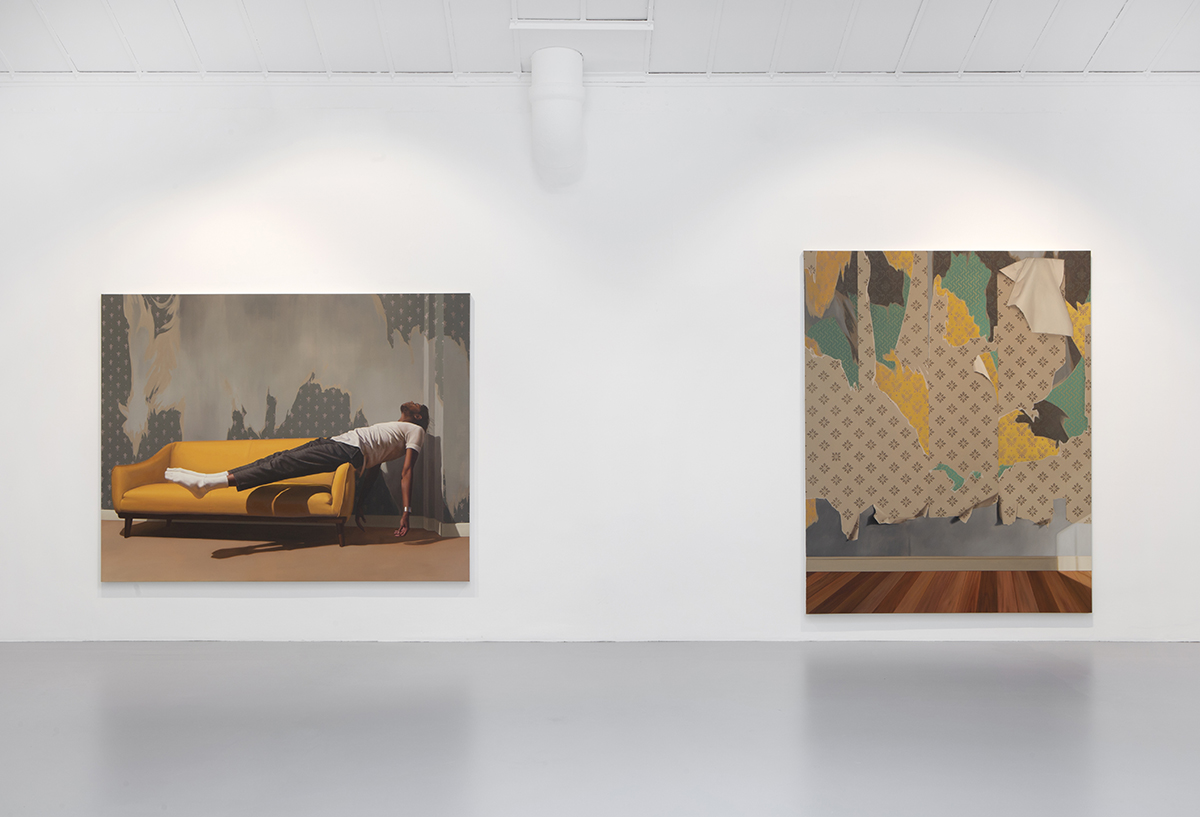 Vues de l’exposition · Exhibition views « Dhewadi Hadjab, Acte I : Vaciller », Mennour (6 rue du Pont de Lodi), 2022 © Dhewadi Hadjab Photo. Archives Mennour Courtesy the artist and Mennour, Paris.
MA: Your recent work traces a trajectory from instability toward fragmentation — figures that waver, then seem to come apart entirely. Was that progression something you planned from the outset, or did it reveal itself as you worked? What comes after fragmentation?
DH: Fortunately, that development is not worked out to the nearest millimetre, but there is, in spite of it all, some evidence that appears with time. I’ve always called my exhibitions Act I, Act II, Act III, for example, considering them acts of choreography because for a long time I’ve had the desire to create a mini-ballet, and move my painted figures from the canvas to the stage.
Today I’m working on the production of a mini-ballet that extends that research on the body and movement in a territory that’s no longer the one of painting. A way to leave my comfort zone and confront my universe with the huge heritage of dance.
MA: Viewers describe a kind of vertigo in front of your paintings — the body and the sofa seem to pull against each other rather than settle. You return to similar subjects again and again. Is repetition, for you, a way of getting closer to an answer, or of making sure one never arrives?
DH: I think I only perpetuate something that belongs as much to dance as to painting: the repetition of the gesture to try gaining something that comes close to what one imagined at the beginning.
In my practice, I question the body and the body in motion helps me pursue that exploration almost indefinitely. I just have to change the position of an arm in a state of tension, to shift the stress onto another joint or to slightly modify a posture, and it generates a different image and opens a new field of possibilities.
In spite of the similarities between my paintings that one sometimes experiences, an aspect we also find in the works of Bacon, a painter I admire a great deal, those repetitions, those similarities never became a problem for me. And in any case, even though one tries to reproduce exactly the same gesture, it is never truly identical.
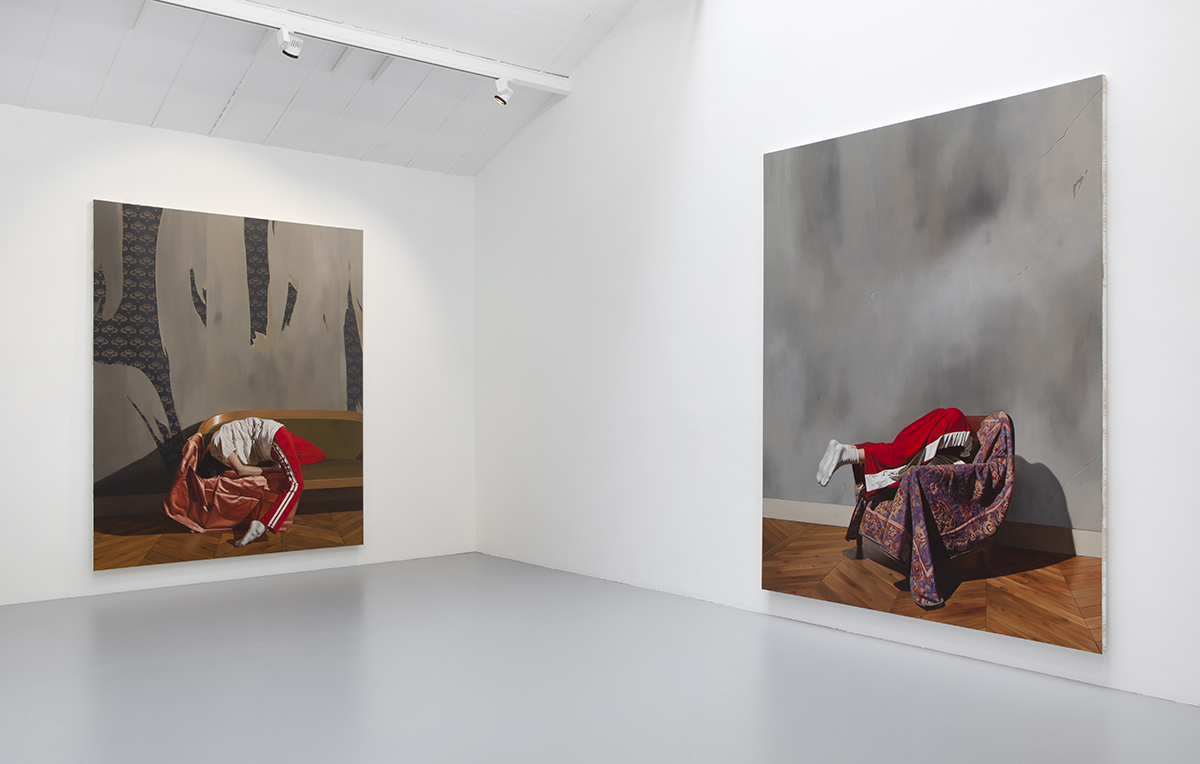 Vues de l’exposition, Exhibition views « Dhewadi Hadjab, Acte I : Vaciller », Mennour (6 rue du Pont de Lodi), 2022 © Dhewadi Hadjab Photo. Archives Mennour Courtesy the artist and Mennour, Paris.
MA: What's left out of the frame in your paintings often feels as loaded as what's in it. How deliberately do you calculate what to hide?
DH: I’m interested in paintings that make me want or encourage me to look beyond the painted surface. The hidden elements and the continuousness of the spaces, which I suggest with horizontal, diagonal or vertical lines, enable me to prolong the space of the canvas and suggest an expanse existing outside the composition without the need to show it.
It’s the same with the body. To hide or partially conceal it paradoxically reinforces the focus on it. What we don’t see often rouses more curiosity than what is given to see in its entirety. To conceal in order to show better.
In that approach, the garment and especially the drape take on an important place. I love painting them, but I also like their adaptability at covering, revealing or concealing the body in a way that’s at times almost random. I am fascinated by their autonomy. Unlike the body that can be manipulated, the material produces its own folds, its tensions, its own vocabulary. There’s always a part that eludes me and that’s precisely what I’m interested in.
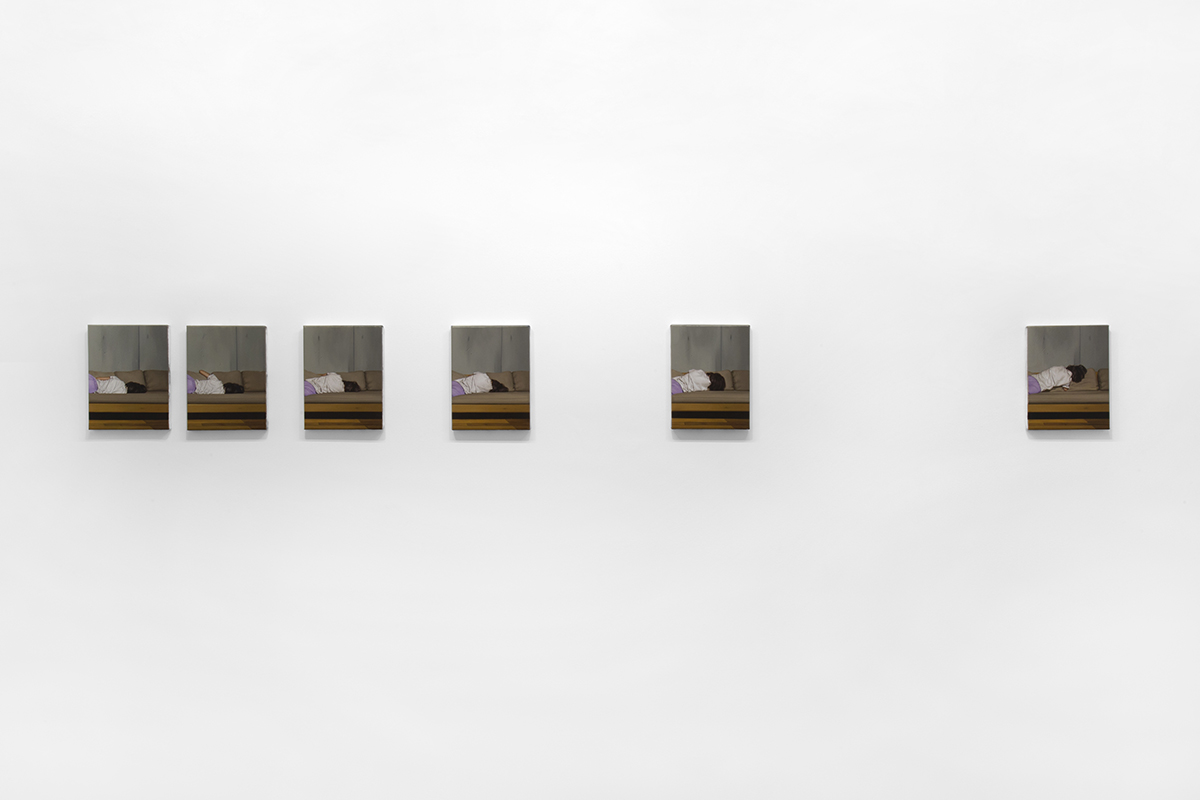 Vues de l’exposition / Exhibition views, Dhewadi Hadjab, « Acte II fragmenter », Mennour (28 avenue Matignon), 2024 © Dhewadi Hadjab. Photo: Archives Mennour, Courtesy the artist and Mennour, Paris.
MA: If someone looked at your body of work as a whole — not single paintings, but the accumulation — what do you think it would tell them about you that you haven't said in an interview?
DH: I hope to never have a full answer to that question, because everything I made so far is maybe an attempt at answering that question of why I do what I do. What really interests me in all that? Am I making some kind of self-portrait or an autobiographical projection? Is it an excavation of the self?
In front of my paintings, people often mention the human condition. It’s interesting, I think, because people probably project their own condition as much as mine.
But I understand the perception that people have of my work because there are many things that come back again and again in my practice, like failing. I’m captivated by the moment the gesture fails, the body tires, the repetition leads to exhaustion or abandon. Maybe it’s precisely in that fragility that the body becomes the most human.
MA: You've spoken about your interest in dance and choreography. What does watching a dancer teach you that watching a photograph doesn’t?
DH: First of all, there’s a fundamental difference between a static image and a body in motion, so those two experiences are opposite but complementary. When I observe dancers, I not only look at a posture, I see how they reach it, how they come out of it, where the effort is, how the weight transfers from one joint to another, the slowness, the power or the impact of a gesture. Some things are only visible to the naked eye, and are very difficult to capture in their integrity in photography or in painting.
Photography only captures a very short fragment of that reality. And that’s precisely where its magic lies, it pauses for an instant what the eye probably would only have seen for a fraction of a second, and enables us to observe it later for as long as we wish.
With the dancers, I observe the duration of the movement, but with photography, I isolate one instant.
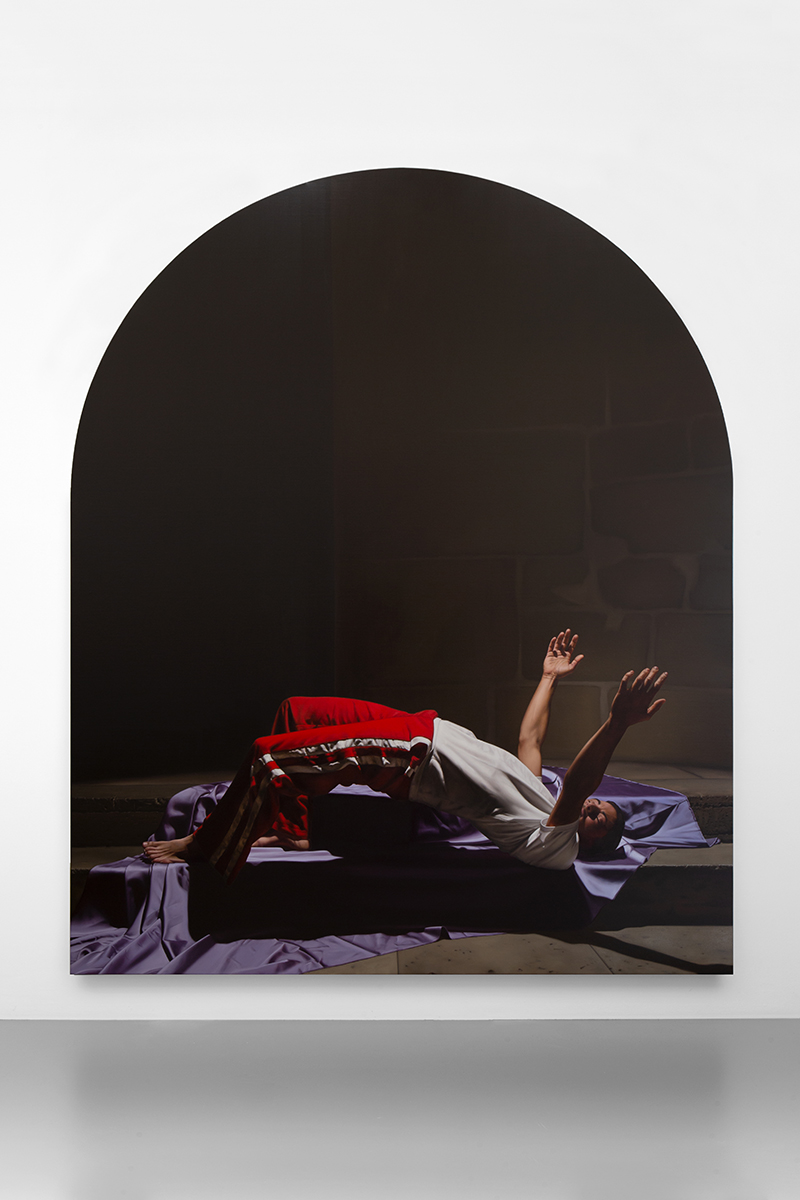 DHEWADI HADJAB Me voici, Seigneur !, 2024 Huile sur toile / Oil on canvas 310 x 256 cm 122 x 100 3/4 in. © Dhewadi Hadjab Photo. Archives Mennour Courtesy the artist and Mennour, Paris.
MA: Painting now competes with an avalanche of AI-generated and digital imagery. Does that competition worry you, or does it clarify what painting is actually for?
DH: I don’t really feel particularly worried about AI. For the time being, it produces images from a whole set of images, knowledge and references already produced and assimilated by Man. It certainly changes our relation to images, but that doesn’t necessarily challenge painting.
What gives rise in me to the need to create also comes from very human experiences like a sense of fragility, fear, joy, sadness, desire, shame, empathy and failure. Those experiences are not simply visual information, they determine the reason why an image becomes vital for someone.
AI can produce extremely convincing pictures, but the question I’m more interested in is what drives someone to physically paint something for days and months?
In fact, there’s nothing new about that debate. The appearance of photography had already heralded the disappearance of painting. But it actually forced it to redefine its territory.
I think that AI today can generate something similar. It doesn’t necessarily mean that some mediums will disappear, but on the contrary, it can force them to question again what is specific to them, and why we carry on practising them with such vital determination.
MA: Painting has survived every prediction of its death for over a century. What's your honest guess — not the diplomatic one — about why it's still standing, and what it risks by staying?
DH: As long as there are painters, painting will exist, in my opinion. It’s not really a judicious answer! Something that has traversed as many centuries and transformations doesn’t seem close to disappearing.
It will of course have to evolve, as it has always done throughout the various movements and artists that have influenced its history. But I can’t see how it could disappear as long as there are people who feel the need to paint, and others who want to contemplate those paintings.
Painting enables us to produce images that don’t entirely respond to the laws of reality. It can compress several temporalities, alter proportions, suppress or fabricate information. And, above all, it always bears the physical trace of the painter who made it with their gaze, their choices, their hesitations and even their mistakes.
The genuine risk it runs today is maybe not to disappear but to become safe and comfortable, to repeat what it already knows. In order to stay vibrant, it must continue to put itself in danger and find new ways to exist.
Margherita Artoni
Margherita Artoni is a contemporary art critic and curator working between Italy and the United States. She began her career collaborating with Flash Art and currently writes for Segno, Juliet, Artribune, Exibart, Inside Art, ArteIN, part of cult(ure), The Art Fuse, and Whitehot Magazine.
She has directed galleries in Turin — including NEOCHROME and EDGE Art Space — and in New York at TEAM Gallery. Her curatorial work has included exhibition programs with international artists such as Rashid Johnson, Theaster Gates, Ali Banisadr, Angel Otero, Tim Rollins & K.O.S., Laura Owens, and Mika Tajima.