Whitehot Magazine
October 2026
"The Best Art In The World"
"The Best Art In The World"
October 2026
Oscar Murillo: Unfinished Thinking: Paintings and Social Maps, on view at David Zwirner
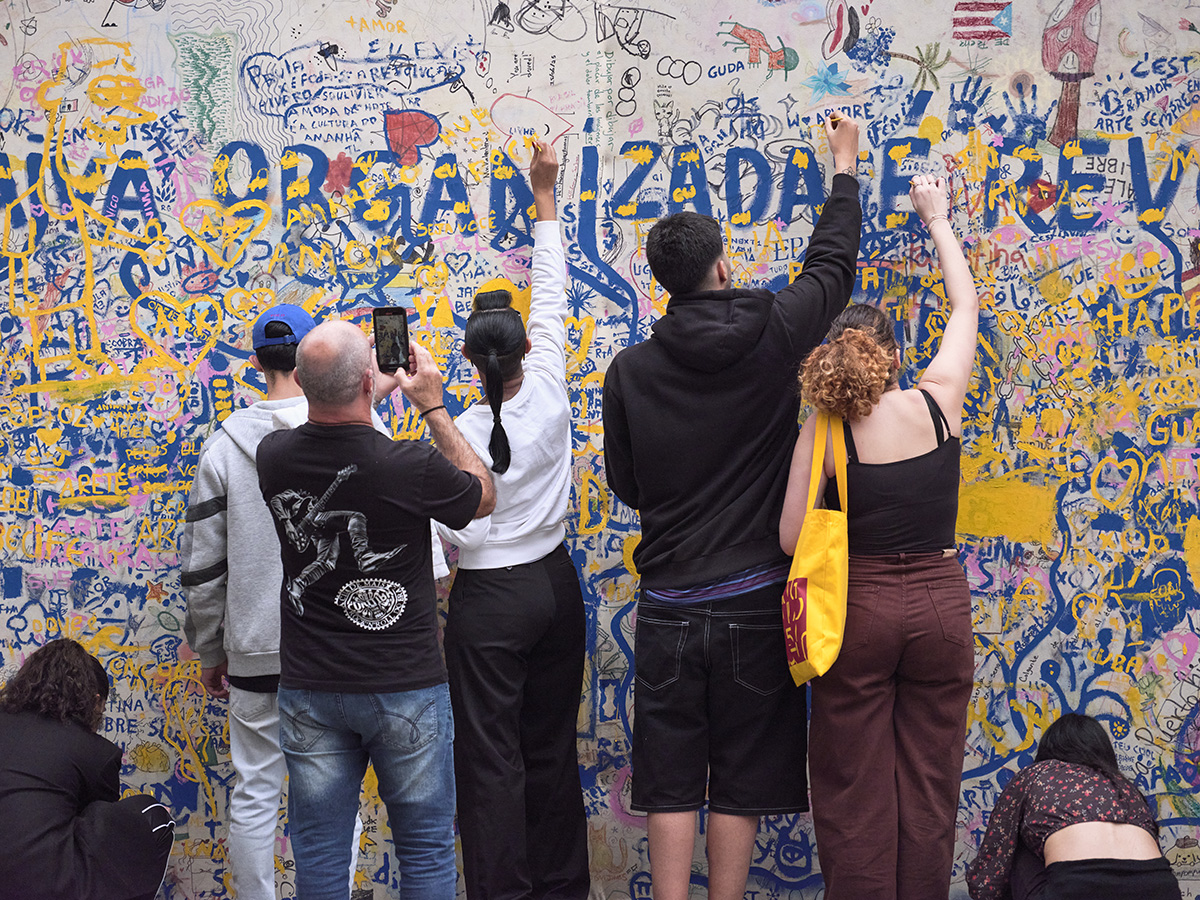 Oscar Murillo, Social Mapping, part of Nem Todo Viandante Anda Estradas / Not All Travellers Walk Roads, 36th São Paulo Bienal, São Paulo, 2025 - 2026 Photo: Reinis Lismanis Courtesy the artist Copyright © Oscar Murillo
By MARGHERITA ARTONI, October 28th, 2026
Who owns an image produced through collective participation? In Unfinished Thinking: Paintings and Social Maps, on view at David Zwirner in Paris from October 19 to December 19, 2026, Oscar Murillo examines the unstable relationship between individual authorship and shared experience. His practice transforms painting into a site where social relations acquire material form, exposing the tensions between participation, visibility, and control.
In the artist’s accompanying statement, “Labor!” leads into “repetition, people, many,” followed by “love, protest, an emoji, a sea of marks.” This fragmented vocabulary places private emotion alongside public expression, refusing to organize experience into a unified narrative. Thought emerges as an accumulation of gestures whose meanings shift according to their proximity to other voices. The surface becomes an arena of competing expressions, each contributing to a whole that no single mark can define.
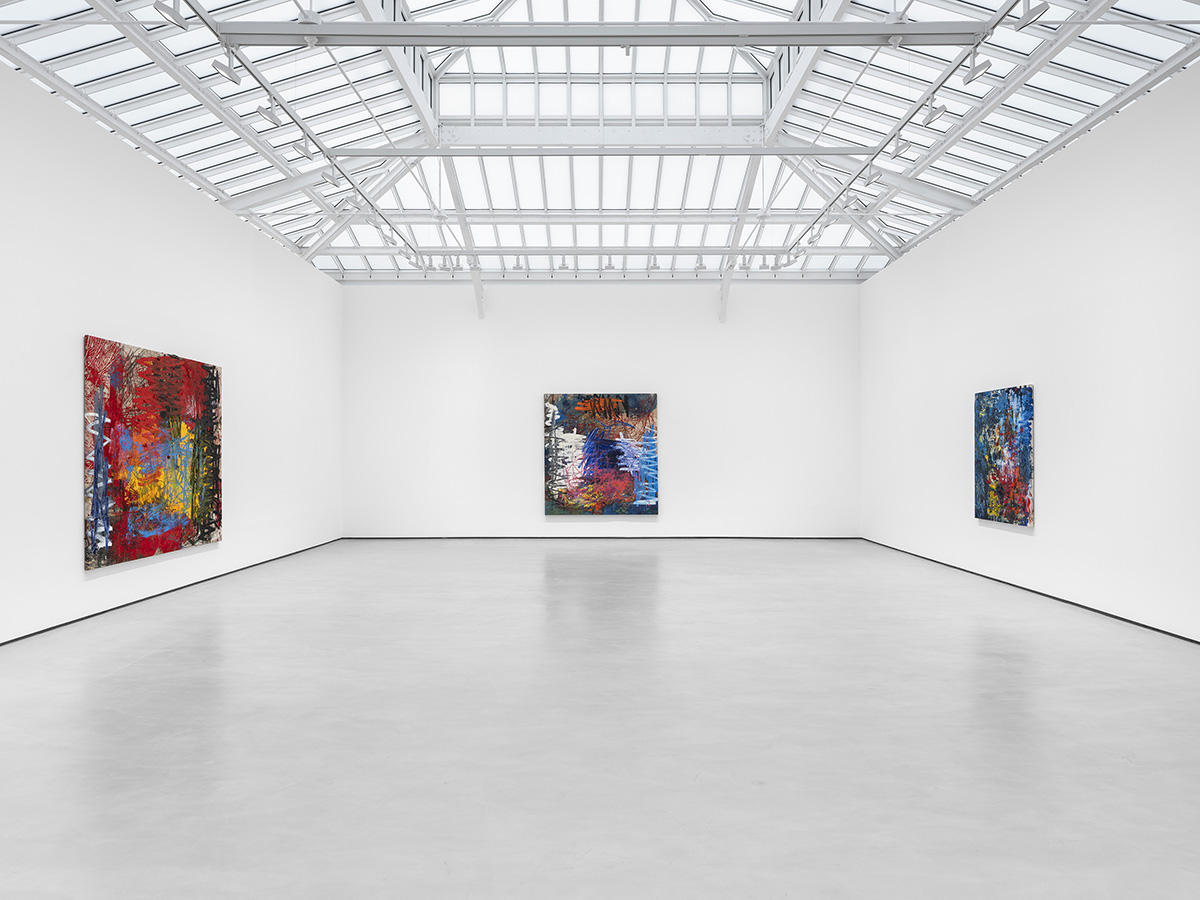 Installation view Oscar Murillo: Unfinished thinking: Paintings and Social Maps , David Zwirner Paris, 19 October–19 December 2026. © Oscar Murillo. Courtesy the artist and David Zwirner Photo by Nicolas Brasseur
This process is evident in Social Mapping, associated with Nem Todo Viandante Anda Estradas / Not All Travellers Walk Roads, the 36th São Paulo Bienal, presented across 2025–2026. Photographic documentation shows an expansive wall covered with handwritten words, symbols, drawings, and overlapping strokes of blue and yellow paint. Visitors reach toward it to add their own inscriptions, turning spectatorship into an act of production. The resulting density complicates the distinction between individual expression and collective authorship: contributions remain intermittently legible, although each new intervention alters the visibility of those already present.
Mark Bradford’s use of layered materials offers a relevant comparison. His paintings transform urban remnants into records of social and economic geography. Murillo shifts the emphasis toward the encounter itself, making the addition of marks an essential part of the work’s meaning. The resulting surface raises a question of authority: participation expands the number of contributors, while the artist retains control over the framework through which their gestures become art.
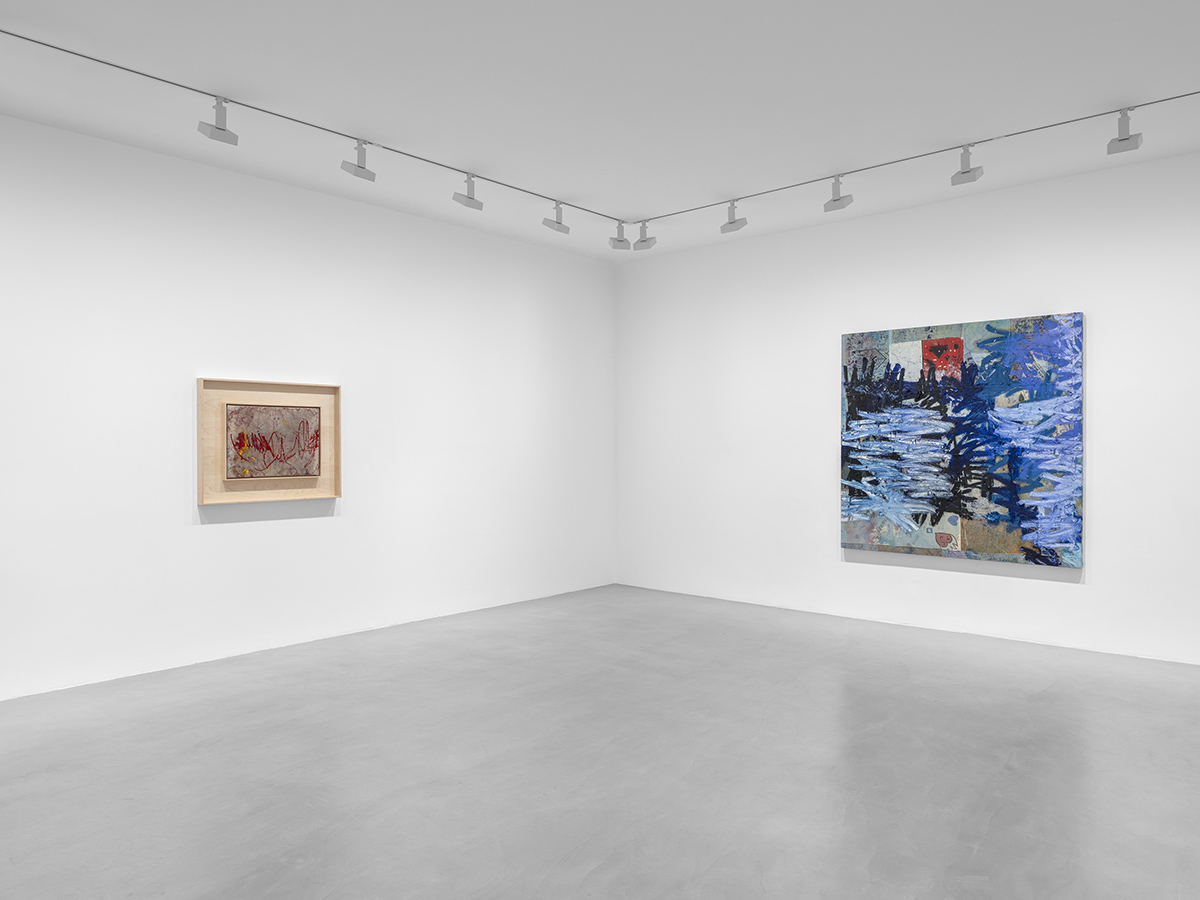 Installation view Oscar Murillo: Unfinished thinking: Paintings and Social Maps , David Zwirner Paris, 19 October–19 December 2026. © Oscar Murillo. Courtesy the artist and David Zwirner Photo by Nicolas Brasseur
A different material tension defines Nothing gold can stay (portraits of our current selves) (2026), executed in oil and oil stick on cardboard and presented in a frame constructed by the artist. A vivid blue field occupies the center of the support, crossed by horizontal strokes of pink, white, yellow, and red. Exposed sections of brown cardboard preserve fragments of commercial printing, including the words “PRODUCT OF UGANDA.” The paint interrupts the packaging’s original function without entirely erasing its history. Abstraction encounters the language of commodity circulation, bringing the movement of goods into the physical substance of the image.
The elaborate gold frame intensifies this contrast. Associated with prestige and permanence, it surrounds a support marked by folds, printed labels, and everyday use. The title introduces a related instability: “our current selves” suggests identities shaped by a present already subject to change. Rather than offering a conventional likeness, the work places the fragility of the support against the cultural authority of the framed painting. Its materials ask how value is produced, whether through an object’s substance, its presentation, or the institutions that determine its status.
Julie Mehretu provides another point of comparison. Her layered compositions transform cartographic and architectural references into visual structures shaped by geopolitical forces. Murillo approaches geography through a more immediate register of human inscription. In Social Mapping, territory becomes legible through accumulated gestures; in Nothing gold can stay, the printed indication of origin connects the painted object to global systems of production and distribution. Both works unsettle the idea of a self-contained image.
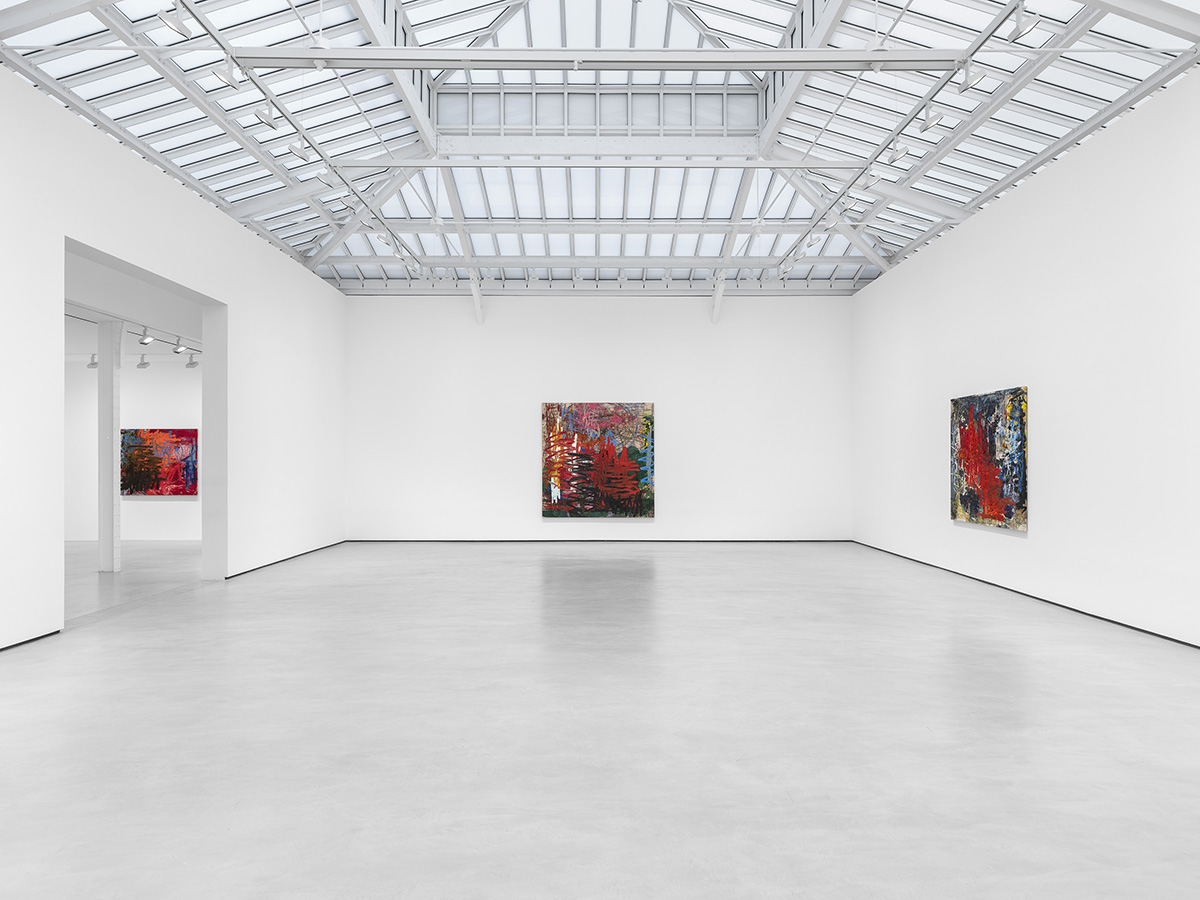 Installation view Oscar Murillo: Unfinished thinking: Paintings and Social Maps , David Zwirner Paris, 19 October–19 December 2026. © Oscar Murillo. Courtesy the artist and David Zwirner Photo by Nicolas Brasseur
Theaster Gates’s engagement with archives and community histories further illuminates Murillo’s interest in collective memory. Gathering materials or inviting participation does not guarantee that differences in experience will remain visible. In Social Mapping, individual contributions risk being absorbed into the mass of inscriptions. In Nothing gold can stay, the commercial label survives beneath the paint, preserving a trace of the object’s previous life. One work confronts the difficulty of distinguishing voices; the other examines the persistence of material histories.
Together, these works reveal the limits of collectivity as an artistic ideal. Murillo creates conditions for shared expression, yet the resulting image remains shaped by decisions concerning inclusion, arrangement, and visibility. This tension gives his practice its critical force. The unfinished surface is neither a promise of consensus nor a resolution of social difference. It records the negotiations through which a collective image comes into being, exposing the distance between allowing many people to contribute and ensuring that their contributions remain perceptible. WM
Margherita Artoni
Margherita Artoni is a contemporary art critic and curator working between Italy and the United States. She began her career collaborating with Flash Art and currently writes for Segno, Juliet, Artribune, Exibart, Inside Art, ArteIN, part of cult(ure), The Art Fuse, and Whitehot Magazine.
She has directed galleries in Turin — including NEOCHROME and EDGE Art Space — and in New York at TEAM Gallery. Her curatorial work has included exhibition programs with international artists such as Rashid Johnson, Theaster Gates, Ali Banisadr, Angel Otero, Tim Rollins & K.O.S., Laura Owens, and Mika Tajima.