Whitehot Magazine
November 2026
"The Best Art In The World"
"The Best Art In The World"
November 2026
Secret Knowledge: The art world’s newest obsession is Scandinavian surrealism
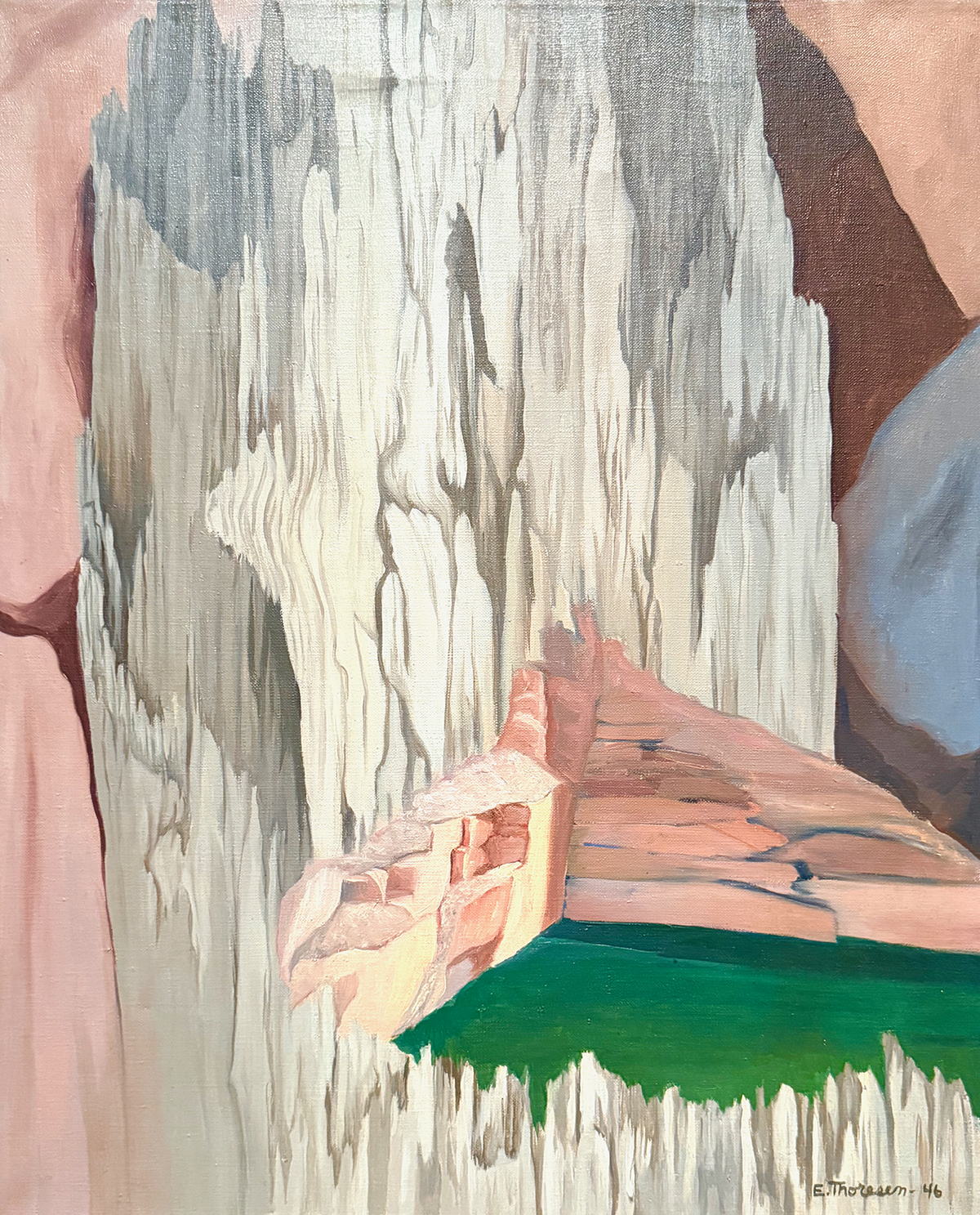 Elsa Thoresen, Untitled, 1946, The Tangen Collection, Kunstsilo Kristiansand (photo by author)
By JULIA FRIEDMAN, November 21, 2026
The art world’s newest obsession is Scandinavian surrealism. Until now, the evidence for this had been mostly atmospheric: a London members’ club adding dreamy northern pictures to its walls and American celebrities buying without posting. This week Hauser & Wirth’s Savile Row space opened a showroom presentation, After the Blue Hour: Nordic Surrealism. Small as it is, it serves as a corrective, dispelling one of the more stubborn myths of modern art history: that surrealism was a French product with a few regional franchises.
The Hauser & Wirth presentation is the curatorial equivalent of de-branded luxury, which is how taste is sold these days. As brand logos trickled down through the social strata, fashion self-corrected by hiding them behind the discretion of “stealth wealth.” The flex now is to skip the signifier and let the signified do the talking. In the absence of a logo, it takes connoisseurship to recognize the baby cashmere combed once from goats in their first year, thirty grams per animal at 13.5 microns. The trend has since migrated well beyond luxury goods, into an economy of newsletters and TikTok tastemakers who monetize the promise of this secret knowledge. They trade in a scarcity of information. A bakery only the right people know about can sell a loaf of bread for sixty dollars. The current interest in Scandinavian surrealism fits this pattern perfectly, since the painters remain little known outside the Nordic countries. Unlike the ubiquitous avatars of surrealism, Magritte and Dalí, a Thorén or a Kernn-Larsen over the mantelpiece signals a taste that has done its homework. Paintings become a password exchanged among people who already know what’s in the vault.
After the Blue Hour follows the hushed-tones trend. It presents a little over a dozen paintings in the gallery’s showroom, while the North and South Galleries are given over to Lorna Simpson and Cindy Sherman. The footprint is that of a gallery testing a market, but the roster amounts to a compact yet comprehensive history of the movement in the north. It includes all six members of Sweden’s Halmstad Group, the Danish painters Vilhelm Bjerke-Petersen, Wilhelm Freddie, and Rita Kernn-Larsen, and the American-born, Norwegian-trained Elsa Thoresen, which is to say most of the people who brought surrealism to Scandinavia in the 1930s and then adapted it to northern landscape and belief.
Several of them have been to the neighborhood before, or at least attempted an entry. In June 1936, the International Surrealist Exhibition opened at the New Burlington Galleries, a few minutes’ walk from where Hauser & Wirth now stands. Sheila Legge drifted through Trafalgar Square with her head wrapped in roses, and later in the run Dalí lectured in a diving suit. Freddie was invited to take part, but his paintings never reached the gallery walls because British customs officers judged them pornographic and impounded them. The following year, the Copenhagen police followed suit, closing his exhibition Sex-Surreal and confiscating the work. Freddie spent ten days in jail. The seized pieces, among them the mannequin-like bust Sex-paralysappeal with a small painted phallus on its cheek, were deposited in the Danish police’s Criminal Museum and returned to him only in 1963. For the authorities of two countries, Freddie’s artwork was mere contraband. Ninety years later, a short walk down the same Mayfair streets leads to his work, and to the circle that produced him. The painter who went to jail for his pictures is now sold in whispers.
Contrary to provincial stereotyping, Scandinavians were not late to the surrealist party. In 1934, Vilhelm Bjerke-Petersen, a young painter and the son of an art historian, published a short book called Surrealismen without the consent of his colleagues in the artists’ group Linien, and the gesture caused the group to split. In January 1935, well over a year ahead of the New Burlington Galleries exhibition, he staged kubisme = surrealisme at Den Frie in Copenhagen, with the Swedish painter Erik Olson as his co-organizer and a contribution from André Breton in the catalogue. The walls of Den Frie featured Magritte, Miró, Dalí, Arp, Man Ray, and Tanguy alongside the Scandinavians. It was among the first international surrealist exhibitions anywhere, and for a few weeks it made Copenhagen a city where Paris came to be shown, instead of a province longing for news from the capital.
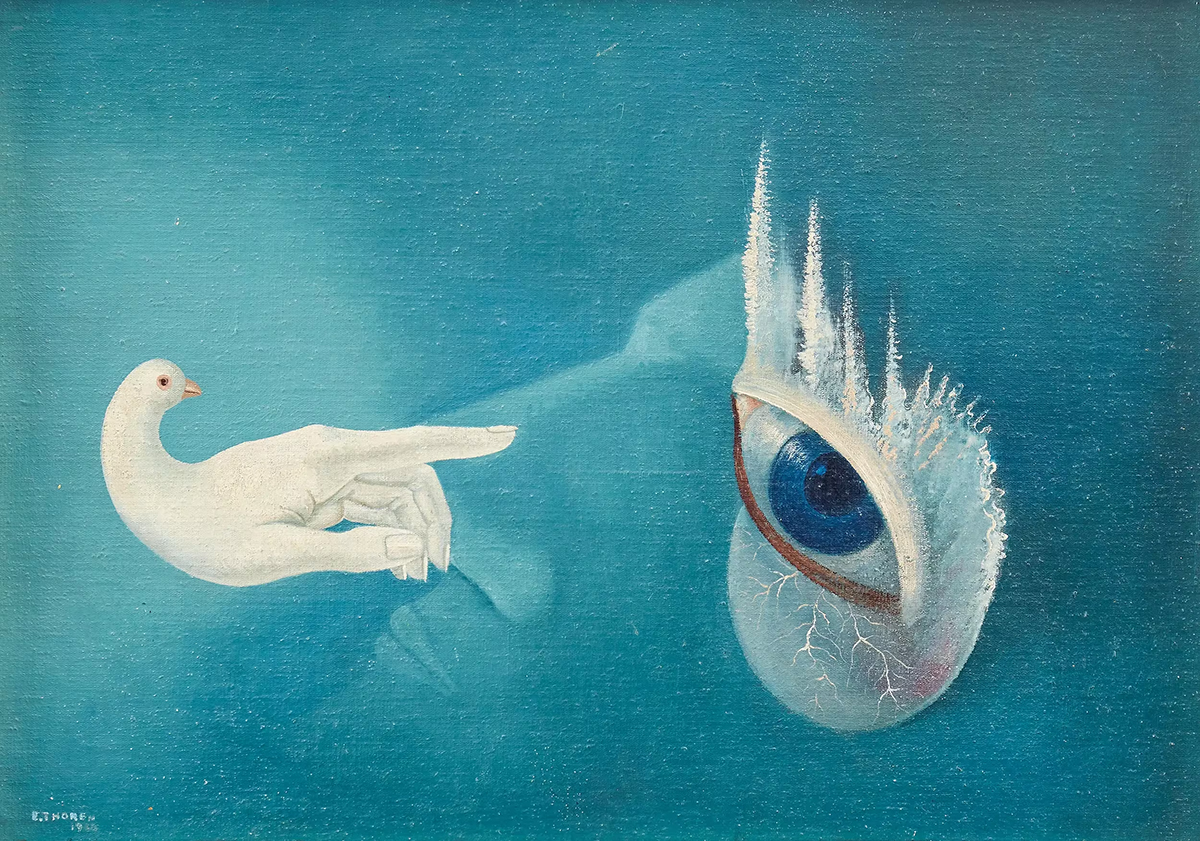 Esaias Thorén, The Winter of the Eye, 1938 © 2026 DACS / The Estate of Esaias Thorén
The Swedish half of the story starts further from any capital. The Halmstad Group was formed in 1929 by Sven Jonson, Waldemar Lorentzon, Stellan Mörner, the brothers Axel and Erik Olson, and Esaias Thorén—six young men with ties to a small port on the west coast. But provincial they were not: several of them had studied in Paris and Berlin, and Erik Olson had moved in the Abstraction-Création circle. Mörner, who read Breton’s manifesto in the year it appeared, became the group’s resident theorist. By the mid-1930s, they had developed a surrealism that owed more to Jung than to Breton’s literary automatism, and more to the flat, wind-scoured coastline of Halland than to the Parisian boulevards. Jonson’s barren landscapes in yellow and brown underscore the minuscule scale of human figures in nature. Thorén’s The Winter of the Eye, from 1938, the painting Hauser & Wirth used as the title image, shows how far this surrealism stands from the Parisian cult of the dream, with its bedchamber accoutrements, which Thorén traded for an ambient expanse of northern winter. In his 1938 The Painter-Seeker, Axel Olson sets a face in the sky and a headless figure inside a picture frame. Unlike their French counterparts, who made a sport of anticlericalism, the Halmstad painters left room for religious feeling. In 1929, Lorentzon and Axel Olson had decorated a country chapel at Skavböke with biblical scenes. The Halmstad Group also managed something no Paris faction ever did, which was to stay together for fifty years, until Mörner’s death in 1979 dissolved it.
The women in the presentation found their own routes through this world. Kernn-Larsen, who had studied with Léger in Paris, met Peggy Guggenheim there in the winter of 1937, and the following spring Guggenheim gave her a solo exhibition at Guggenheim Jeune on Cork Street, the first surrealist show the future collector ever organized. The Spectator’s critic, who confessed that he belonged “to the supporters of the dingy realists,” admitted to having enjoyed it. Kernn-Larsen had come to London for the opening and, with her Jewish husband, the journalist and dealer Isak Grünberg, remained there through the war. Thoresen married Bjerke-Petersen in 1935 and showed at the 1938 International Surrealist Exhibition in Paris. In 1944, they fled the German occupation to Sweden, where the couple joined the Halmstad painters at their colony in Söndrum. She later left both the marriage and Scandinavia, and died in Seattle in 1994.
After the Blue Hour is also where the understatement ends. It belongs to a broader pattern in which powerful galleries build markets for rediscovered artists by recovering their histories rather than inventing new mythologies for the art of our own time. Nordic modernism has had committed collectors for decades, and some have been anything but quiet. Nicolai Tangen, the chief executive of Norges Bank Investment Management, which runs Norway’s sovereign wealth fund, has spent three decades assembling what Kunstsilo calls the world’s largest collection of Nordic modernism, and in December 2024 his AKO Foundation added 333 works from the Canica collection for 240 million kroner. The collection lives at Kunstsilo in Kristiansand, a 1935 grain silo converted into a museum that opened in May 2024 and was named the world’s most beautiful museum at the Prix Versailles ceremony at UNESCO in December 2025. Kristiansand is a long way from Mayfair, but there is nothing secretive about a museum that wins architecture prizes and announces its acquisition budgets. When collections on that scale fill museums, and a gallery with Hauser & Wirth’s reach hangs the Halmstad Group on Savile Row, the paintings are being revalued aesthetically and financially, and the language of discretion is part of how that revaluation gets sold.

Julia Friedman
Julia Friedman is a Russian-born art historian and critic living in California. Her writing can be found at www.juliafriedman.org
view all articles from this author