Whitehot Magazine
October 2026
"The Best Art In The World"
"The Best Art In The World"
October 2026
Matt Dillon's Exurberance for Painting
By EDWARD WAISNIS May 20th, 2026
After attaining the stature of a Hollywood-level thespian (aka movie star), Matt Dillon has turned his mind and eye to painting.
Dillon’s most recent turn in film, as the villain Horn in Claire Denis’ adaptation of the play by Bernard-Marie Koltès (Black Battles with Dogs), The Fence, figures prominently in the body of work presented here, particularly the West African shooting location. *
Surrounded by a lineage of artists — from his father and grandmother to two cartoonist great-uncles (responsible for the Flash Gordon and Blondie comic strips) — Dillon has undoubtedly been fueled in his art-making. His friendship with the dealer Patrick Painter in the ’90s ignited his habit of bringing art supplies to film locations in order to utilize downtime productively. During the past decade, Dillon set up his New York studio and has accumulated a healthy list of mostly group shows as part of his practice’s history.
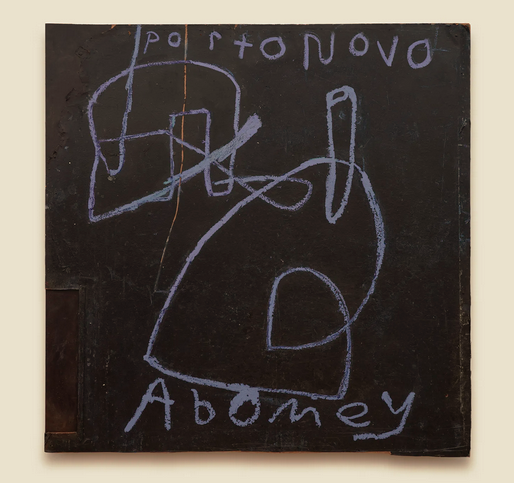 Matt Dillon, “Porto Novo”, 2026, oil on masonite 49.5 x 48.5 inches. Copyright © Matt Dillon. Courtesy Courtesy: The Journal Gallery. Photo: Guang Xu.
Kicking things off from the street is Porto Novo, 2026, an oil-on-masonite work installed in the window. Nocturnally infused, twisty-turn wire puzzle-like forms framed by block-letter legends — “portoNovo” (at the top edge) and “Abomey” (at bottom) — constitute the composition, setting the stage for the exhibition inside; in essence, a placard announcing the exhibition’s title. Said forms coalesce into adjoining domestic-evocative structures, one completed by a chimney stack, carrying the whimsy of Paul Klee while rooted in the influence of the West African locations that inspired them. The azure linework is laid upon a tarry field that echoes felt roofing paper (as seen in the works of Theaster Gates, for instance), lending a fathomless quality. The captions turn out to be the names of two cities in the country of Benin where Dillon spent time shooting the Denis film. Rife with this experience, Dillon immersed his painting in the vestiges of that environment.
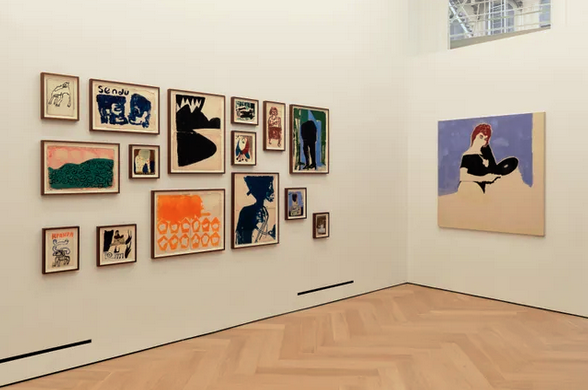 Installation view “Matt Dillon: Porto-Novo to Abomey”, The Journal Gallery, NY.
Once inside the intimate confines of the gallery, a strategy of installation emerges. Bracketed by three walls holding five paintings, the fourth wall has been deemed the realm of a salon arrangement of fifteen works on paper, many of them sketches toward the paintings.
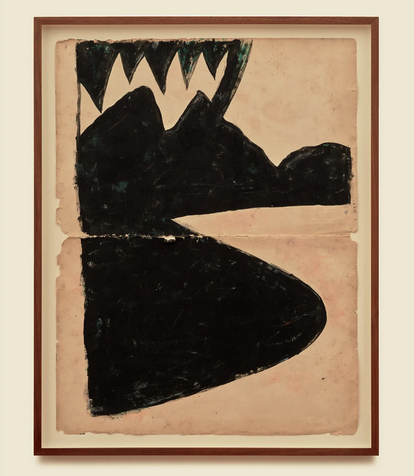 Matt Dillon, “Coastal Landscape”, 2026, Flashe on paper, 25.5 x 19.5 inches. Copyright © Matt Dillon. Courtesy Courtesy: The Journal Gallery. Photo: Guang Xu.
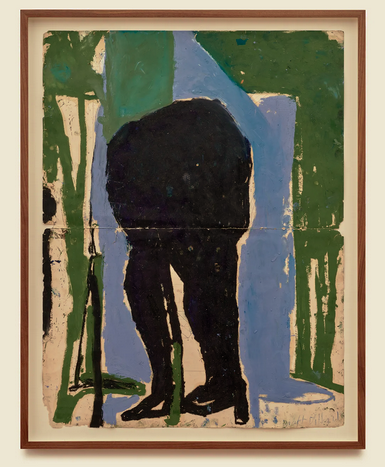 Matt Dillon, “Headless Figure”, 2021, oil on paper, 25.5 x 19 inches. Copyright © Matt Dillon. Courtesy Courtesy: The Journal Gallery. Photo: Guang Xu.
Three of these — two Flashe works and one oil on paper — are particularly handsome. The former two works, Coastal Landscape, 2026, and Green Sea, both 2026, traffic in landscape through hard-edge characterizations, whereas the oil, Headless Figure, 2021, is exactly what it portends, with a stocky, stiletto-wearing, noggin-less body surrounded by a periwinkle and emerald interlocked setting that might be read as a stage. Bill Traylor’s methodology hovers over all three, as well as a healthy respect for the linearity of Modernist formal graphics.
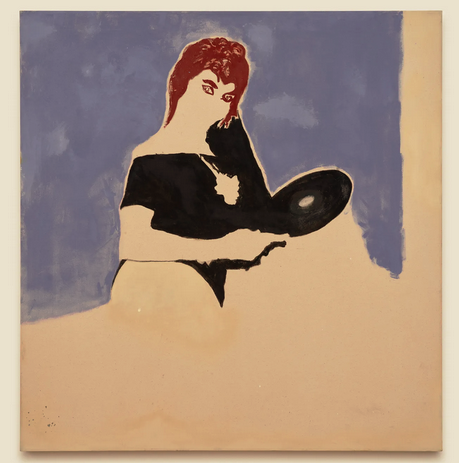 Matt Dillon, “Showgirl”, 2025, oil on canvas, 52 x 50 inches. Copyright © Matt Dillon. Courtesy Courtesy: The Journal Gallery. Photo: Guang Xu.
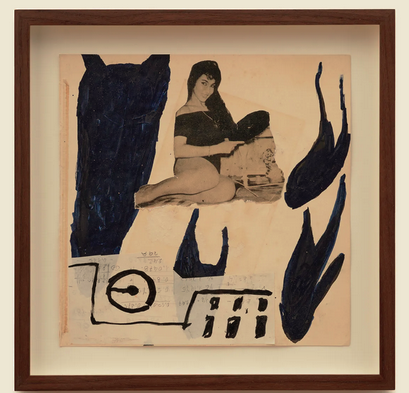 Matt Dillon, “Showgirl (Study)”, 2025, mixed media on paper, 9.4 x 9.4 inches. Copyright © Matt Dillon. Courtesy Courtesy: The Journal Gallery. Photo: Guang Xu.
Showgirl, 2025, features the titular character curled up demurely, proffering a vinyl record. The source material, a photo culled from a newspaper, appears in one of the paper works. Whether viewed as a model or a wink at a colonial past, the painting enhances the come-hither look and Spanish camilla presence by focusing on the eyes and posture. The whole affair is executed in shades of blue, raw umber, and black, with the lower extremity left vacant, much like the famous unfinished portrait of George Washington.
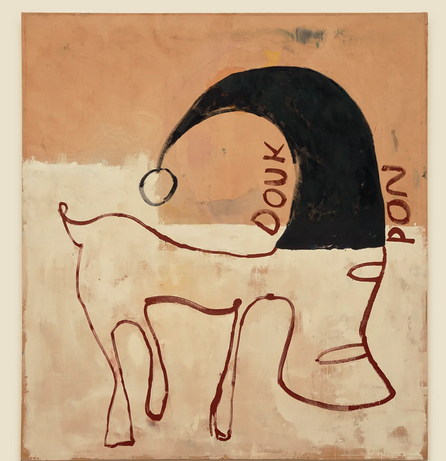 Matt Dillon, “Duok Pon”, 2025, oil and gesso on canvas, 66 x 60 inches. Copyright © Matt Dillon. Courtesy Courtesy: The Journal Gallery. Photo: Guang Xu.
Shepherded — or perhaps “encouraged” is the less controlling term — by Dillon, local children at the filming locations made contributions to his sketchbook, to which he has paid homage. Duok Pon, 2026, bearing the name of one of these participating collaborators emblazoned around the headwear worn by a starkly playful creature caught against a half-gessoed canvas, continues a working theme emerging throughout the exhibition. A festive air permeates the work due to the prominent pom-pom dangling from the end of the animal’s toque.
The creature makes an earlier appearance in Untitled, 2025, with features more fleshed out, wandering in a Constructivist cityscape.
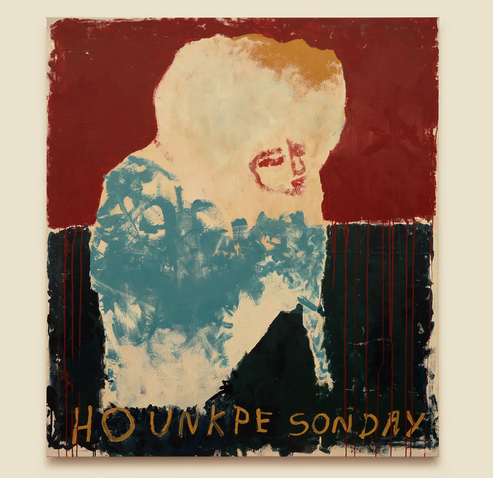 Matt Dillon, “Hounkpe Sonday”, 2026, acrylic on canvas, 58.5 x 51.5 inches. Copyright © Matt Dillon. Courtesy Courtesy: The Journal Gallery. Photo: Guang Xu.
Besides favoring raw areas that have foregone the assault of the brush, Dillon has a penchant for rusty browns. Hounkpe Sonday, 2026, in which the tone makes up the upper half of the picture, brings in the topicality of politics by acknowledging the losing Beninese candidate through a cobbling together of his surname with a bastardization of the day of the week the election was held. The central frame is inhabited by a sphinx donning a blonde mane above a demurely amiable face that is half-disappeared into the abundant hair, either casting a spell or holding rank.
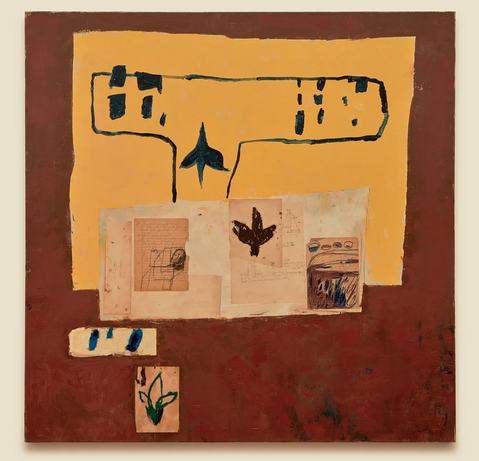 Matt Dillon, Untitled, 2025, oil and mixed media on canvas, 48 x 48 inches. Copyright © Matt Dillon. Courtesy Courtesy: The Journal Gallery. Photo: Guang Xu.
Untitled, 2025, a virtual compendium of materials and sources offering variations on a starkly depicted frond against varied backgrounds — from collaged sheets (pages from the aforementioned sketchbook?) to painted schematics — is constrained by a pleasing formality.
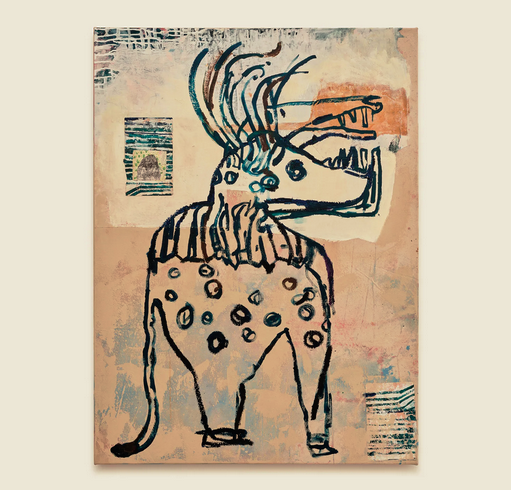 Matt Dillon, “Taneka with Figure", 2026, mixed media on canvas, 39.5 x 29.5 inches. Copyright © Matt Dillon. Courtesy Courtesy: The Journal Gallery. Photo: Guang Xu.
The look and spirit of the SoHo scene of the late ’80s and early ’90s — in particular that encapsulated by the artists associated with the galleries of Tony Shafrazi and his cousin Vrej Baghoomian — permeates the previously mentioned works, with emphasis toward the paintings being done by James Brown at that point and, of course, Jean-Michel Basquiat, while also wafting throughout Dillon’s output. This indebtedness is evident in Taneka with Figure, 2026, with layering and the overlay of a fanciful character that alludes to another Shafrazi stable alumnus, the late Donald Baechler.
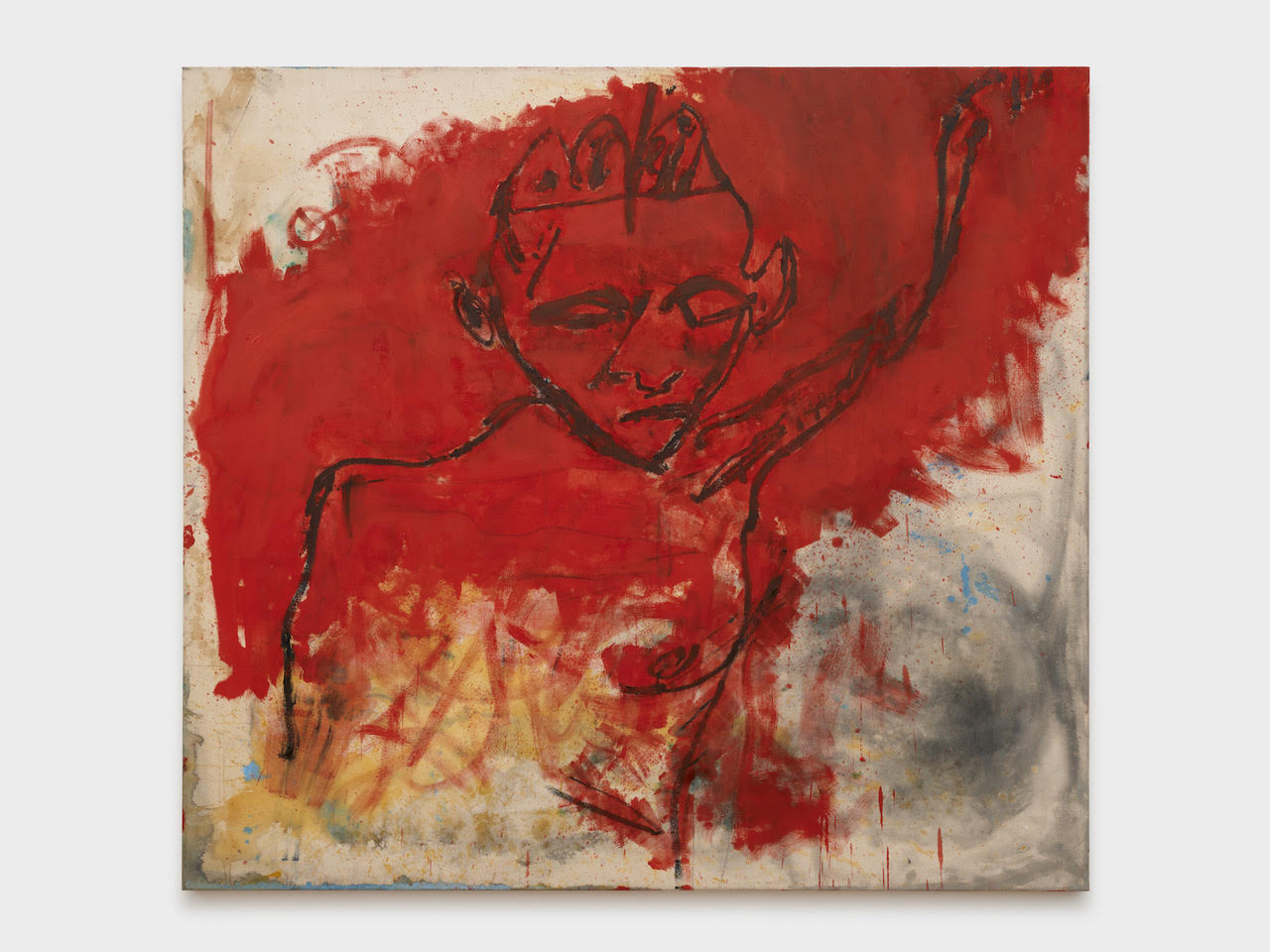 Matt Dillon, “Untitled (Red King)”, 2026, oil on canvas, 60 x 65 inches. Copyright © Matt Dillon. Courtesy Courtesy: The Journal Gallery. Photo: Guang Xu.
On a return visit to the gallery, I spied Untitled (Red King), 2026, installed in the office. Swathed in an expansive patch of crimson, on top of which an emaciated and withering crowned torso grimaces in mock triumph, the figure commands the canvas. Whether a tipsy reveler at Mardi Gras or a figure caught in an embattled psychological quandary of epic proportions played out on the stage is left to interpretation, though the latter gains favor given Dillon’s decades-long trade.
The flicks and smudges of cerulean in the lower portion offer glimmers of promise beyond the hot-house conflagration; the stain of romance abounds.
______________________
• The film was shot in Senegal, after which Dillon ventured to the adjoining nation of Benin (known as the birthplace of voodoo) where he visited the capital, Abomey, and the the once capital of the Kingdom of Dahomey, Porto Novo.
Matt Dillon: Porto-Novo to Abomey
The Journal Gallery
45 White Street, New York, NY 10013
April 24–May 23, 2026

Edward Waisnis
Edward Waisnis is an artist and filmmaker. Additionally, he is the Producer of two Quay Brothers films, Through the Weeping Glass and Unmistaken Hands, as well as having overseen the facilitation of their 2012 MoMA retrospective. His writing has appeared in Art New England, COVER, ARTextreme and STROLL.
view all articles from this author