Whitehot Magazine
October 2026
"The Best Art In The World"
"The Best Art In The World"
October 2026
AFTERLIFE: Martha Diamond at David Kordansky
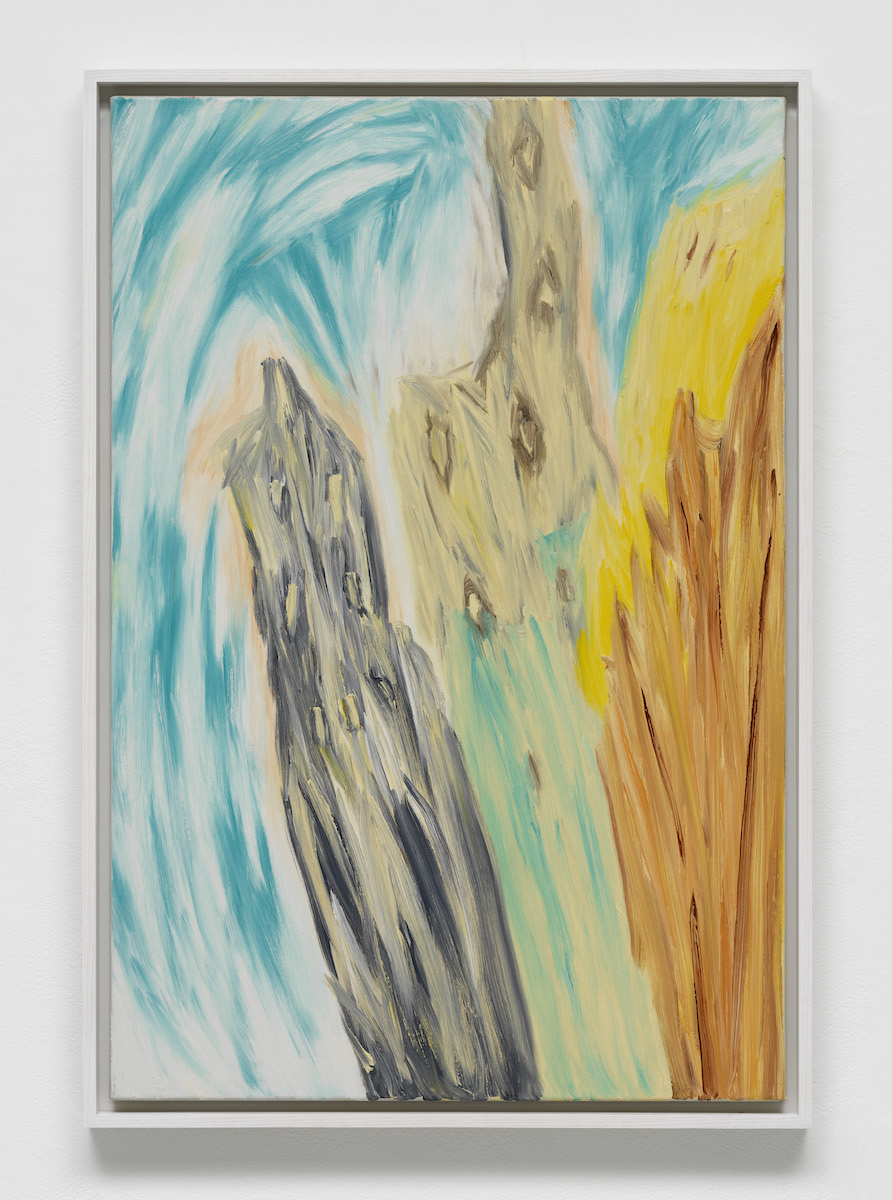 Martha Diamond, “Spring”, 1987, oil on linen, 36 x 24 x 1.25 inches © Martha Diamond Trust. Courtesy of David Kordansky Gallery
By EDWARD WAISNIS June 2, 2025
Speaking painting’s language with ease, Martha Diamond was not afforded the recognition her elan was worthy of–up till recently, that is. With an apt title, “After Image”, at David Kordansky Gallery, is the latest of effort to redress fate and joining the recently concluded retrospective at the Aldrich Museum of Contemporary Art (co-organized with the Colby College Museum of Art).*
Mirroring the lush alla prima application favored by Philip Guston has placed her, as an early adopter, amongst the candidates for heir apparent to one of the most revered painter’s painter legacies. Further, with connection to that movement in a minor key, New Image, while her embrace of the urban built environment as model executed with the licks of wet into wet oil, additionally affords linkage to Lower East Side expressionism. Diamond’s primacy of surface, together with a yen to capture moments of revelation–sunspots reflecting off the mirrored glass of a skyscraper; the dank swell of twilight descending into the cavernous valleys of mid-town Manhattan–, lend the necessary qualifiers for marking her practice as romanticized post-Modern painting. Aspects that, while connecting her in her own time also pigeon-holed her a something of a reactionary. All of which seems dated in our present age of all embrace. Diamond’s connection to a circle of downtown poets (and, poetry in general) ordains her bona fides as a denizen of bohemia of yore.
Diamond’s mastery of color comes by way of her intuitive grasp of contrasting dominant and sub-dominant combinations. It is almost as though she was adding a handicap, by resorting to these often unlikely pairings, that could easily have diverged into the garish (appropriate to the media-inspired work of Andy Warhol), but, in the end, deliver wallops of sensation that keep you looking. Another engagement with impairment flirting with resultant disaster is found in Diamond’s reliance on non-dominant hand. This encouragement of the awkward, together with the long slashing permutations (that emulate movement worthy of the Vorticists’) are the ingredients of Diamond’s recipe.
For anyone who has experienced heart palpitations at the sight of a resplendent Manhattan vista (the silhouette of the beloved tiers and set-backs of the Empire State and Chrysler buildings; the crystalline box masterwork that is the Seagrams) Diamond proffers satiation to the appetite of recall.
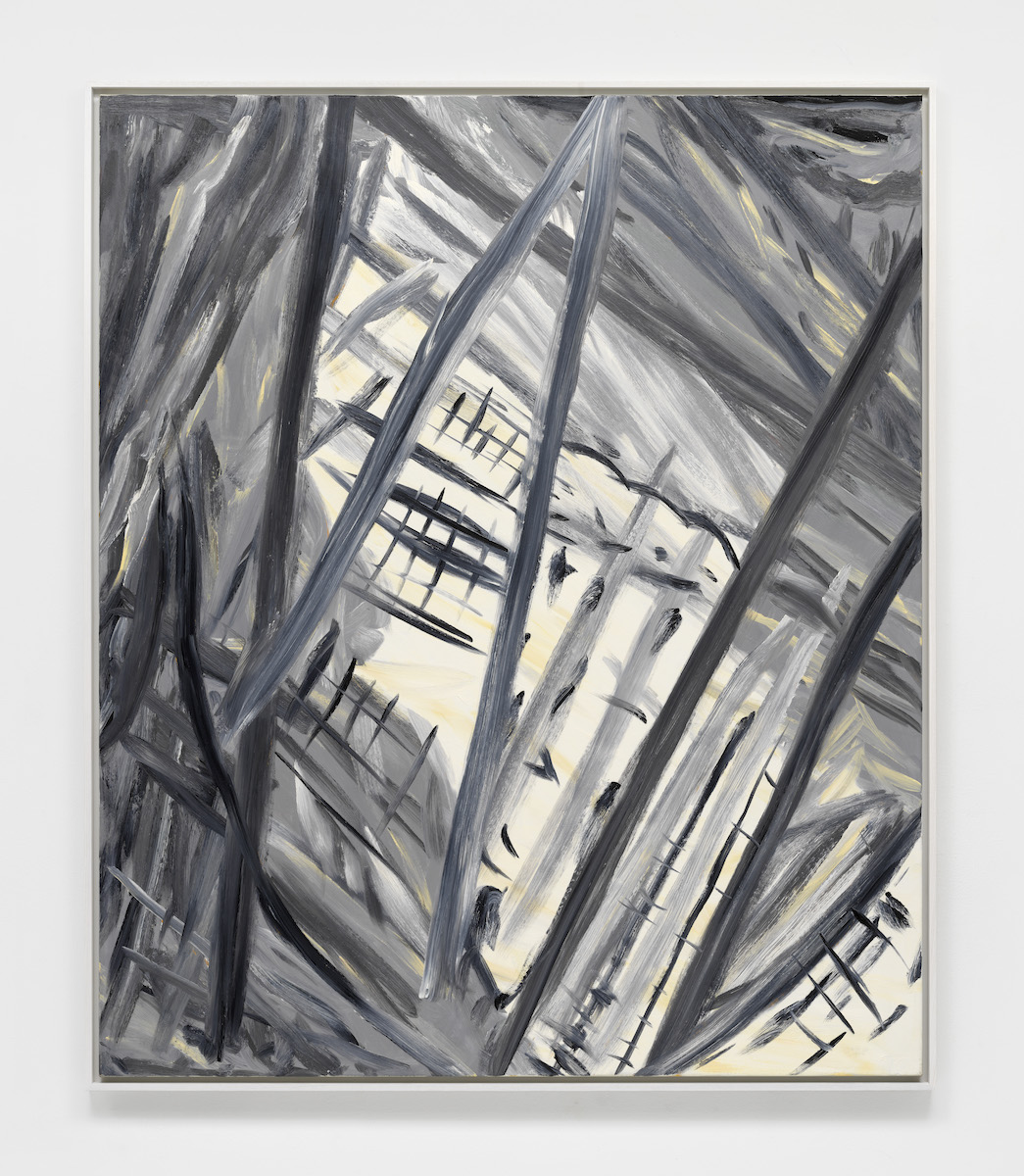 Martha Diamond, “Grey Cityscape”, 1990, oil on linen, 72.125 x 60.125 x 1.25 inches © Martha Diamond Trust. Courtesy of David Kordansky Gallery
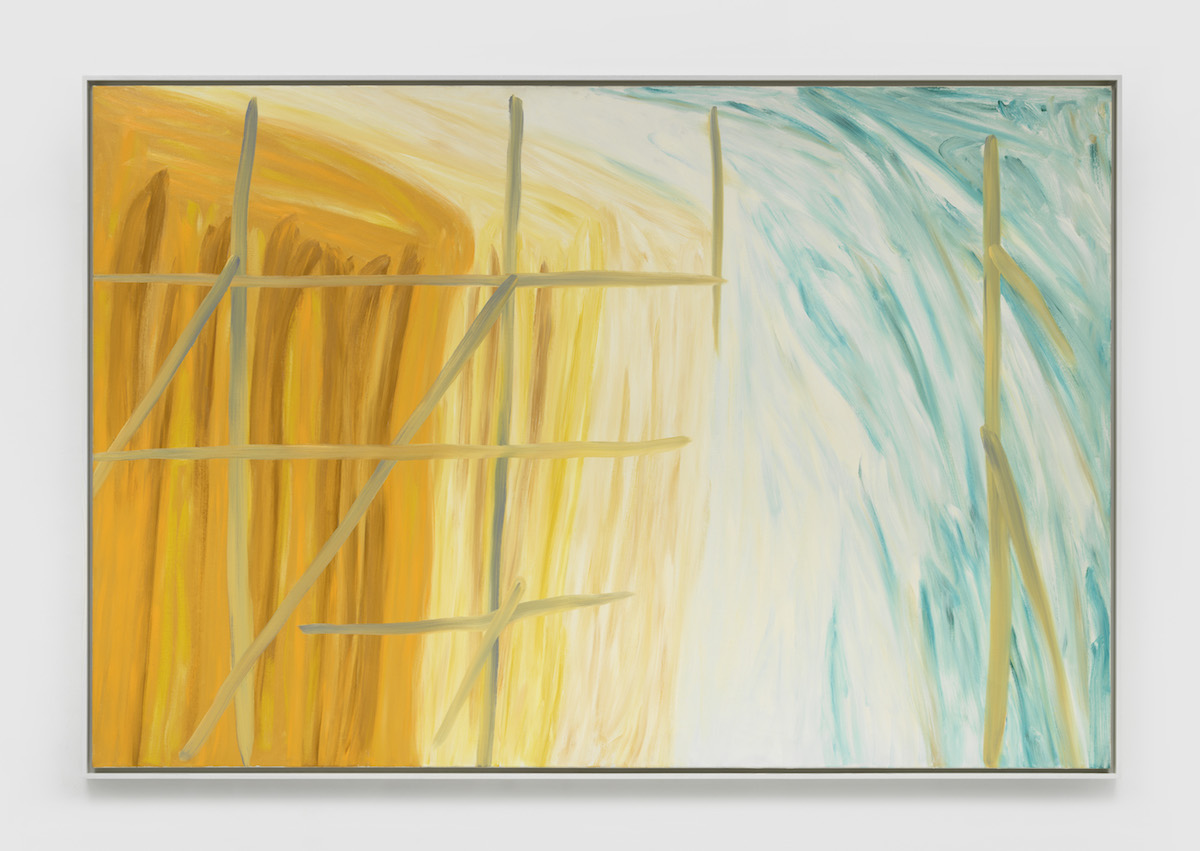 Martha Diamond, “White Light”, 1986, oil on canvas, 72.25 x 108.125 x 1.625 inches © Martha Diamond Trust. Courtesy of David Kordansky Gallery
From the midday burn of White Light, 1986, an underlay of a teal-to-orange blended brushy fade laid over by rudimentary ochre grid-work that comes to be read as the steel post and lintels of a building under construction against a risky sky. To the grisaille moody under the boardwalk clammy atmosphere, set at a “Dr. Caigari” worthy tilt, and illuminated by a spotlight composition that is Grey Cityscape, 1990. Light is the third star ingredient Diamond puts through it’s paces.
The towering Light Between Apartment Buildings, 1991 painted in mid-tone grey streaks, for the buildings components, coalesces the ethereal substance into a substantive roiling ball of phosphene, a nebula inflected with touches of yellow and blue amidst the swirl; more threatening maelstrom than reflective luminescence. The sight is closer to the moment of disaster than to the idyl Diamond set out to capture. And this undercurrent of malevolence, with periodic glints of surfacing, can be found throughout the work if you care to look beyond the vibrant countenance.
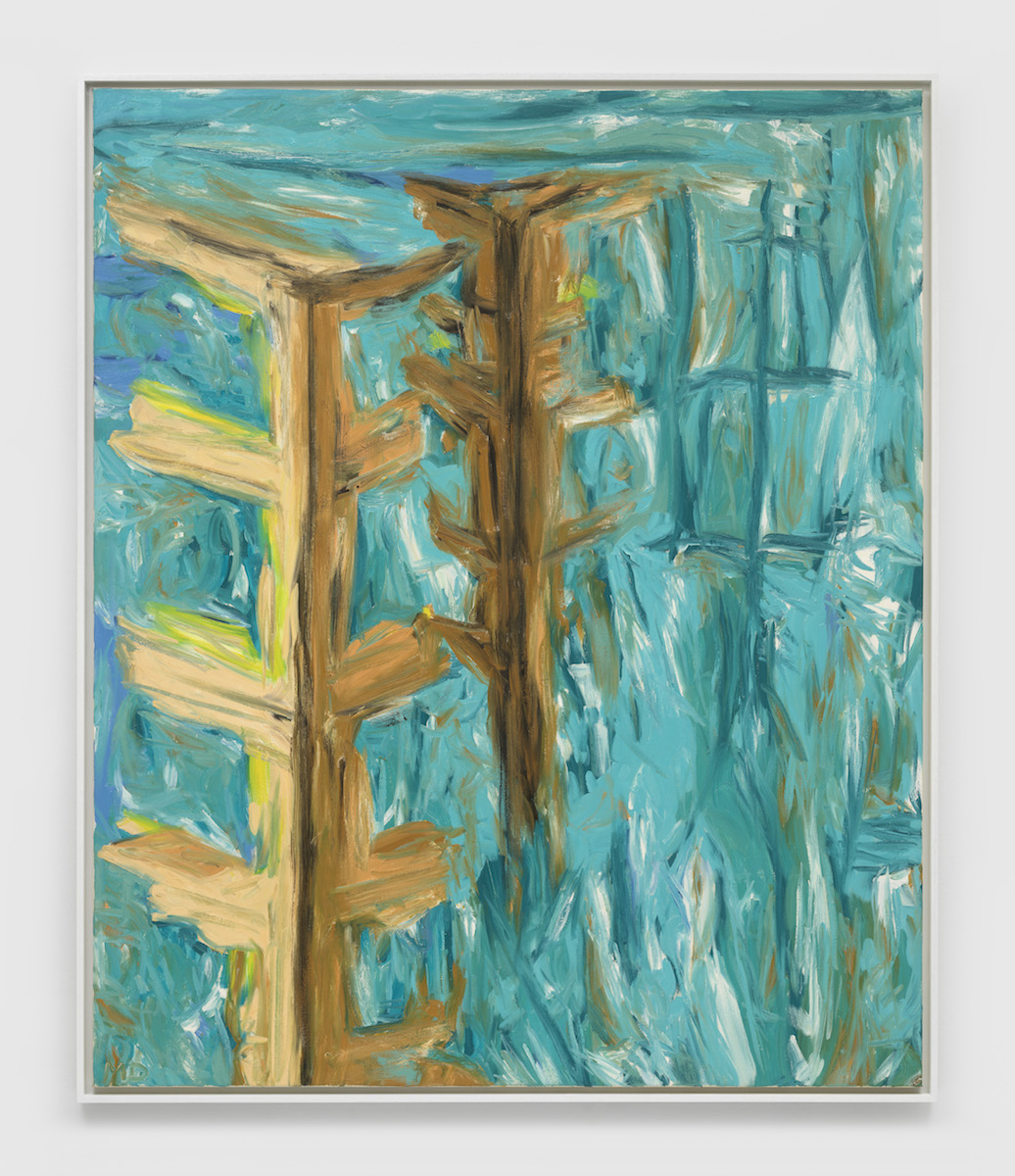 Martha Diamond, “After Image”, 1991, oil on canvas, 72.125 x 60.125 x 1.75 inches © Martha Diamond Trust. Courtesy of David Kordansky Gallery
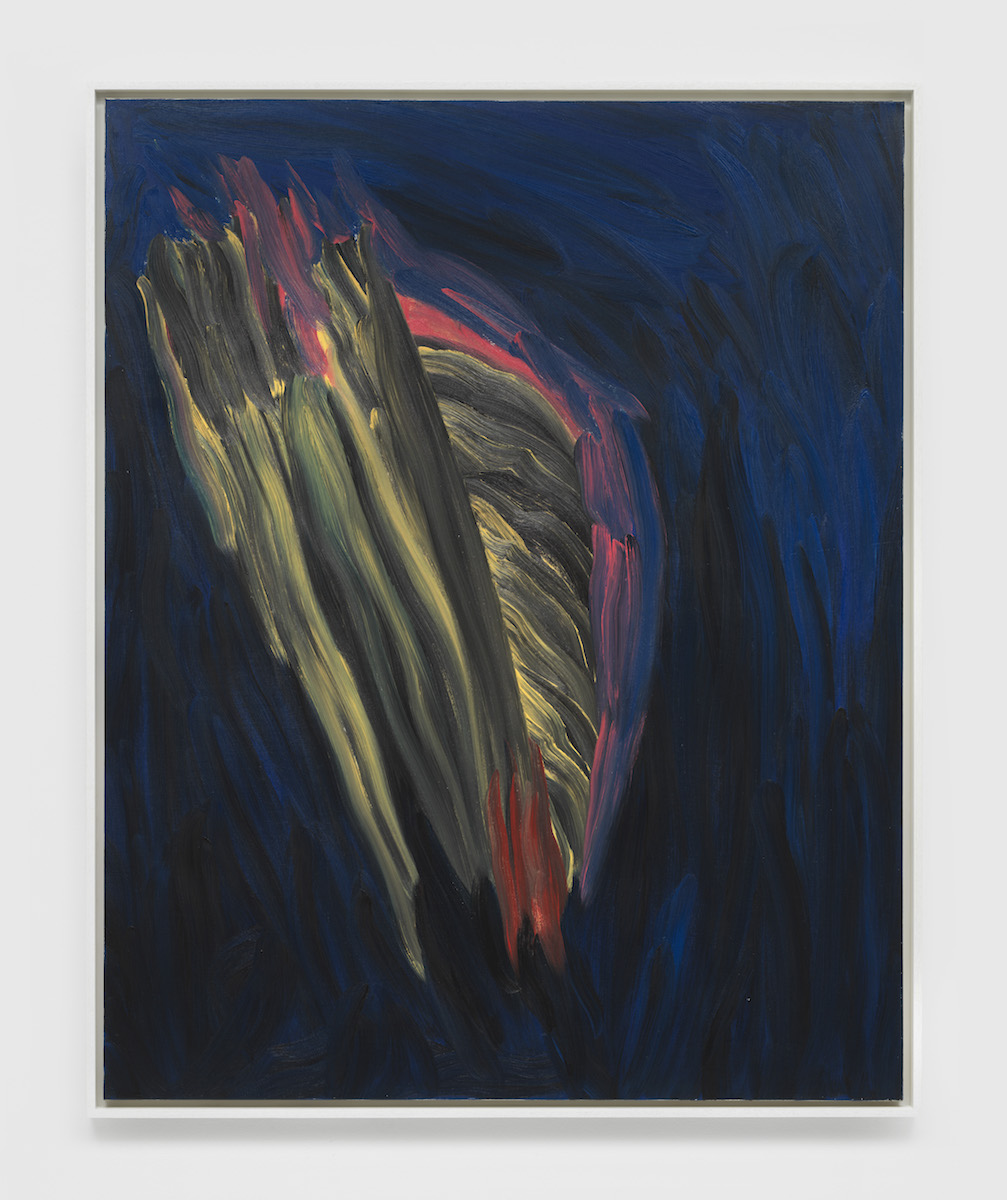 Martha Diamond, “Crossing”, 1984, oil on linen, 60 x 48.125 x 1.25 inches © Martha Diamond Trust. Courtesy of David Kordansky Gallery
Venturing beyond her signature city terrain, in paintings that respond to wider-ranging scapes, from nature After Image, 1991 and Facade, c. 1980s, to Crossing, 1984, with a difficult to identify central core of intermingled yellow, black and scarlet strokes–it might be depicting a by Diamond that smells of a knowing nod to the poster for the surprise hit film “Halloween”, released a half dozen years earlier.
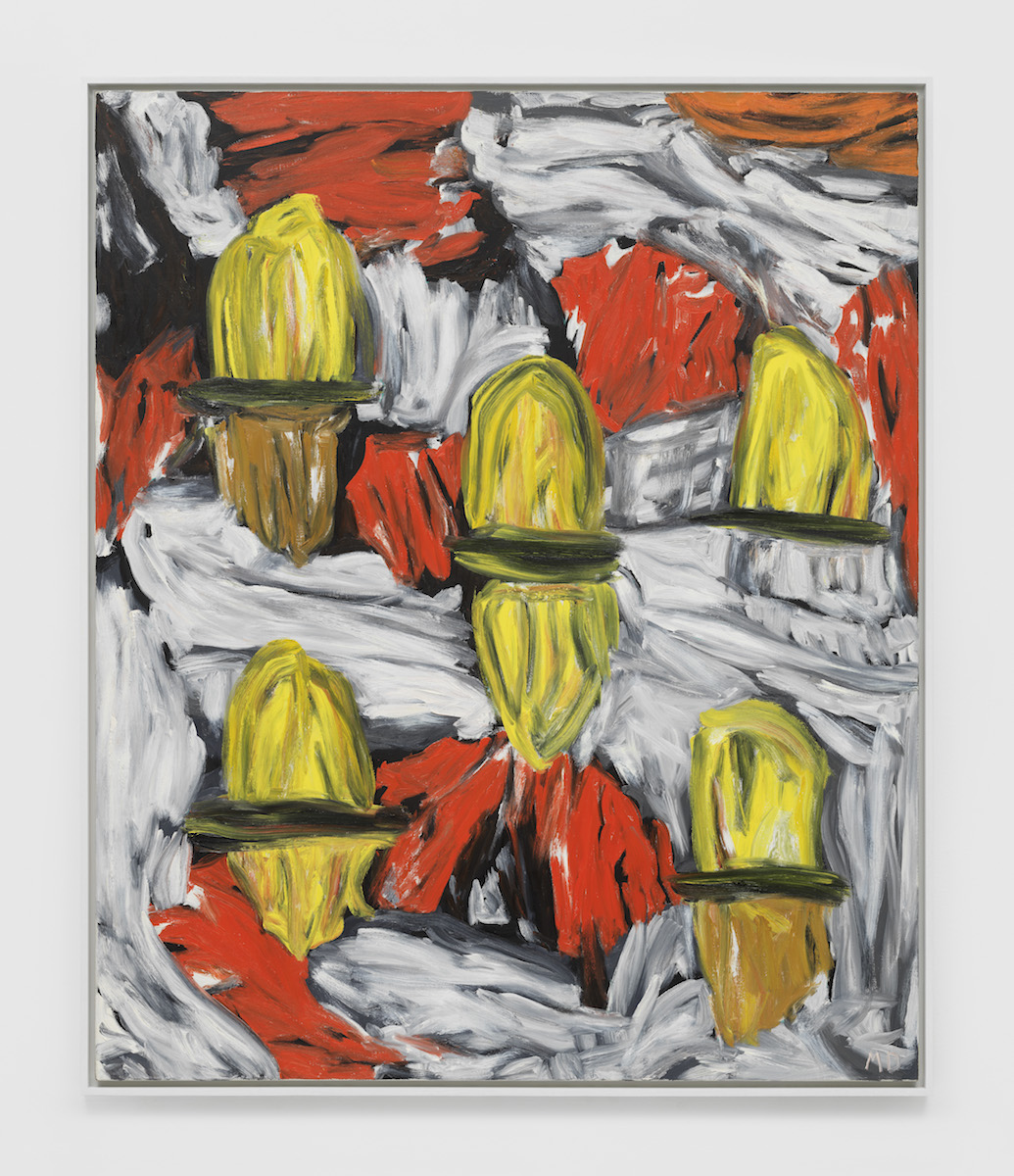 Martha Diamond, “Contracts/Jigsaw”, 1991, oil on linen, 72.25 x 60.25 x 1.25 inches © Martha Diamond Trust. Courtesy of David Kordansky Gallery
The stop you in your tracks encapsulation of Contracts/Jigsaw, 1991 a still life of the pot-like ‘seals’ (that ancient cultures regarded as what we now think of as monetary, or promissory, objects) is presented as a vibrant banquet of strokes that emit a mystical vibe similar to that associated with Susan Rothenberg’s work; another painter with whom Diamond shares connections, including slippage with the New Imagists.
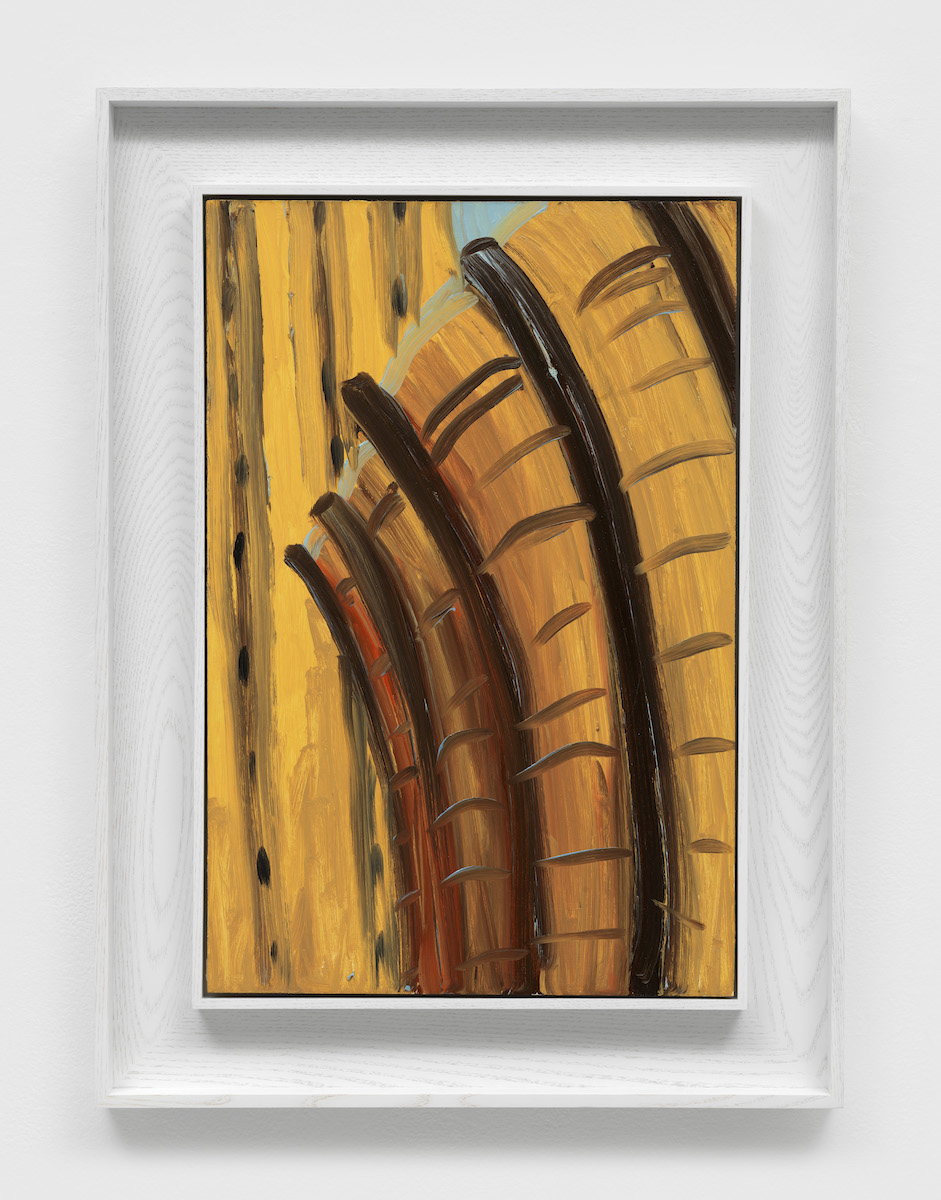 Martha Diamond, “On the Street”, 1983, oil on board, 21 x 14 x .75 inches © Martha Diamond Trust. Courtesy of David Kordansky Gallery
A bonus comes with the inclusion of a handful of small works that, regardless of their being studies, carry intensity equal to their full-scaled neighbors. On the Street, 1983 limning a sectioned Madison Square Garden enflamed in a buttery yellow-orange/brown mix. Conversely, the image summoned Sigmar Polke’s Lager, 1982, which depicts concentration camp fencing, culled from a historical photograph. Bringing the prospect of a Shoah reference to Diamond’s staunchly physical, apolitical, but deeply biographical art.
It was satisfying to learn that Diamond, who passed in 2023, got to see the beginning of the renewed interest in her oeuvre.
_______________________________
* “Martha Diamond: Deep Time”, Colby College Museum of Art, Waterville, ME, July 13–October 13, 2024; Aldrich Museum of Contemporary Art, Ridgefield, Ct, November 17, 2024–May 18, 2025. There is a wonderfully informative, well researched, video, that covers the Aldrich leg, posted on YouTube by Painting Nerds: https://www.youtube.com/watch?v=CFYjh67yNyo
Martha Diamond: After Image
David Kordansky Gallery
520 West 20th Street, New York, NY
May 1–June 14, 2025

Edward Waisnis
Edward Waisnis is an artist and filmmaker. Additionally, he is the Producer of two Quay Brothers films, Through the Weeping Glass and Unmistaken Hands, as well as having overseen the facilitation of their 2012 MoMA retrospective. His writing has appeared in Art New England, COVER, ARTextreme and STROLL.
view all articles from this author