Whitehot Magazine
October 2026
"The Best Art In The World"
"The Best Art In The World"
October 2026
Drawing Things Together: First Marks at Mount Saint Vincent
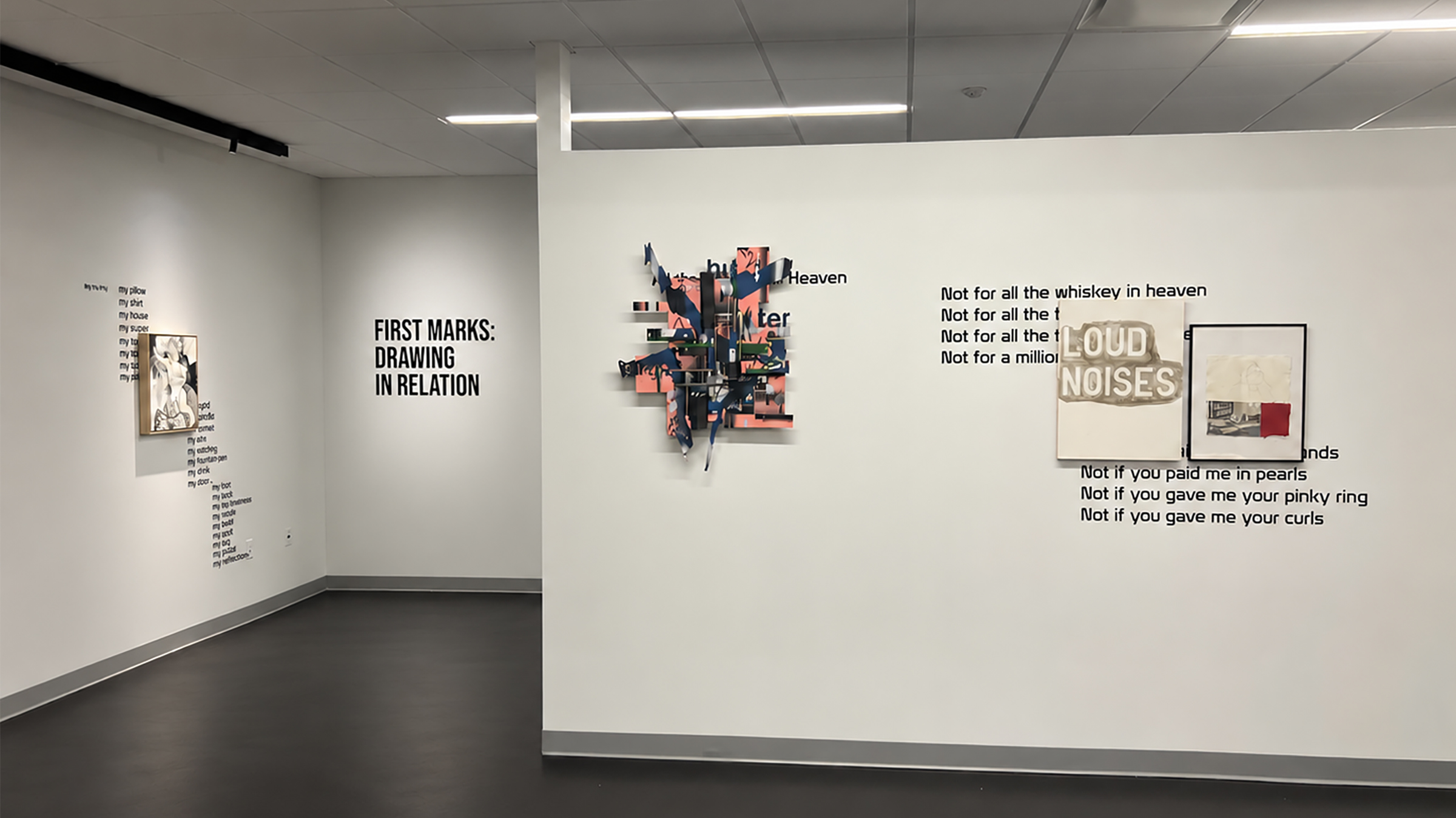
Installation view of “First Marks: Drawing in Relation,” the inaugural art gallery exhibition at University of Mount Saint Vincent (2026)
MIKE MAIZELS October 25th, 2026
"Everything is autobiographical and everything is a portrait, even if it's a chair.”—Lucian Freud
The University of Mount Saint Vincent, the historic Catholic institution tucked into one of the Bronx's surprisingly verdant corners, recently inaugurated a new exhibition space. If its debut exhibition, First Marks, is any indication, the program has ambitious aims. Installed in an understated gallery tucked above the university's library and new student center, the exhibition brings together an eclectic mix of participants: internationally recognized figures such as Rirkrit Tiravanija, Lil Picard, and Justin Favela alongside UMSV faculty whose practices span disciplines from studio art and the humanities to sociology.
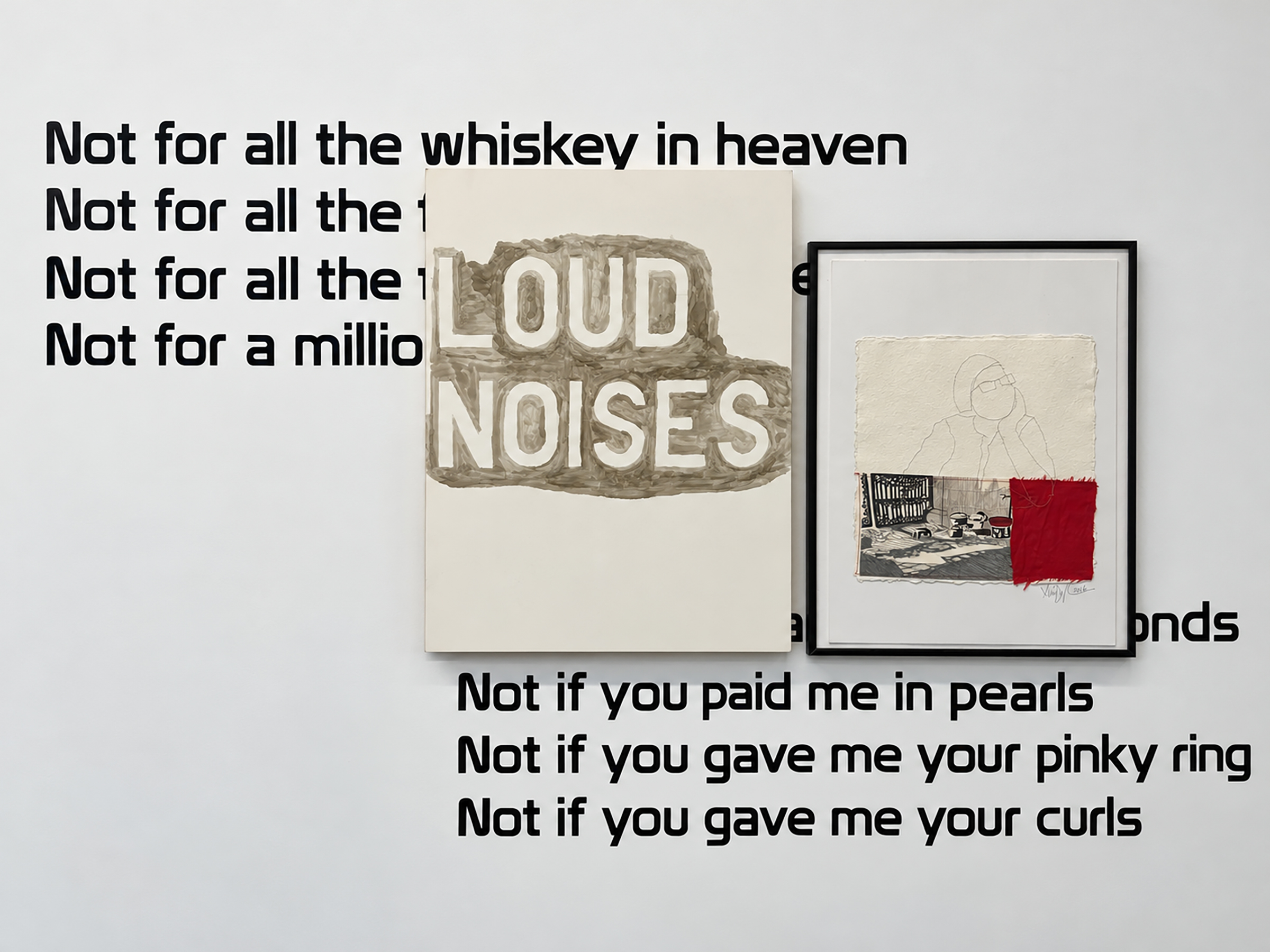
Installation pairing of Rirkrit Tiravanija’s “Loud Noises” with LinDa Saphan’s “Stitches” (2026)
The show's premise becomes clear immediately upon entering. Tiravanija's text-based work “Loud Noises” is paired with a drawing by sociologist and UMSV dean LinDa Saphan, who maintains an active artistic practice alongside her academic career. Tiravanija’s piece, an artifact of a broader performance practice, can feel deliberately elliptical, recalling the conceptual language games of Ed Ruscha or Glenn Ligon. Saphan's piece is more direct and intimate: a stitched self-portrait made with the sewing techniques she learned from her mother, a seamstress, and interwoven with images of the Cambodian landscape. Yet the pairing reveals a shared investment in mark-making as a social act, linking questions of language, identity, memory, and justice that resonate with the university's broader mission.
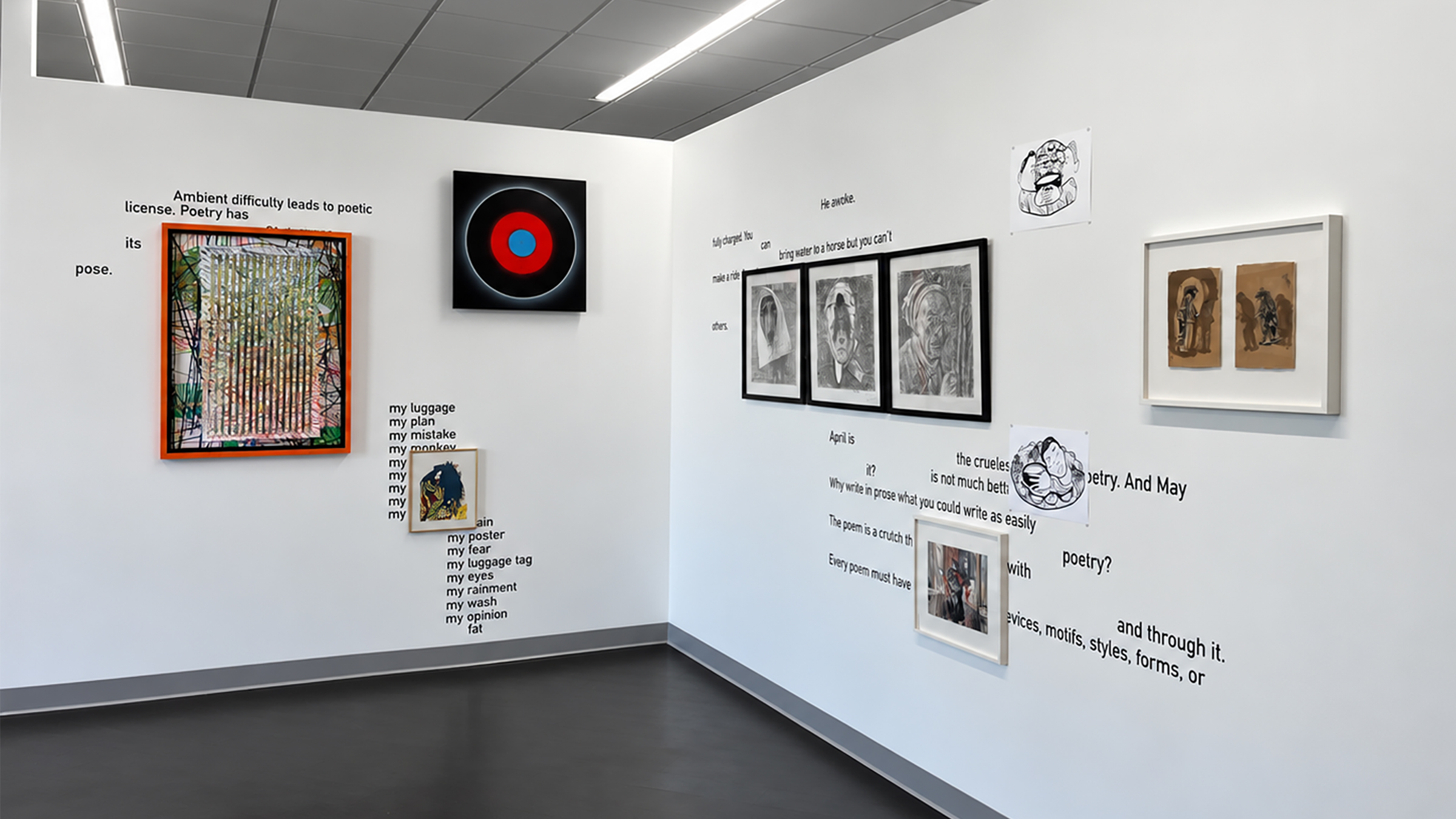
Installation view (artists from left to right): Alejandro Contreras, David Teng Olsen, Angela Kallus, Matthew Archibald, Juan Francisco Elso Padilla, Séverine Rebourcet, and Michael Vasquez (2026)
A second wall stages a more unexpected triangulation. Juan Francisco Elso Padilla, whose work drew on Indigenous and Afro-Caribbean spiritual traditions to rethink Cuban identity, appears alongside drawings by UMSV faculty Séverine Rebourcet and Matthew Archibald. Rebourcet turns recipes into vessels for memory, folding ingredients, African textile patterns, and family histories into her compositions; Archibald’s triptych moves between painter Catherine Kehoe, his dog Nuit, and Chardin through the recurring motif of a head covering. What binds the three is less style than transmission: ritual, food, art history, and even a studio exercise become forms through which memory and meaning pass from one person, culture, or generation to another.
Behind this curatorial structure is Thomas Ray Willis, a UMSV studio art professor whom I have known for the better part of a decade. Willis was the driving force behind the new gallery, pushing for the space for over 5 years and helping define its ambitions. He also brought fellow artist Rafael Domenech onto the art faculty in 2025. Together, Willis and Domenech co-curated First Marks.
The partnership makes sense. Domenech came through Columbia University, where formal experimentation has long mixed with relational and socially engaged practices. His own work moves between architecture, publishing, installation, and social exchange. Willis comes from a different history, but shares the same interest in the point where objects become situations and form becomes interaction. That common ground gives First Marks much of its curatorial logic.
Still, Willis’s imprint is hard to miss. His personal history runs through the exhibition, from the artists he has known to the kinds of unlikely encounters he likes to construct. This is his curatorial debut, but it hardly feels tentative. Willis has spent much of his career framing situations, assembling people, and testing what happens when different social and aesthetic worlds are forced into contact. The gallery gives that impulse a larger stage.
Willis did not study with Dave Hickey but arrived at UNLV in his wake. Hickey had already left the art department, but his influence remained palpable through the faculty, graduate students, and friends he had drawn into the Las Vegas scene, as well as through the reaction against his arguments for beauty and formalism. Willis and peers such as Justin Favela came of age inside that tension, absorbing both Hickey’s legacy and a competing emphasis on performance, ephemerality, and relational aesthetics. That split is legible in First Marks. Favela contributed one of his iconic piñata collages, while Angela Kallus offers an airy circular composition whose shifting optical effects evoke the California Light and Space movement of the 1970s. Taken together, the two works suggest that Willis’s Nevada inheritance is less straightforward Hickeyism than a distinctly Las Vegas dialectic: beauty and anti-beauty, object and event, formal rigor and social experiment, all underwritten by an insistence on collapsing the boundaries between high and low culture, authenticity and performance.
Although he may have a Vegas origin story, Willis is perhaps best known in New York for a conceptual art-meets-Nathan Fielder-esque stunt that served as his final MFA critique at NYU. Rather than simply presenting work to classmates and faculty, Willis hired a professional courtroom stenographer to transcribe the entire event, transforming the critique itself into the artwork. The resulting publication, NYU MFA Art Critique, exposed the rituals, anxieties, and power dynamics of graduate art education while forcing participants to confront the possibility that their off-the-cuff observations might become permanent public record. As both performance and institutional critique, the project managed to be funny, uncomfortable, and unexpectedly revealing all at once.
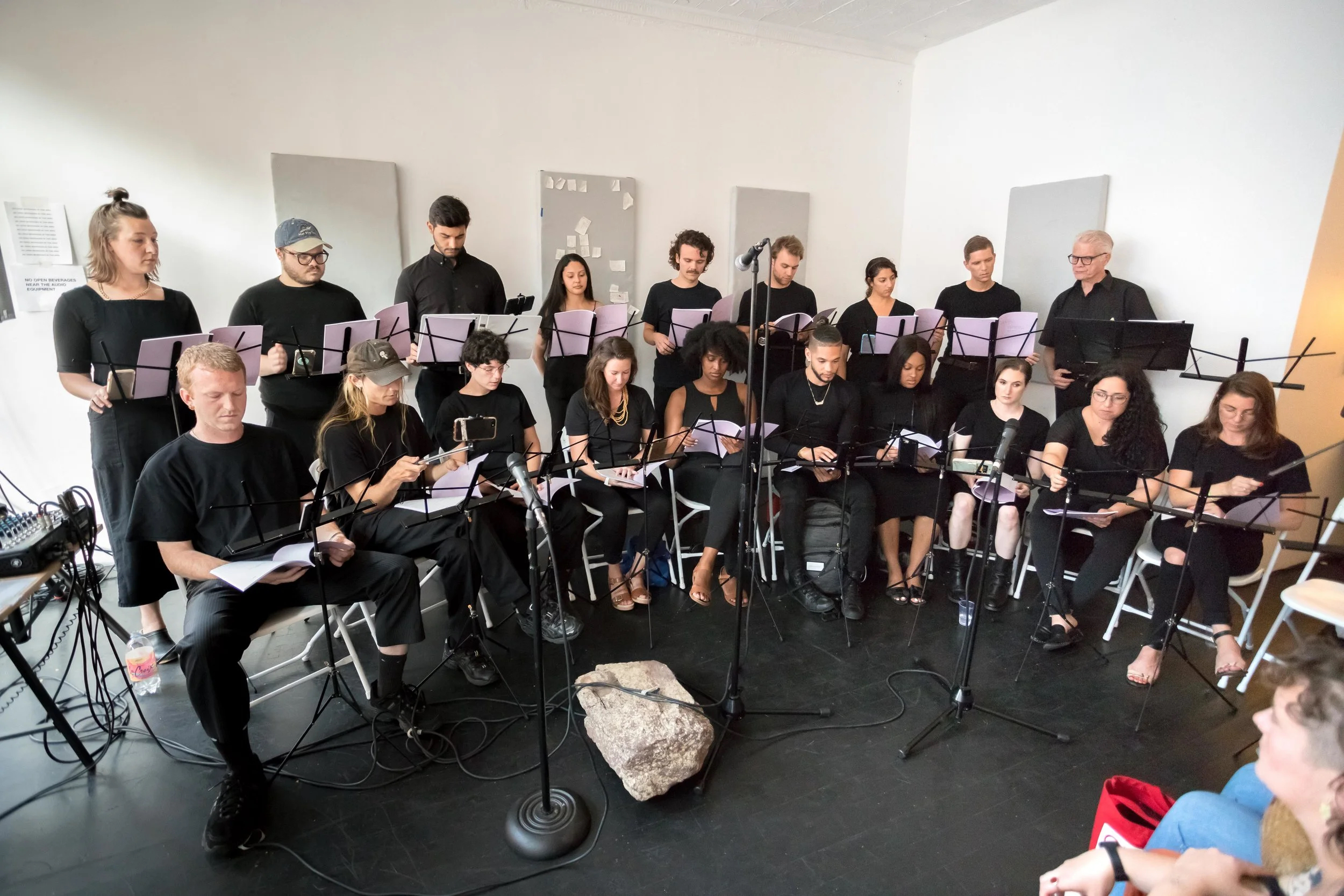 Thomas Ray Willis, “NYU MFA Art Critique Live Reading,” Montez Press Radio, New York (July 25, 2019)
That work will remain one of my favorites for a long time, with its increasingly self-conscious repetitions refracting back upon themselves like light trapped inside a colorless diamond. It was gratifying, then, to encounter something of a sequel in Willis’s own contribution to First Marks. In Mount Saint James, he shreds discarded student drawings and reassembles them into a collage drawn from his personal life. The anxious, hyper-critical MFA candidate has become a patient and invested teacher, but he is still making self-referential work from the artifacts of studio life itself.
Teaching, for Willis, has rarely stopped at the classroom door. I first came to know him at Wellesley College, where Willis, David Teng Olsen (also included in First Marks), and myself were part of the same art department community. Willis had a knack for turning departmental life into an event. He threw parties in an old art building awaiting demolition, then celebrated the opening of the new one he had helped shape through faculty planning committees. He rented party trolleys to circulate through campus and, at one point, transformed the department gallery into a Vegas-inflected nightclub. He even designed a “Party Cart” that students could check out from the equipment cage and use to stage gatherings of their own. The joke was never entirely a joke. Social life was part of the pedagogy.
Willis is the first to admit that his talents lean more toward framing situations than supplying subject matter. In this respect he belongs to a distinguished lineage of artists whose greatest works are, in part, the communities they assemble around them. One thinks of George Segal at nearby Rutgers, where an unusually fertile network of artists, teachers, and students helped give rise to Happenings, Fluxus, and some of the most adventurous art pedagogy of the postwar period. Segal's farm became a gathering point for Allan Kaprow, George Brecht, Robert Watts, Roy Lichtenstein, and others. The lesson was simple enough: an art program could be more than a collection of courses. It could become a scene.
That history makes the move from Wellesley to UMSV feel less accidental. With the new gallery, Willis and Domenech now have a space in which exhibition-making, teaching, and social life can overlap more deliberately. First Marks already sketches the possibilities: old colleagues reappear, faculty work beside internationally recognized artists, and students participate not simply as viewers but as contributors to the life of the exhibition.
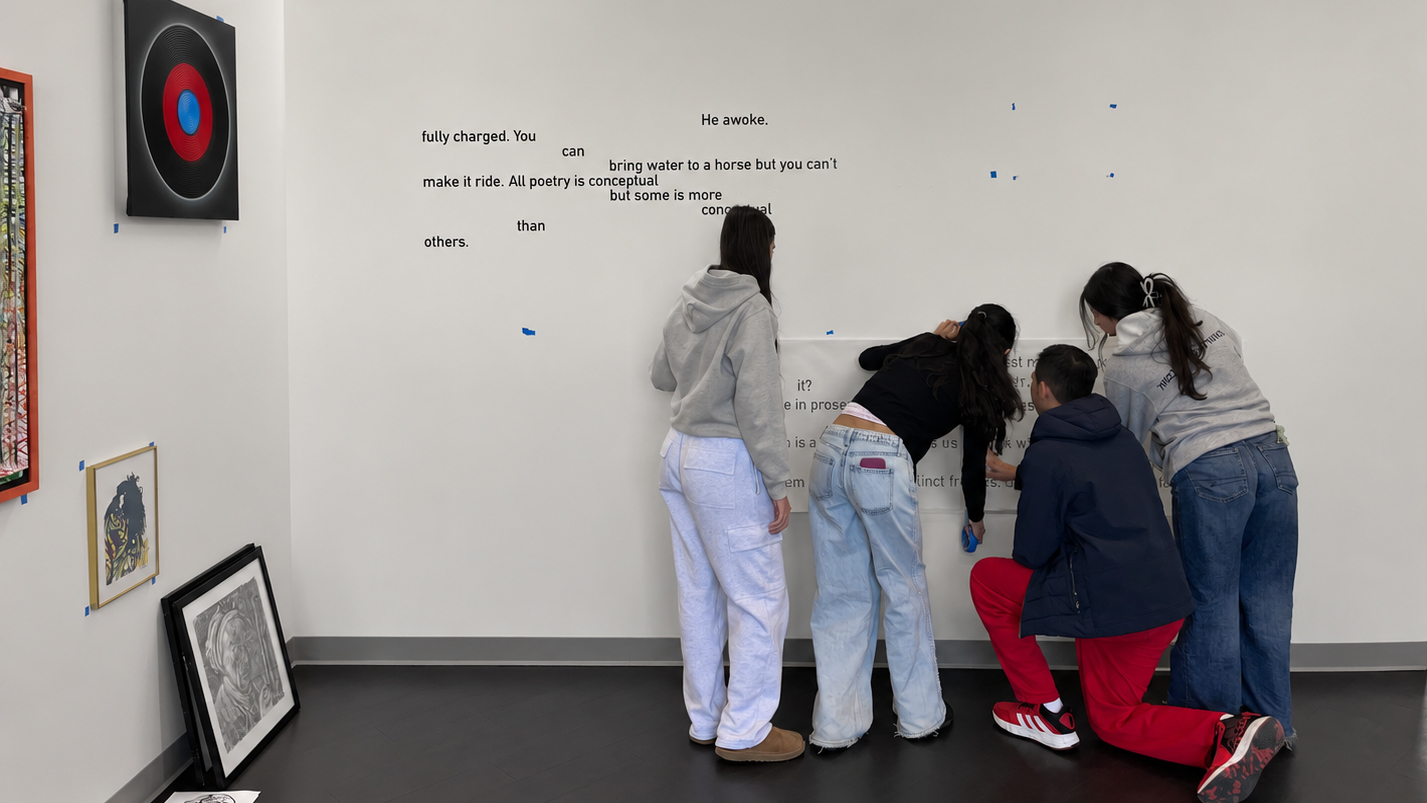
Students in Rafael Domenech’s “COMM 346: Information Arts” course installing “First Marks: Drawing in Relation” at the UMSV Art Gallery (2026)
No one should burden a new gallery with predictions of historical significance. Still, First Marks succeeds because it recognizes that institutions are built not only through facilities and budgets but through relationships. The exhibition's most compelling achievement may be the network it begins to make visible: artists brought together across generations and geographies, students encountering professional practice at close range, and a university staking a claim within the cultural life of the Bronx. If New Brunswick once became an improbable center of artistic experimentation, there is no reason the Bronx/Yonkers border cannot surprise us in similar ways. The first marks, after all, are only a beginning.
First Marks: Drawing in Relation is on view through December 10, 2026, at the UMSV Art Gallery, second floor of the Elizabeth Seton Library and Student Center, University of Mount Saint Vincent, Riverdale, New York.
Artists: Alexandre Arrechea, Matthew Archibald, Alejandro Contreras, Rafael Domenech, Juan Francisco Elso Padilla, Justin Favela, Baris Gokturk, Angela Kallus, Jennifer Nuss, David Teng Olsen, Lil Picard, Séverine Rebourcet, LinDa Saphan, Rirkrit Tiravanija, Alejandro Valencia, Michael Vasquez, Tomas Vu, and Thomas Ray Willis.

Mike Maizels
Michael Maizels, PhD is an historian and theorist whose work brings the visual arts into productive collision with a broad range of disciplinary histories and potential futures. He is the author of four books, the most recent of which analyzes the history of postwar American art through the lens of business model evolution. He has also published widely on topics ranging from musicology and tax law to the philosophy of mathematics.
view all articles from this author