Whitehot Magazine
August 2026
"The Best Art In The World"
"The Best Art In The World"
August 2026
Louise Bourgeois at Hauser & Wirth
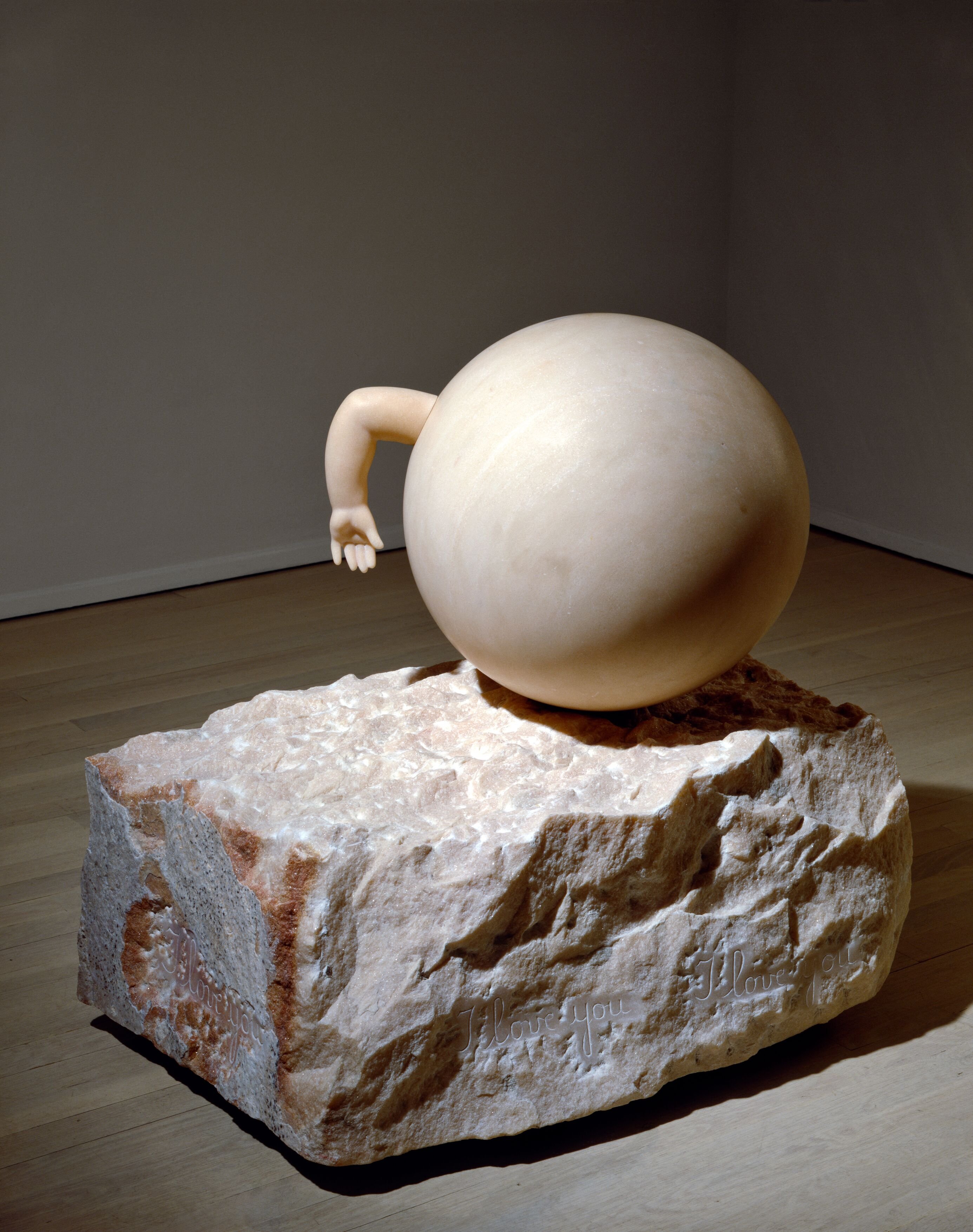 Louise Bourgeois (1911 - 2010), Untitled (With Hand), 1989, Pink marble74.6 x 78.7 x 57.2 cm / 29 3/8 x 31 x 22 1/2 inches
By JONATHAN GOODMAN April 12th, 2026
Louise Bourgeois, the famous and distinguished French-American surrealist sculptor, is putting on a very strong show at Hauser & Wirth in Chelsea.The group of sculptures relay the artist’s psychological insight and unusual ability to render a complex outlook in decidedly psychic terms. The work itself, strongly influenced by early to middle modernism, takes the second half of the 20th century as a window for innovations in efforts that are highly independent and original. A dark emotional life purveys the spirit of her work.
The artist’s tacit emotional difficulty originated with a personal circumstance that would harm most anyone. As most viewers know, Bourgeois’s father installed a close female companion as a nanny in his home, exposing his family to a highly difficult arrangement. The artist responded by making art that alluded to hardship, but this was done in abstract terms. The results were hard to explain—the art was rarely overt in a psychological sense, but nonetheless chose a convoluted expression. Trouble hovered over Bourgeois’s undertaking.
We have to remember that Bourgeois worked mostly in the second half of the 20th century, when the innovations of surrealism were still in high recognition, giving the artist a good window with which she could combine personal difficulty with a structure of true originality. Such a combination is central to Bourgeois’s unsettling, but genuinely powerful achievement.
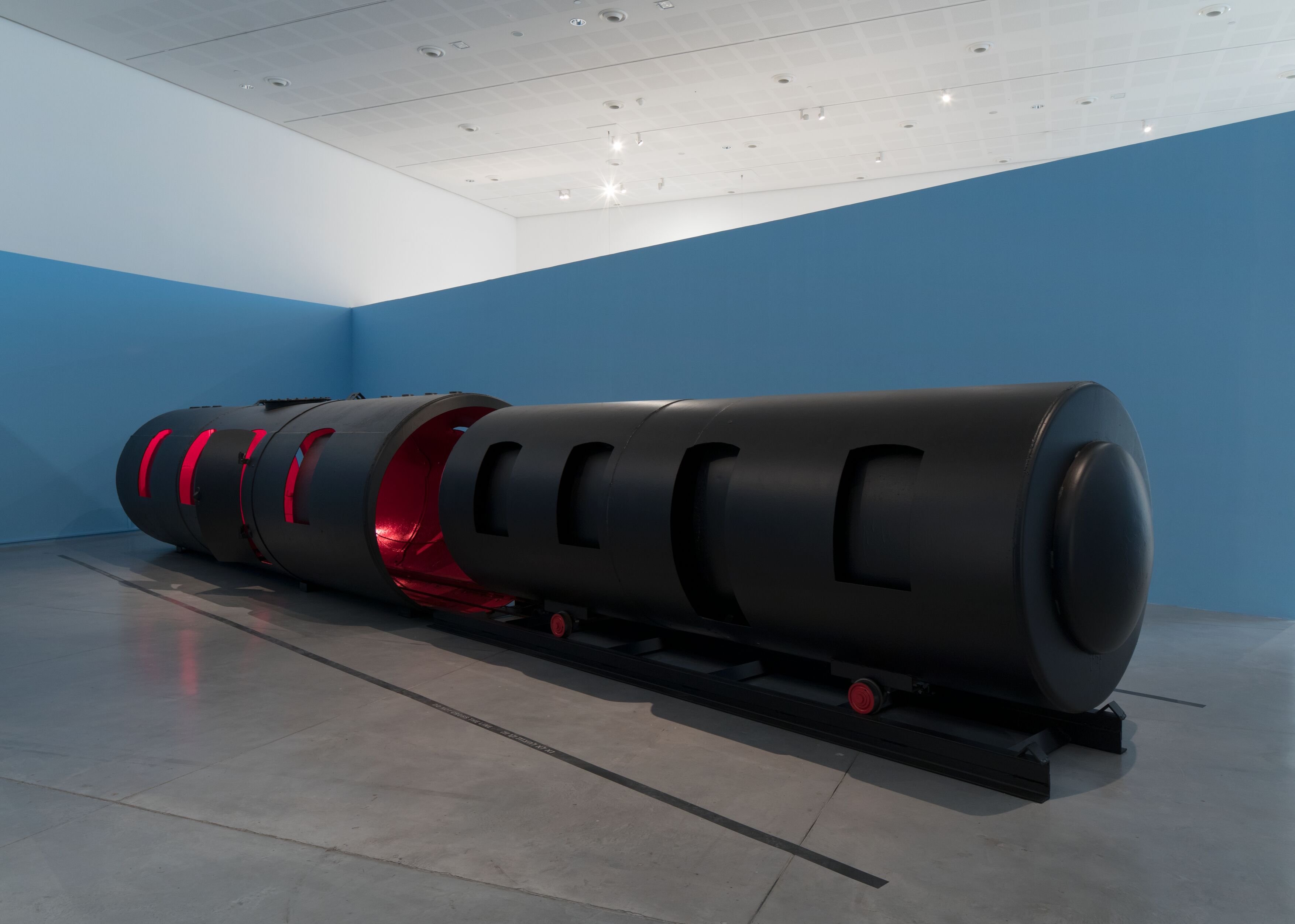 Louise Bourgeois (1911 - 2010), Twosome, 1991, Painted steel, electric light, and motor190.5 x 198.1 x 1237 cm / 75 x 78 x 487 inches
One can see this in Twosome (1991). The almost life-size, two-car black locomotive, on a short track, the first object to meet the gallery visitor. The all-metal black steel chassis holds a tubular child, free of industrial embellishments, that moves in and out of the cavity of the second car. It is both compelling and eccentric in its brief narrative. Again, the subject—a steel infant emerging from an industrial mother—suggests problems of feeling, albeit in a tacit manner. The conceit is a disturbing one, shifting intimacy into a state of cold manufacture.
The mysterious melancholic awkwardness enveloping this work and much of Bourgeois’ other efforts stems from personal suggestion. But that does not mean the work is grounded only in private trauma. One of the strengths of the artist is her ability to transform troubled feeling into art of strenuous originality, in which the newness of the forms keep, to some extent, the themes and construction of the artwork contemporary and alive. This kind of translation occurs on a regular basis in the art. Bourgeois invests the personal in an emotional manner that keeps her feelings valid and also makes them accessible, without too much difficulty, to the people looking at the work.
Another work, Untitled (with hand) 1989, consists of a a low-lying sphere from which a child’s arm and hand extend. The hand extends beyond the sphere and might be considered a reach for help. Even so its gestalt is something of a conundrum; we are to make of it what we can. Whatever the meaning of this strange, eccentric piece might be, it is clear that nature and humanity are somehow merged in relations that are both engaged with and independent from the theme of the sculpture. Underpinning the surrealism is a nuanced uncertainty—a stance surrealism can speak very well to. Bourgeois occupied a place between memory and current art, switching effortlessly among the possibilities, technical and thematic, that comprise her broad view. Today, when we go over the work, we see a masterly control of materials, in the service of something that approaches sorrow without saying so.
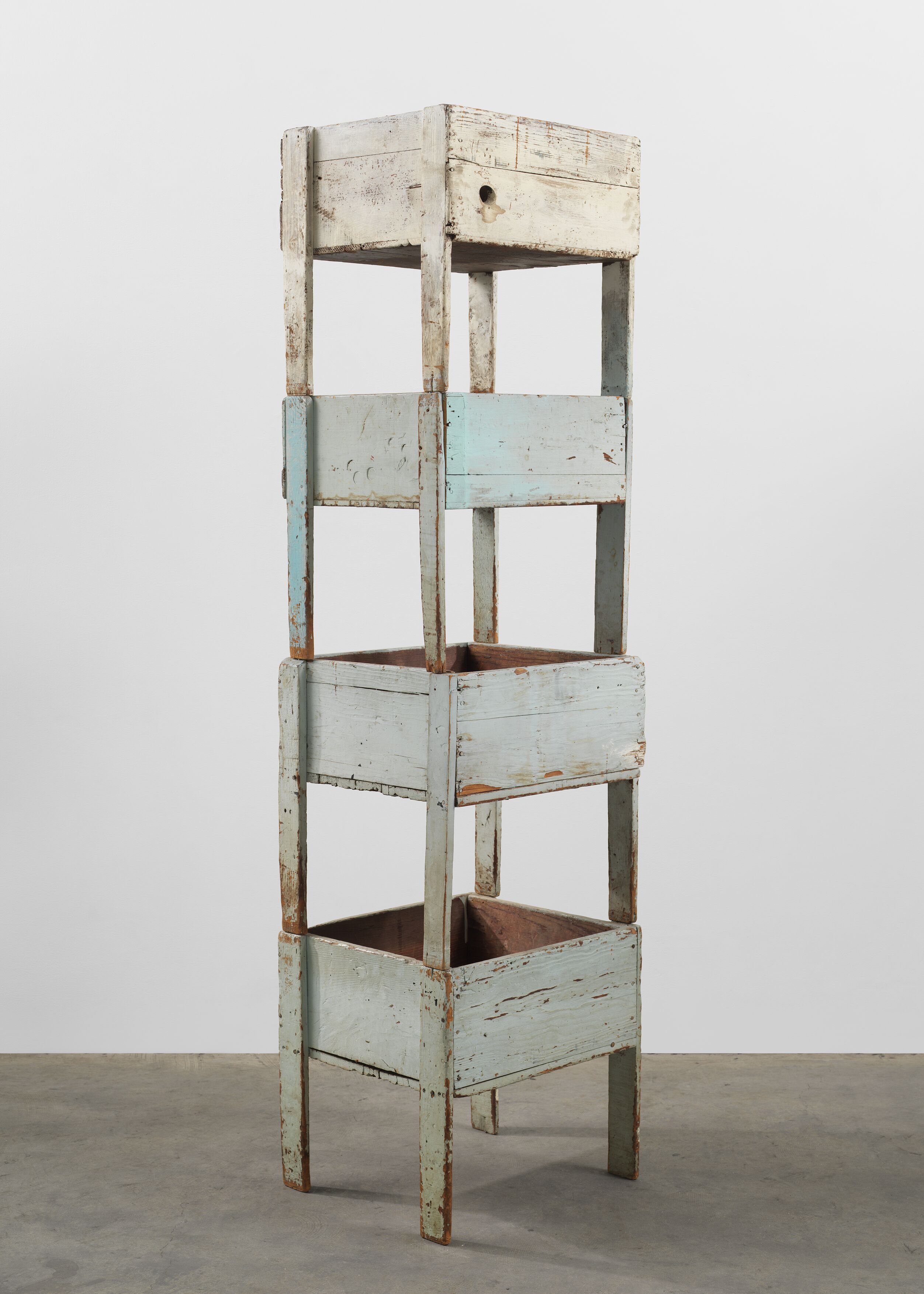 Louise Bourgeois (1911 - 2010), Untitled, 1988, Painted wood and marble2, 14.6 x 57.2 x 49.5 cm / 84 1/2 x 22 1/2 x 19 1/2inches
“Ray of Hope” (2006) is a collection of smallish drawings consisting of watercolor and color pencil on embossed paper. It is relatively free of the artist’s predisposition toward psychic statements. Still, it is a notable piece of work that involves repetition and subtle similar changes from one image to the next. The closeness of these grouped pictures create a world that is independent and viable. The title, "Ray of Hope”, reminds us that personal difficulty is almost always a part of the artist’s aesthetic. Unlike the sculptures, which appear more openly surrealist, this work while not decorative is accessible in a very attractive way.
Bourgeois is mostly interested in the idiosyncrasies in sculpture, so the work just described has a life very much its own. It differs sharply from the locomotive that gives birth or the child’s hand extending from the sphere of the world. At the same time it would be a mistake to see this two dimensional collection of similar images as merely decorative. The title gives this effort a seriousness that we can almost always count on when viewing bourgeois’s demanding art.
The striking sculpture, “Untitled” (1988) consists of a squared tower of open space banded together by sheets of wood and supported vertically by narrow struts. The sculpture is so simple as to suggest the minimalism of the time, but it is also a piece of mechanical imagination. Without this combination the work might seem too simple but it was also made at a time when simplicity was important to the way people made art in New York. It doesn't seem to have an openly emotional meaning but its structure occasions investigation. This means that the artist was as good at developing a visual structure of things as she was at implying a psychic trauma. We can't ask too much about her personal hardship but we can recognize the unspoken suffering suggested by much of the art. This suffering is both supported and to some extent constrained by the brilliance of her surrealist advances.
Louise Bourgeois is not a cult artist, but for some she may be an acquired taste. Her work communicates a way of thinking that is both privately personal and publicly formal. It is rare to see someone do both at the same time so well. For that reason alone, Bourgeois can be seen as an important artist. It is easy enough to box her in with a psychological reading but the work means more than that. By reaching out to the surrealism of France, her former home, she elevated what otherwise would be a purely private undertaking. Surrealism is often psychological, and the artist makes the best of that. The show at Hauser & Wirth very nicely expresses the complexity Bourgeois has constructed, for both herself and her audience. WM

Jonathan Goodman
Jonathan Goodman is a writer in New York who has written for Artcritical, Artery and the Brooklyn Rail among other publications.
view all articles from this author