Whitehot Magazine
October 2026
"The Best Art In The World"
"The Best Art In The World"
October 2026
David Hockney's Moon Room: The Last Light at Pace Gallery
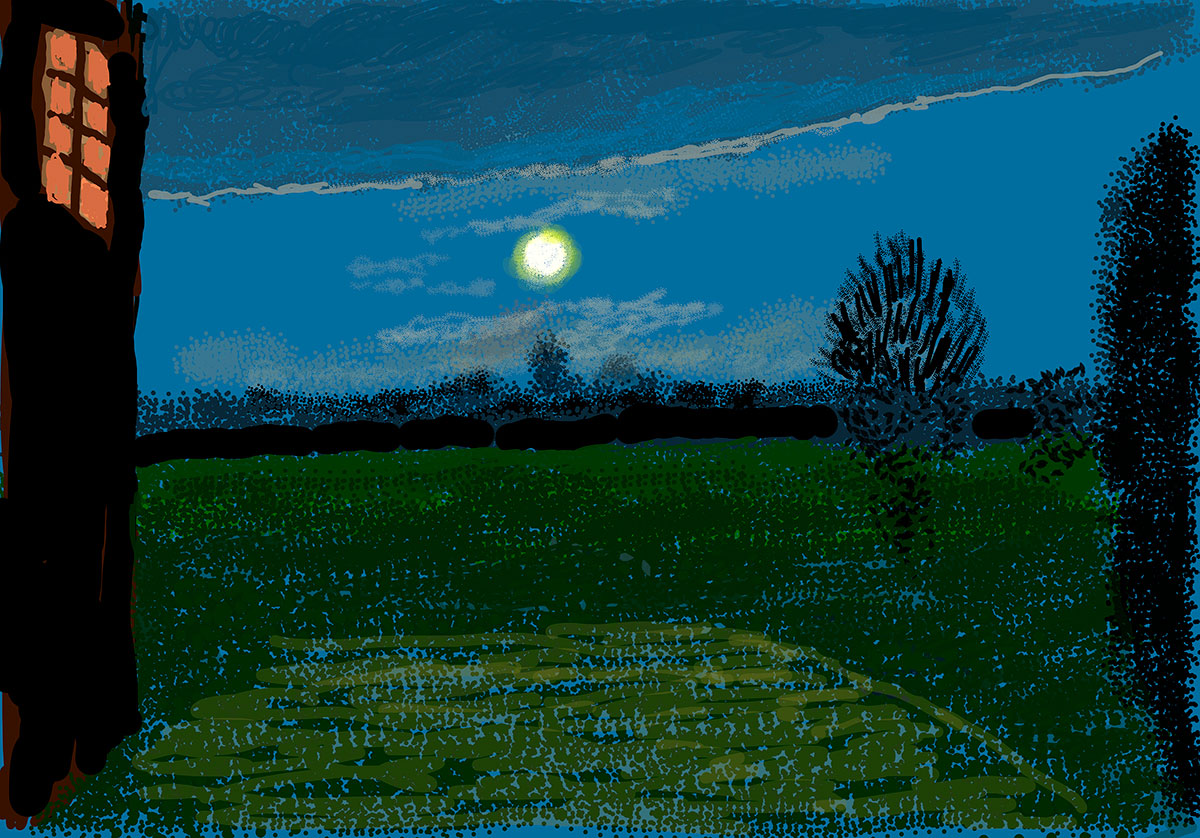 Hockney, David 31st October 2020, No. 1, 2020 iPad painting printed on paper, mounted on Dibond © David Hockney
By MARGHERITA ARTONI August 10th, 2026
Two months ago, David Hockney stopped looking. Before that moment came The Moon Room: fifteen iPad paintings created during the pandemic in Normandy, now on view at Pace Gallery in New York. These final works insist on what Hockney spent his life proving—that seeing is an act of resistance. At a moment when images are increasingly generated, circulated, and consumed at a speed beyond human attention, Hockney's last series proposes something radical: to look slowly is to refuse the present's demand for speed. The significance is no longer only aesthetic. It has become elegiac, and defiant.
These paintings were made between April and December 2020 while Hockney was confined at his seventeenth-century farmhouse in Normandy. During a period defined by uncertainty and confinement, these works transform a limited physical environment into an expansive field of observation. The moon, recorded from different points across his twelve-acre property, becomes the subject through which Hockney explores light, duration, memory, and the relationship between the visible world and the image. The apparent simplicity of the series conceals a deeper argument about artistic practice. Hockney approaches the iPad as another instrument within painting's long history of investigating vision. From his experiments with the camera lucida in the 1990s to his digital drawings and video works, he consistently explored new tools as extensions of the eye. The medium changes; the essential question remains: how does an image emerge from an encounter with the world? In Moon Room, one of the most contemporary image-making devices becomes a means of returning to one of the oldest concerns of art: the transformation of light into experience.
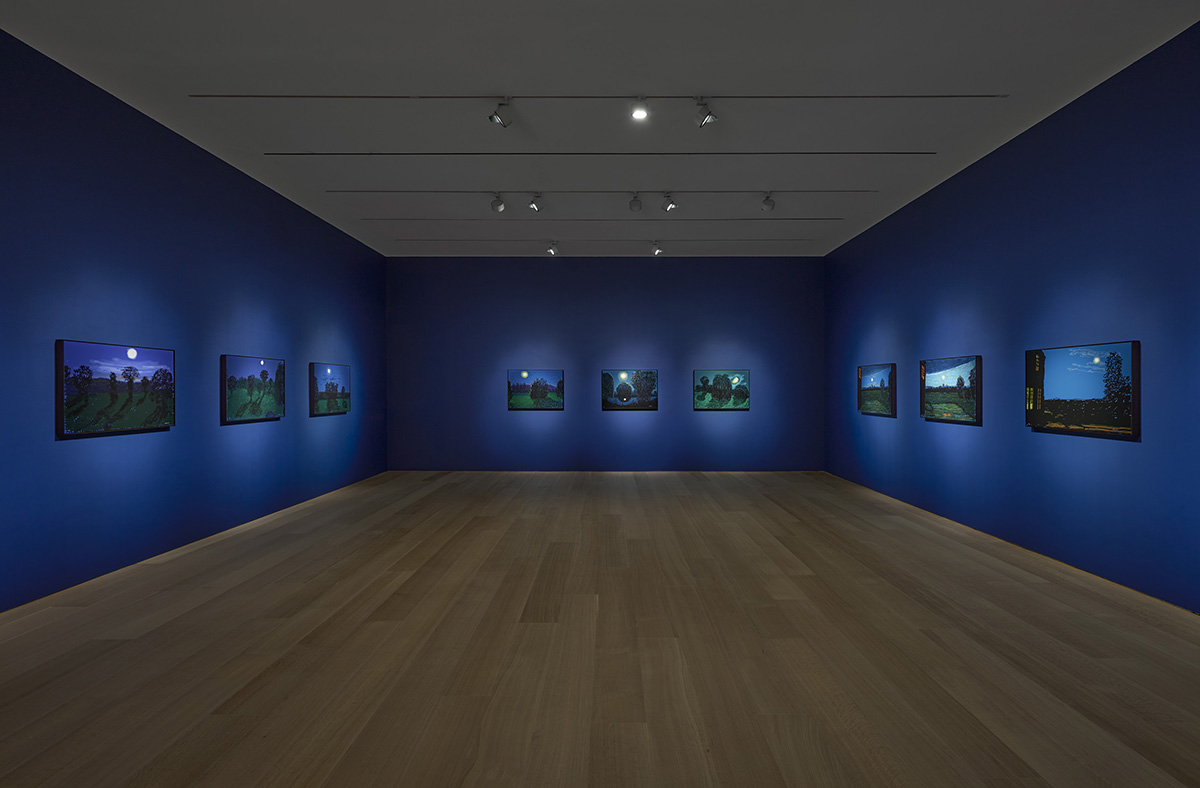 David Hockney: The Moon Room 540 West 25th Street, New York, NY 10001 May 15–August 14, 2026 Photography courtesy Pace Gallery
The iPad allows Hockney to register phenomena that might otherwise disappear, including the shadows cast by trees under moonlight. As he explained, after the lights of his house were switched off, the moon became bright enough to project shadows across the grass. The illuminated screen enabled him to capture this fleeting event directly. Technology serves as a way of intensifying presence. The series belongs to a longer history of painters who understood light as an event unfolding through time. Hockney's relationship with artists such as J.M.W. Turner and Claude Monet emerges through a shared interest in perception as something constantly changing. Hockney's entire body of work has been fundamentally concerned with the experience of seeing. His paintings investigate the processes through which reality becomes visible, revealing vision as an active construction. In this final series, that inquiry reaches a kind of culmination—deepening rather than concluding.
In David Hockney, 3rd July 2020, No. 3, the moon appears as a luminous presence suspended within a nocturnal field. The surrounding darkness becomes an active pictorial space, allowing subtle variations of atmosphere and tone to emerge. The work transforms a familiar celestial object into an examination of rhythm, distance, and visual experience. What might have seemed simple becomes, through sustained looking, inexhaustible. David Hockney, 4th July 2020 develops another dimension: the relationship between repetition and difference. The moon remains constant, yet each observation produces a distinct image. Hockney turns daily attention into a record of change, demonstrating that familiarity deepens perception. This approach recalls Agnes Martin, whose practice transformed repetition into a method of concentration. In both artists, systematic limitation reveals subtle variations within a confined field.
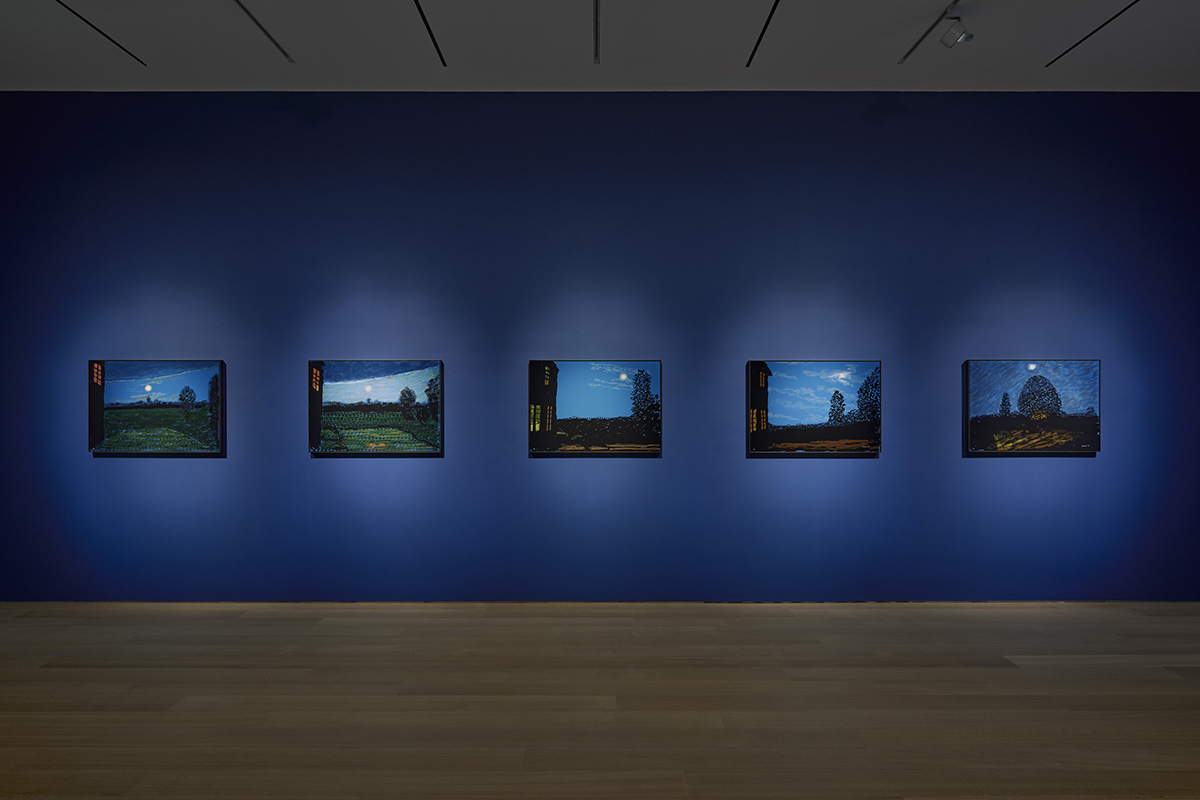 David Hockney: The Moon Room 540 West 25th Street, New York, NY 10001 May 15–August 14, 2026 Photography courtesy Pace Gallery
The significance of Moon Room lies in its encounter between digital technology and slowness. Contemporary image culture often separates pictures from place, duration, and physical experience. Hockney reverses this tendency: he takes a device associated with immediacy and transforms it into a tool for contemplation. The iPad, designed for speed, becomes a medium of patience. This understanding of technology connects Hockney to Nam June Paik, who viewed emerging media as extensions of human creativity. What matters is what forms of experience a medium allows artists to reveal. In David Hockney, 31st October 2020, No. 1, the later development of the series becomes visible. Months after the first works, the painting demonstrates how sustained observation accumulates over time. The moon remains recognizable, yet the image carries memories of previous encounters. The series becomes a visual diary of changing conditions—a record of how looking itself transforms.
The pandemic context provides the historical background for Moon Room, though the works ultimately move beyond their circumstances. Their deeper subject is attention itself. Confinement became the condition for intensified awareness. Looking at these paintings now, six years after their making, they acquire new meaning. Each captures not only light, the movement of seasons, hours, days—the visible markers of time. They are works by an aging artist, recording his presence through the most constant of natural objects. Six years later, they carry the weight of finality. With Hockney's recent passing, Moon Room has become something more than an exhibition. These fifteen paintings function as a final meditation on what it means to see, to attend, to remain present to the world. They are a sustained inquiry—a refusal to accept that seeing can ever be exhausted. The moon continues its cycles; the paintings remain.
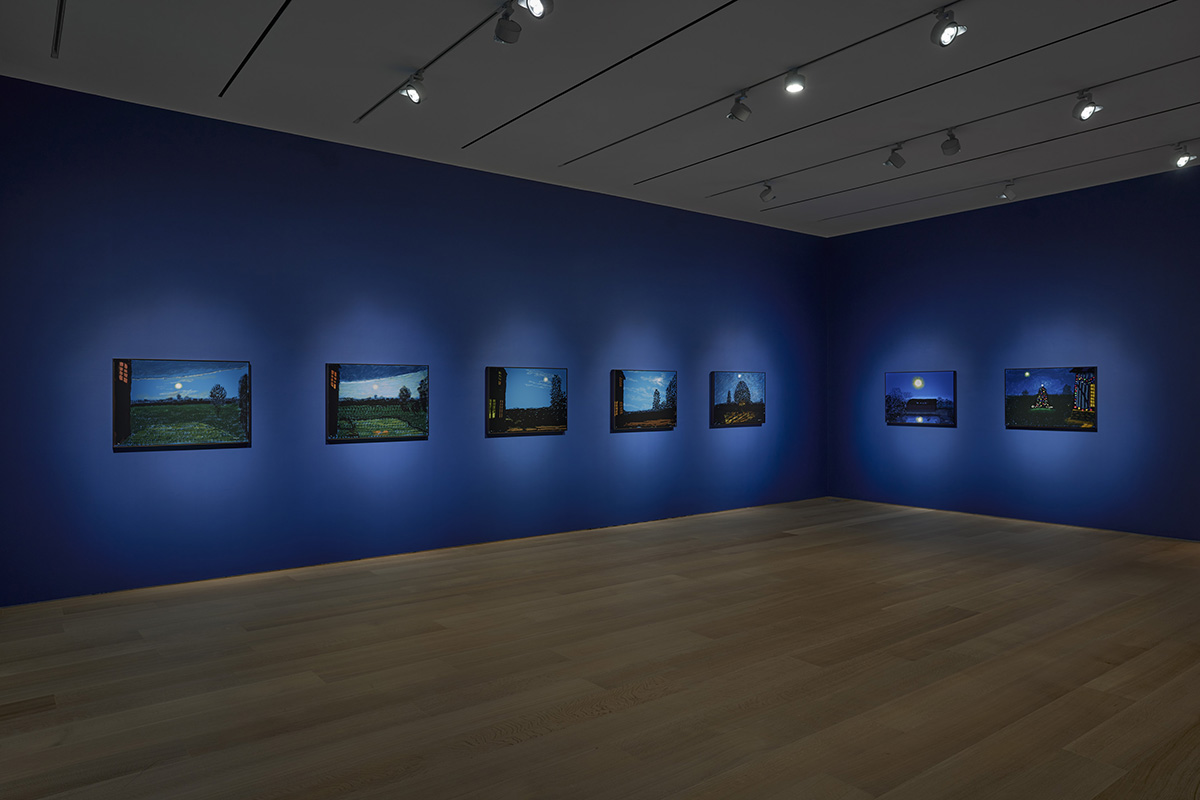 David Hockney: The Moon Room 540 West 25th Street, New York, NY 10001 May 15–August 14, 2026 Photography courtesy Pace Gallery
Hockney's achievement lies in showing that painting's future depends entirely on the act through which the world becomes visible. Material and device matter only as servants to this act. In an age of disposable images, Moon Room proposes something rare: the value of sustained looking. The future of painting was always looking. In these final works, David Hockney demonstrates what that looking can become—patient, accumulative, tender, and inexhaustible. The paintings will outlive the hand that made them, the eye that guided them. Still, they insist: there is nothing more necessary than to look.

Margherita Artoni
Margherita Artoni is a contemporary art critic and curator working between Italy and the United States. She began her career collaborating with Flash Art and currently writes for Segno, Juliet, Artribune, Exibart, Inside Art, ArteIN, part of cult(ure), The Art Fuse, and Whitehot Magazine.
She has directed galleries in Turin — including NEOCHROME and EDGE Art Space — and in New York at TEAM Gallery. Her curatorial work has included exhibition programs with international artists such as Rashid Johnson, Theaster Gates, Ali Banisadr, Angel Otero, Tim Rollins & K.O.S., Laura Owens, and Mika Tajima.