Whitehot Magazine
September 2026
"The Best Art In The World"
"The Best Art In The World"
September 2026
Postcard from Frankfurt, Discovering Arp Kovacs: Painting Between Perception and Reality
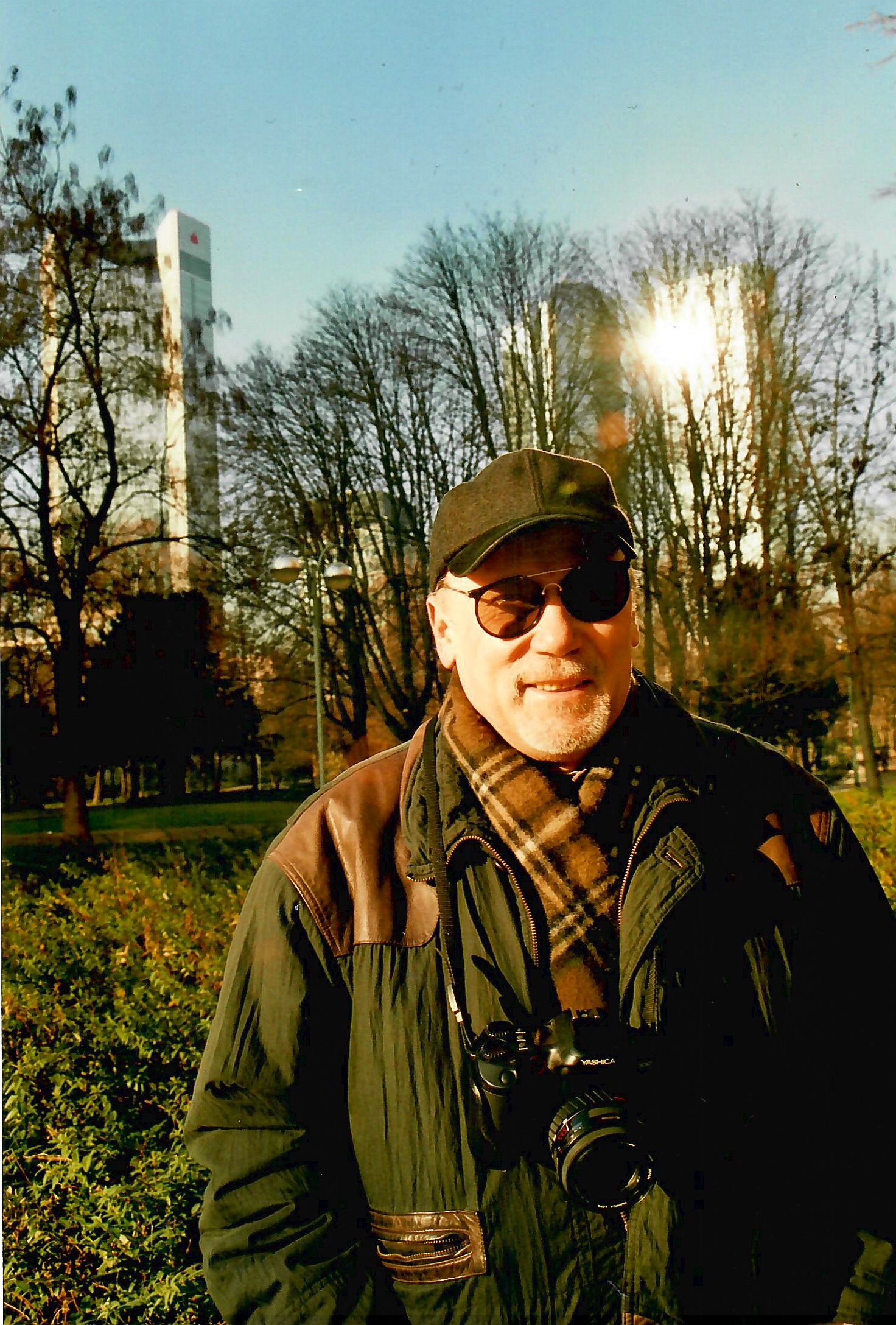 Portrait of Arp Kovacs, January 2005. Photo by Ilse Kovacs. Image courtesy of Kovacs estate.
By NINA MDIVANI July 22nd, 2026
It is rare to encounter an artist whose work feels both fully realized and almost absent from the broader narratives of contemporary art, an artist who worked throughout his life but remained in the shadows. During a recent visit to Frankfurt on the invitation of the Kovacs estate, I expected to spend time with the artist's archive. Instead, I found myself entering what felt less like an artist's studio than an entire artistic universe, organic and unfathomable in its breadth. Hundreds of paintings, drawings, notebooks, sculptural experiments, and decades of sustained philosophical inquiry unfolded before me, revealing a practice of remarkable latitude that had remained largely unseen outside a close circle of family, friends, and collectors. Entering the space felt like entering a part of a theatrical backstage where the leading actor is missing.
As a curator and writer based in New York, I spend much of my time researching artists whose work already circulates through museums, galleries, biennials, and art fairs. Discovering an oeuvre of Kovacs’ ambition that had developed almost entirely beyond these familiar institutional frameworks was both surprising and deeply compelling. My first question was not simply who Arp Kovacs was, but how an artist capable of producing such an expansive and intellectually rigorous body of work could have remained largely absent from wider conversations surrounding postwar European painting. That question became the starting point for this essay. But I also need to say a few words about his town.
Visiting Frankfurt at the end of May, I encountered Germany from a markedly different angle. In contrast to Berlin's restless energy and perpetual reinvention, Frankfurt reveals itself gradually—through its stately facades, traditional white-and-brown Fachwerkhäuser, museum-lined riverbanks, and the fragrance of linden trees in bloom. Beneath its reputation as a global financial center lies a city attentive to continuity, where layers of history coexist rather than compete. It is perhaps no coincidence that Kovacs chose to spend the final three decades of his life here. After moving from Romania to Israel and later to Germany, he settled in Frankfurt in 1995, finding an environment that supported the sustained intellectual inquiry that came to define his mature work. Much like the city itself, Kovacs's paintings resist spectacle. They unfold through accumulation, reflection, and careful observation, inviting viewers into a space where perception and thought become inseparable.
The connection between artist and place is not merely biographical. Walking through Frankfurt's historic center, where reconstructed medieval architecture stands alongside postwar modernism and contemporary glass towers, one becomes acutely aware of multiple temporalities occupying the same space. A similar sensibility permeates Kovacs's paintings. Figures emerge from layered surfaces only to dissolve again into fields of charcoal, pigment, and geometric structures. Memory and presence, abstraction and figuration, certainty and ambiguity remain suspended in productive tension. His paintings do not present fixed narratives but create visual environments in which different modes of perception coexist.
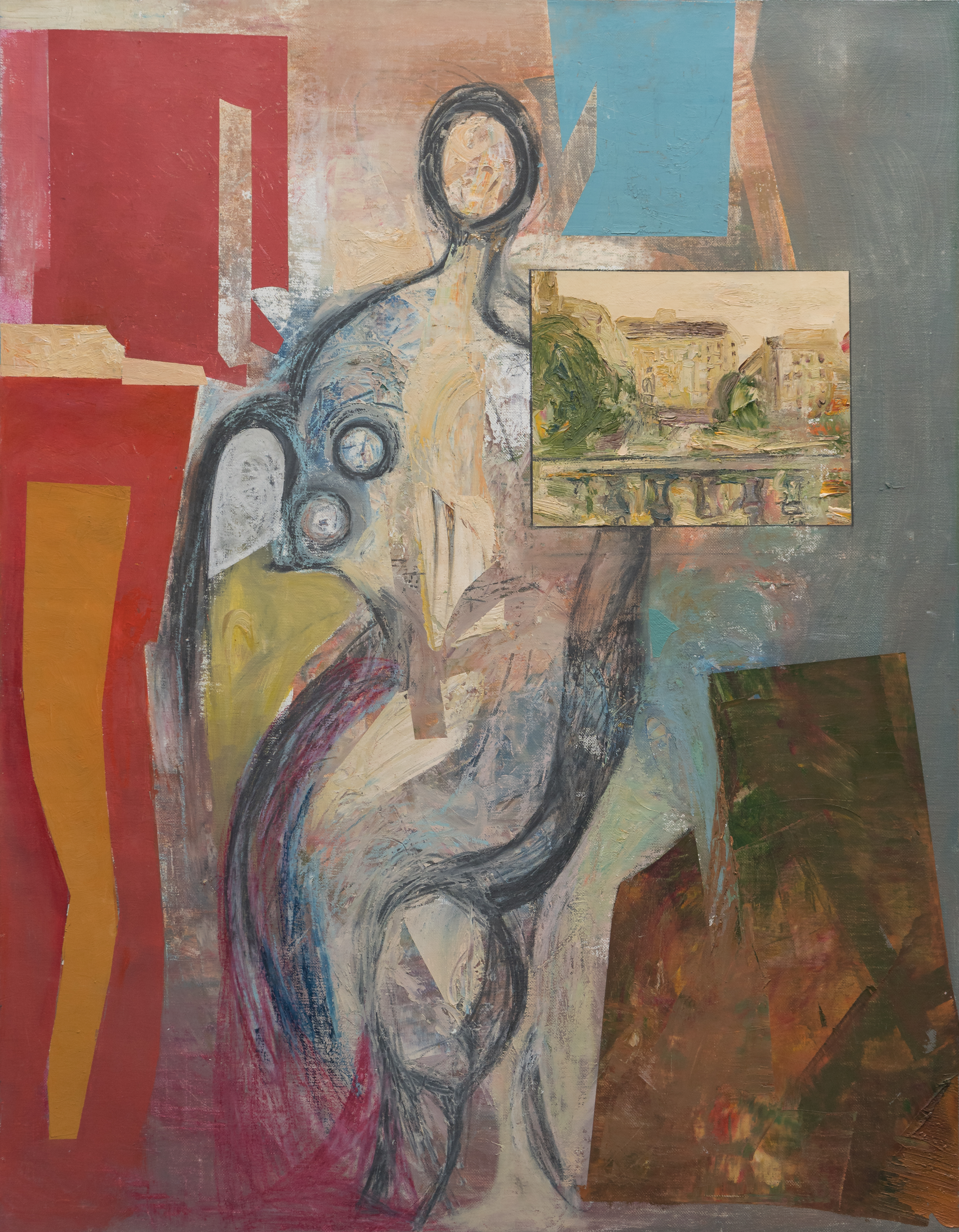 Arp Kovacs, Interpretation of the unknown, 1982. Acrylic, graphite and oil on canvas, 94x74cm. Image courtesy of Kovacs estate.
Born in Romania in 1948, Kovacs studied at the University of Cluj, graduating in 1973 before establishing himself within Romania's art scene. In 1985 he emigrated to Israel, and ten years later relocated to Frankfurt, where he would remain for the rest of his life. These geographical movements are significant not because they produced overtly autobiographical work, but because they exposed the artist to distinct cultural and visual environments that continually informed his evolving practice. Throughout these transitions, he maintained a remarkably consistent interest in the relationship between subjective experience and objective reality.
Yet Frankfurt tells only part of the story. Between 1995 and 2020, Kovacs and his wife, Ilse, spent every winter in South Florida, maintaining a studio in Dania Beach while regularly working throughout the Miami area. These annual migrations introduced an entirely different visual atmosphere into his practice. The intensity of subtropical light, expansive horizons, saturated color, and the vibrancy of everyday life found their way into the paintings. Catalogued today as the "Miami" period, these works represent some of the most chromatically rich and formally liberated compositions of his career. Rather than interrupting his philosophical concerns, the American landscape expanded them, demonstrating how shifts in geography could become catalysts for renewed experimentation. For American audiences, these works create an unexpected bridge between a European intellectual tradition and the sensory immediacy of South Florida.
Kovacs's mature paintings resist the binaries that have traditionally structured discussions of painting. Neither fully abstract nor conventionally figurative, they occupy an unstable territory where forms continually emerge and dissolve. Human figures appear fragmented, suspended within layered surfaces composed of oil, charcoal, graphite, wax, rope, and found materials. The paintings feel less like representations than records of perception itself—visual fields in which sensation, memory, cognition, and materiality intersect.
Underlying this apparent spontaneity is a rigorous structural logic. Many compositions begin with mathematical grids that organize the pictorial space before gradually yielding to improvisation. These frameworks never function as rigid systems. Instead, they become dynamic fields of possibility in which order and intuition remain in constant dialogue. Layers of pigment overlap and interrupt one another, allowing traces of geometry to remain visible even as forms dissolve into ambiguity. Rational structure and subjective experience are not presented as opposing forces but as mutually dependent conditions of seeing.
This dialogue between structure and perception extends into the philosophical language that accompanies many of Kovacs's works. References to descriptive ontology, phenomenology, Cartesian dualism, and Hegelian thought suggest an artist deeply engaged with questions of consciousness and knowledge. Yet these references never function as illustrations of theory. Rather, they serve as points of departure through which painting itself becomes a mode of philosophical investigation. The works do not explain ideas; they test them through material experience.
Kovacs himself described reality as a convergence of objective social conditions and subjective emotional experience. Painting became the medium through which these dimensions could be brought into relation. His surfaces accumulate through layering, erasure, interruption, and revision, reflecting the instability of perception itself. Meaning remains provisional rather than fixed, continuously reconstructed through the viewer's encounter with the image.
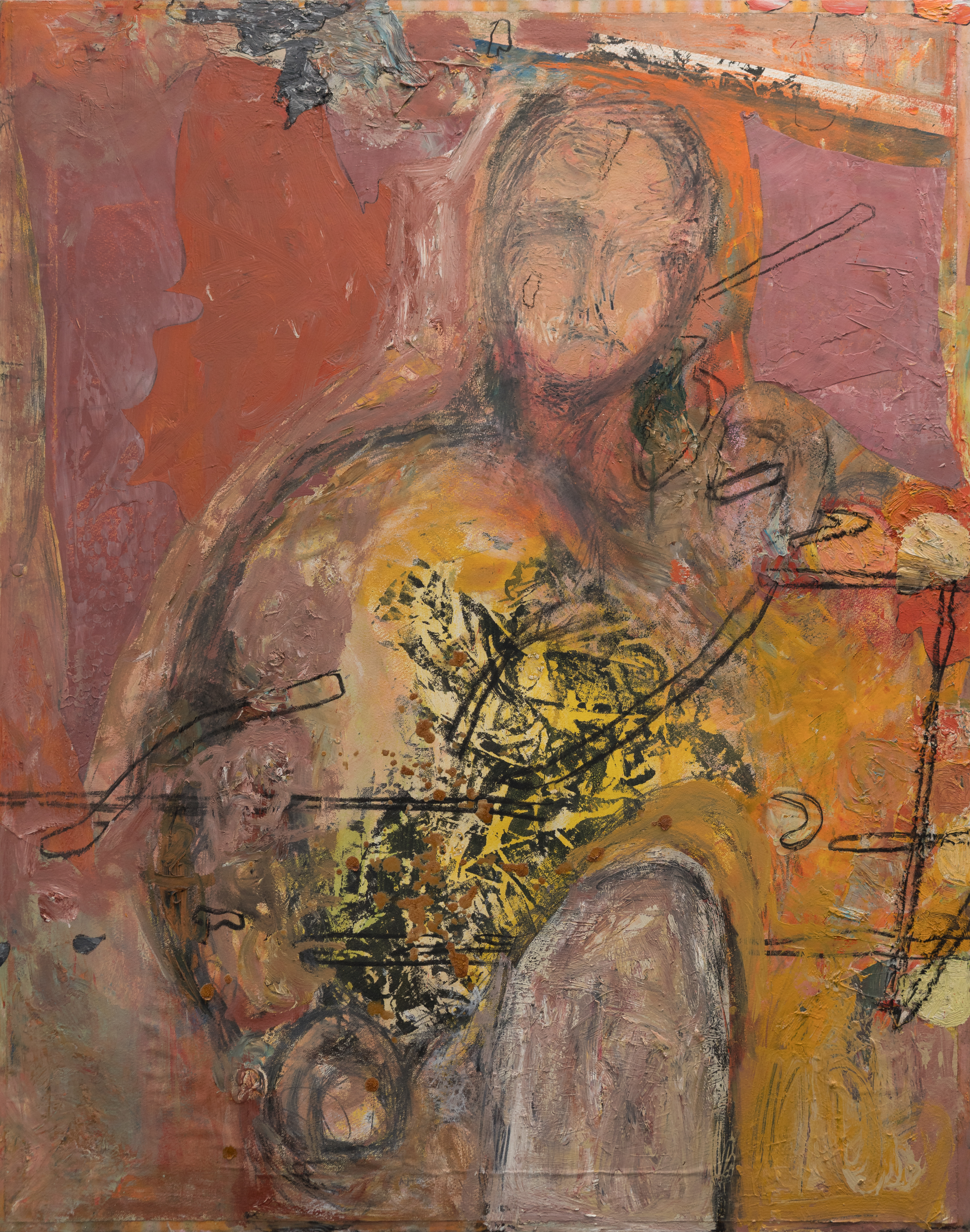 Arp Kovacs,“The depths of self-love,” 1983. Oil and Graphite on canvas, 102x81cm.
During my time in the archive, another question continued to return. How could an artist who produced such a vast and consistently sophisticated body of work remain largely absent from broader art historical narratives? There is no simple answer. Kovacs appears to have devoted himself less to self-promotion than to the quiet, sustained development of his practice. Decades of paintings accumulated in the studio, accompanied by notebooks, philosophical writings, and experimental works, forming an extraordinary archive that remained largely inaccessible during his lifetime. Encountering this material today feels less like recovering a forgotten artist than discovering an overlooked chapter of postwar European painting that has yet to be fully written.
Looking back, what remains with me most vividly is not a single painting but the cumulative experience of moving through that studio. Opening one storage rack after another, I realized that I was witnessing the material record of an entire artistic life. Canvases from Romania stood beside works created in Israel, Frankfurt, and Miami; philosophical notes accompanied finished compositions; experiments sat beside resolved paintings. The experience revealed an artist who never ceased questioning the possibilities of painting, regardless of country, language, or historical circumstance. There was something profoundly moving about encountering such sustained intellectual and artistic commitment outside the familiar mechanisms of visibility that often define the contemporary art world.
Seen today, Kovacs's oeuvre offers an alternative to the increasingly polarized categories that often shape contemporary painting. His work neither retreats into formalism nor subordinates itself to explicit political messaging. Instead, it occupies a space of sustained inquiry, where philosophical reflection, material experimentation, and lived experience remain inseparable. At a moment when contemporary culture frequently privileges speed, certainty, and immediate legibility, Kovacs's paintings insist upon something slower and more demanding. They remind us that perception is never passive, that looking itself is a form of thinking, and that understanding remains perpetually unfinished.
Like Frankfurt itself, the paintings reveal their complexity gradually. What first appears orderly and composed slowly unfolds into a network of histories, ideas, memories, and perceptions that resist definitive interpretation. They reward patience rather than immediacy.
This essay is intended as an invitation rather than a conclusion. I hope that it encourages readers to continue exploring Kovacs's remarkable archive for themselves. The breadth of his inventory, now being systematically catalogued, makes it possible to trace the evolution of an artist whose practice unfolded across Romania, Israel, Germany, and the vibrant Miami years with exceptional richness. There is a particular excitement in encountering an artist before the broader art world has fully recognized the significance of his contribution. Arp Kovacs's work deserves precisely that kind of sustained attention. If this essay opens the curtain onto his artistic universe, the archive itself reveals just how much more remains to be discovered.
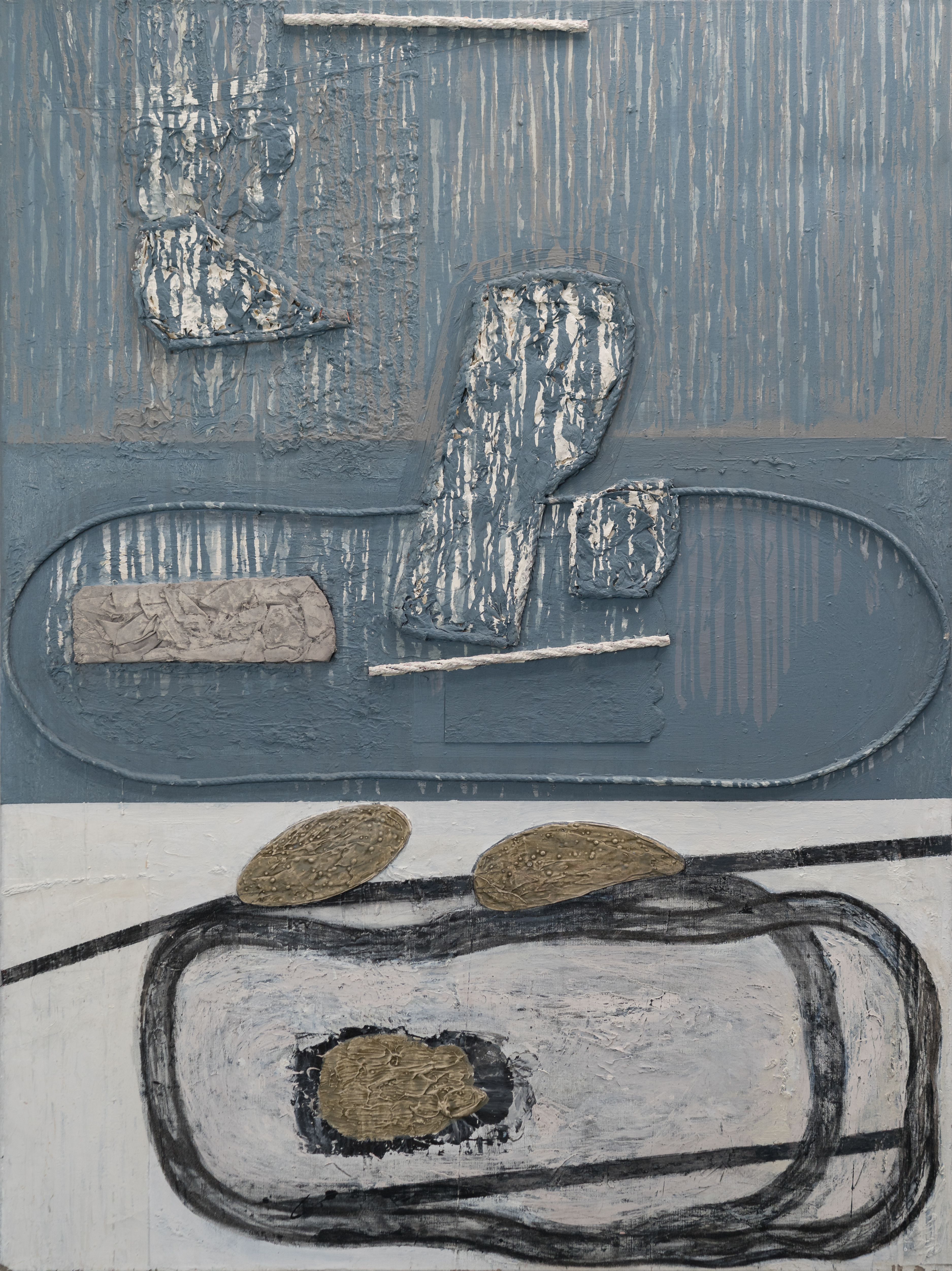 Arp Kovacs, Gossip, 1998. Oil, charocal & rope, styropor on canvas , 160x120cm. Image courtesy of Kovacs estate.
Nina Mdivani
Nina Mdivani is Georgian-born and New York-based independent curator, writer and researcher. Her academic background covers International Relations and Gender Studies from Tbilisi State University, Mount Holyoke College and Museum Studies from City University of New York. Nina's book, King is Female, published in October 2018 in Berlin by Wienand Verlag explores the lives of three Georgian women artists and is the first publication to investigate questions of the feminine identity in the context of the Eastern European historical, social, and cultural transformation of the last twenty years. Nina has contributed articles to Hyperallergic, Flash Art International, The Brooklyn Rail, JANE Magazine Australia, NERO Editions Italy, XIBT Magazine Berlin, Eastern European Film Bulletin, Indigo Magazine, Arte Fuse. As curator and writer Nina is interested in discovering hidden narratives within dominant cultures with focus on minorities and migrations. You can find out more about her work at ninamdivani.com