Whitehot Magazine
September 2026
"The Best Art In The World"
"The Best Art In The World"
September 2026
Jadé Fadojutimi: Abstraction Before Language
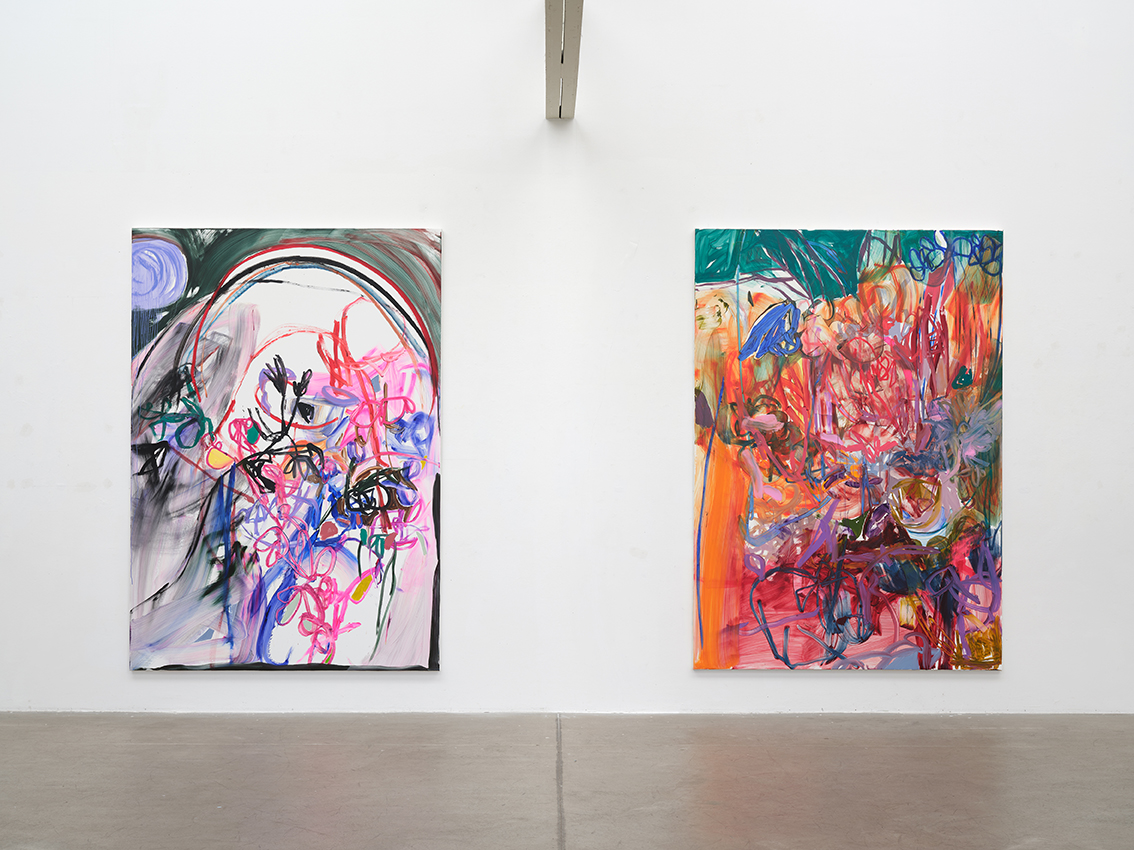 2026, Jadé Fadojutimi, Can we see the colour green, Michael Horbach Foundation Galerie Gisela Capitain, Cologne, photo: Simon Vogel
By MARGHERITA ARTONI September 18th, 2026 at 6:37pm EST
Can We See The Colour Green Because We Have a Name For It? Chapter I, Jadé Fadojutimi’s third exhibition with Galerie Gisela Capitain, at the Michael Horbach Stiftung in Cologne, poses a question belonging equally to the philosophy of language and the phenomenology of perception: do we see green because we have a word for it, or does the word come after the experience of colour? On view from September 5 through November 28, 2026, the exhibition brings to the foreground a question central to Fadojutimi’s practice: how experience becomes form.
Fadojutimi’s paintings emerge from concrete materials of lived experience—everyday objects, memories, clothing, Japanese popular culture, anime and video-game soundtracks—that lose their original identity within the painting. What remains are traces, rhythms, intensities, and layers. The Venice Biennale noted how such references can reappear in her paintings as gestures, colours, and elusive allusions; Fadojutimi herself has described colour as a form of “synaesthesia,” connecting it to a constantly shifting perception of identity.
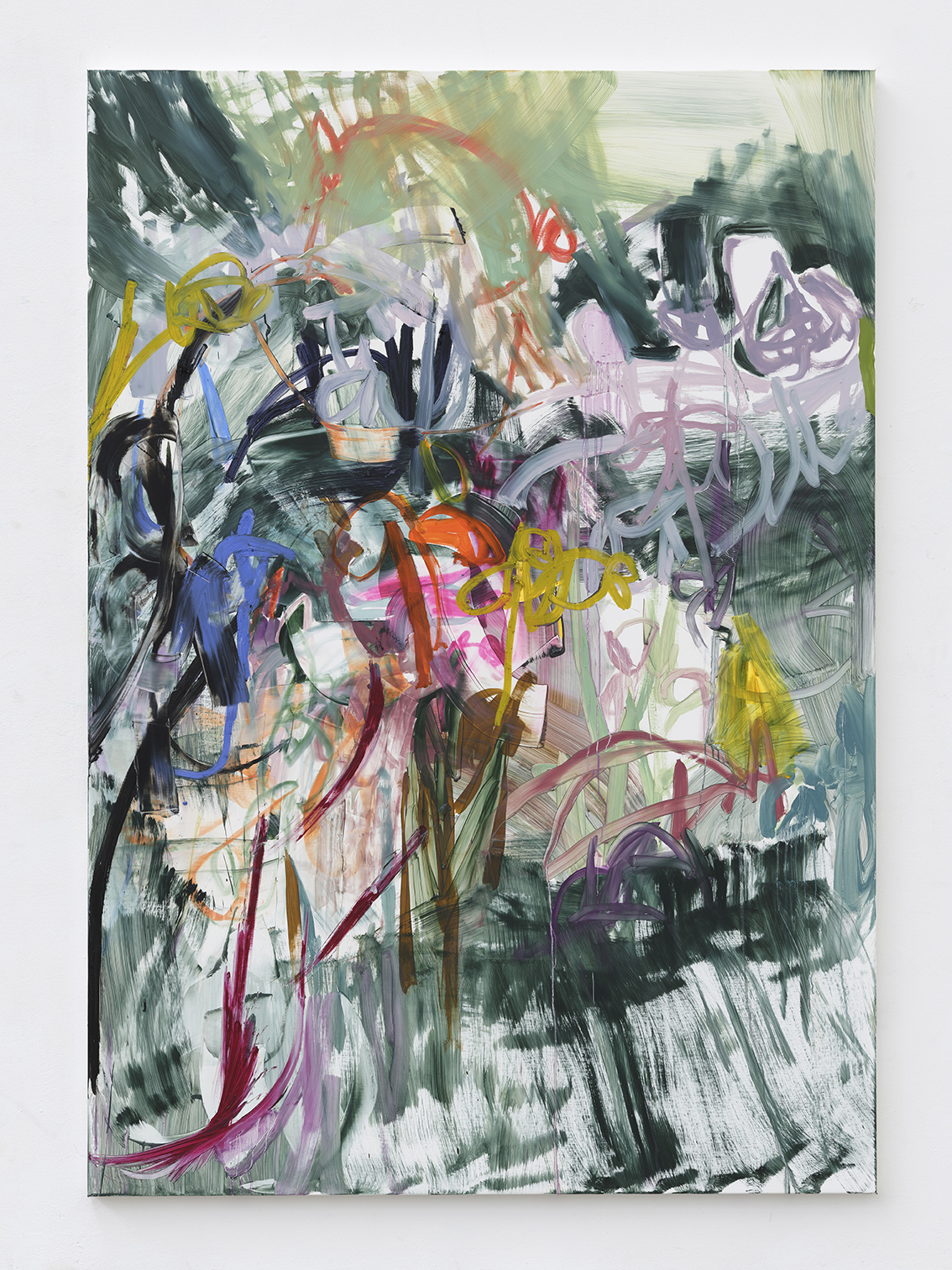 2026, Jadé Fadojutimi, Flowers of Guilt, photo Simon Vogel
Flowers of Guilt introduces this ambiguity immediately. Its title suggests a flowering charged with guilt, while the surface refuses any narrative translation. Forms condense and dissolve at once; colour builds an unstable field crossed by competing pressures. The work asks the eye to relinquish the search for a subject and submit instead to the duration of looking.
It is in this tension between recognition and the loss of the recognisable that Fadojutimi’s abstraction becomes autobiographical. The further painting moves from figuration, the more it records a personal history: selections, erasures, accumulations, and juxtapositions become a form of self-portrait without an image.
The relation to Joan Mitchell illuminates this process. Fadojutimi has written directly about the American painter, focusing on the distance between painting and reality, the experience of seeing, and the role of the body in producing the mark. She describes Mitchell’s painting as an energy capable of transforming the materiality of reality into “monumental relationships and conversations with everyday environments.” The formulation also describes Fadojutimi’s procedure: the referent retains its origin, then changes state, becoming surface, pressure, and rhythm.
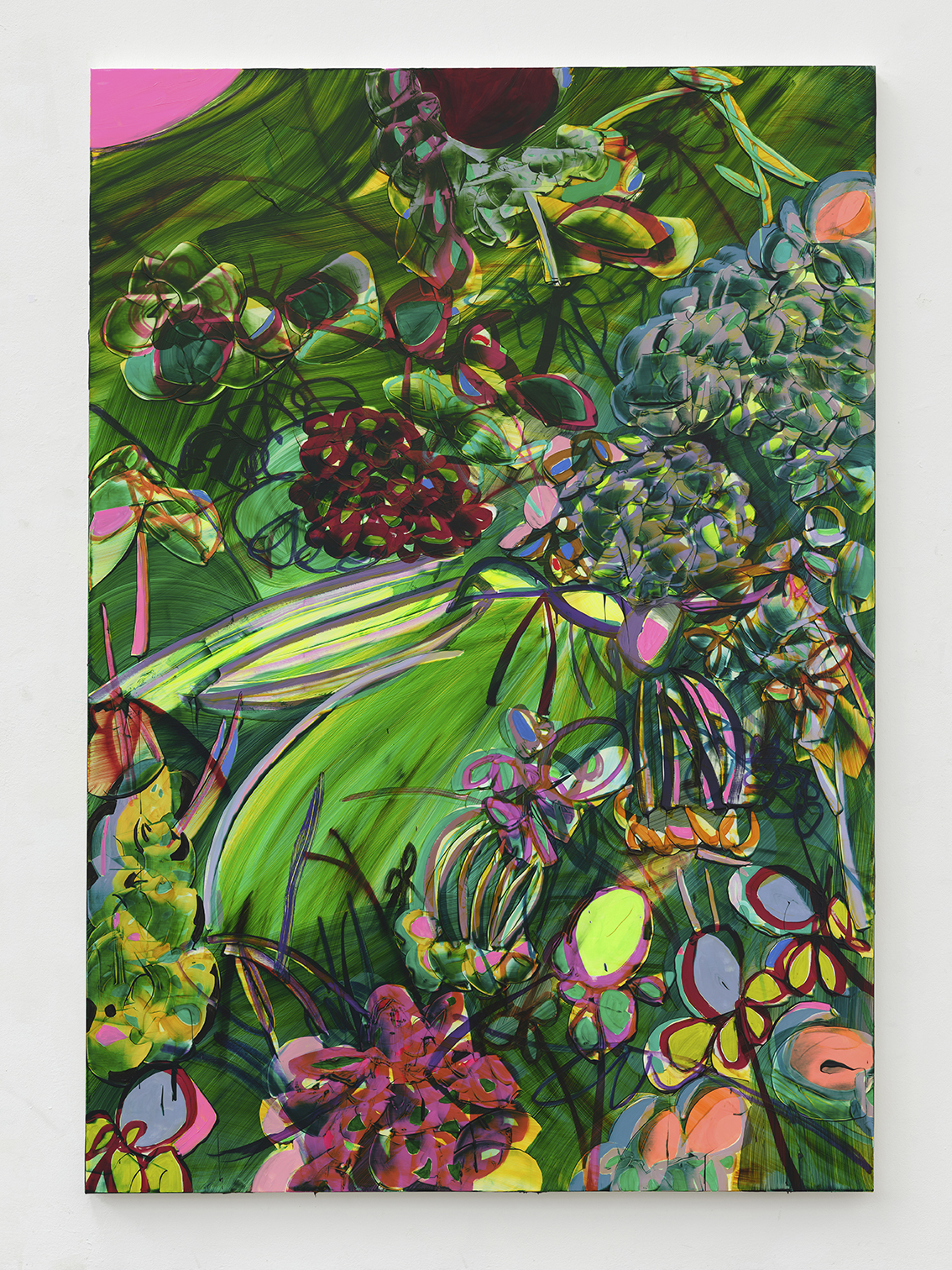 2026, Jadé Fadojutimi, Nightmares yet nothing blooms within the stomach of a gluttonous daydream, photo Simon Vogel
Nightmares yet nothing blooms within the stomach of a gluttonous daydream pushes this transformation toward a more unsettling register. Its title conjures a mental landscape of dream, excess, and threat; the painting offers instead a field of tensions without narrative resolution. Inner images are absorbed into gesture and material until they become almost unrecognisable. The canvas becomes a threshold where imagination takes shape without settling into a definitive image.
Amy Sillman provides a second crucial interlocutor. For decades, her painting has questioned the separation between abstraction and figuration, making correction, doubt, and material transformation integral to the process. The Kunstmuseum Bern has described her practice as a way of “thinking inside abstraction,” in which painting remains an open process. In Fadojutimi, this openness takes on a personal dimension: the self emerges through relations between heterogeneous elements, through a continual process of making, undoing, and recomposing.
The sorrow of endearment introduces a different emotional temperature. The affection suggested by its title is shadowed by possible loss, while the painting preserves the feeling’s ambiguity. Here too, autobiography resides in the material: in colour, density, and the pressure of the surface. Intimacy becomes pictorial structure.
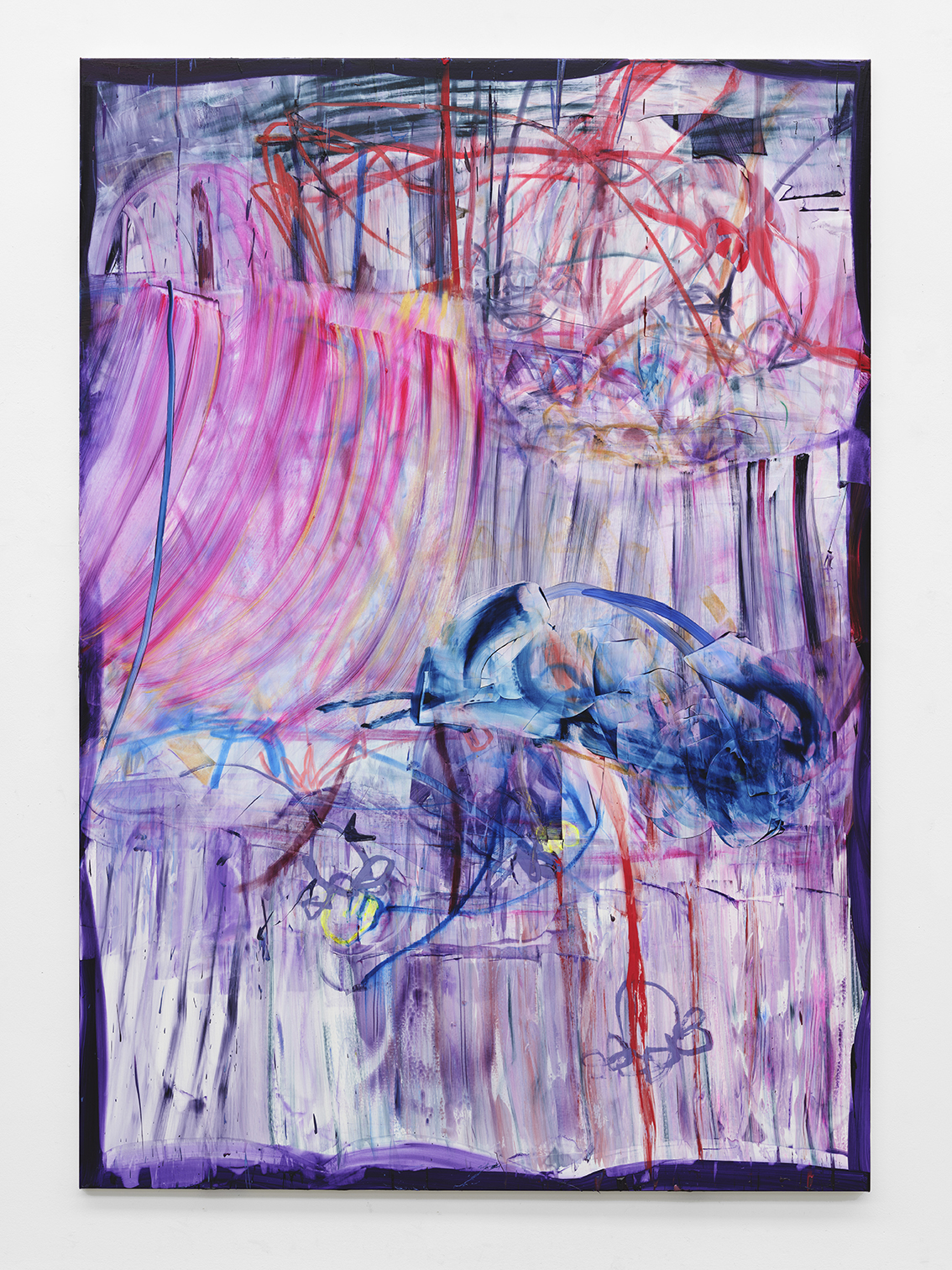 2026, Jadé Fadojutimi, The sorrow of endearment, photo Simon Vogel
This is where synaesthesia acquires its critical significance. Kandinsky connected colour, sound, and form to the possibility of constructing an abstract language capable of moving beyond the referent. Fadojutimi revisits that question under radically different conditions: colour becomes a means of testing the distance between what is perceived and what can be named. The question of green posed by the exhibition title concerns precisely this interval.
Julie Mehretu offers another possible genealogy. In her practice, too, abstraction makes complex processes—space, memory, time, accumulation—perceptible through a painting that unfolds gradually. Mehretu has described painting as a “time-based” experience. In Fadojutimi’s work, time remains embedded in the surface, which preserves the traces of successive actions and presents them simultaneously.
Jennifer Higgie has described Fadojutimi’s surfaces as resembling “panes of glass or fast-moving water”: mobile, reflective, impatient. The image captures the perceptual nature of the work. The eye moves through layers, reflections, and intervals without reaching a final point of resolution. Looking becomes an activity in itself.
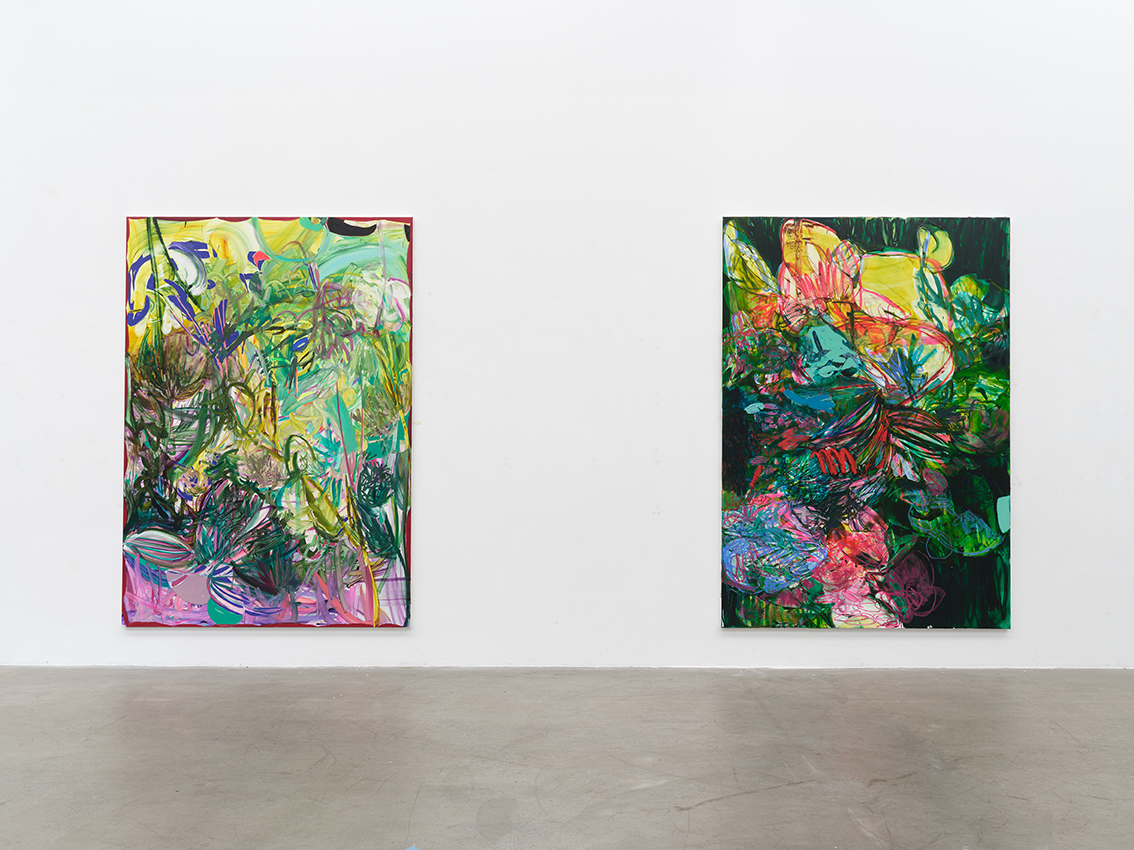 2026, Jadé Fadojutimi, can we see the colour green, Michael Horbach Foundation, Galerie Gisela Capitain Cologne, photo Simon Vogel
This is what distinguishes Fadojutimi from a simple aesthetics of intensity. Flowers of Guilt, Nightmares Yet Nothing Blooms Within the Stomach of a Gluttonous Daydream, and The Sorrow of Endearment establish three distinct emotional thresholds: tension, unease, intimacy. Together, they show how biographical material, cultural references, and interior states can be absorbed into painting until they become an autonomous grammar.
The exhibition title ultimately brings this inquiry onto the terrain of language. The question of green concerns the moment when a sensation acquires a name and, with it, a shared form. Fadojutimi works before that stabilisation. The painting holds the instant in which something is sensed, only partially recognised, and then transformed.
Abstraction thus becomes a mode of knowledge. It does not illustrate what we already know. It registers what is still searching for a form.
Margherita Artoni
Margherita Artoni is a contemporary art critic and curator working between Italy and the United States. She began her career collaborating with Flash Art and currently writes for Segno, Juliet, Artribune, Exibart, Inside Art, ArteIN, part of cult(ure), The Art Fuse, and Whitehot Magazine.
She has directed galleries in Turin — including NEOCHROME and EDGE Art Space — and in New York at TEAM Gallery. Her curatorial work has included exhibition programs with international artists such as Rashid Johnson, Theaster Gates, Ali Banisadr, Angel Otero, Tim Rollins & K.O.S., Laura Owens, and Mika Tajima.