Whitehot Magazine
October 2026
"The Best Art In The World"
"The Best Art In The World"
October 2026
Eric White - Interviewed by Isabella St. Ivany
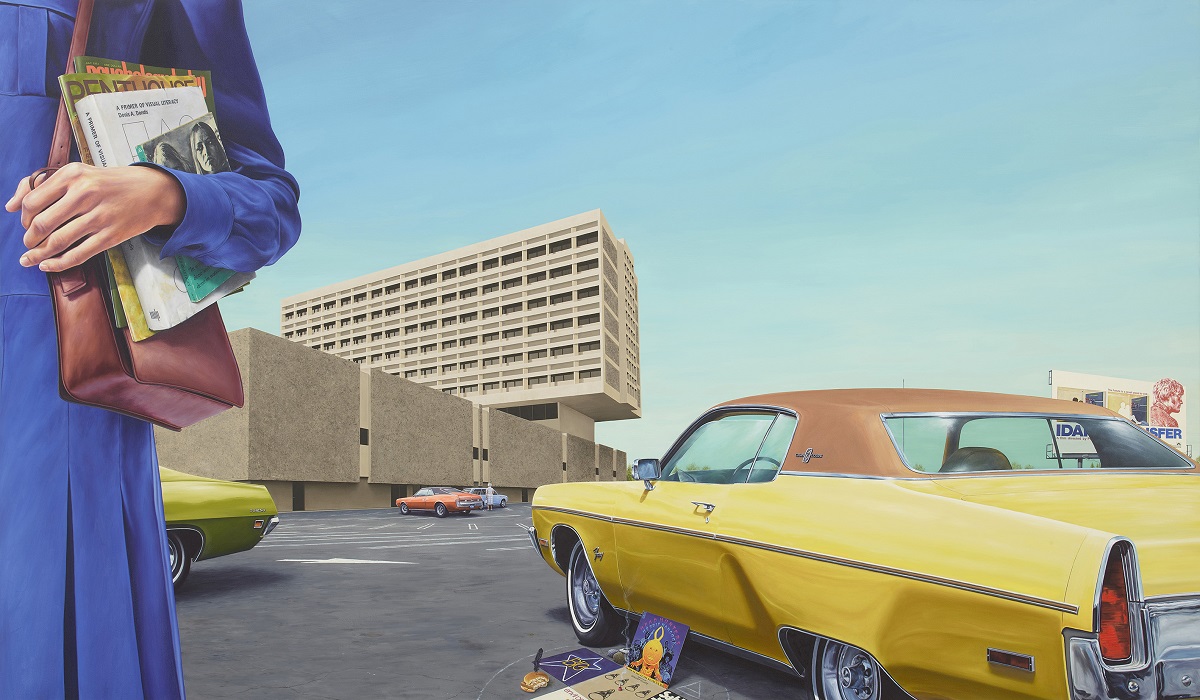 Eric White, East [1973 Plymouth Fury] 2018, oil on canvas, 84 x 144 inches
By Isabella St. Ivany May 4th, 2026
Vignettes & Mutations revisits moments from paintings spanning more than two decades of your career. What prompted you to return to these earlier works?
The exhibition grew out of conversations with Jorg [Grimm] about having put so much conceptual and technical effort into these bodies of works over the years, and wanting to explore some of these ideas further. Once we landed on the idea of reinterpreting details from previous works, it was exciting to seek out moments that still resonate with me, from when I was in a different head space and circumstance, and then reworking and improving upon them, or updating them to the current cultural moment. It gave me a baseline, so I wasn’t starting from scratch, and there was an automatic conceptual continuity. I wanted to let the way I reworked them develop organically and to not overthink things, which is difficult for me. They were smaller, and as a result, more manageable, which was also a relief. So ultimately it was an attempt to get back to a greater enjoyment of the entire process. In the press release, the gallery called it a “refracted retrospective,” which I really like. I have revisited my works before. About ten years ago I did an installation where I had my work hand reproduced in a Chinese painting factory at 1/3 scale, and I mounted a miniature retrospective. So in a sense this show is indirectly tied to that.
Do you consider these new works to be continuations?
Yes, I think some of them are. This idea of an anonymous woman having a spiritual epiphany and/or a psychotic break was something I’d been thinking about for over a decade by the time it all came to fruition in my last show Local Programming, and I was exploring it in my previous show Triage prior to that. The narrative still interests me, and I can expand it outward in my mind, and so I chose to rework part of a large piece from the Triage show in The Fury. Working on that painting, I was contemplating what the woman’s state of mind would be today. Would she have advanced or transformed her ritualistic practices? Would she still be attempting to pick up communications from ethereal realms?
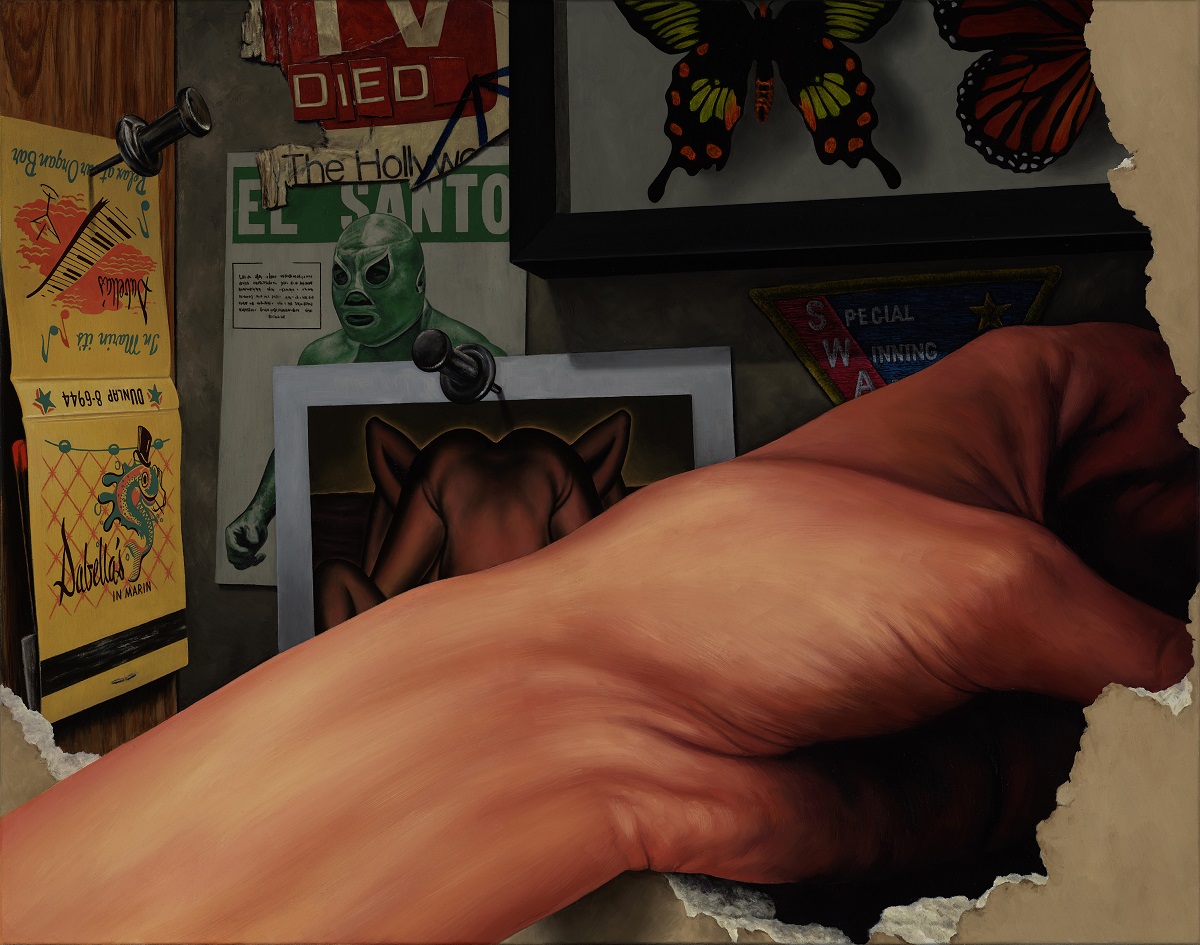 More Offerings 2026 High resolution images Oil on canvas 55.9 x 71.1 cm I 22 x 28 in
These are precise works, but you were saying that you've moved away from having to essentially fully map out the composition before moving to the canvas, to allow freedom for something to spring up during the process of painting.
I’ve had to force myself over time to become less uptight in my process. I'm a control freak and I derive a weird satisfaction from working in a technical way. In the past I would work everything out in a comp before even touching the canvas. I’d enjoy conceptualizing and composing the image, but once that was done, it was just a matter of execution and it got boring. Now I usually establish a basic structure by putting one or more figures or elements in place, and build it out from there. It can be unnerving and is more challenging, but it allows more freedom and it's ultimately more exciting and satisfying.
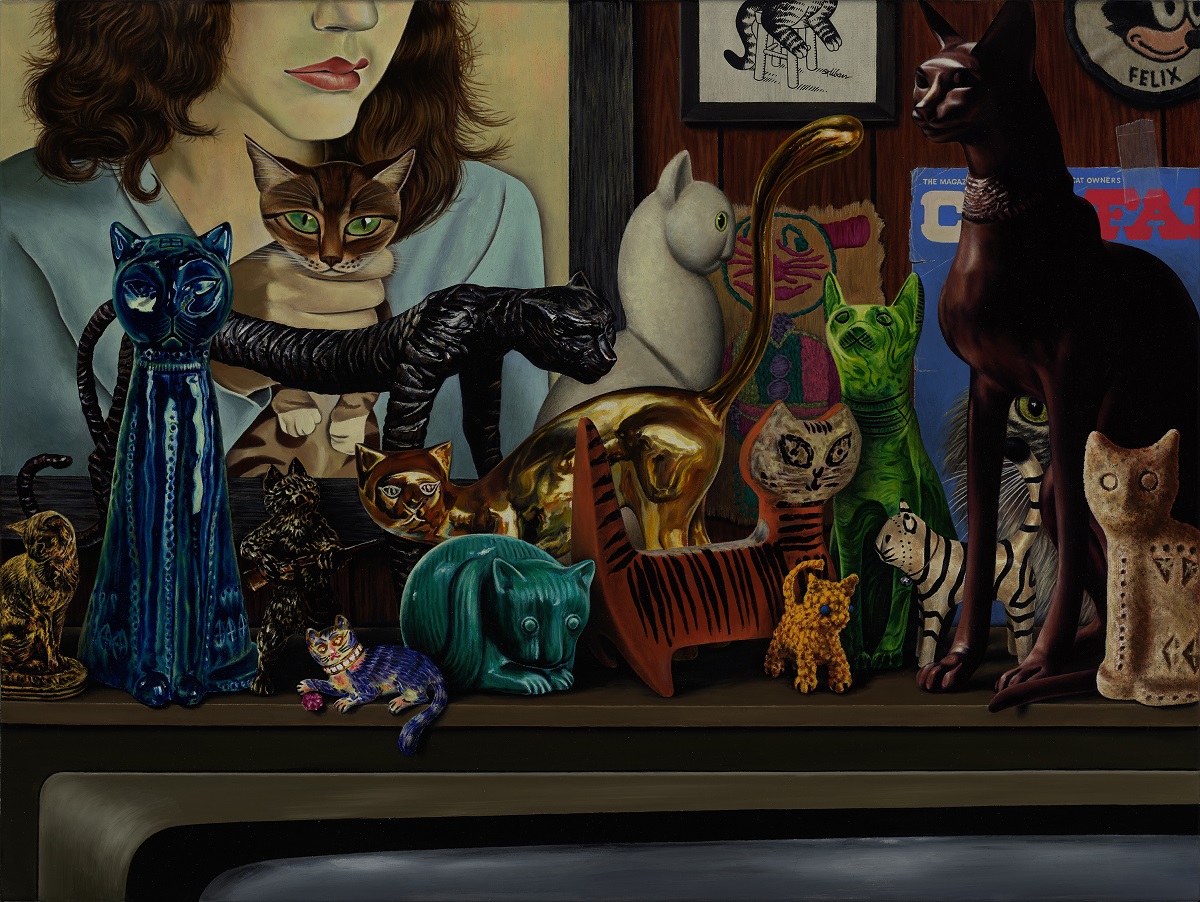 Squares [for Lucian & B.] 2026, Oil on canvas 45.7 x 61 cm I 18 x 24 in
What interests you about incorporating typography and language?
The typography started as a purely visual, aesthetic thing, and eventually became about something else. I’m drawn to the tension between rendered and graphic elements in an image. I'm sure there are earlier instances, but I'm thinking of the first time I saw Peter Blake's paintings, and how much they impacted me. I've been implementing that combination since my earliest paintings. Though when I started this show, I promised myself I wouldn't include any graphic elements whatsoever…
Why was your initial inclination not to have any typography in the show?
Because of how taxing it had been in the previous couple shows, especially Local Programming, where there's lots of type, logos, graphic shapes, in every painting. That was probably the most technically involved and difficult body of work I've ever made. So I wanted to give myself a break and not feel compelled to put so much energy into the mechanical aspects of the work. But once I started, I gave in to it being my natural inclination, and it kind of cascaded. I then decided to have a graphic element in every single one as a unifying component for the show.
Do you have a fascination with creating rules in your work?
Well, I’m not sure it's that fascinating, but it's an ongoing issue. I feel like I'm constantly battling my psychology and my unproductive habits. Apparently I can't help but set parameters for myself in the work. It's not always intentional, it seems automatic at this point. I truly was making an effort to not have them connect to one another, but adding graphics was a simple way to satisfy the OCD part of my brain.
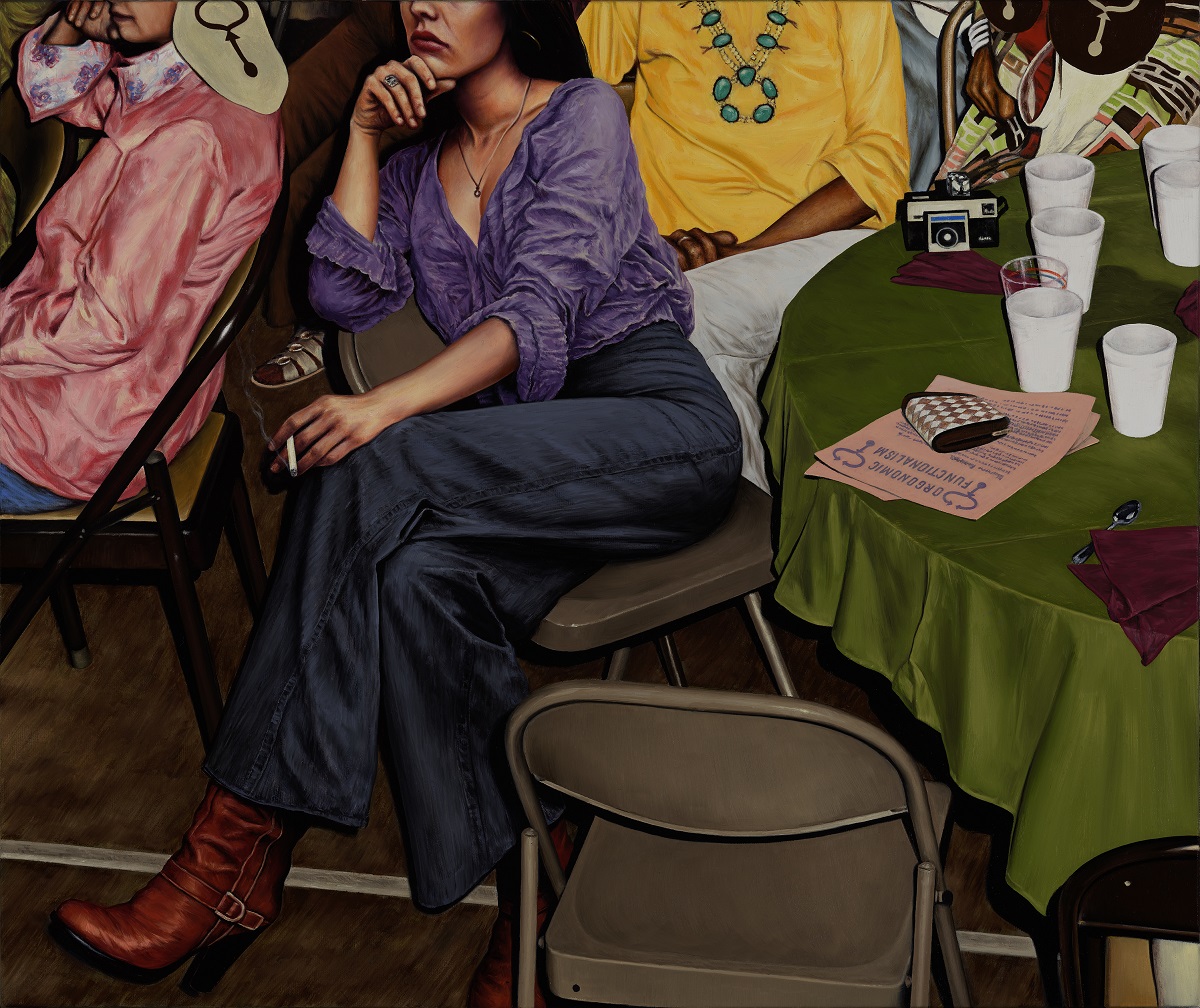 OFC, 2026, Oil on canvas 50.8 x 61 cm I 20 x 24 in
There's a lot of humor in your work, especially with wordplay.
That started in the LP paintings, which were born out of a ridiculous and hilarious dream involving a famous album cover, which inspired a series of paintings based on existing LPs, and the wordplay came through immediately. It’s the only time I’ve drawn directly from a dream in my work, and it was a total gift, because it broke me out of a rut I was in with a series that I was beginning to hate. I wanted to replicate the absurdist quality of that initial dream in every painting, and language allowed me to add another layer of humor and meaning, and I’d manipulate the wording to my liking, often using anagrams. At RISD I trained myself to lucid dream by studying a book by Stephen LaBerge, who ran the dream research lab at Stanford, and developed techniques to become lucid and to retain lucidity. One of the ways to trigger it is to look at type, which is never static in a dream. It will continually shift and morph as you stare at it. We have such a dim understanding of what dreams are. They are endlessly fascinating to me, and my waking life has been thoroughly enriched by them since I was a kid.
Many of your paintings stage encounters between very different symbolic registers, from high culture and pulp imagery, philosophy and eroticism, myth and mass media. When you are composing a painting, do these disparate combinations arise intuitively?
Early on I didn't think I could work intuitively, but I try to let things flow naturally as much as possible now. It’s not that I didn't believe in intuition, I just didn't think I had the ability. Over the course of my career there have been multiple instances of things coming together in specific ways that I didn't intend, and the meaning or connection was revealed later. In the late 90s I painted Eisenhower and the word Lockheed together on a cereal box in a painting, and at that point I was unaware of Ike’s speech about the military industrial complex. That's quite a coincidence, and I can take no credit for it. To me this is evidence of at the very least the mind operating on a level outside of our conventional understanding of consciousness, which defies scientific explanation. Surprisingly, it happened a couple times in this new body of work. Mondrian said the artist is essentially a channel, and I think he's right. I've unintentionally proven to myself that I have that ability, and I imagine everyone does to some degree, whether or not it ever reveals itself.
Eric White Vignettes & Mutations ran from March 20th to May 2nd, 2026 at GRIMM Gallery

WM
Whitehot writes about the best art in the world - founded by artist Noah Becker in 2005.
view all articles from this author