Whitehot Magazine
October 2026
"The Best Art In The World"
"The Best Art In The World"
October 2026
Rebecca Ness: Inheritance at Morgan Presents, NYC
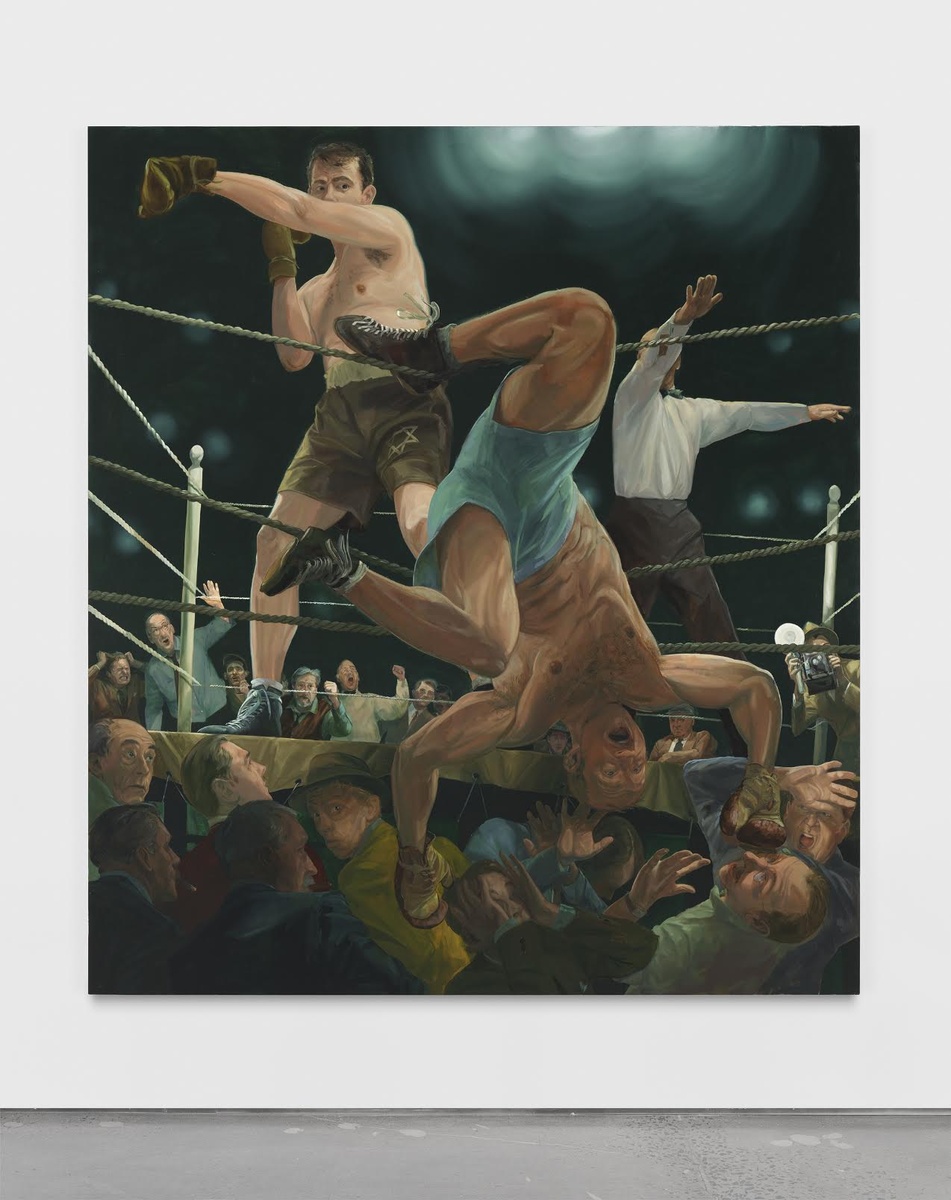 Abe's Winning Punch, courtesy of Morgan Presents
By LIZZIE CONKLIN October 6th, 2026
After her mother died, Rebecca Ness inherited twenty plastic bins of loose paper that had been accumulating in an attic. Walking between the boxes, planning each step through a crowded floor like a child charting a path of stones across a stream, Ness stumbled through moldy, skeletal archives that her mother had amassed: photos of her life, letters of correspondence between family members, Ness’s childhood diaries, her schoolbooks, baby books, tchotchkes, old cell phones, old iPods, old Walkmans, old sunglasses, her mother’s dulcimer, family secrets, and her mother’s medical notes from when she got sick.
Though parts of the show are based on her mother’s archive, Ness built the show around her own collection of memories, histories, and records, which do include her mother’s documents, but radiate beyond her family to encompass the self-portraits of Van Gogh that she pinned to her studio wall, the memorabilia hung from the Cubbyhole ceiling, and mirrored reflections of Ness herself. Inheritance expands upon the concept of heritage beyond just one genome that rhymes with another. This show will be on view from September 10—October 20 at Morgan Presents.
In the more narrative, large paintings, sparse details of Abraham, an amateur Jewish boxer on the Lower East Side whose legacy survived in her mother’s archives, flooded Ness’s canvases with Odyssean boxers, painted with the figurative vocabulary of George Bellows’s sinewy fighters that synecdochize the Ashcan School. Ness found Abraham’s name, but she found no photos of the man she embarked upon painting. Ness set out to paint Abraham, who she figured looked kind of like her friend Jake Corcoran, a young man whose slender build matched the only description of Abraham that Ness could find. Corcoran posed for references. Ness found Abraham. The narrative began.
Ness moved from ancestral heritage to another inherited territory: the city of New York. In the 1910s and 1920s, pogroms forced Polish and Romanian Jews out of Eastern Europe. Those who could, including Ness’s family, fled to Brooklyn and the Lower East Side. To get from Manhattan to Flatbush, Ness’s family must have navigated New York City via the Q train, which has run to Flatbush for about as long as her family has been in New York. Without this context, it’s easy to look at Ness’s painting of the Q as a simple homage to the subway, a life-size rendering of the underground we crawl through at 6:00 am and 6:00 pm. With footnotes, the painting is an examination of how human beings have gotten from point A to point B for over a century.
One of the most striking paintings in the series depicts a setting that did not exist when Ness’s ancestors came to Brooklyn: Cubbyhole. Although lesbian bars like Eve’s Hangout have been around since the 1920s, Cubbyhole did not open in the West Village until 1987. Compared to much of the source material for Inheritance, this bar is relatively new, but it traces a culture that came to be long before 1987 and has been inherited from generation to generation of queer people. It fits neatly into the show as the setting of her work “A Place at Cubbyhole,” one edition in a series of paintings staged at the few (37, to be exact) lesbian bars in the United States.
The first time that Ness bought a drink at a lesbian bar, she did it where the photo reference was taken. M, the subject of the painting and a photographer who gets recognized in Kentucky for being “that bartender at Cubbyhole,” poured martinis to pose for one of many references required to make the painting, which includes the detailed memorabilia hanging from the ceiling that makes Cubbyhole “an archive in itself,” according to Ness.
These grand-scale narratives are interrupted by smaller, more intimate scenes of her studio wall, where art historical references and torn-up photos are pasted near mirrors that reflect Ness by virtue of her brush and her image. Behind the desk in a binder are original photos that hung on Ness’s drywall, nearly indistinguishable from the trompe-l'œil images that Ness painted in 2026; every inch of canvas stretched on Morgan Presents’s wall is real. None of it is jammed or wedged in. It is an outpouring of heritage and remembrance—a preservation of the sensitivity and empathy we so willingly erode as we age, and a testament to the boxers, the bartenders, the train conductors who try to preserve theirs, too.
The exhibition continues at Morgan Presents until October 20th, 2026
Lizzie Conklin
Lizzie Conklin is a painter, weaver, and writer. She was the 2024-2025 Editor-in-Chief of the Yale Record. Now, she is a teacher in New York City. https://www.lizzie-conklin.com
view all articles from this author