Whitehot Magazine
September 2026
"The Best Art In The World"
"The Best Art In The World"
September 2026
BAUSTEINE: Bettina Blohm at Helm Contemporary
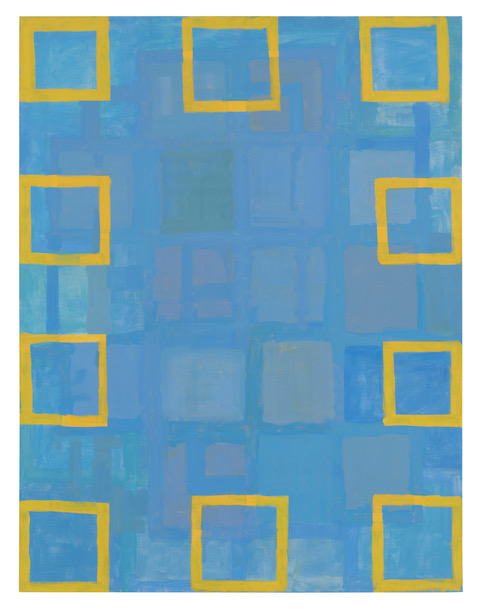 Bettina Blohm, Echo Blue, 2019, 65x50”, oil on linen.
By JONATHAN GOODMAN July 25, 2025
Bettina Blohm is a mid-career painter originally from Germany, where she first studied art. Now, living in Tribeca in her studio for some three decades, she has devoted her efforts to what she does so well: the construction of geometric paintings, often seeming regular and based on simple forms such as squares and rectangles and lines that are repeated. It would seem that the designs are pure and hard abstractions, but instead, something else happens. The interest of Blohm’s efforts derives from the subtle irregularities and nuances in the handling of the imagery.
For example, in the center of one painting, we can pick up, barely, a black rectangle covered with similar yellow shapes. The black forms are reticent but accessible, giving Blohm the subtlety she seeks in her finely extrapolated art. This kind of work has its following in an international scene, and we remember that Joseph Albers, the German-born painter who taught at Yale for many years, also worked with a very limited square format, three or four on top of each other.
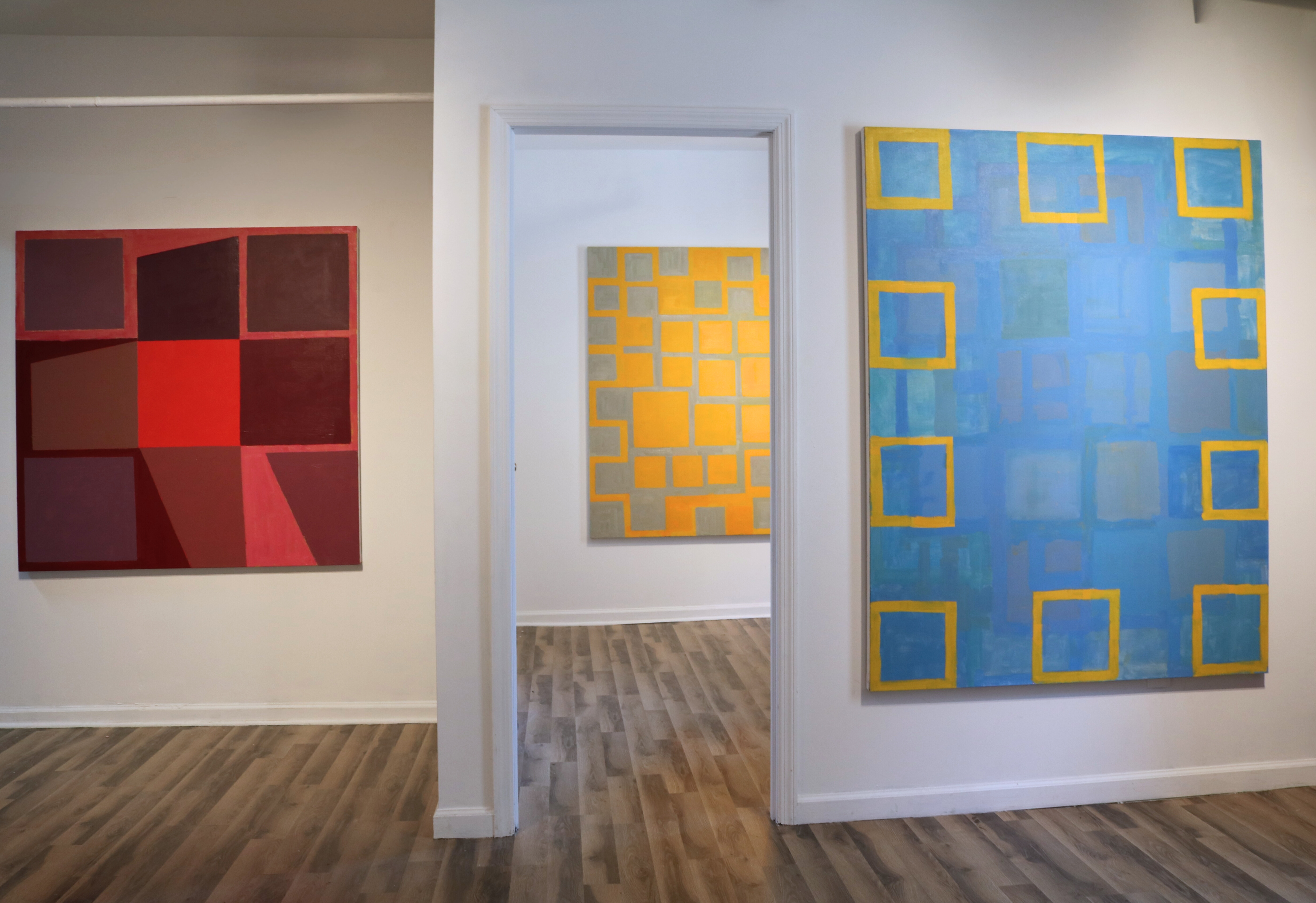 Installation view, Bettina Blohm.
Blohm is much more varied in her approach, but the strength of her efforts does seem to come from the quiet subtleties of her work. It is a right-angled construction she is devoted to, bringing to the fore a style she generally shares with more than a few painters in New York City and Europe. The artist clearly identifies as a New York artist, despite her travels back and forth with her family home in northern Germany and her apartment in Berlin. We are living in times of recognizable proximity from culture to culture in contemporary art, and Blohm’s fine constructivist puzzles, and likely their suggestion of Bauhaus activities, extend an open understanding of geometric non-objective painting.
This is not a theoretical comment. You can see this in the works themselves. Echo Blue (2019), a terrific study of open yellow boxes arranged on the edges of a light blue background covering the entire painting, has the ghosts of squares placed underneath the central blue of the painting; they nearly silently reiterate forms in the painting brought more easily to the fore. The regularity of the work, with its four yellow square outlines on the left and right and three across the top and bottom, yield a visual empathy with order, and show off Blohm’s wonderful use of right-angled shapes.
In Shift (2022), an esthetic similar to that of Echo Blue applies. The painting is taken up with a fog green, while similar rows, on the left and right and top and bottom edges are squares; a number of which are partially cradled by a L-shaped line covering two sides of the square. Again, there is the suggestion of black squares glossed over by the fog green.
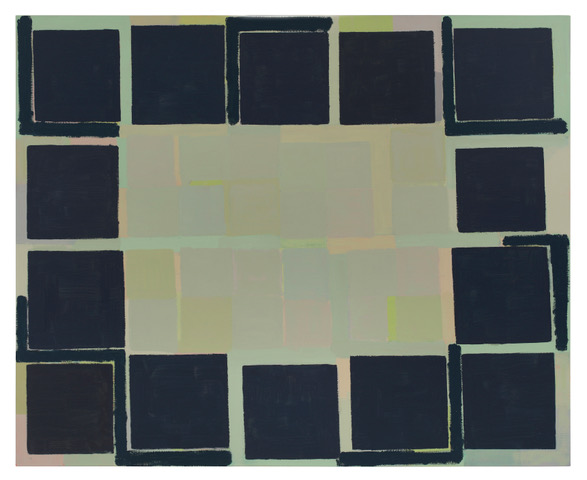 Bettina Blohm, Shift, 2022, 53x65”, oil on linen.
One by one, these paintings add up to a vigorous presentation of abstract forms. We know for decades now that abstraction can carry emotional weight, and it looks very much like her fine art is produced as subtler essays on feeling. But my own sense of the show is that Blohm is most interested in the iteration of shapes that echo among themselves. This is not redundancy but a kind of tacit minimalism — a movement the artist would be familiar with given her long duration in New York.
The last piece to be looked at here is Blohm’s November Mood (2024), again an extended meditation on squares, shows nine of the forms, several of them made by means of a slanted line cutting inward into the square on one side. The central piece is a full red square. Most of the other squares are a subtle mixture of mauve, maroon, and purple. The shapes are rendered with a brightness of tone that stands in contrast to the darker color and the single purple/blue square on the lower left. This was for me the strongest painting in the show. The restrained tonalities of color, along with Blohm’s innate sense of rhythm and composition, reward her audience with an unusual amount of nonobjective meaning, not to mention beauty. Blohm here shows how working for decades in a high order, passes her own standards, into a terrific language of relations and place. WM

Jonathan Goodman
Jonathan Goodman is a writer in New York who has written for Artcritical, Artery and the Brooklyn Rail among other publications.
view all articles from this author