Whitehot Magazine
August 2026
"The Best Art In The World"
"The Best Art In The World"
August 2026
Whitehot Interview with Harold Wortsman: A Sculptor in Clay
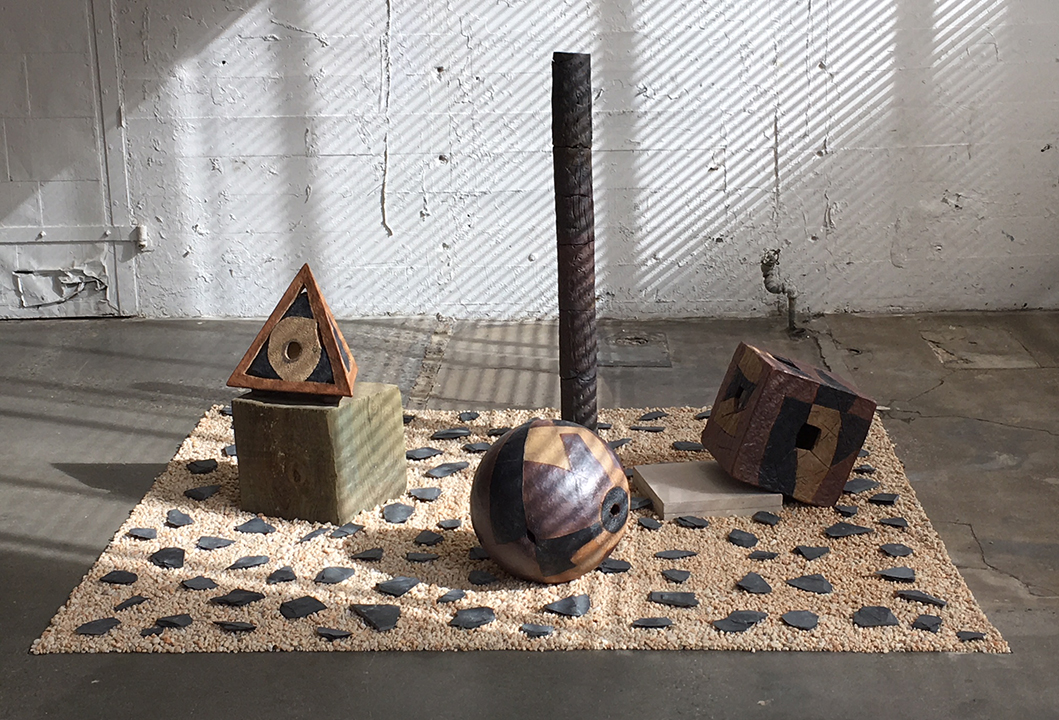 Cube, Pyramid & Sphere 2017-2023, high fired clay pigmented with oxides, wood, river gravel, limestone and slate, 48 x 78 x 70 inches
By JONATHAN GOODMAN July 2nd, 2026
Harold Wortsman is a sculptor and printmaker working in Brooklyn. Educated in the humanities at Brandeis University, and in sculpture at the New York Studio School, the artist has eschewed convention in favor of a highly original combination of the very old and the very new. He specializes in clay sculpture, both volumetric and relief, and makes as well drawings and prints of unusual beauty.
The work is close to uniformly abstract, with occasional (as he says: unintentional) hints of figuration. Wortsman’s art can suggest ancient architecture, forests, monuments, and direct abstraction. Plinths build walls; landscapes are suggested. As time continues, Wortsman has increasingly moved into his own–a place in which the oblique relations between the abstractions of volume and the intimations of very old culture are merged in a way that is new. We see so much contemporary art now, but the larger part of it usually disappoints, in part because of an absence of technique. Wortsman silently opposes this approach–he is both a poet and a craftsman whose skill becomes itself a lyric stance.
The artist has regularly talked about anonymity in art–in particular, the anonymity we find in the great tradition of African sculpture and other cultures of the past. In his own work, we also see the wish to present a view that is not linked to the personality of the artist; rather, it demonstrates his appreciation for cultures whose visuals remain alive after centuries. Still, it must be reiterated that Wortsman is no antiquarian, believing, correctly, that the historical impulse in art must not only be preserved but simultaneously opposed to also embrace the present.
Wortsman’s art, both his three-dimensional works and his reliefs, are idiosyncratic but hardly eccentric. Very much the independent, in both his thought and his art, Wortsman reexamines ancient and modern traditions in light of what it means to make art in the cultural vacuum contemporary life seems to have become. The questions I have posed to him reflect a long familiarity with him as a person and with his art.
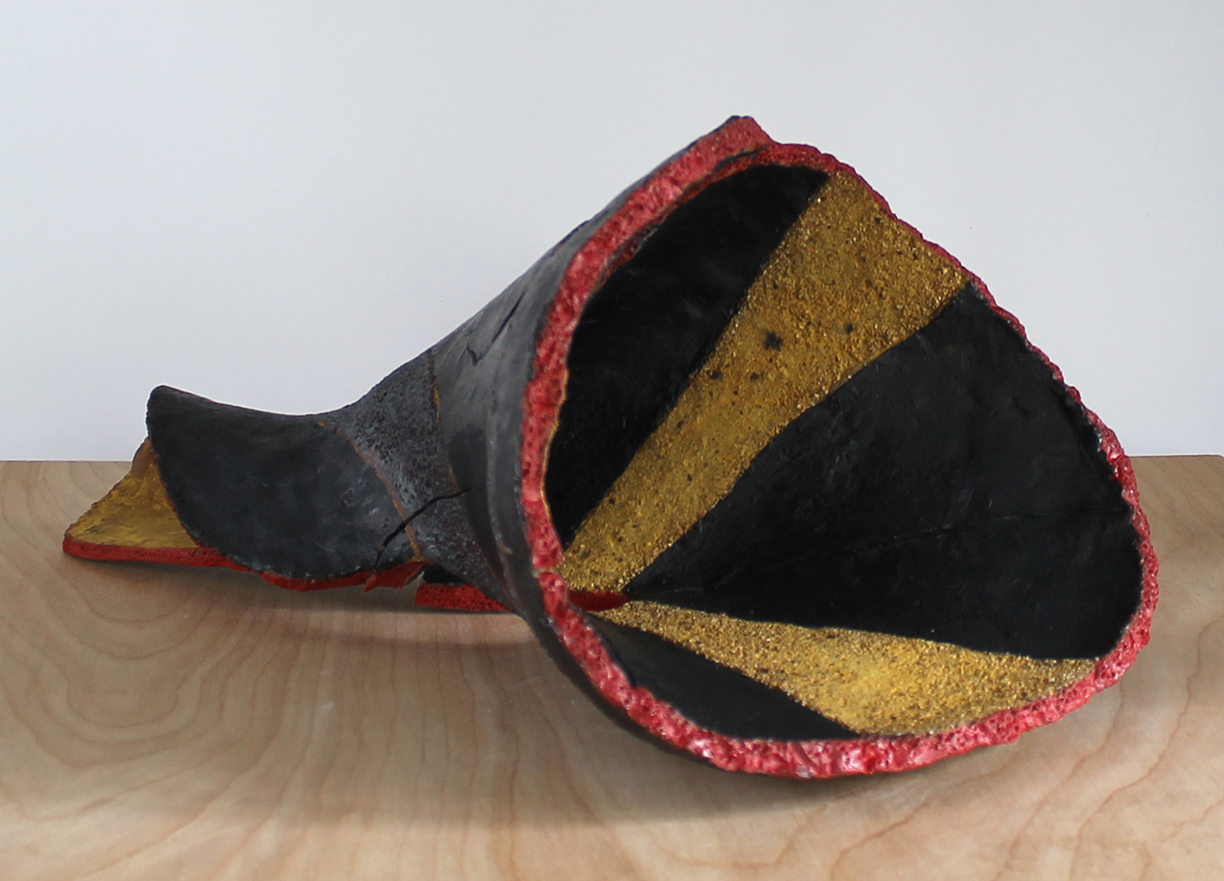 Vortex 2025, high fired clay pigmented with oxides, 9 x 11 x 16 inches
You have a European background; your parents came from Vienna. How has this background affected your art making?
I have always loved European art but have never felt an exclusive attachment to that world. As a child I played with clay; plasteline. My earliest museum memories are visits to the Metropolitan’s hall of armor. Afterwards, I cut up an old change purse of my mothers, and made it the chainmail of my medieval clay warriors. Later, I became deeply involved with the work of Goya and Rodin; the tormented expressionism of Goya, and the extreme sculptural sensuality of Rodin. Other loves were the German expressionists, especially Kirchner. In college, I discovered Indian sculpture and was overwhelmed by the erotic power of that work. Later, during my time at the NY Studio School, I discovered the work of both Chaim Soutine and Albert P Ryder, who remain some of my favorite artists. Clearly, European art has been a great influence upon me. But it quickly became clear that European art is the art of a small part of our world – no better or worse than the Egyptian, African, Indian, Oceanic or Mexican (to name but a few).
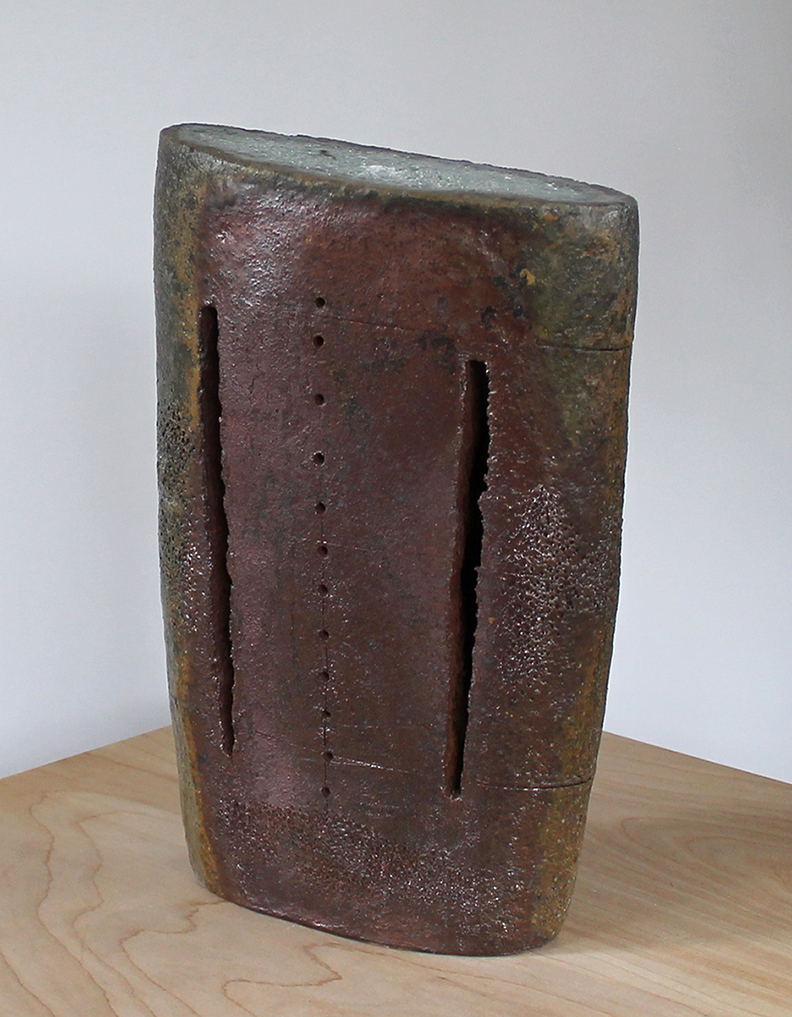 2 + 1 = 0 2024, wood fired clay plus sand, 14 x 8 x 3.5 inches
You were educated through high school in NYC. Did your early education push you in any particular direction?
I have worked in clay since the age of five. The leader of my toy soldiers was a plasteline hero, reincarnated in many forms. All the fantasies of childhood were visited upon these plasteline beings. But it was pure play; I knew nothing of art. Early loves included paleontology and archaeology. High school led me to biology and I seriously considered a life in science, but organic chemistry did me in. I took my first sculpture course with Chaim Gross at the Henry Street Settlement House. I didn’t talk to him, nor he to me. For three weeks we worked on a head from a model who posed. I worked dutifully and carefully. The fourth week of the pose also happened to be the last class before summer. Not having properly packed the clay, to my horror the head collapsed as I unwrapped it. Within two hours I remade the head, this time making something alive. Gross ended up giving me an award.
My first year of college was an unusual one-year program at the Graduate Center of City University. Professors included Irving Howe, Marcia Tucker and the great art historian Leo Steinberg. Steinberg’s weekly lectures on the history of art were a revelation. Later at Brandeis, I studied many things, but finally only Art remained.
Although Brandeis is known as an academic university, you studied sculpture there, can a conventional school like Brandeis provide an art student with proper training?
At Brandeis I studied sculpture with Peter Grippe, who later introduced me to the New York Studio School. He taught me many of the technical basics like mixing plaster and building an armature. I also studied the history of modern sculpture with William C. Seitz, former curator of sculpture at MoMA. I will never forget using Seitz’s name to get access to MoMA’s storage area and standing face to face with Giacometti’s tiny plaster figures from that period in his career. There was as well much study of literature, language, history and art history. In my senior year I was given a studio and was able to experience the difficulty and delight of solitary work. A year-end honors exhibition solidified my decision to become an artist. Every artist is fundamentally, self educated, and any place which encourages that can be good. In that sense Brandeis was a good beginning.
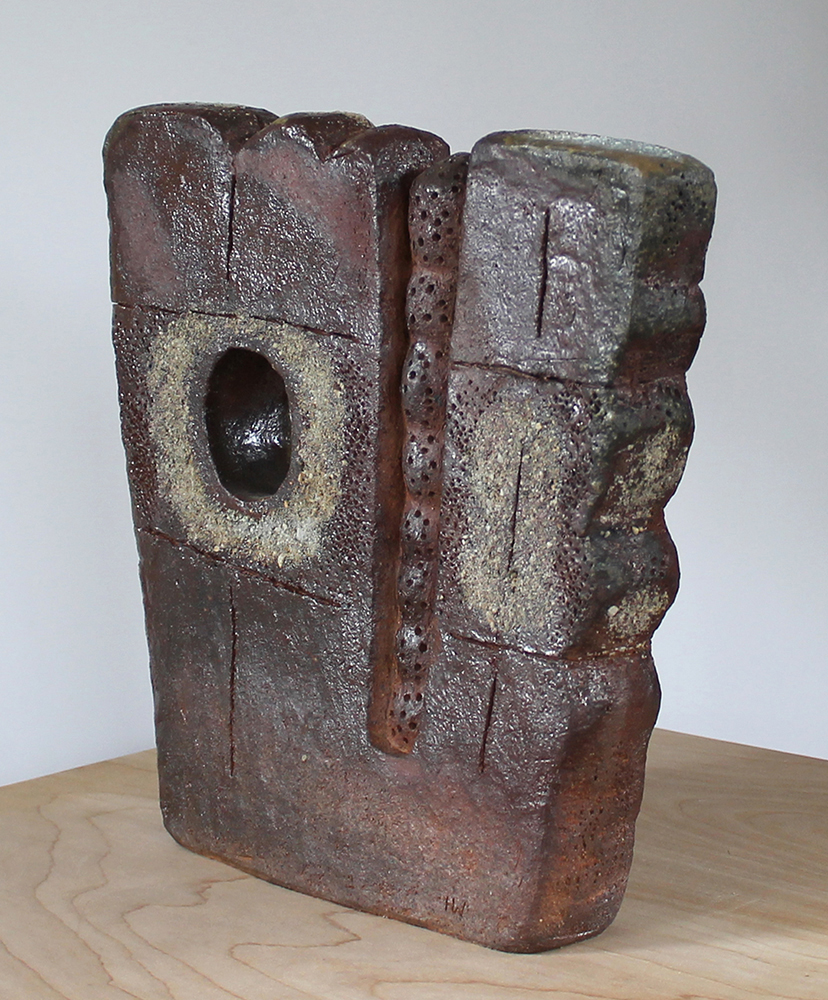 The Sand Man’s Dream 2024, wood fired clay plus sand, 13 x 12 x 2 inches
You spent almost three years at the New York Studio School. What did that school teach you in a technical sense and then in a thematic sense?
At the end of college, I was a “finished artist”. I had my own studio, an honors exhibition, and began to sell my work. The work was figurative, distorted and highly expressionistic But I realized that it was all wrong and that I needed to clarify my vision, to learn how to look. I went to the studio school to “become an idiot,” to start afresh. At the Studio School I studied with sculptor George Spaventa, and painter George McNeil. Through them, I began to understand the plastic language across time and the need to develop my own clear version of that visual language.
At the time there were no grades, no degree, and no one told you when to leave. The Studio School was heavily influenced by the Abstract Expressionists and the work of Giacometti. It was a good place to “clarify my vision.” But it was also a difficult time. I left in the middle of my third year and eventually took my first studio on 28th Street, between Lexington and Park.
Much of your work suggests other cultures. Is this a conscious decision or the result of working intuitively? What are two or three of your favorite cultures to borrow from and why?
My background is European, but I have always felt equally drawn to the work of other cultures, the ancient Egyptian, Etruscan, Oceanic, African, Mezo American and the archaic Greek. But I never directly borrow from any time or place. To copy a culture or style is not of interest. A particular work may move me, but it’s effect on my own work is always indirect and unconscious.
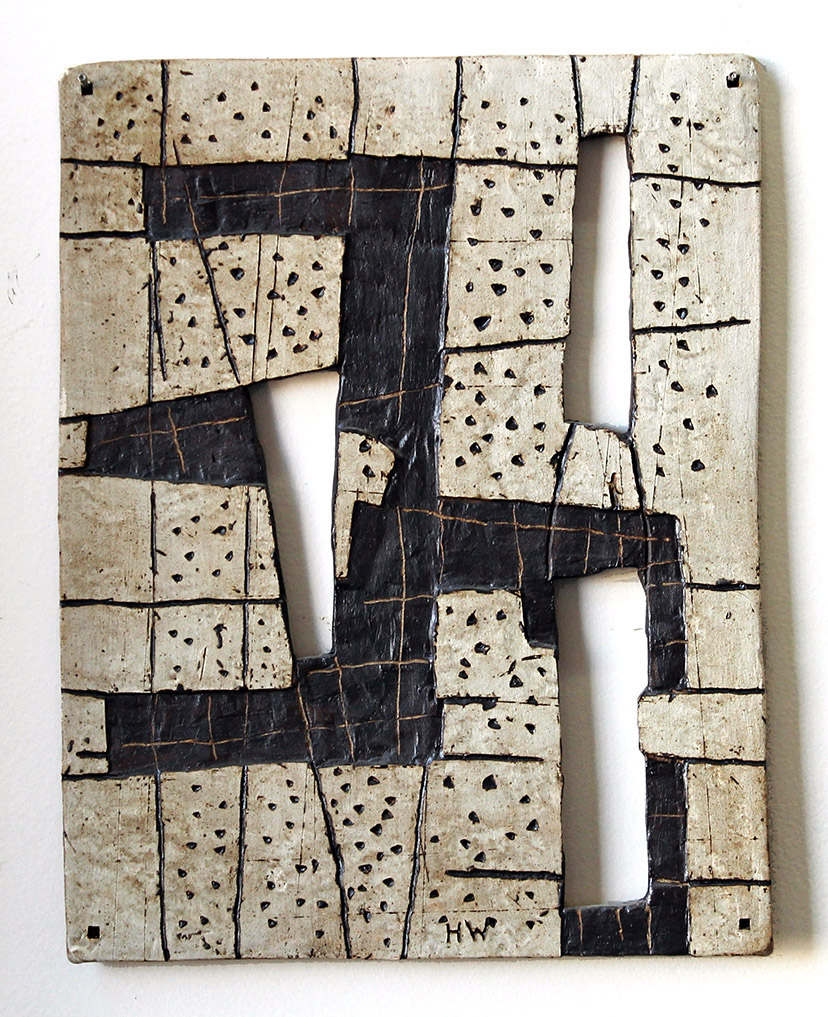 Dragonfly 2020, high fired clay pigmented with engobe, 10 x 8.5 x 0.25 inches
Writing is an important part of your family background. Has writing informed your understanding of your sculptural work? Is it hard now to find good contemporary critical literature?
My brother is a writer and we often collaborate. You and I as well talk often about art, including the similar issues faced by both artist and writer. But I long ago realized that the verbal language and the visual language are parallel universes, without any direct connection. The critic is important as an intermediary between artist and public. But I have always found it difficult to read writing on Art.
As much as I enjoy talking about art in all its facets, I am always haunted by Matisse’s words that the first thing an artist must do “is to cut out their tongue.” Visual art is, after all, not about verbal statements but about the creation of clear visual images.
For a long time, you were reclusive as an artist. How has this independence affected your understanding of your own art? Does independence promote artistic strength or does it isolate you from your work?
An unspoken message of the Studio School was to work in isolation for many years until you achieved personal clarity. I suppose that is what I have done. About 10 years ago it became important for me to show my work and become a part of the public conversation. That is what I have tried to do. Independence definitely promotes artistic strength in the face of prevailing fashion. It gives you time to clarify your vision and space to craft your artistic language.
Independence can also be quite isolating; not from my own work - on the contrary, it brings one closer. But it can sometimes be a very lonely place.
NY is famous for its gallery and museum shows. Does your work ever reflect the forms and ideas associated with contemporary art?
The galleries and museums of New York are an incredible resource that nourish an artist. Sometimes I would go often and other times not at all. We cannot help but be part of our present. People often say that my work has an archaic quality, but I am as much a part of the present art world as anyone else. At the same time, I have always tried to follow my own direction.
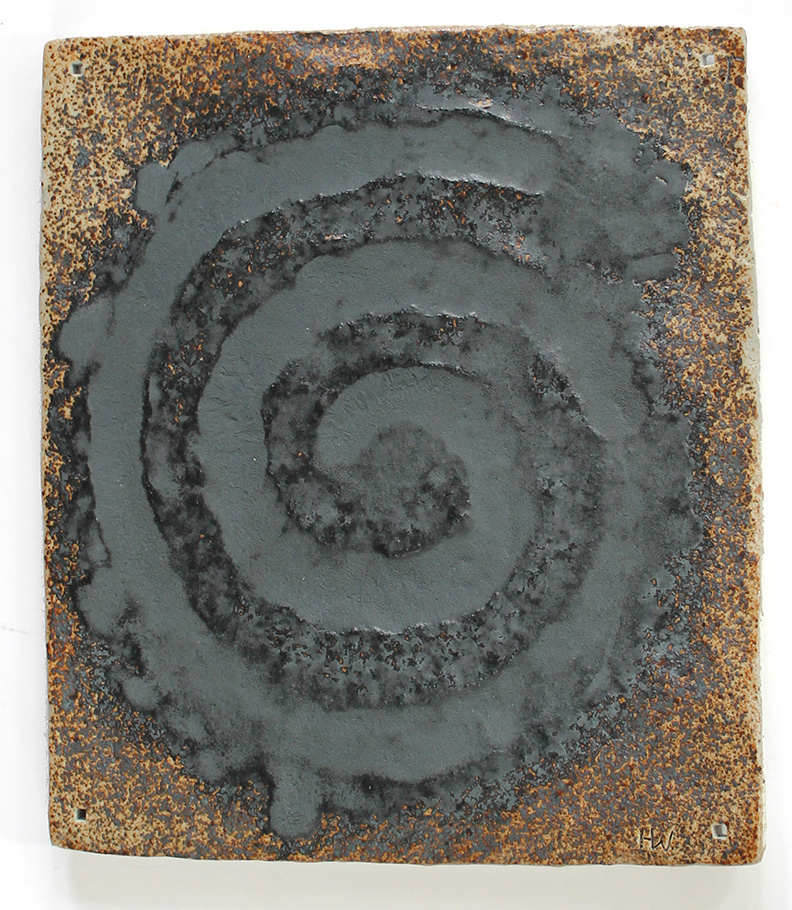 Mazunte 2025, high fired porcelain pigmented with black sand, 8.5 x 8.5 x 0.25 inches
How important is it to you to have an artistic community and how has this affected your work. Does an artistic community provide the artist with sufficient support? Or does it force a conventional attitude on the artist?
Almost all the people who have been dear to me are artists; whether writers, musicians, actors, painters or sculptors. At the same time there is something isolating about New York life. You meet friends at parties and openings, but a direct artistic community is sometimes hard to find. One positive aspect of the internet is to broaden the net of connections/community.
You ask whether an artistic community can force a conventional attitude on the artist? Many of my friends are quite idiosyncratic, and we do not always agree. Either way, we follow our own path, regardless of contemporary convention.
You are primarily a clay sculptor. Does working with clay distance you, or bring you closer to the current art world.
Clay is likely the oldest artistic medium. In the Bible Adam was made out of earth (adamah), a substance synonymous with clay. Abraham‘s father was a clay idol maker. My approach to clay is no different than any other painter or sculptor’s approach to their chosen medium. Clay seems to be having its moment in the current art world, and it appears to be becoming more fully liberated from the mantle of craft. I hope that with time the art world will fully embrace clay as a medium equal in value to paint, stone, video and all else that fills our galleries.
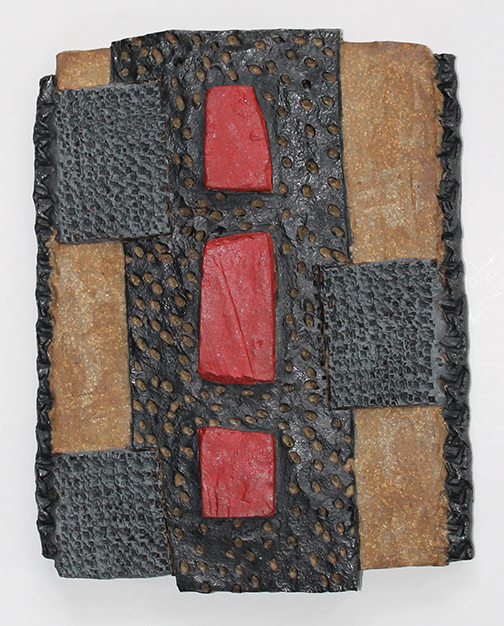 3 x 3 2025, high fired clay pigmented with oxide, 7.5 x 6.5 x 0.25 inches
You work with clay, the oldest material known to art. Technology and the virtual world have become increasingly influential. Can you talk about this. How does your work in clay fit in?
Clay is a profoundly non virtual material rooted in the earth. You get it into the pores of your skin and under your fingernails. But, like many other artists, I use instagram. Once an image of my work is posted, it enters the virtual world and has as much possibility of transmission as a digitally created image. Whether digital or analog the artist’s business is to make clear images that touch the viewer. If successful, those images will enter the virtual world, regardless of their origin.
The issues facing an artist have become broader and broader. Is your work an embrace of or a distancing from the way people work now.
This is an eclectic and fragmented time in the art world. Conceptualism has
run its course. Politics and identity often reign supreme. People are working in many different modes. We are all part of the present moment; we cannot escape that. But there is always room for the individual vision. Edward Hopper painted during the heyday of Abstract Expressionism and yet now his work is as valued as theirs.
My work is neither an embrace or a distancing from the way people work now. It is rather a continuing attempt to “speak” as clearly as possible, and make images that hopefully move the viewer. And in a more personal sense, I try not to forget my origins: the child who did not know about art, but knew how to play.
Jonathan Goodman
Jonathan Goodman is a writer in New York who has written for Artcritical, Artery and the Brooklyn Rail among other publications.
view all articles from this author