Whitehot Magazine
September 2026
"The Best Art In The World"
"The Best Art In The World"
September 2026
GaHee Park: The Exhaustion of Distance
 Installation views of GaHee Park's special presentation Half-Looking, Half- Seen on view at Perrotin New York, 2026. Photographer: Guillaume Ziccarelli Courtesy of the artist and Perrotin.
By Margherita Artoni April 30th, 2026.
Painting in GaHee Park’s Half-Looking, Half-Seen does not stabilize perception; it exposes its prior instability and the conditions through which it is continuously reorganized. At Perrotin New York (April 24–May 30, 2026), the exhibition extends a trajectory toward her institutional debut at Yerba Buena Center for the Arts while withholding resolution. Images surface only to retract from legibility, as if visibility were always provisional and already in the process of withdrawal. A hinge organizes the field: the passage from day into night. Light breaks form rather than disclosing it, producing discontinuities that interrupt recognition at the level of emergence. Figures appear as partial configurations, suspended mid-formation, never fully stabilizing into objecthood. Recognition does not consolidate; it drifts, recalibrated with each modulation of illumination.
In Seafood Heaven, the scene begins after impact, as if the event has already passed through the image and left only distributed residue. Marine bodies lie dispersed across a coastal field under an implied wave that never fully appears. Extraction and spectacle share the same surface without distinction. In Wetland at Dusk, amphibian, insect, and predatory forms occupy a flattened temporal field in which sequence collapses entirely into coexistence. Time no longer organizes perception but accumulates as stratified simultaneity. At the center, a doubled mouth folds ingestion, respiration, and perception into a single unstable aperture that refuses functional separation.
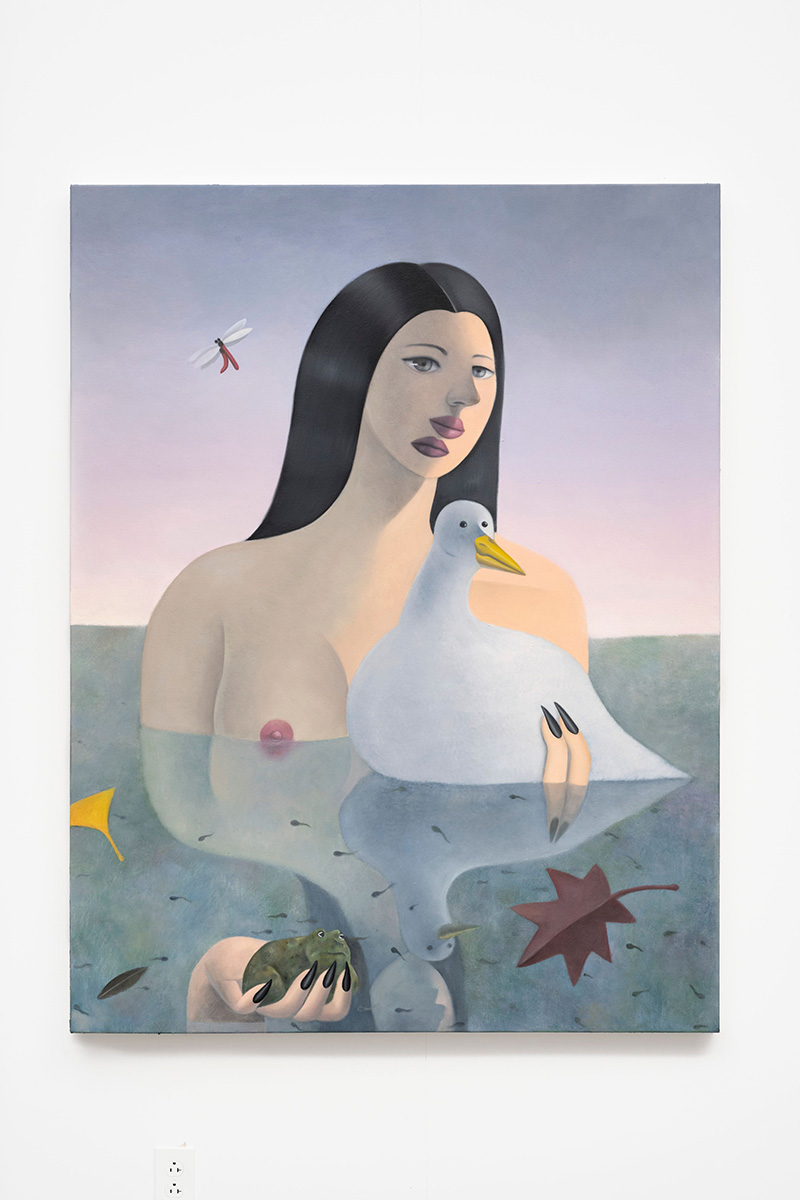 GaHee Park Wetland at Dusk, 2026 Oil on canvas 60 x 46 inches Photographer: Paul Litherland Courtesy of the artist and Perrotin.
Portraiture breaks into dispersion and loss of origin. In Creeping Shadow, proliferating eyes remove any stable point from which vision could be attributed. The gaze no longer issues from a subject but distributes itself across the pictorial field, producing a system in which looking is impersonal and continuous. In Half-Looking, Half-Seen, illumination and occlusion coincide without hierarchy; figures remain inseparable from the conditions producing them. Identity does not register as unit but as exposure to perceptual conditions that never stabilize into form.
The still lifes operate through interruption rather than composition. In Still Life With Tired Moth and Still Life with Butterflies, minor intrusions—a detached fingernail, inert insects—interrupt continuity at the level of detail and resist symbolic incorporation. They remain at the threshold of legibility without resolving into meaning.
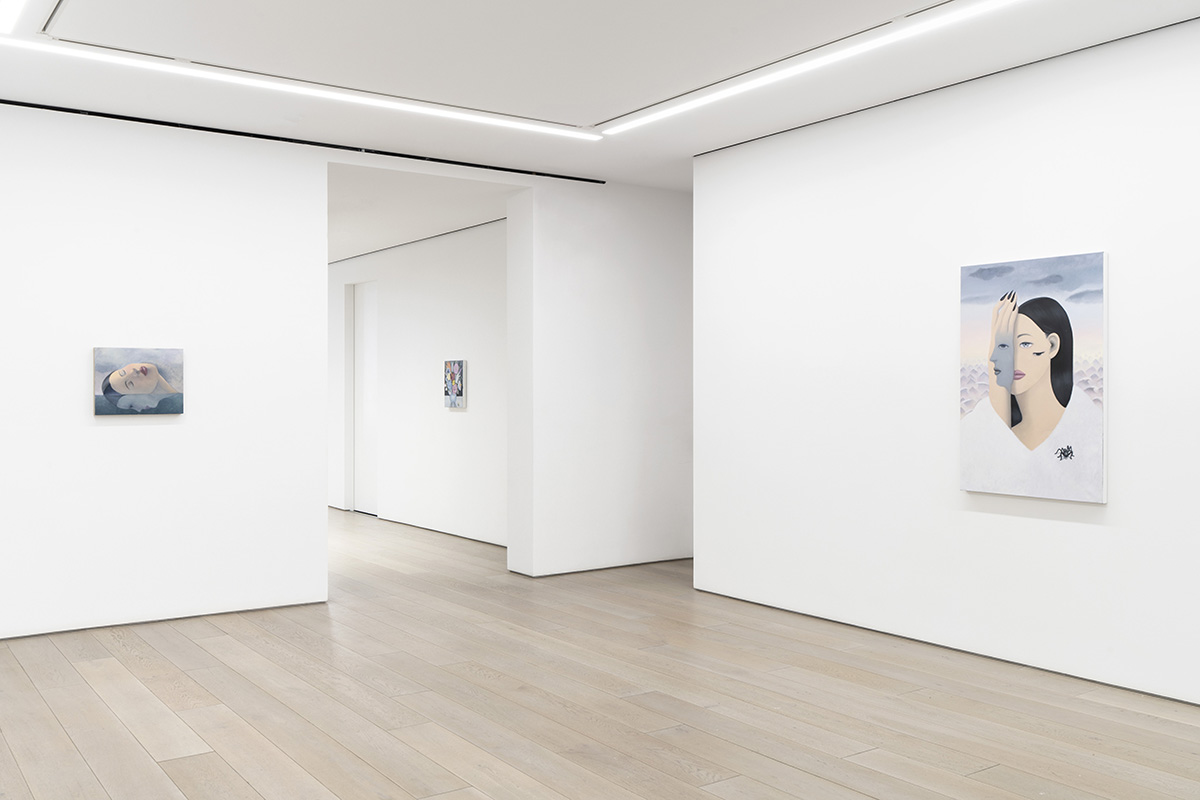 nstallation views of GaHee Park's special presentation Half-Looking, Half- Seen on view at Perrotin New York, 2026. Photographer: Guillaume Ziccarelli Courtesy of the artist and Perrotin.
Across the exhibition, painting functions less as image than as passage and modulation. Attention, affect, and value circulate rather than accumulate. Park does not stand outside this condition; she works within its internal constraints, where instability is not represented but operational and continuously enacted. Yet this containment is never complete: moments emerge in which perception exceeds its own structural framing, without being fully absorbed back into circulation. What appears systemically integrated leaves behind residual configurations that do not resolve into the logic that produces them.
The distinction between structure and effect begins to blur further under sustained viewing. Fragmentation, suspension, indeterminacy are not themes but shared procedures between work and context, operating as a common grammar that precedes interpretation. The exhibition neither opposes nor reflects them; it passes through them without exteriority or critical distance. At a certain threshold, the question shifts: whether perceptual instability can still be read as critique, or whether critique has already been absorbed into its conditions of operation.
No position remains from which the work can be stabilized or extracted. Perception is bound to the infrastructures that produce visibility, without remainder or vantage. What remains is exposure: vision circulating within its own conditions of emergence, without distance sufficient to interrupt it.
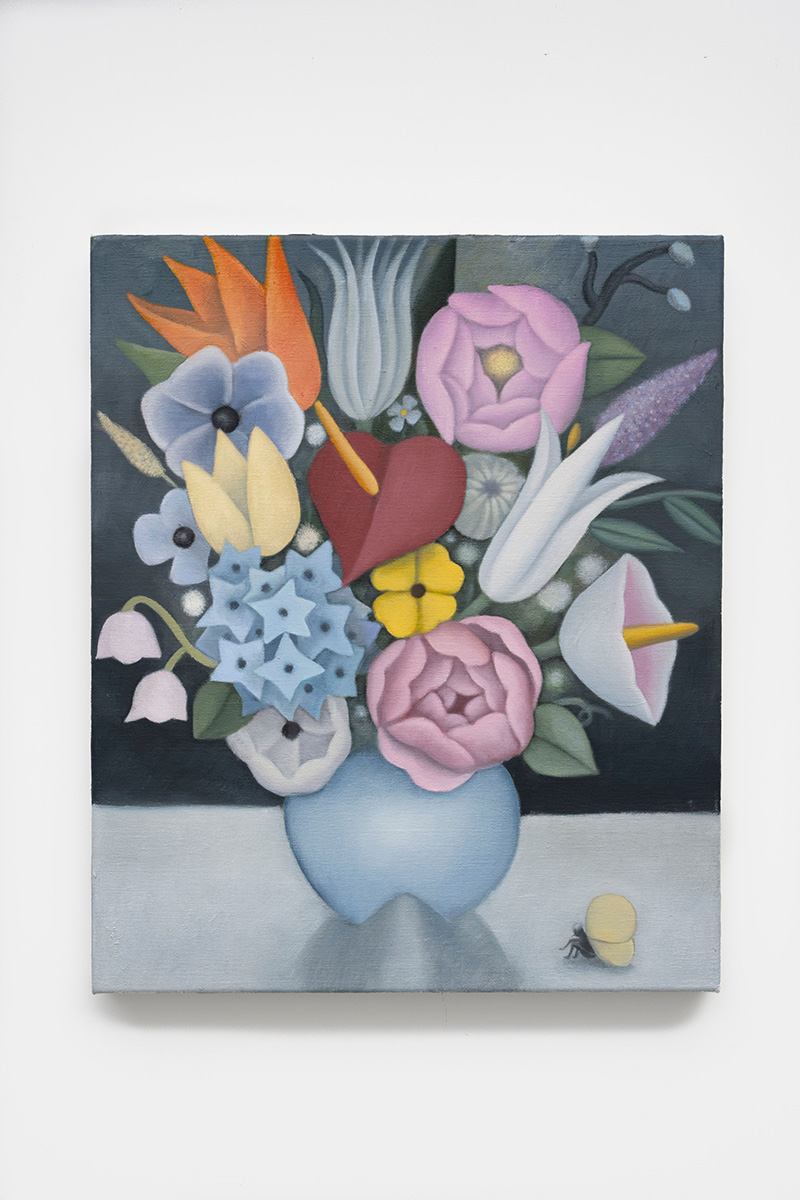 GaHee Park Still Life With Tired Moth, 2025 Oil on linen 18 x 15 inches Photographer: Paul Litherland Courtesy of the artist and Perrotin.
Within contemporary painting discourse (Rosalind Krauss, Nicolas Bourriaud, and related post-medium frameworks), the image no longer rests on representation but on distributed and infrastructural regimes of circulation. In this frame, painting is not object but situation, not representation but embedded perceptual condition. Park’s work does not illustrate this shift; it operates at its limit, where exteriority ceases to function as category.
At that point, painting is no longer reflection on instability. It is instability without outside, sustained as continuous condition rather than resolved form.
Margherita Artoni
Margherita Artoni is a contemporary art critic and curator working between Italy and the United States. She began her career collaborating with Flash Art and currently writes for Segno, Juliet, Artribune, Exibart, Inside Art, ArteIN, part of cult(ure), The Art Fuse, and Whitehot Magazine.
She has directed galleries in Turin — including NEOCHROME and EDGE Art Space — and in New York at TEAM Gallery. Her curatorial work has included exhibition programs with international artists such as Rashid Johnson, Theaster Gates, Ali Banisadr, Angel Otero, Tim Rollins & K.O.S., Laura Owens, and Mika Tajima.