Whitehot Magazine
September 2026
"The Best Art In The World"
"The Best Art In The World"
September 2026
The Genesis of Ab Ex: Willem de Kooning Achievement
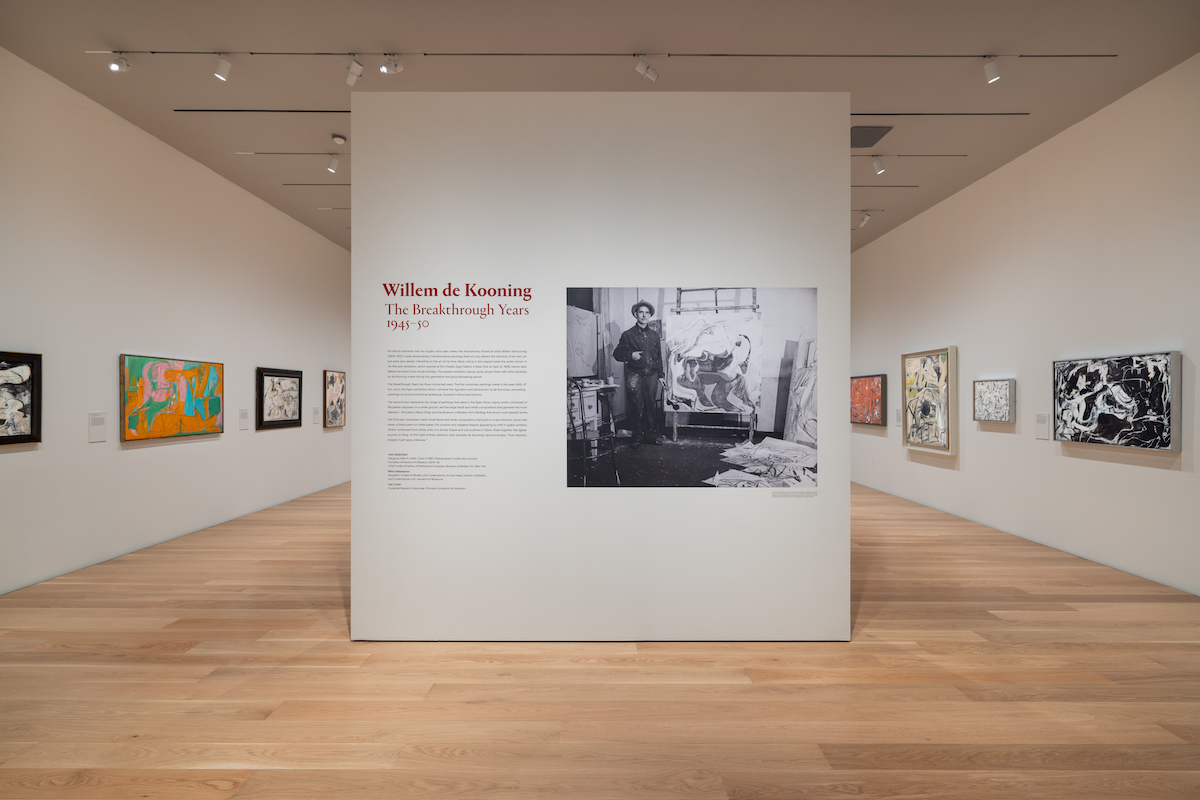 Installation view "Willem de Kooning: The Breakthrough Years 1945–50", Courtesy Princeton University Art Museum. Photo: Joseph Hu
By EDWARD WAISNIS July 17th, 2026
For anyone doubting the exalted status that Willem de Kooning has attained merely has to look to this concise, and superbly well-informed (exemplifying what an Ivy League university art gallery is capable of), exhibition. Accompanied by a catalogue–a book, really–assisted, contributed to and compiled by a battalion of historians, archivists and conservators, that offers that scholarly juicy rounding up that satisfies beyond; indeed, a satisfying read that offers support, but also an alternative, to the exhibition.
Esteemed scholar, and Chief Curator Emeritus of Painting and Sculpture at MoMA (where he oversaw the de Kooning retrospective in 2011) John Elderfield carries the ball, for it is his conception of both the exhibition–spurred on by Princeton University Art Museum Director James Christen Steward (who desired an expansive view on the institution’s own masterwork Black Friday, 1948, and the publication, that carries his leading, exhaustively researched, essay. Steward’s charge provided the spark and the fact that that work was in de Kooning debut solo exhibition, at Charles Egan Gallery, 1948, offered the armature of bringing together a large portion of the pictures that were in that show, against works from preceding and subsequent years, among the dozen-and-a-half on view.
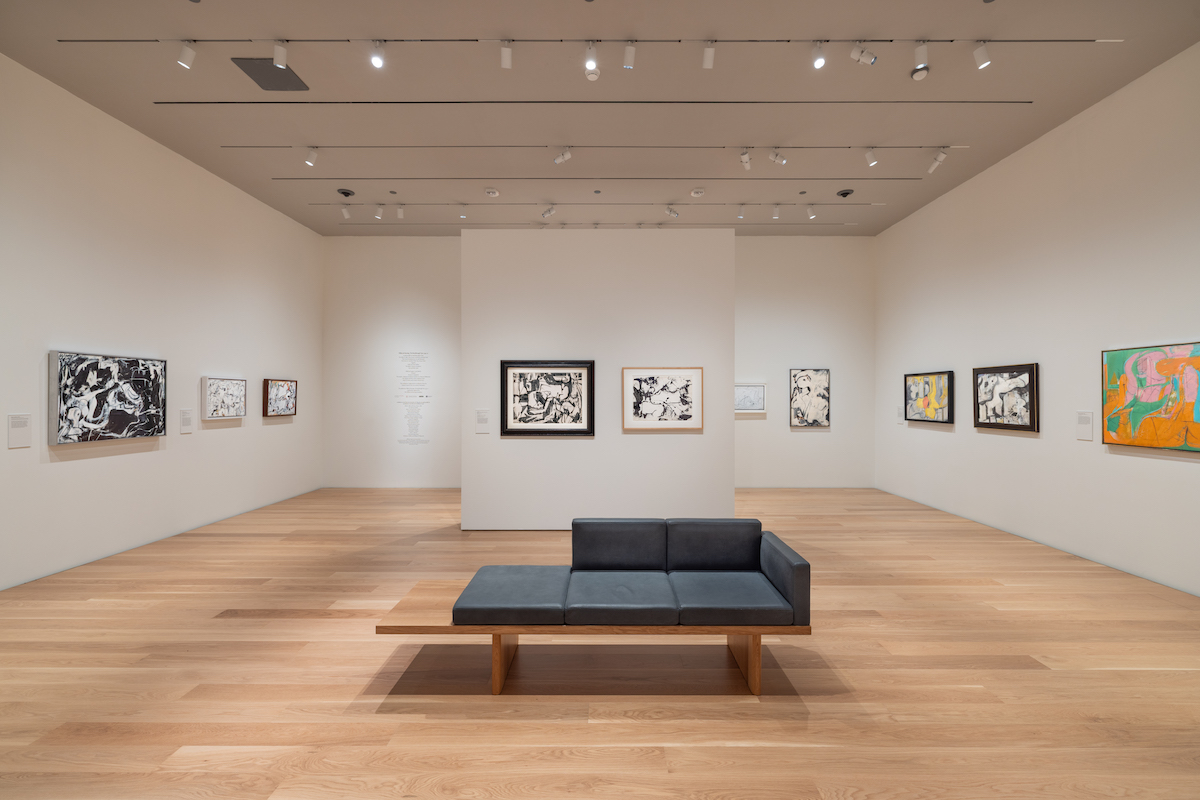 Installation view "Willem de Kooning: The Breakthrough Years 1945–50", Courtesy Princeton University Art Museum. Photo: Joseph Hu
The thesis, if there is one, made by Elderfield, is that de Kooning was a figurative/hybrid painter from the get-go. In opposition to the Greenbergian creed of the painter being: “an outright ’abstract’ painter”.*
The restless quality of the paintings, testaments to the formulation of Abstract Expressionism, can be accounted for through the accrued (constructed) qualities of composition and application.
The lore of de Kooning–arriving in New York, from the Netherlands, as a stowaway; falling in with Arshile Gorky, Jackson Pollock, et. al.–is well-accounted for. What this exhibition provides is a media res detailed accounting(including a blow-by-blow chronology, of the five years under examination, compiled by Lee Colón) of the five year period around de Kooning's breakthrough.
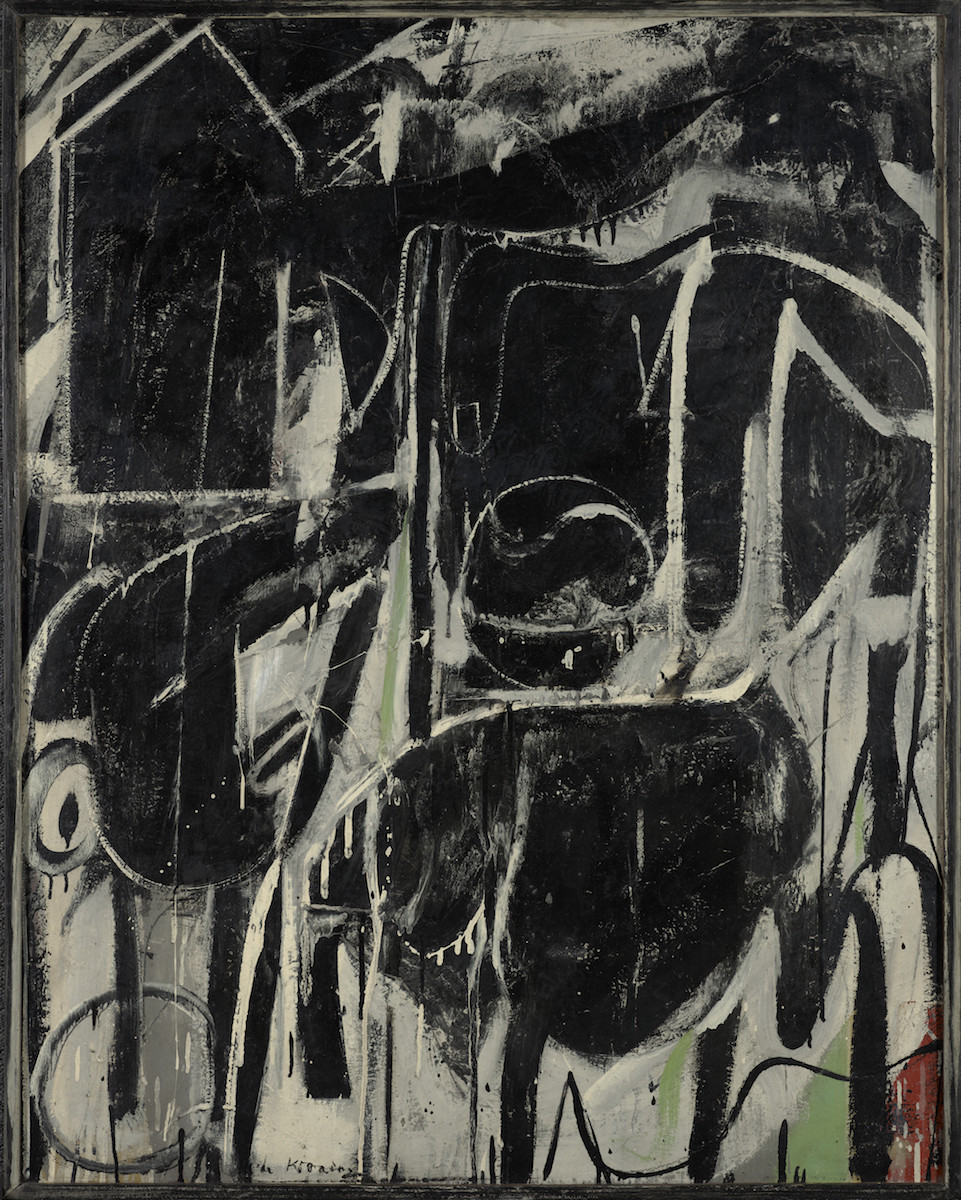 Willem de Kooning, “Black Friday”, 1948. enamel and oil over paper collage on fiberboard in painted wood frame, Princeton University Art Museum. Gift of H. Gates Lloyd, Class of 1923, and Mrs. Lloyd in honor of the Class of 1923. © 2026 The Willem de Kooning Foundation / Artists Rights Society (ARS), New York. Photo: Jeff Evans
The key to de Kooning's meandering weaving, interlocking, sinewy line relied upon the liner brush, as well as his reliance on commercial enamels, which Pollock took up, as well.
The liner brush facilitated nods to the achievements of Gorky (descended from Joan Miró), while bearing resemblance to Paul Klee’s skittish oil transfer outlines. Layered over, and around, the skeins de Kooning's block forms coalesce in quagmires of dense paste, or thinned flat passages. Never fusing into pictograph, á la Klee-to-Torres-Garcia-to-Gottliebesque pastiche, all while skating amidst figuration.
The breathless color harmonies, in a few of the works, owe allegiance to Matisse, whose blacks are also a source of inspirational lineage, side-by -side with Edouard Manet’s legendary masterful championing of the dark.
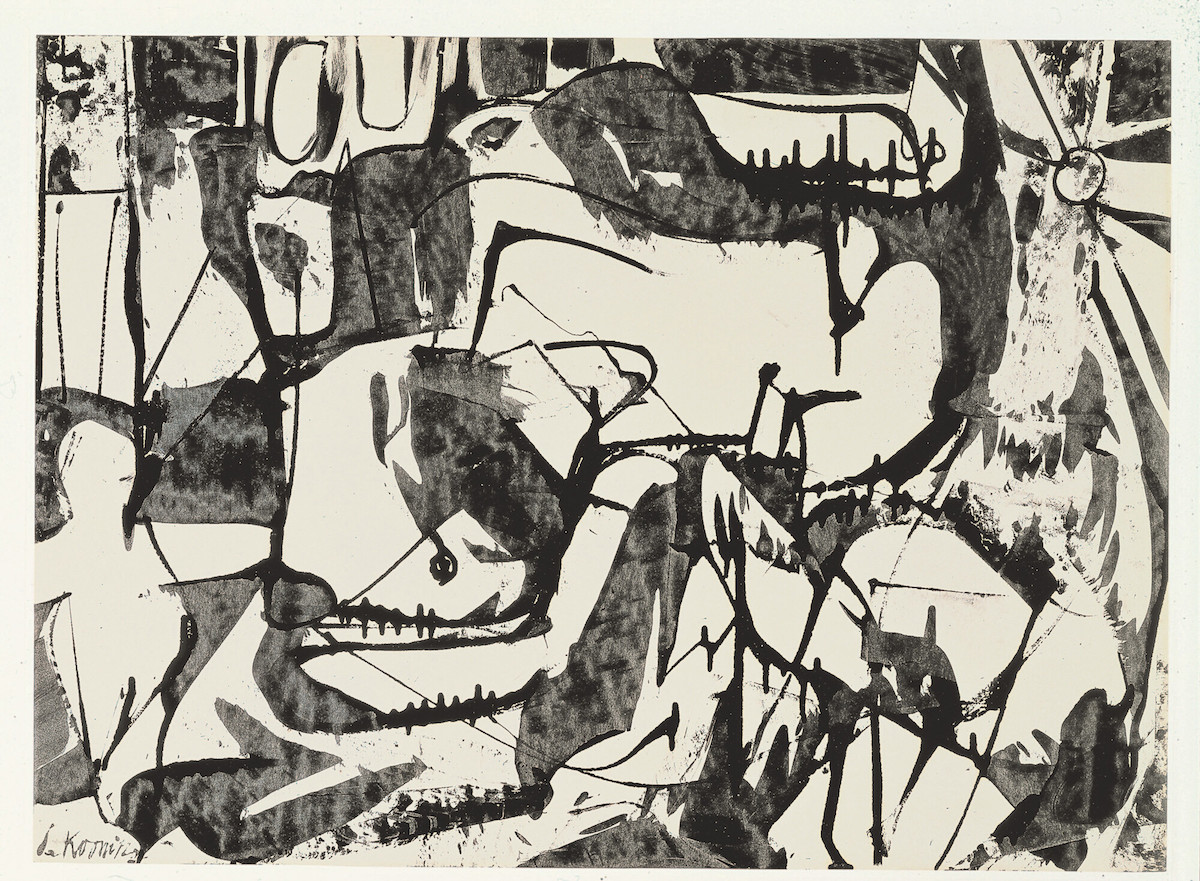 Willem de Kooning, “Untitled (Black and White Abstraction)”, 1950, Sapolin enamel on paper, Private Collection. © 2026 The Willem de Kooning Foundation / Artists Rights Society (ARS), New York.
To Elderfield’s point, a fine drawing from 1950, Untitled (Black and White Abstraction), contrary to the work’s subtitle, the fullness, depicted in Sapolin enamel on paper, nearly coalesces into a scene from a Eugene O’Neil play. Or, more appropriately the Cedar Bar. In fact, the entire body of work is infused with literature, drama and poetry of the high-bar period that was burgeoning parallel to aesthetic developments.
The central, rear, wall of the gallery is buttressed by a trio of powerful, thoughtful, dense primarily black paintings. These works were made at height of noir, in film (that often relied on settings of dockside abutting, or urban choked locales, endemic to the environment from which these works emerged. One gains the sense of the grimy, oil and soot, stained existence of Manhattan in the 40s; exuberant, having surmounted, and defeated, the scourge of Fascism; worn down, lived in and used.
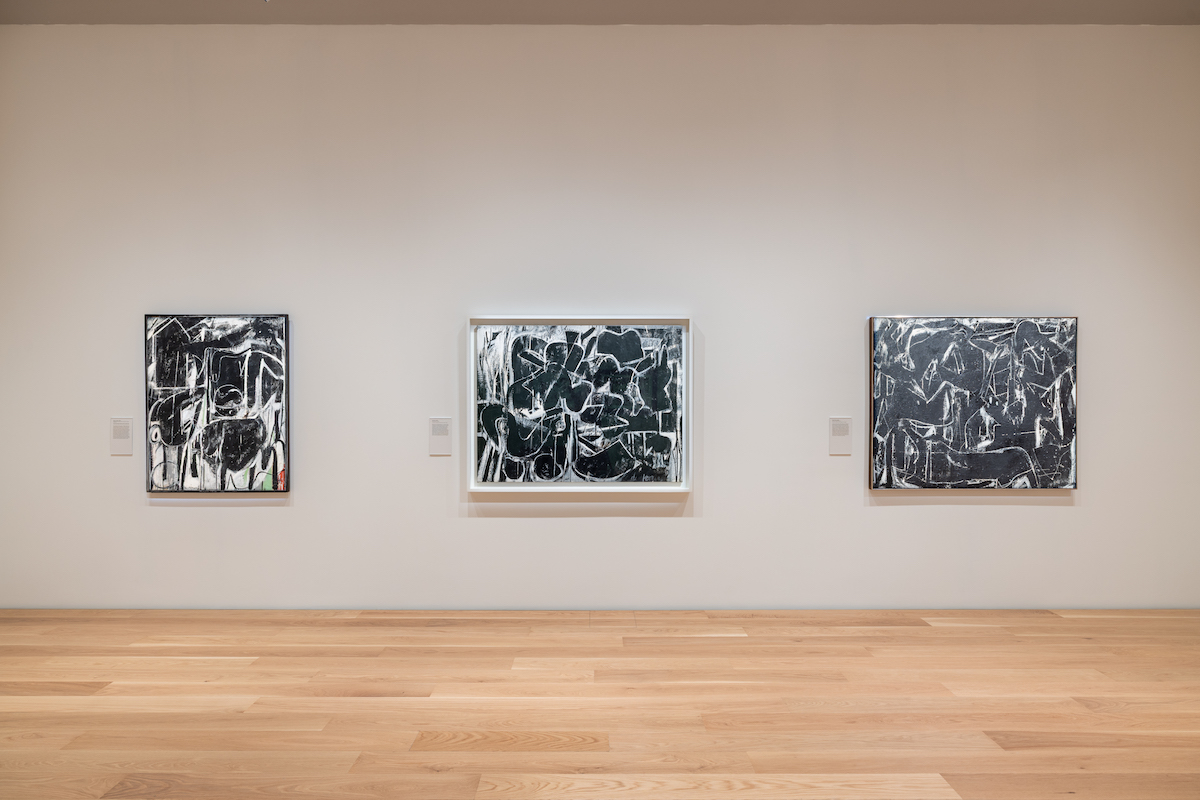 Installation view Willelm deKooning: The Breakthrough Years 1945–50, Courtesy Princeton University Art Museum. Photo: Joseph Hu. Showing: “Black Friday”, “Painting” and “Dark Pond” (all 1948)
Painting, Dark Pond, and the engine that propelled this entire endeavor, Black Friday (all 1948), comprise a powerful trio, hung together on the central (back) wall. They collectively encapsulate the momentousness of the time in which they were executed, as well as de Kooning's achievement; he put everything from his experience that led to the moment of setting it down into this. Their power akin to that of Rauchenberg’s black paintings to follow in a few years; an interpretation infused with the winds of Pop. Dark Pond has a particularly Black Mountain College/Twomblyesque air about it, where he would be invited to teach to, and as a result of, the Egan exhibition. While Painting bathes in a more open volumes scape while Black Friday orchestrates a claustrophobic balancing act.
The catalogue includes an incisive essay by conservators James Coddington and Bart J.C. Devolder, who jointing forensically dissected the construction and creation of Black Friday.
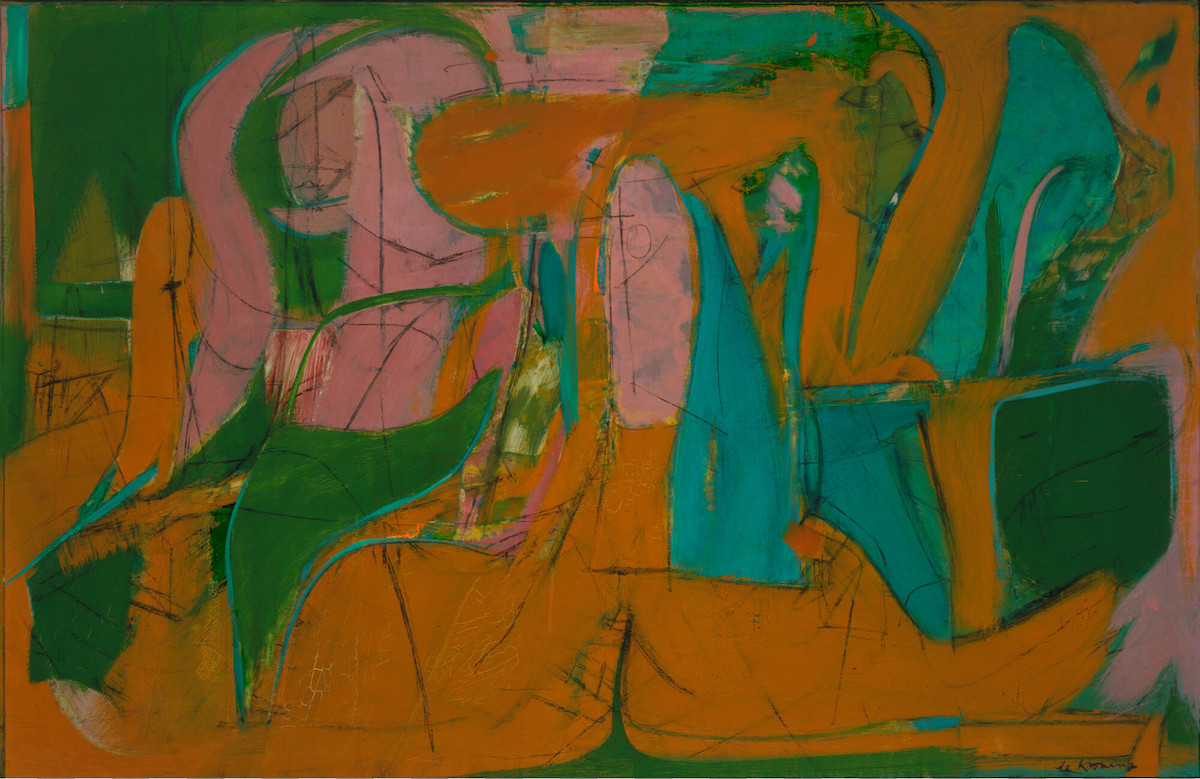 Willem de Kooning, “Bill-Lee's Delight”, 1946, oil on paper mounted on composition board, Private collection. © 2026 The Willem de Kooning Foundation / Artists Rights Society (ARS), New York.
Bill-Lee’s Delight, 1946, is an example of the work that led to de Kooning's show. In sweeping embracing harmonies of green, red (orange), pink and turquoise, it is an example of deKooning transitory working method, in that it followed a period of figurative work, of which de Kooning's long career would be comprised of many; most notably the Woman series that were soon to follow.
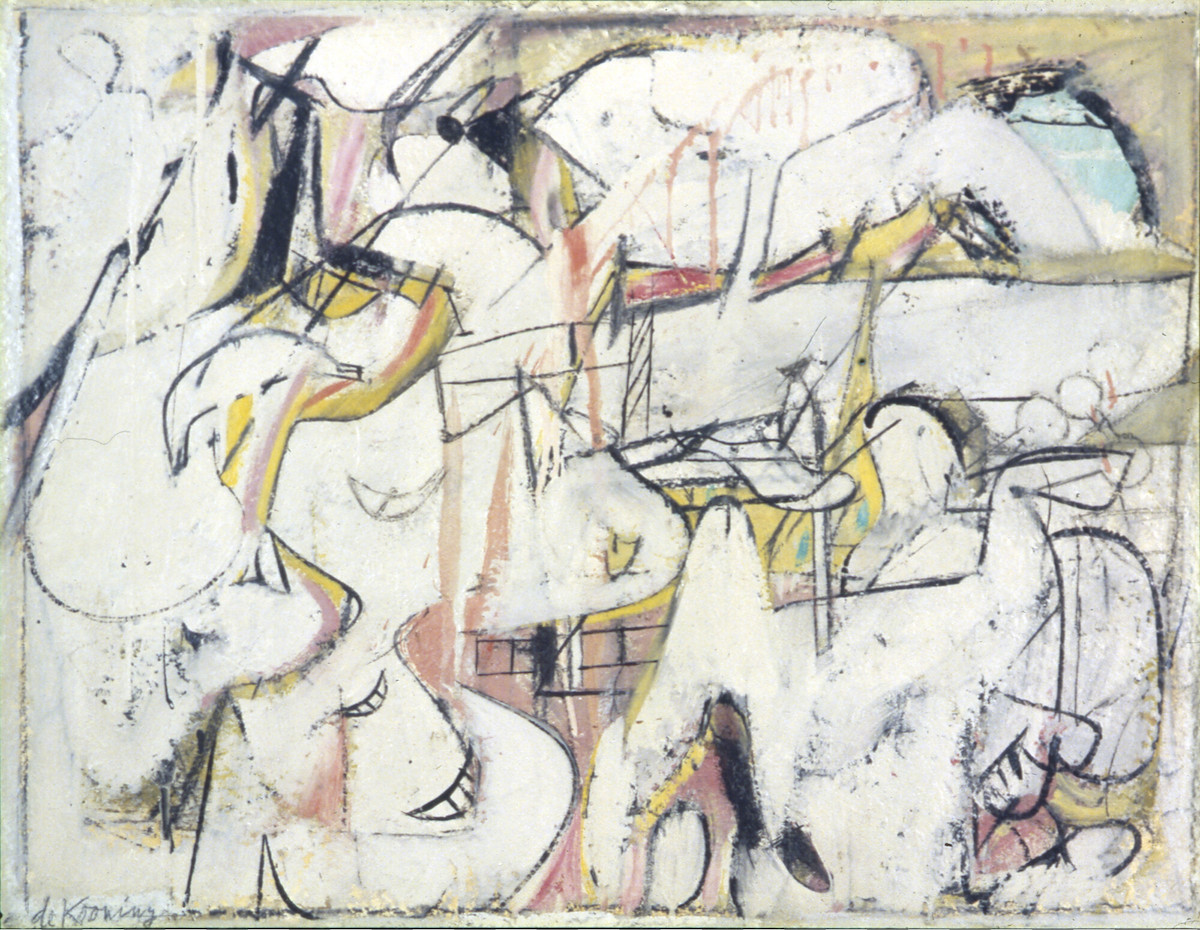 Willem de Kooning, “Mailbox”, 1948, oil, enamel, and charcoal on paper on composition board, Collection of Bettina Bryant. © 2026 The Willem de Kooning Foundation / Artists Rights Society (ARS), New York.
A bit of buoyancy is brought by Mailbox, 1948, with a suite of faces grinning mouths reminiscent of cartoon work. This is one of the facets that future generations of painters would pick-up; I’m thinking, specifically of a particular body of work by Sue Williams, as the Woman series would be picked-up, albeit wrenched of it’s original shock, by Richard Prince.
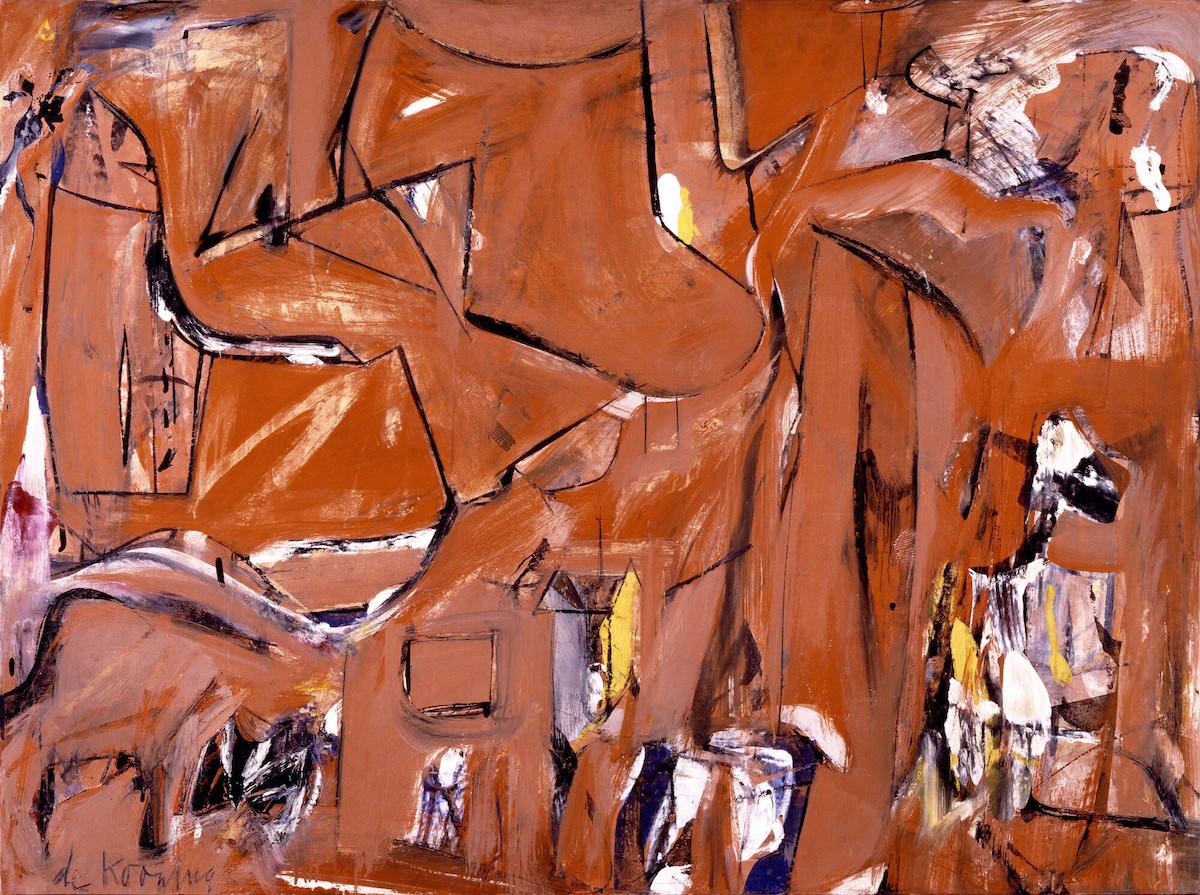 Willem de Kooning, “Gansevoort Street”, ca. 1949, oil on cardboard, Anderson Collection at Stanford University. Gift of Mary Margaret Anderson. © 2026 The Willem de Kooning Foundation / Artists Rights Society (ARS), New York.
Amongst the masterworks, Gansevoort Street, 1949–talk about titularly defining a location–defines sanguine bathed in an oxblood palette, memorializing the meat packing distract, prior to it’s SoHo-fication, when the meat was literal, the odor of the slaughterhouse was redolent.
Another lead-up-to-the-show work, Noon, 1947, introduces one of de Kooning's modes of operation, Here is lays down a rudimentary grid of block letters, including the word ART scrawled purposefully awkward in the lower quadrant, over and around which he adds his flourishes and swipes of oil and enamel. Balanced by Valentine, 1947, that displays this technique whilst holding homage to it’s title with a predominantly pink palette.
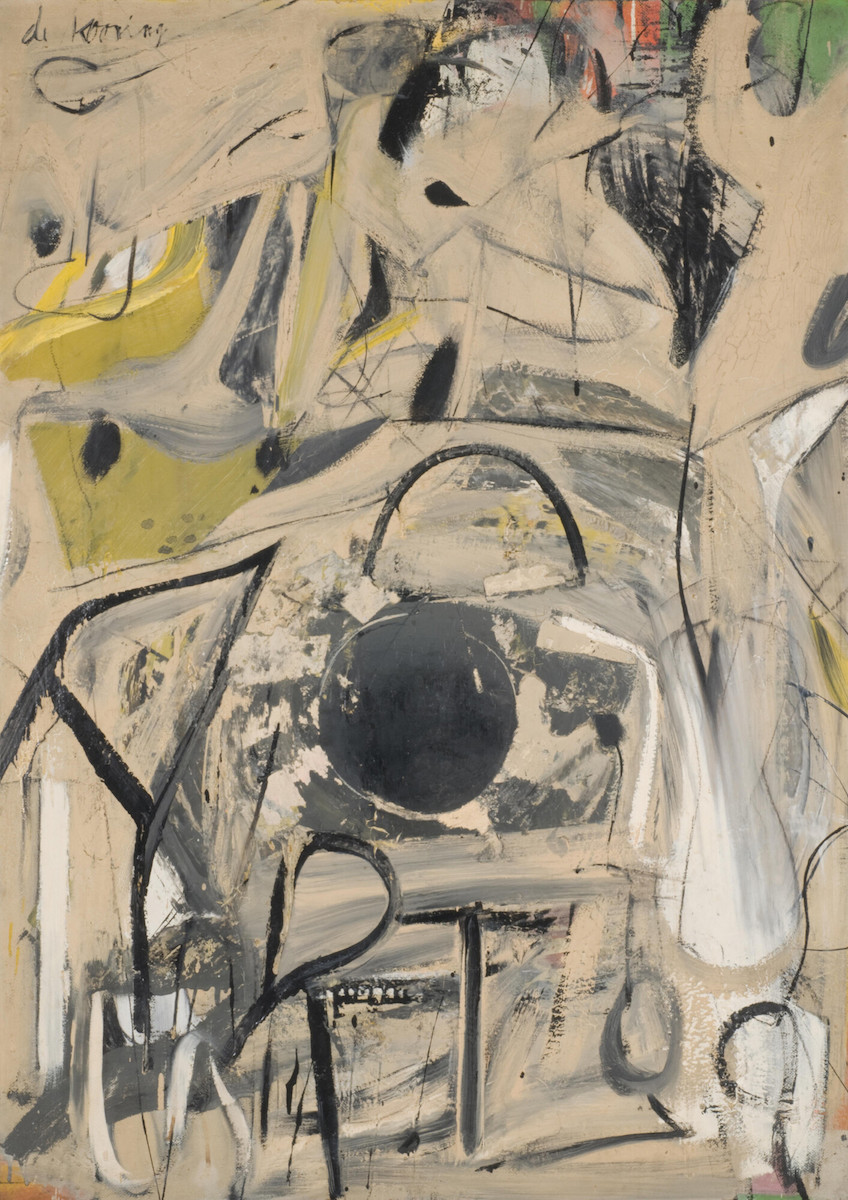 Willem de Kooning, “Noon”, ca. 1947, oil and enamel on Masonite, Philadelphia Museum of Art: The Albert M. Greenfield and Elizabeth M. Greenfield Collection. © 2026 The Willem de Kooning Foundation /Artists Rights Society (ARS), New York.
Bringing up de Kooning's sweeping pared-down late work Untiled (Reclining Figure), 1945, prefigures those East Hampton seaswept light days to come, when the work would have waiting lists, facilitating things moving out of de Kooning's line-of-fire given hi propensity to paint over and over. Though the earliest dated work, it is testament to a long career and consistent focus of exploration.
To follow would be the Women, followed by a couple of decades of gushiness unleashed; swaths of rich creamy (the myth that deKooning mixed mayonnaise into his oils) pigment applied with house painter’s brushes; Ed Clark a beneficiary of this development.
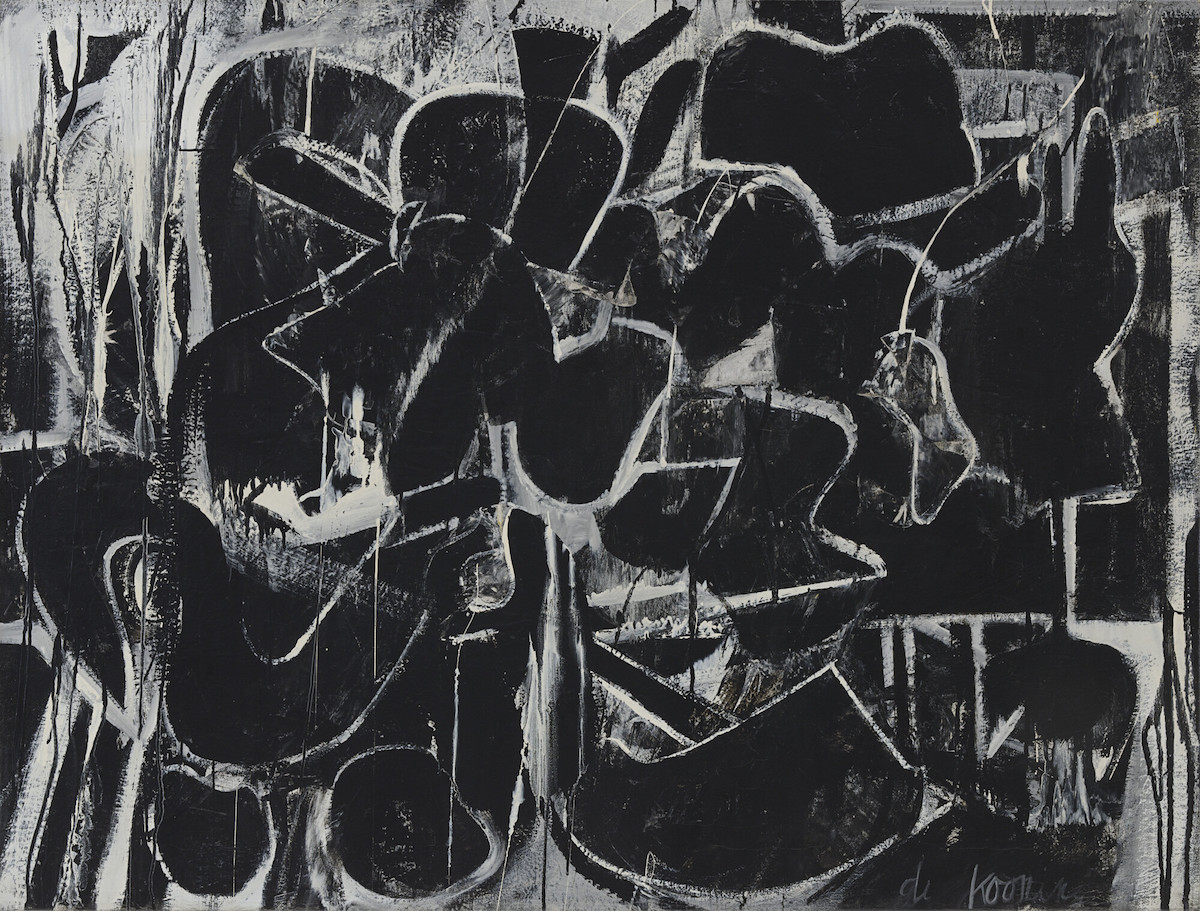 Willem de Kooning, “Painting”, 1948, enamel and oil on canvas, The Museum of Modern Art. Purchase, 1948. © 2026 The Willem de Kooning Foundation / Artists Rights Society (ARS), New York. Photo: John Wronn
In the end, de Kooning's monumental achievement boils down to a seismically iconic marker strapped to that great leveler, time, which has treated him well
_____________________
* quoted from Clement Greenberg’s review of Willem De Kooning's debut solo exhibition at the Charles Egan Gallery, NY.
Willem de Kooning: The Breakthrough Years, 1945-50
Princeton University Art Museum
45 Elm Drive, Princeton, NJ 08544
Through July 26, 2026

Edward Waisnis
Edward Waisnis is an artist and filmmaker. Additionally, he is the Producer of two Quay Brothers films, Through the Weeping Glass and Unmistaken Hands, as well as having overseen the facilitation of their 2012 MoMA retrospective. His writing has appeared in Art New England, COVER, ARTextreme and STROLL.
view all articles from this author