Whitehot Magazine
September 2026
"The Best Art In The World"
"The Best Art In The World"
September 2026
Stanley Whitney: Chromatic Autonomy - Painting as a Structure of Vision and Determination at Gagosian Hong Kong
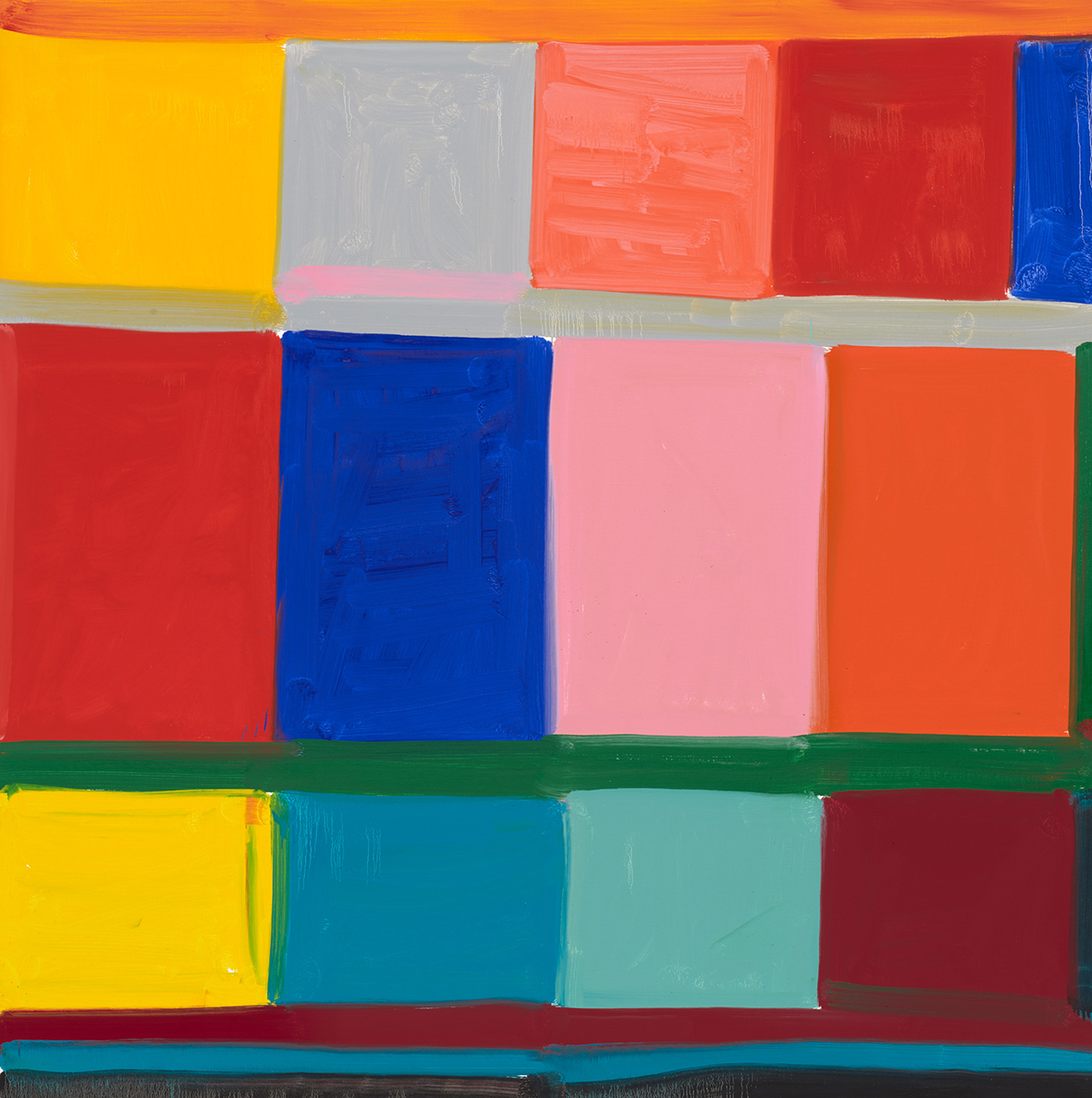 Stanley Whitney, Yesterday's Tomorrows, 2026 ,Oil on linen, 60 x 60 in, Credit Stanley Whitney, Photo Owen Conway, Courtesy Gagosian
By MARGHERITA ARTONI September 15th, 2026
With Isn’t Love the Strangest Thing, on view at Gagosian Hong Kong from September 10 through November 7, 2026, Stanley Whitney brings his sustained investigation of color, rhythm, and spatial structure into a new geographical context. The exhibition marks his first solo presentation in Asia and gathers paintings ranging from twelve to seventy-two inches square. Its title comes from a 1936 recording by Duke Ellington and His Orchestra, with vocals by Ivie Anderson, establishing from the outset a connection to jazz that runs deeply through Whitney’s practice.
Whitney’s relationship with jazz provides a fundamental model for understanding his approach to painting. His discussions of Charlie Parker and Ornette Coleman reveal an interest in forms that combine discipline with spontaneous response. The analogy is structural rather than illustrative: jazz offers a framework in which individual interventions can alter the direction of the whole. Whitney’s paintings operate through a comparable logic, in which an underlying order creates the conditions for improvisation. Rhythm, variation, repetition, and response become visual rather than musical phenomena.
The title Isn’t Love the Strangest Thing reinforces this openness. Its jazz reference introduces fluctuation and rhythm, while the paintings translate those qualities into visual terms. One color calls forth another; each intervention changes the balance of the whole. The result resembles improvisation without becoming an illustration of music. As Whitney explains, “One color calls forth another.” And, more decisively, “Color dictates the structure, not the other way round.”
Whitney’s paintings begin with structure and continually transform it. Since the 1990s, he has worked with loose arrangements of rectangular fields organized in three or four rows and separated by horizontal bands. Within this framework, color becomes the active force. The grid consequently functions less as a fixed geometric device than as a system capable of absorbing instinct, rhythm, variation, and change.
The distinction is fundamental to Whitney’s understanding of painting. His compositions are carefully constructed while retaining the immediacy of gesture. Each chromatic field maintains its own presence while altering everything around it. The painting develops through relationships rather than predetermined hierarchy: a color establishes a condition, the next responds, and the larger structure gradually emerges from that sequence.
Whitney’s years in Rome during the 1990s were decisive in this development. He lived and worked in the city for five years, encountering ancient architecture, archaeological surfaces, changing light, exposed walls, and the coexistence of historical periods within the same urban space. Rome provided a setting in which color and structure could be reconsidered through direct experience. Whitney has repeatedly described the period as essential to the formation of the mature language that defines his work.
The encounter with Roman architecture sharpened his sensitivity to accumulated time. The facades of the Colosseum and Palazzo Farnese, together with the funerary urns at the Museo Nazionale Etrusco, offered different manifestations of repetition, layering, interval, and proportion. Whitney did not translate these sources into imagery. He absorbed their spatial logic and redirected it into a vocabulary of color and geometric organization.
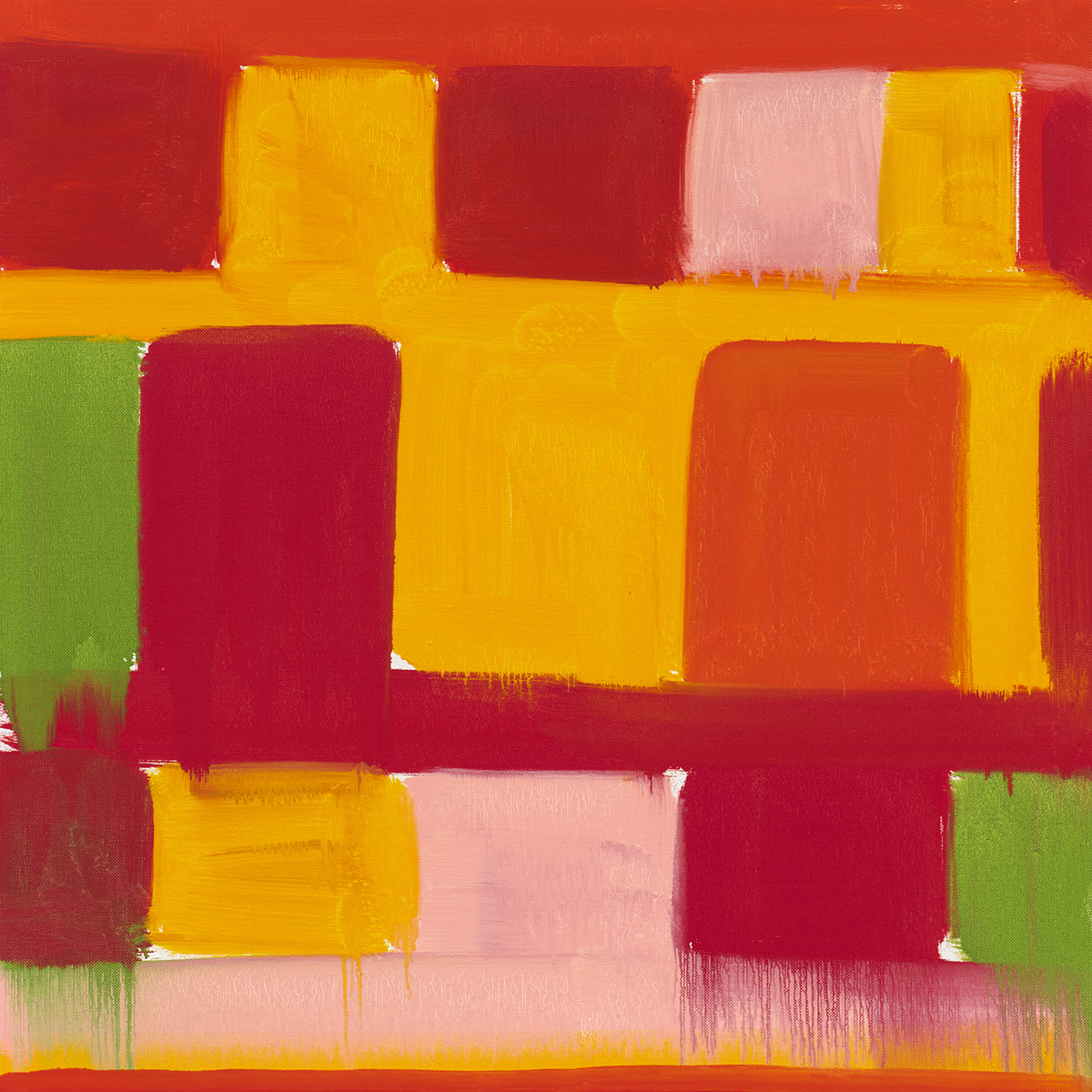 Stanley Whitney, Roma 57, 2026, Oil on linen, 24 x 24 in, Credit Stanley Whitney, Photo Owen Conway, Courtesy Gagosian
Black Southern quiltmaking constitutes another significant reference. Its modular structures, repetition, variation, and accumulated patterns resonate with Whitney’s approach to the grid. Gagosian also identifies Piet Mondrian, Giorgio Morandi, and Abstract Expressionist painters including Adolph Gottlieb and Mark Rothko among the artistic sources relevant to his practice. These references belong to different histories; Whitney brings them into proximity without reducing them to a single lineage.
In Yesterday’s Tomorrows, yellow, gray, orange, red, blue, pink, and related hues unfold across the square canvas in a dense sequence of chromatic exchanges. Warm and cool passages continually modify one another, generating shifts in temperature and intensity across the field. The composition preserves the evidence of successive decisions while remaining visually immediate. Its title introduces a temporal paradox—a future recalled from the present—while the painting itself holds duration within a structure experienced all at once.
Roma 57 brings this chromatic logic into a more intimate scale. Yellow and red prevail, producing a concentrated field of warmth and tension. Other passages work in relation to these dominant hues, keeping the composition in motion. The title connects the work to Whitney’s enduring engagement with Rome and to the period that transformed his approach to space, color, and structure. The Roma series, begun in 2017, continues that engagement decades after his residence in the city.
The grid itself remains visible without becoming the subject. Whitney has resisted defining his paintings simply as grids, emphasizing instead the act of placing and responding to color. Structure functions as a condition of the work, while perception moves between fields, borders, intervals, and tonal relationships.
This is particularly evident at the edges. Boundaries are active sites where one color alters the perception of another. Whitney’s handling of oil paint preserves the movement of the brush and subtle variations in density, allowing neighboring passages to remain distinct while influencing one another. What initially appears as a simple arrangement of colored rectangles consequently becomes a finely calibrated system of reciprocal effects.
The works in Isn’t Love the Strangest Thing extend this investigation across different scales and temporal registers. Summer of Familiar Pleasures (2024–26), Poetry Afternoon (2026), and Sometime Between Midnight and Dawn (2026) are among the paintings identified for the Hong Kong exhibition. Their titles introduce suggestions of memory, sensation, music, and duration without prescribing an interpretation. The visual field retains its autonomy.
This independence between title and image is crucial. Whitney’s paintings do not require an external narrative to become intelligible. Meaning develops through attention: proximity and distance, repetition and interruption, saturation and restraint. Sustained looking reveals a structure whose complexity is inseparable from the experience of perception itself.
Whitney’s achievement lies in making freedom compatible with formal discipline. His paintings neither dissolve structure into gesture nor reduce color to decoration. They create a field in which intuition, repetition, rhythm, and decision remain active simultaneously.
Hong Kong adds another dimension. A visual language shaped in New York, transformed through Rome, and informed by African-American cultural traditions enters an Asian context without losing the specificity of its sources. The exhibition demonstrates how abstraction can move across histories and geographies while remaining formally self-determined.
Color is the decisive element. It carries rhythm, activates the grid, establishes spatial relationships, and determines the direction of the painting. Each decision remains within the accumulated structure. The finished work therefore contains both process and presence: the history of its making held within a field experienced in the immediate present.
Whitney’s paintings propose freedom as a condition generated through attention. Structure provides the framework; color tests its limits; rhythm keeps it alive. The painting arrives through a succession of responses, each opening the possibility of another. Form becomes less a fixed answer than a living proposition. WM
Margherita Artoni
Margherita Artoni is a contemporary art critic and curator working between Italy and the United States. She began her career collaborating with Flash Art and currently writes for Segno, Juliet, Artribune, Exibart, Inside Art, ArteIN, part of cult(ure), The Art Fuse, and Whitehot Magazine.
She has directed galleries in Turin — including NEOCHROME and EDGE Art Space — and in New York at TEAM Gallery. Her curatorial work has included exhibition programs with international artists such as Rashid Johnson, Theaster Gates, Ali Banisadr, Angel Otero, Tim Rollins & K.O.S., Laura Owens, and Mika Tajima.