Whitehot Magazine
September 2026
"The Best Art In The World"
"The Best Art In The World"
September 2026
The Exhibition That No Longer Needs to Be Read: Pierre Huyghe and the Collapse of Curatorial Sovereignty at Fondation Beyeler
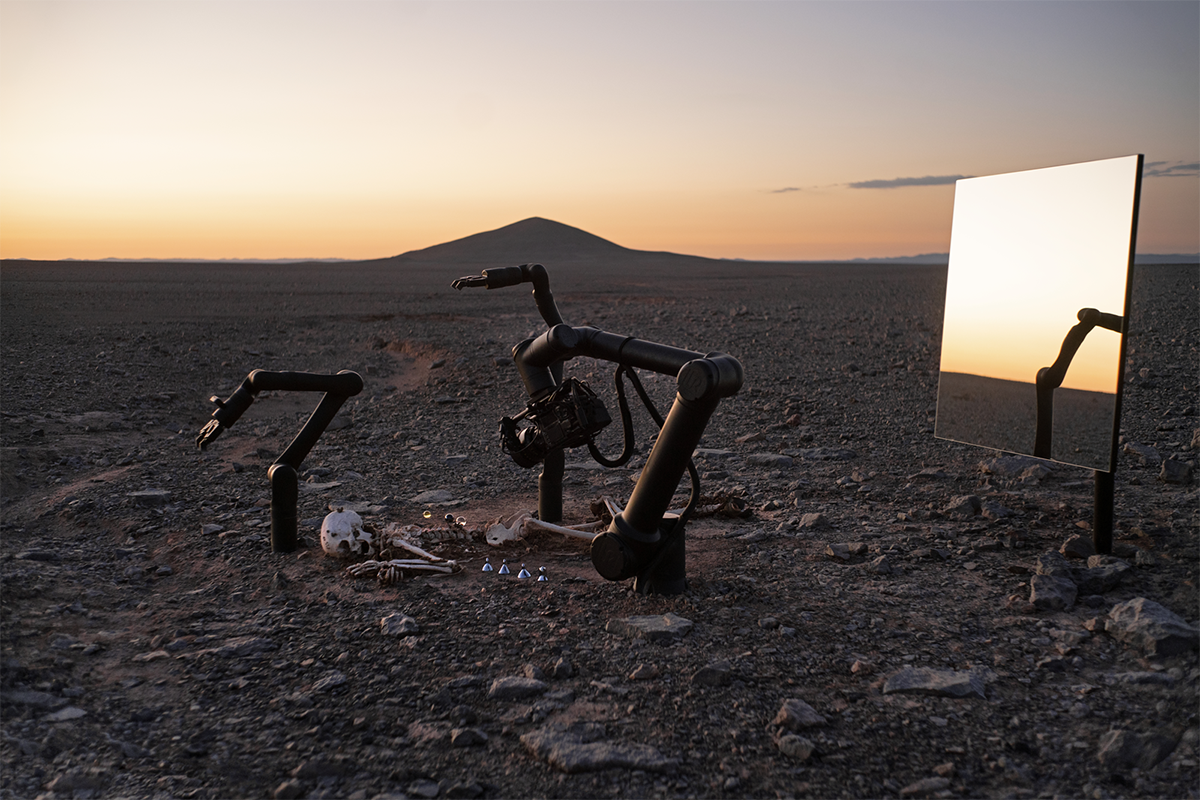 PIERRE HUYGHE, CAMATA, 2024 Robotics driven by machine learning, self-directed film edited in real time, sound, sensors Collection Maja Hoffmann / Luma Foundation, Sammlung Maja Hoffmann / Luma Stiftung, Courtesy the artist © Pierre Huyghe, represented by ProLitteris (CH) / ADAGP (FR)
By MARGHERITA ARTONI June 29th, 2026
At Fondation Beyeler, Pierre Huyghe does not extend the exhibition into life. He exposes something more unsettling: the point at which the exhibition stops functioning as a structure capable of guaranteeing authorship, description, or perceptual closure. What unfolds in Basel is not immersion, not post-human ecology, not installation in any conventional sense, but a weakening of curatorial sovereignty as an epistemic regime.
The Fondation Beyeler frames the exhibition as a convergence of cinematic, technological, biological, physical, and digital elements forming "living and dynamic situations" in which new subjectivities may emerge over time. This signals a shift internal to institutional exhibition-making: the exhibition is no longer a container of works but a condition of emergence. If it becomes condition rather than composition, authorship is dispersed across the systems it hosts.
Huyghe's exhibition does not expand installation. It exposes the exhaustion of the assumption that it can be described from a position external to its operational field. What is staged is not a set of works in relation, but a field that produces relations without compositional guarantee. Curatorial sovereignty does not disappear; it becomes irrelevant to perceptual coherence.
Apnea is respiration redistributed as infrastructure: a breathing system extended into space, no longer contained within a body or attributable to a subject. It produces rhythm without origin and synchronisation without agreement. Breathing ceases to function as metaphor and becomes environmental regulation: a distributed cadence that reorganises perception as a shared physiological field.
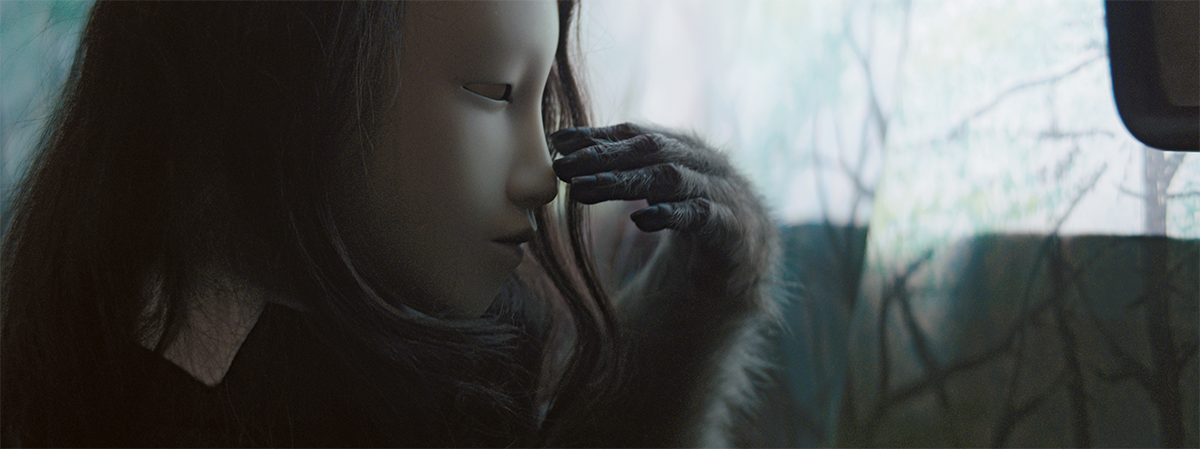 PIERRE HUYGHE, HUMAN MASK, 2014 Film, color, sound, 19 min., Collection Maja Hoffmann / Luma Foundation, Courtesy the artist and Anna Lena Films, Paris © Pierre Huyghe, represented by ProLitteris (CH) / ADAGP (FR)
Alchimia operates as a threshold entity resisting ontological stabilisation. Neither object, organism, nor interface, it cannot be separated from its environmental triggers without losing its defining properties. Its behaviour is conditional, not expressive, and therefore non-assignable. The work exits classification rather than oscillating within it.
Liminals removes the assumption of a subject undergoing transformation. There is no prior stability: the figure never consolidates. Subjectivity is withheld from formation, remaining in non-coalescence.
Human Mask intensifies this displacement at the level of behaviour. Gesture persists without interiority, action without interpretive guarantee. Meaning no longer adheres to movement; action becomes undecidable.
Camata operates as a continuously reconfigured system in which cinematic and machinic processes are updated in real time through environmental input. It unfolds as revision rather than sequence. The work cannot be isolated as object without falsifying its condition. Memory becomes operational: continuous reactivation without final state.
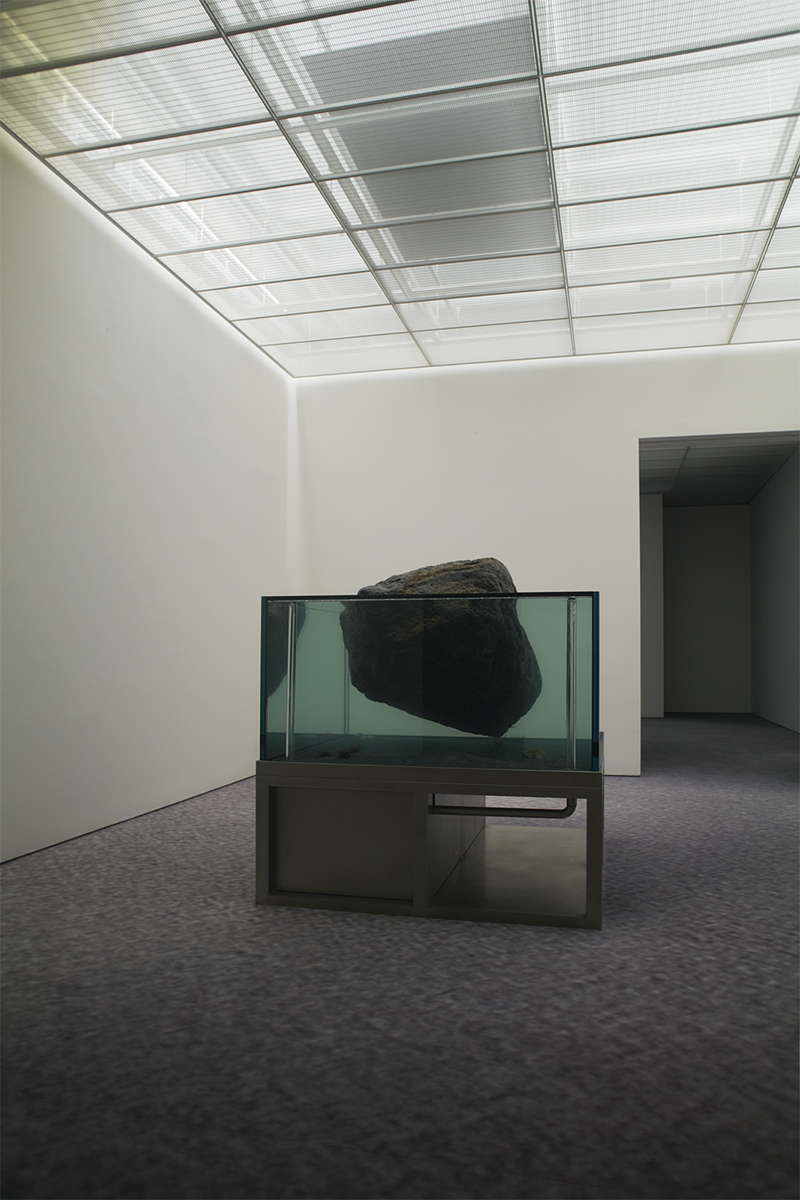 INSTALLATION VIEW “PIERRE HUYGHE”, FONDATION BEYELER, RIEHEN/BASEL, 2026 © Pierre Huyghe, represented by ProLitteris (CH) / ADAGP (FR) Photo: Ola Rindal
Light Dust extends this logic into time itself. Time is no longer narrative or duration but distributed across surfaces, dust, light, and spatial drift. What appears is time refusing consolidation into image.
Taken together, these works form a field of overlapping operational conditions that continuously modify one another. Sound, light, biological presence, machinic systems, and spatial configuration circulate without hierarchy. The exhibition no longer stabilises into a readable whole; it reorganises the conditions under which readability appears.
This marks a shift beyond post-human ecology or expanded installation. It is the exhaustion of descriptive sovereignty — the assumption that an exhibition can be accounted for from a position external to its operational field.
Once this collapses, curatorial practice becomes hosting rather than composition. Curatorial authority becomes exposure without guarantee. The exhibition produces its own conditions of legibility while being experienced.
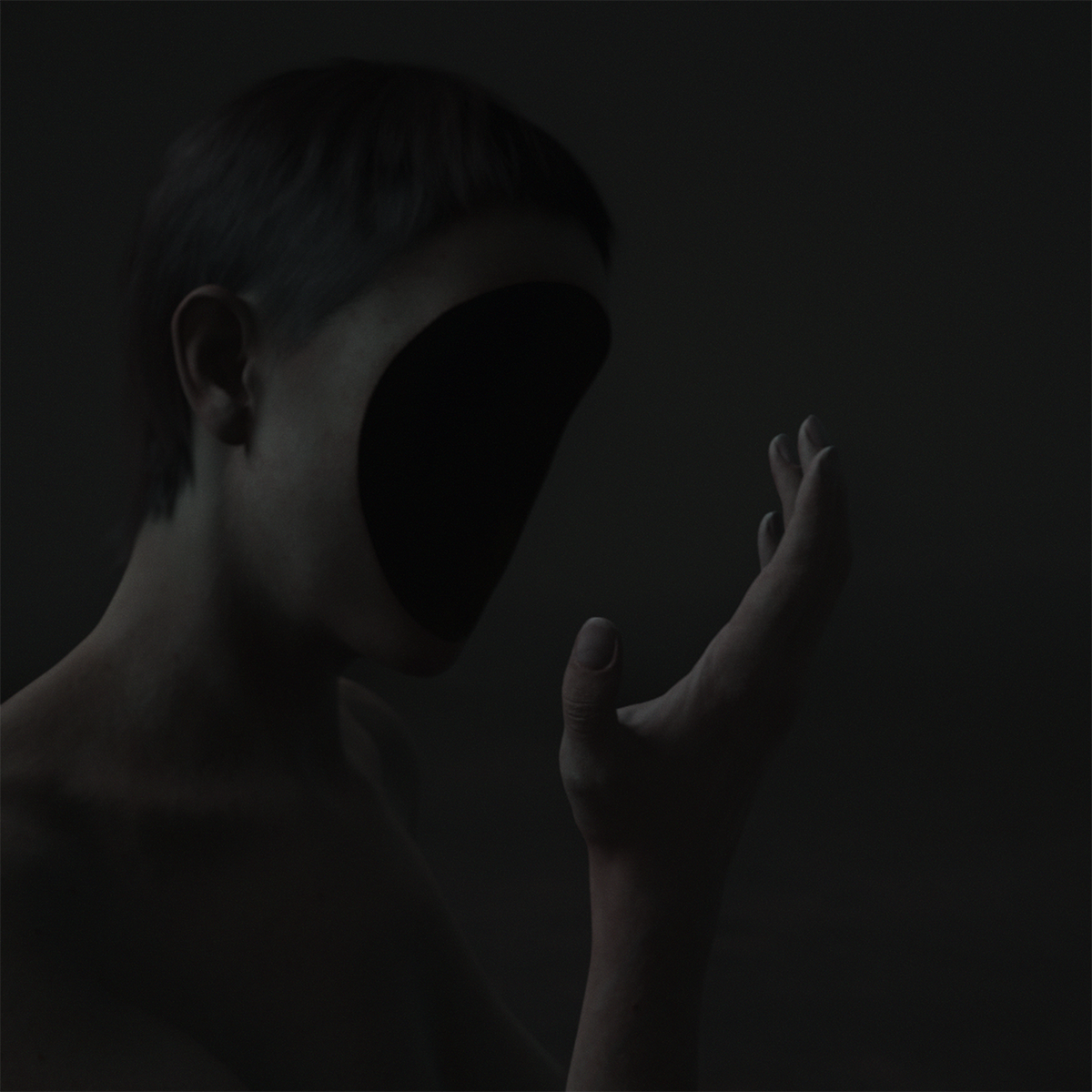 PIERRE HUYGHE, LIMINALS, 2025 Film, sound; body and landscape photogrammetric scans, motion capture, and real-time physical recording through game engine, Commissioned by LAS Art Foundation and Hartwig Art Foundation, Courtesy the artist and Galerie Chantal Crousel, Marian Goodman Gallery, Hauser & Wirth, Esther Schipper, TARO NASU, Anna Lena Films, Paris © Pierre Huyghe, represented by ProLitteris (CH) / ADAGP (FR)
What Fondation Beyeler stages is not the expansion of art into life, but the point at which the exhibition ceases to function as a representational device. What replaces it is a field of distributed operationality in which perception is generated by interacting systems that do not require interpretive closure to persist.
The most uncomfortable implication is not that critique is exceeded, but that it remains inside the system it attempts to stabilise.
At this point, the exhibition no longer fails to be read. It neutralises the conditions under which reading could claim exteriority.
The exhibition does not ask to be read. It continues without us.
Margherita Artoni
Margherita Artoni is a contemporary art critic and curator working between Italy and the United States. She began her career collaborating with Flash Art and currently writes for Segno, Juliet, Artribune, Exibart, Inside Art, ArteIN, part of cult(ure), The Art Fuse, and Whitehot Magazine.
She has directed galleries in Turin — including NEOCHROME and EDGE Art Space — and in New York at TEAM Gallery. Her curatorial work has included exhibition programs with international artists such as Rashid Johnson, Theaster Gates, Ali Banisadr, Angel Otero, Tim Rollins & K.O.S., Laura Owens, and Mika Tajima.