Whitehot Magazine
October 2026
"The Best Art In The World"
"The Best Art In The World"
October 2026
40 Minutes and .6 Miles: A Conversation with Erin M. Riley
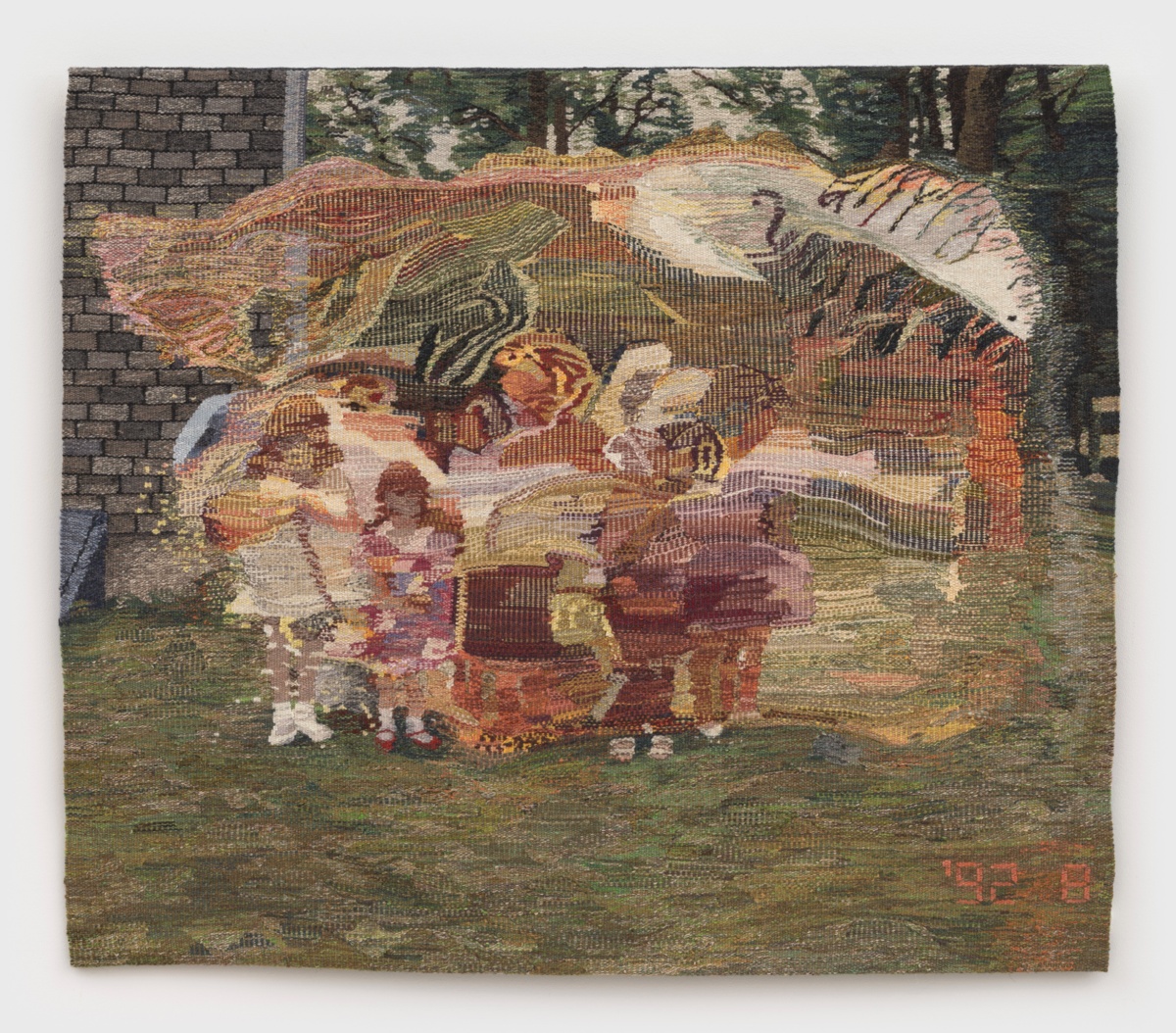 Absence, destroyed by water, 2023, wool, cotton, 48"x 41," courtesy of Erin M. Riley and P.P.O.W Gallery
By LIZZIE CONKLIN May 18th, 2026
Erin M. Riley never works with assistants, but since she began weaving in 2005, she has woven more than 235 textiles. If the average size of her textiles is around 50”x 50” (a conservative estimate) and she has woven 235 textiles, Riley has woven over 330,000 square inches in her lifetime. That’s about .6 square miles. You could cover half of Central Park with Riley’s textiles.
Though this may sound like a word problem, these statistics are integral to understanding her prolific and iterative process. On her website, she has catalogued 81 tapestries as her first body of work compiled between 2005 and 2017. Since 2018, when Riley received a spot in the MacDowell residency, she has made 132 tapestries, spanning from 8”x11” to over 100”x69.” In 2023, she kept track of all the yarn she used: 28 tubes, 800 yards each. That’s 22,400 yards, or 67,200 feet, or 12.72 miles of yarn, touched only by Riley’s hands, until the artworks migrate from her studio to a wall. Some of them stay in her studio, resting outside the internet’s purview, adding to the already monumental mileage of her work.
Online or not, Riley’s textiles are hers alone. There are no components of the process that she can outsource to anyone else; the dying, warping, and weaving are not only specific to Riley’s precise vision, but they provide a ritual of relief for the artist’s seasoned hands. Each piece is entirely her conception, from dream to material to physical reality, untainted by the factory systems that accompany textiles in a functional and commercial environment. Riley’s textiles are not for consumer purposes. They are sacred. Their size, quantity, and stream-of-consciousness compositions expand them from the human scale into a dimension that we are only submerged in when we close our eyes; Riley weaves dreams.
Riley grew up in Cape Cod, Massachusetts, but she has not been back since she was a child. Now, she lives and works in her studio in Brooklyn, with a bed, bath, and a 100” floor loom. As she told me in a coffee shop a few blocks from the train, “You can turn any room into a studio as long as you cover up the bed.”
When she was starting her career, she lived on her wages from Whole Foods, stocking shelves, bagging produce, and directing customers to aisle x. “I needed a job that I could quit if I got a residency,” Riley told me, and like the majority of young artists, extracted work from her psyche when she had rare time to spare. Between shifts, Riley wove the threads of ideas that would become signature symbols of her oeuvre: nudes, screenshots, and tangled bodies untangled by their medium: plain-woven, hand-dyed woolen wefts bound by cotton warps.
She received her BFA from Massachusetts College of Art and Design in 2007 and her MFA from Tyler School of Art in 2009. P.P.O.W. represents her in Tribeca, where she recently exhibited a solo show of textiles from her 2025 show Life Looks Like a House For a Few Hours, which featured a selection of looming, 100-inch-wide pieces made with cotton warps and hand-dyed wool wefts. Each fiber is a pixel of a photo reference that shows a body (often Riley’s own), a dimly lit reflection on a window, or a note from a source that may not literally appear in her tapestries, but thematically taints every warp and weft. Two of her textiles are currently on view at Museum Angewandte Kunst in the show Wool. Silk. Resistance. Her work will be featured in the show Powerful Textures. Language in Textile at the Klingspor Museum from May 9 to August 16, 2026.
Her compositions are curated photocollages. She invokes humor in her subject matter (the phrase “invokes humor” might be the least funny phrase ever written), with images of a fortune that reads “You never fail to tackle your most difficult problems,” or a woman perched outside of an open fridge. She even weaves abstraction in absence, destroyed by water (2023), a textile that looks like a bleeding inkjet print, through the illusion of alternating between colors between rows of thread, gradually mixing colors like analog pixels. Images of women's bodies behind foregrounded “pause” and “play” icons gradually become more shadowed, dimensional, saturated, and visually complex, until they morph into Riley’s own.
She acknowledges this by weaving in her tattoos, claiming each figure, to avoid repurposing unethically produced imagery. The overlap of photographic pixels and units of woven thread integrates Riley’s medium with her subject matter; through the predominantly feminine tradition of weaving, Riley can own images of her body by turning their pixels into thread with her very own hands. These images are under her surveillance, ownership, and domain. They are hers and hers alone because only she wove them.
After looking at my lap to find a napkin shredded by a bout of cold brew-induced fidgeting, I asked Riley if her audience ever spills their own memories to her upon seeing her tapestries. They do. Do they ever overshare? No. Riley wants to hear their stories. This does not mean that some strangers do not breach the boundaries of her work by sending her strange gifts or refusing to leave her alone, overstepping the power of her textiles, neglecting the work’s intention as art, and refusing to look at her work as anything other than an invitation.
These tapestries demand to be archived in writing as a product of our constant yet subconscious interaction with textiles and their derivations.“Text,” a stand-alone, monosyllabic word and a Latin root for the word “textile,” means to weave. As I weave the memory of our conversation, I write down Riley’s practice in an attempt to consolidate a record of an often-neglected practice kept alive by women who need to keep their hands moving inside their homes, an art that is receiving overdue attention through Riley’s alternative, photographic approach to an ancient medium. Although Riley does it alone, she does not do it in a vacuum; she weaves because of a tradition of garments that clothe every person on Earth, and swim around us constantly, whether literally—as t-shirts and scarves—or conceptually—as Ada Lovelace’s inspiration for the binary code that allows our phones to light up when we lift them from our bedstands.
Textiles infiltrate our subconscious because we unknowingly interact with their foundations every time we use a computer, and knowingly sport them as clothing on our bodies every day. Because of their omnipresence, they tie easily into a dream-world of emotional processing and the uncontrollable stream of consciousness, which Riley harnesses to mend her medium and her ambiguous, surreal imagery. Tapestries, woven color-field by color-field, integrate with an image more seamlessly than paintings can, because applications of color are generally performed before the work is woven. Optical mixing happens at its basest level; in absence, destroyed by water, pink is mixed by weaving red and white threads close together. Orange is mixed by weaving red and yellow threads on top of each other. Riley presents us with illusions that we can break down and build up into images that we project onto and pull apart thread by thread.
She left the coffee shop where we met after about 40 minutes of glimpses into stories and technical mastery. Although her shows attract hordes of bleached-blonde art students and bespectacled collectors, Riley is alone when she works. The bunching, tying, overlapping, crossing, and collecting required by her tapestries happen in solitude, untethered to outside influence. She dyes her own wool. She warps her own loom. She beats her own wefts. The textiles are Riley’s memories. Only she can weave them.

Lizzie Conklin
Lizzie Conklin is a painter, weaver, and writer. She was the 2024-2025 Editor-in-Chief of the Yale Record. Now, she is a teacher in New York City. https://www.lizzie-conklin.com
view all articles from this author