Whitehot Magazine
August 2026
"The Best Art In The World"
"The Best Art In The World"
August 2026
Wallace Chan in Shanghai - Part 2
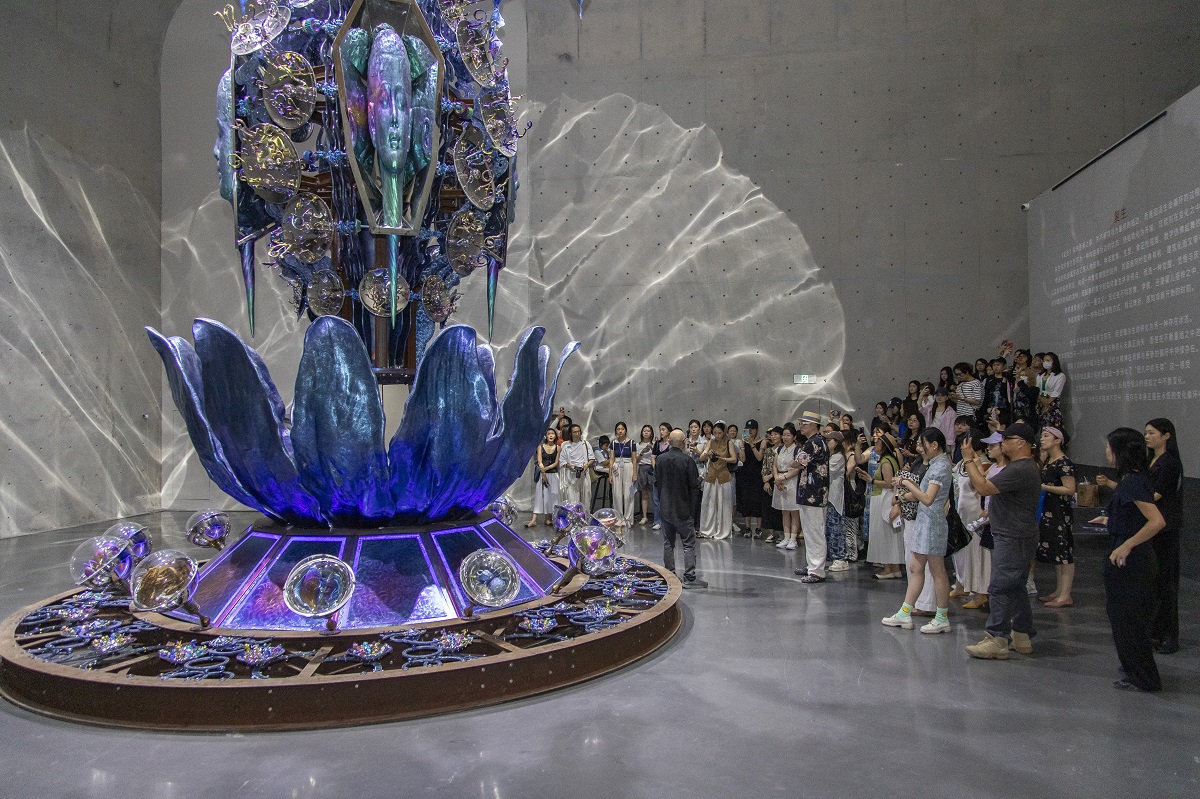 Wallace Chan, Vessels of Other Worlds Press Preview
By SHANA NYS DAMBROT August 20th, 2026
Wallace Chan’s rapturous, expansive career survey-and-then-some exhibition Vessels of Other Worlds at the Long Museum in Shanghai—itself a masterpiece of adaptive reuse industrial Brutalism, whose poured concrete stacks and undulations make themselves part of the experience at every turn—chronicles a journey of decades, and makes that journey not only imparted to, but literally retraced by, its visitors.
Viewers traverse a series of winding passages and corridors that trace the evolution of Chan's practice across three previous Venice Biennale projects: Titans, Totem, and Transcendence. These introductory spaces move from the dialogue between imperishable titanium and rusting iron beams in Titans, the fragmented, archaeological monumentality of Totem, and the suspended, meditative faces swaying almost imperceptibly to the atmospheric sonic breeze of Brian Eno's soundscape in Transcendence. Curator James Putnam was, as always, keen to support both the experiential and narrative ambitions of Chan’s ideas.
 Wallace Chan, Vessels of Other Worlds, Press Preview, Vessels and Passage
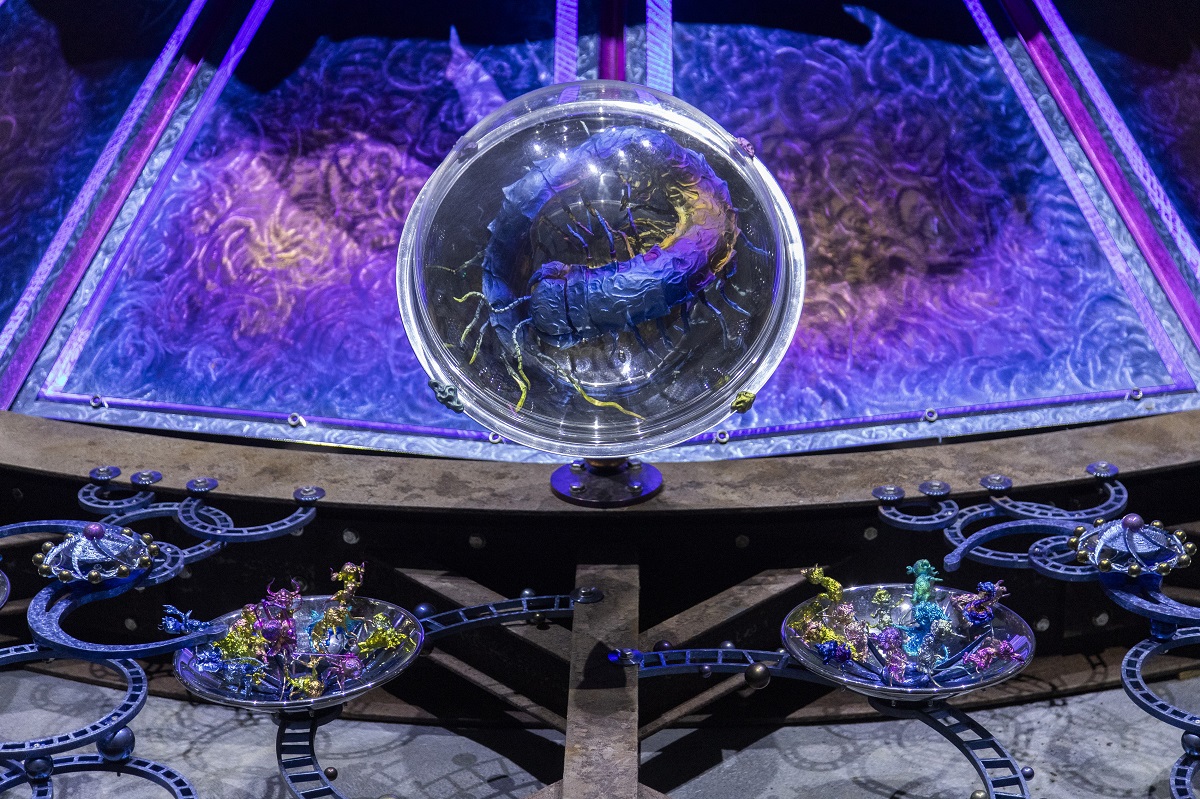
At the heart of the Shanghai exhibition—and near the end of the journey, deep in the heart of the building—a series of vaulted chambers each contain one of three colossal titanium vessels ranging from seven to ten metres in height and patinated in subtly shimmering shades of gold, hot ruby, and aquamarine, these monumental structures combine rigorous engineering with rich spiritual and mythological symbolism culled from global traditions. Thousands upon thousands of titanium pieces, gears, and screws are interwoven with walking babies, resin-encased artifacts, surreal botanicals, zodiac animals, sacred signs, and a proliferation of mirrored discs that scatter light in all directions. Visitors can enter the revolving interior of the final vessel, whose slow spin is a metaphor for time’s invisible passage, wherein a kaleidoscopic environment reflects Chan's historic Wallace Cut gemstone-carving technique—but on an architectural scale.
To fully grasp the scale of these monumental structures, the exhibition contextualizes Chan's fifty-plus-year trajectory, mapping his journey from a self-taught carver in 1970s Hong Kong to a master innovator. Over the decades, his relentless technical curiosity yielded groundbreaking inventions, from the 1987 illusionary three-dimensional Wallace Cut and patented jadeite luminosity technologies, to his mastery of titanium and the development of Wallace Chan Porcelain, a material five times stronger than steel. Following a monastic retreat in the early 2000s that turned his focus toward modest materials like concrete and stainless steel, his work expanded toward the metaphysical, eventually bringing space-age titanium into both miniature and monumental realms.
 Wallace Chan, Vessels of Other Worlds - Rebirth
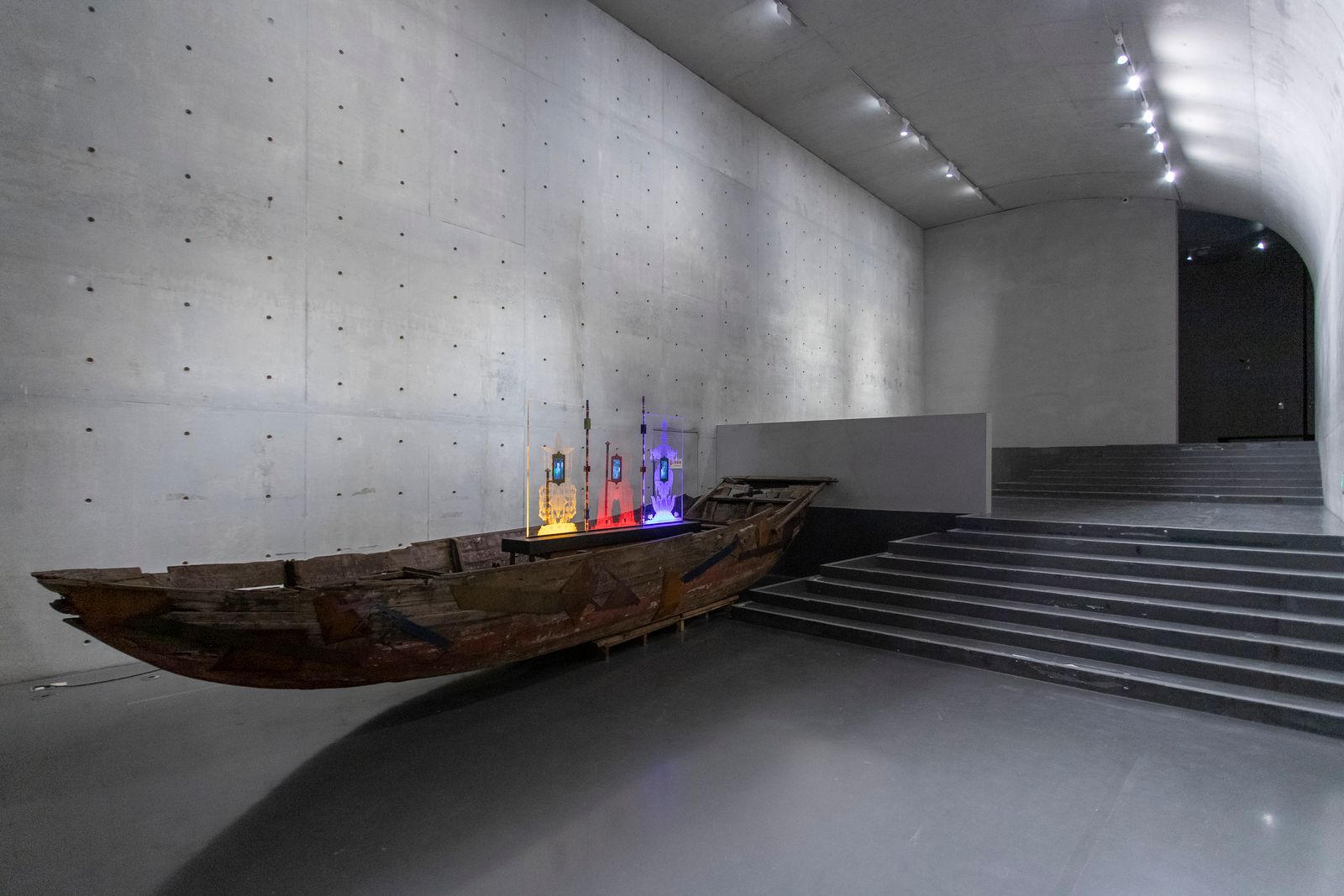
As we noted in “Part 1: Wallace Chan in Venice,” the Long Museum exhibition unfolds simultaneously with a parallel presentation at the Chapel of Santa Maria della Pietà in Italy, bridging geographic distance through real-time transmission and twinned installations. Resting above an old wooden boat that recalls Chan's childhood journey from Fuzhou to Hong Kong, three translucent screens glowing in yellow, red, and blue display a live 24/7 video link to the Italian site, establishing an immediate, poetic dialogue between two cities bound by water. Visitors to the show in Venice are invited to peer into a correspondence of three portals, where they can view Shanghai’s rooms in return.
The overall historical framework also makes room for a rare convergence that grounds the fine art in his broader legacy, as the vault galleries bring together a heavily guarded selection of the exquisite jewelry for which he is internationally celebrated. Though Chan rarely fuses these two distinct halves of his practice—noting famously that jewellery is the body's sculpture while sculpture is the earth's jewelry—this exhibition allows the meticulous micro-craftsmanship of his wearable art to converse directly with his monumental installations. “For me, this exhibition is also an account of more than half a century spent contemplating matter, time, life and the spirit,” Chan shared in his opening remarks. “I have always believed that art is a form of spiritual practice. It must withstand the test of time, and it must also withstand the test of the human heart,” he says.
“I have always reminded myself to create as the universe creates: to build the monumental from the microscopic,” he continued. “I have always believed that art should begin with a good heart and give rise to goodwill. The art I aspire to create is art that allows people to become still, to see themselves anew and to enter into conversation with themselves once again. If my work can offer even a little light or a little strength, that will be enough to fulfill my wish.” The good news is, there’s a vast amount of light and more than a little strength in evidence at the Long Museum.

Shana Nys Dambrot
Shana Nys Dambrot is an art critic, curator, and author based in DTLA. She is the editor and co-founder of 13ThingsLA—a weekly Substack of curated exhibition reviews and art event recommendations in Los Angeles. Her writing appears in LA Times, Alta Journal, Artbound/PBS SoCal, Music Connection, Palm Springs Life, Flaunt, WhiteHot, and other culture publications, and was the longtime Arts Editor at the L.A. Weekly. She is the recipient of the Rabkin Art Writers Prize and the LA Press Club Critic of the Year award.
Photo by Eric Mihn Swenson
view all articles from this author