Whitehot Magazine
August 2026
"The Best Art In The World"
"The Best Art In The World"
August 2026
Wallace Chan in Venice
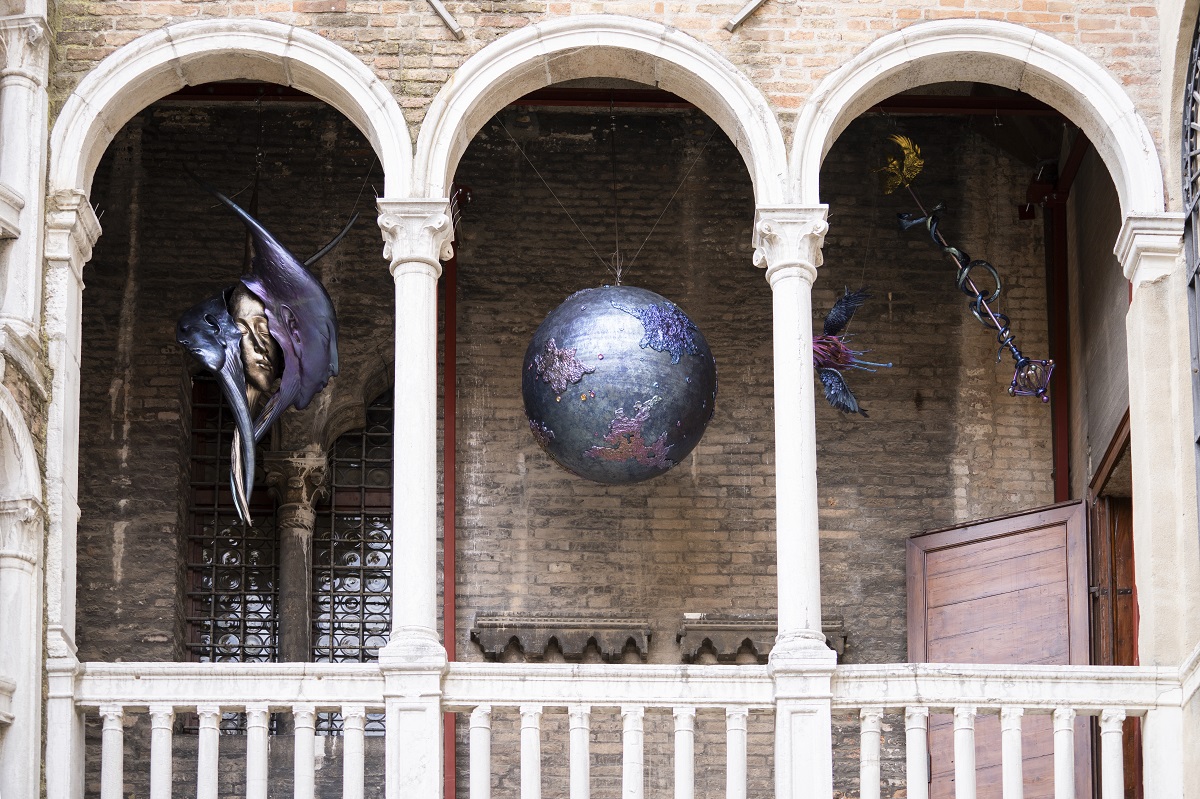 Wallace Chan, Vessels of Other Worlds and Mythos, Venice Italy 2026, photo by: Federico Sutera
By SHANA NYS DAMBROT July 1st, 2026
At the intersection of meticulous precision, and lyrical effusion hover the strange, luminous, and liminal sculptures by artist Wallace Chan. In two concurrent exhibitions in Venice, Italy, the artist defies everything from conventions to expectations, boundaries, time, and gravity. But the multifaceted story of this work is ultimately not one of rebellion, but of radical acceptance and transcendent commonality among humans.
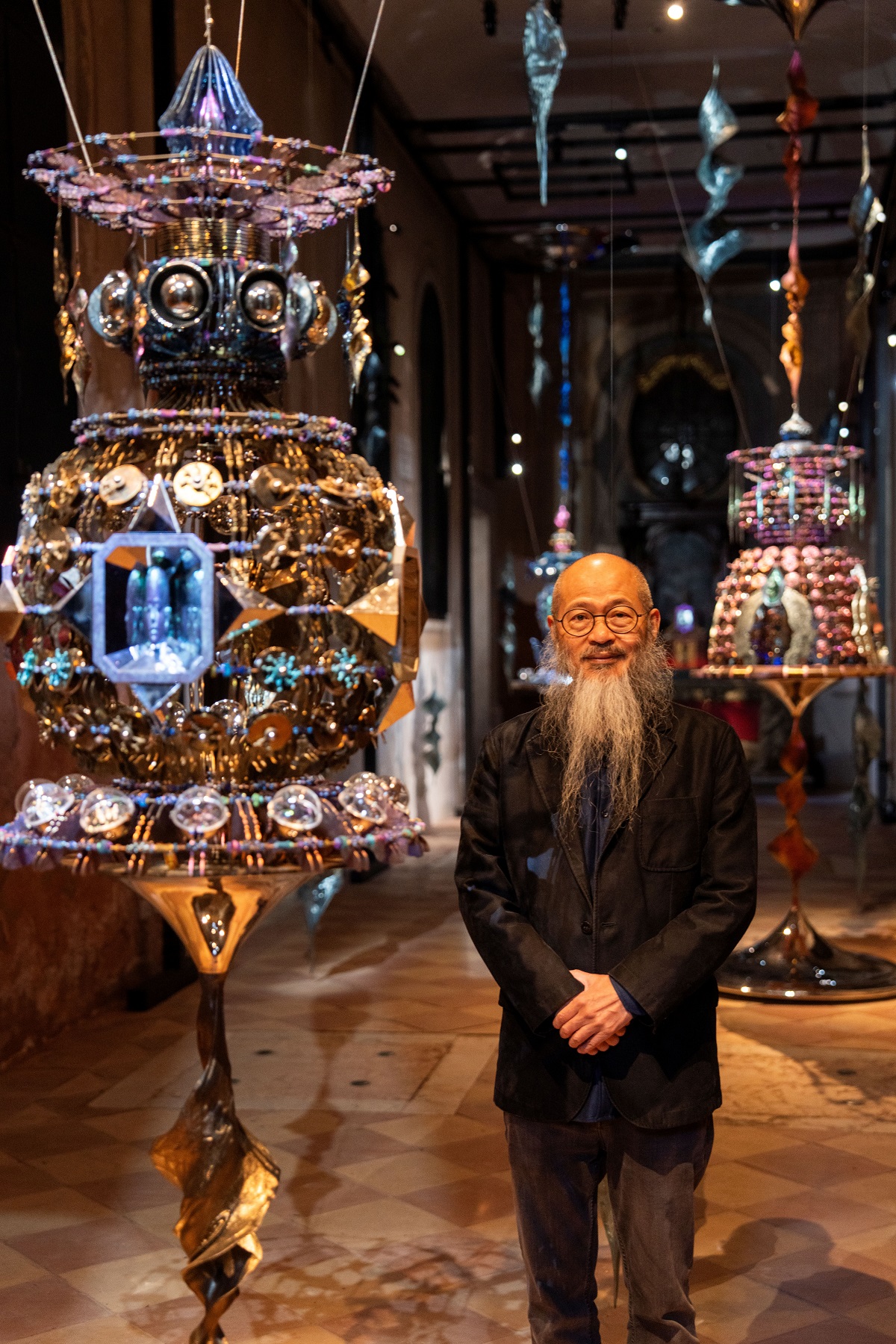 Wallace Chan, Vessels of other Worlds, photo by: Federico Sutera
Working with titanium—a medium bound to technical innovation both in upper echelon jewelry design such as Chan has practiced for decades, as well as architectural engineering and physiological medicine—Chan further transmutes its tensile preciousness into a luminous, elemental repository for memory and the soul.
Inside the interior of Giorgio Massari’s 18th-century Chapel of Santa Maria della Pietà, an environment steeped in both elaborate design and genteel entropy, Chan’s preoccupations with sacred geometry and spiritual ritual manifests through three distinct vessels titled Birth, Growth, and Rebirth. Built from 5000-8000 finely made individual elements—ranging from faces and filigree, to droplets and flowers—these prismatic, refractive, mysterious sculptures hang in the dimly lit chapel like romantic reliquaries or celestial chalices.
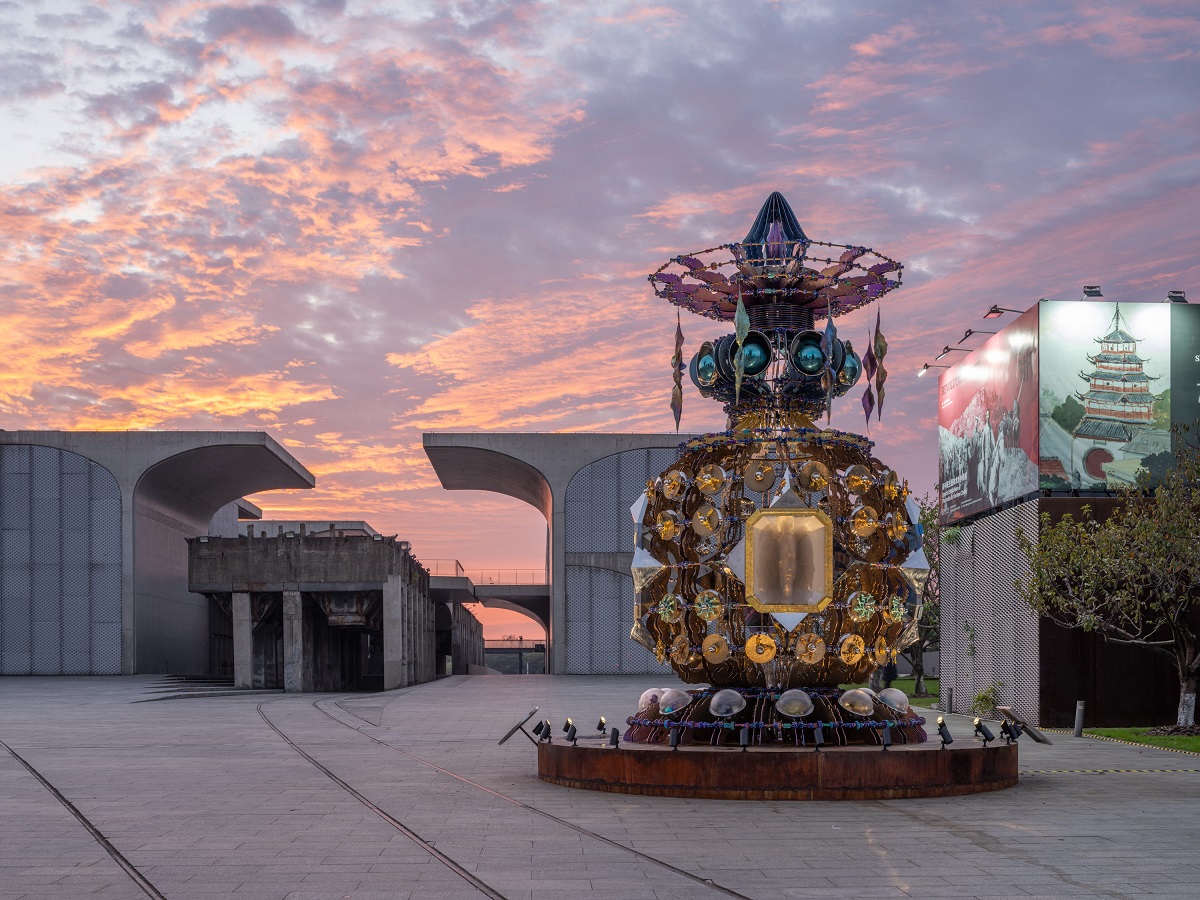 Wallace Chan, Vessels of Other Worlds, Long Museum Shanghai, Birth Sculpture
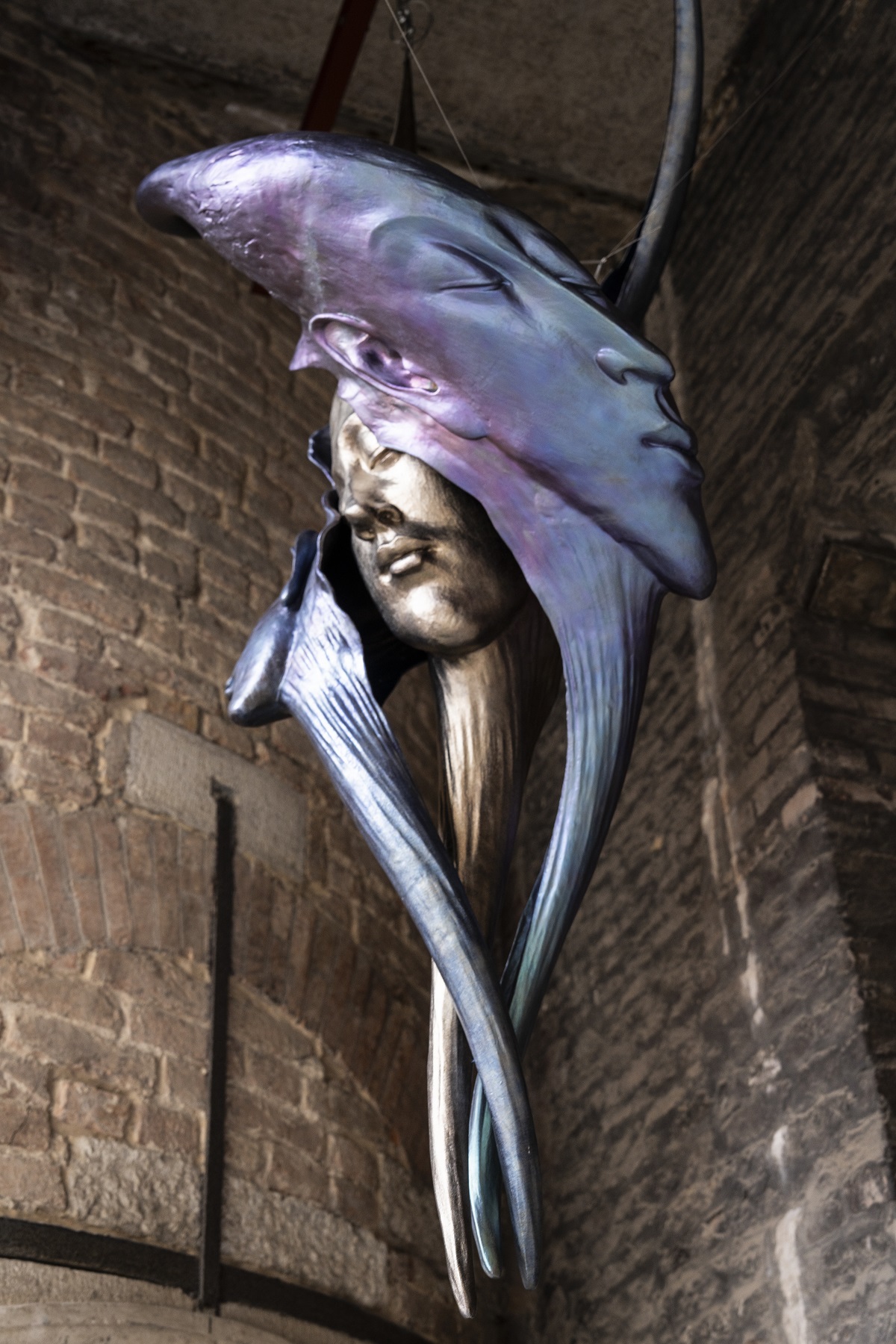 Wallace Chan, Mythos, photo by Federico Sutera
The silhouettes resemble ornate bells, yet each closer inspection reveals an astonishingly dense internal labyrinth. Concentric rose-gold spirals house miniature tracks stamped with tiny figures, turning wheels, and minute clockwork numbers that mimic the relentless passage of time. Apparitions from inside suspended apertures—the profiles of ghostly figures with metallic skins, who seem to float and move as the works gently sway—transform these devotional abstractions into kinetic sites of (re)generation.
Chan treats his most beloved metal with an acute sensitivity to light and internal reflection that mirrors the faceting of a gemstone, blurring any perceived boundaries between the micro-world of the jeweler and the human- and monumental-scale vision of a sculptor. Chan anchors the objects in an ongoing dialogue between what is preserved and what is lost, telling Whitehot through an interpreter that, “I juxtapose these minute details of the body with watchmaking gears, blowing up elements that are usually invisible, so people can reconstruct the messages within themselves.”
 Wallace Chan, Mythos, photo by: Federico Sutera
To create these literal and metaphysical vessels, Chan pulls from his own memories—what has been learned, remembered, and forgotten over many years of practice. “It is about observing not only the big and obvious, but also the small and neglected, entering the micro-world to explore its details,” he says. “There is an infinity in taking the small and making it big, and taking the big and making it small.”
The chapel installation also contains three video screens arranged along the rear altarpiece like a Flemish triptych, and which connects across time and space to the on-site Venice works’ monumental counterparts on view at the Long Museum in Shanghai, half a world away. Furthermore, although the three titanium sculptures are inspired by the sacred oils used in the Catholic Church for blessing rituals—the Olea Sancta—Chan is adamant that he is not doctrinaire as regards the melting pot of global spiritual traditions that inform his iconography. “I do not want to project a singular, clear narrative,” he says. “I want to allow absolute space for the imagination.”
 Wallace Chan, Mythos, photo by: Federico Sutera
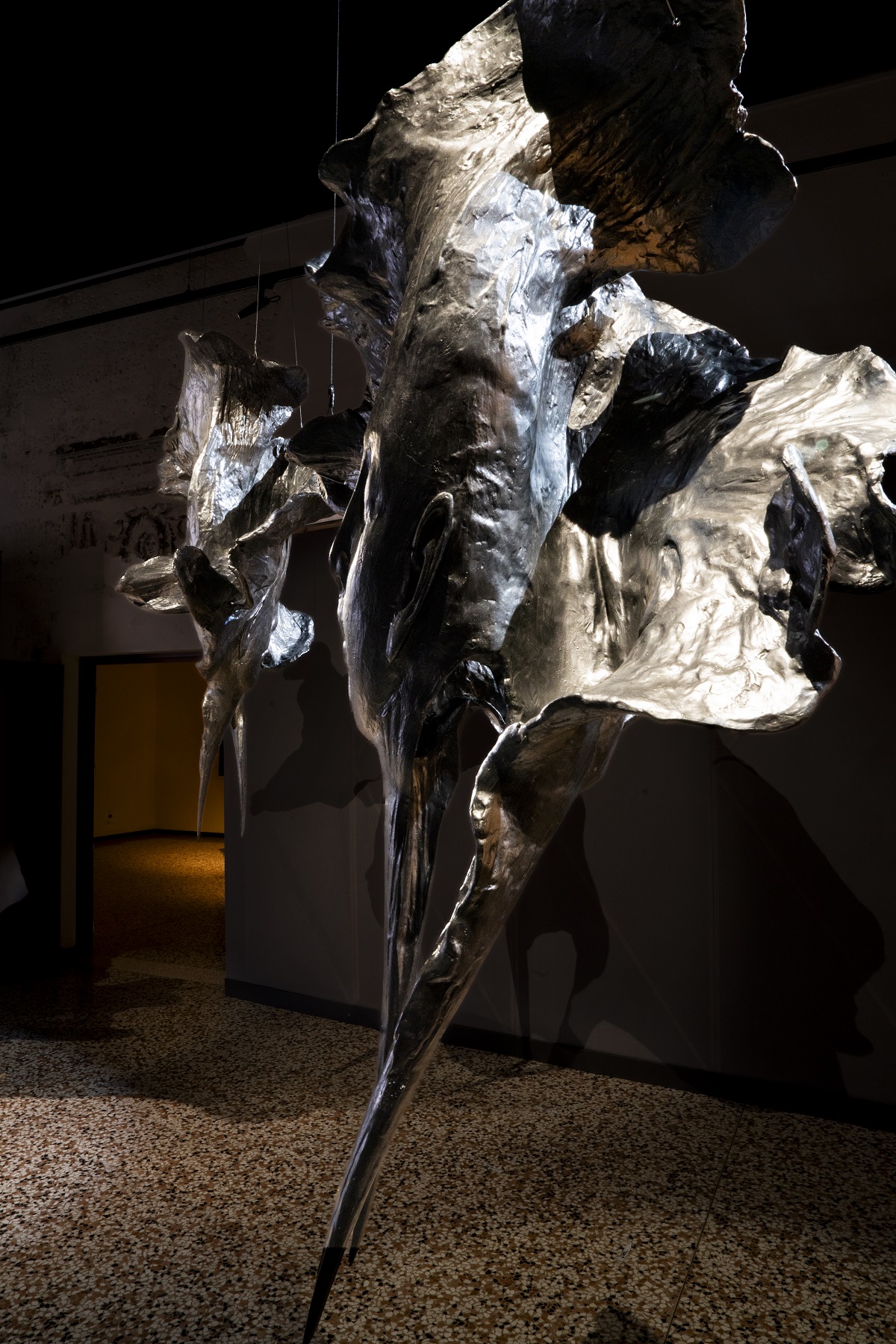
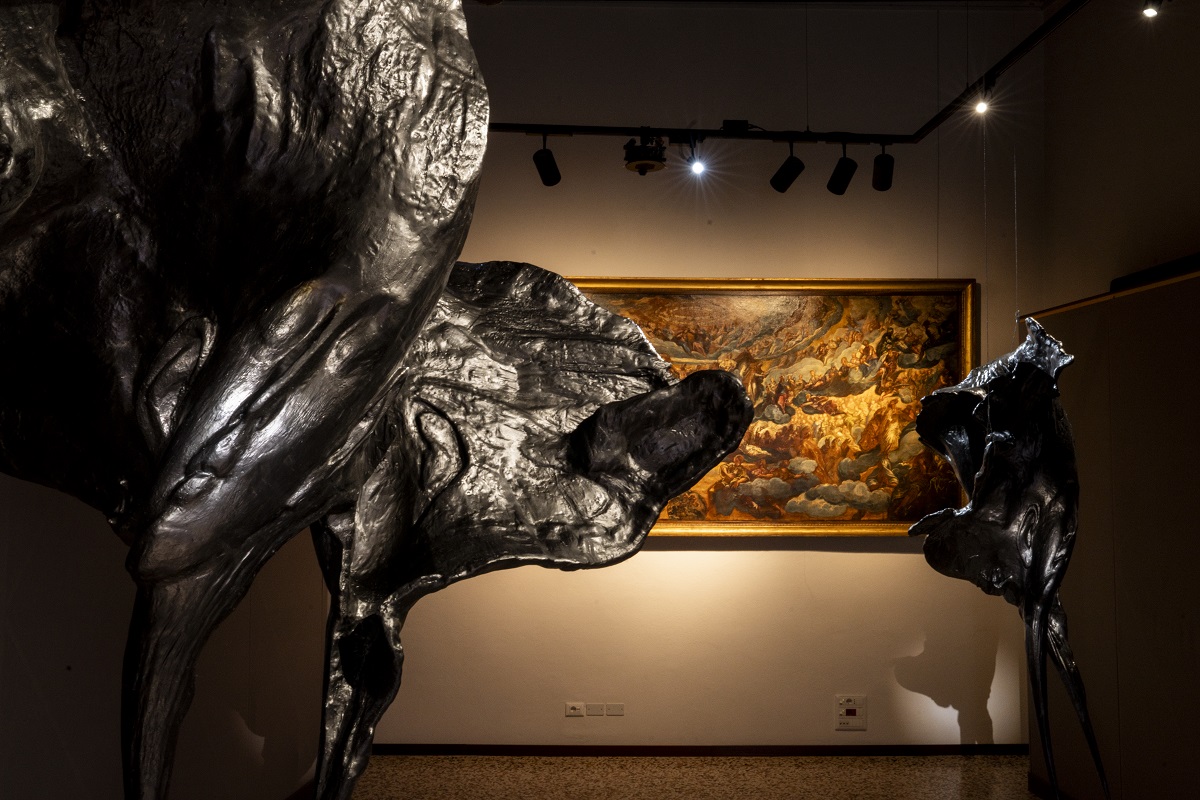
A different kind of psycho-spatial, art-historical, and alchemically material discourse unfolds nearby at the Scala Contarini del Bovolo, where Chan’s site-specific project Mythos engages directly with the famous 15th-century cylindrical tower, the most famous spiral staircase in Venice. After climbing the recently restored landmark, you reach a small exhibition hall, where three of Chan’s more expressive, elusive titanium sculptures hang in a constellation facing Tintoretto’s expansive pastoral masterpiece, Paradise, which resides permanently in the room. The dark, sweeping contours of the metal cast their beguiling, fluid shadows and create an unexpected temporal tension against the dense, agrarian field of the Renaissance canvas. Rather than attempting to replicate classical figuration, Chan worked directly with the source—the collective subconscious—to match its energy.
This engagement with the canon represents a conscious choice to speak across centuries, viewing the past as an active catalyst rather than a static artifact. “I feel like I am always standing on the shoulders of giants. Today's creations have the potential to become tomorrow's legacies, forming a dialogue across time,” says Chan. “The spiral staircase is a metaphor for how history lifts us up; as you ascend, it is a constant discovery until you finally see the entirety of the city. With history as a foundation, we are permitted to continue discovering new ideas.”
 Wallace Chan, Mythos, photo by: Federico Sutera
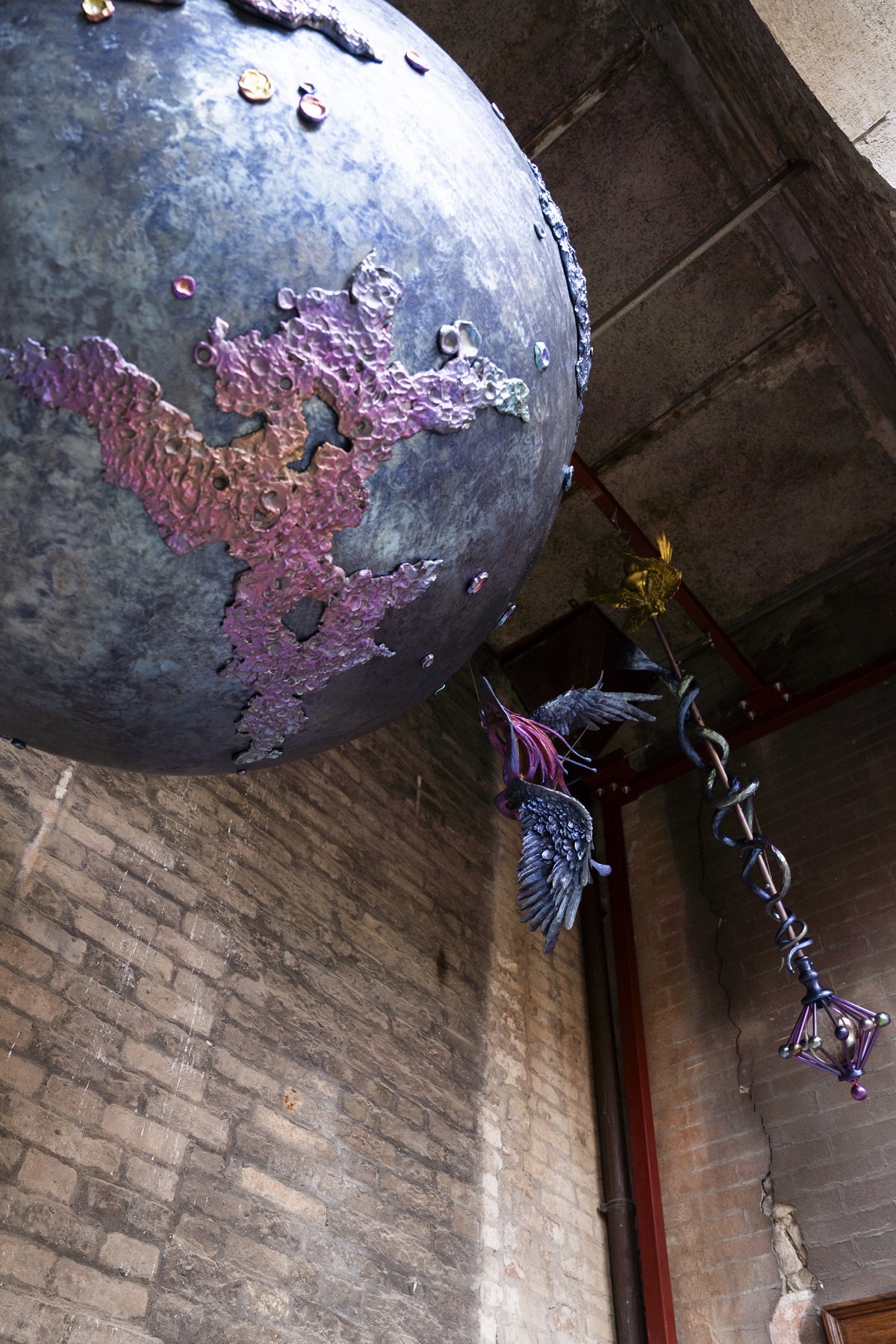
This historical elevation finds its purest visual form in Chan's reimagining of Tintoretto’s locally held masterpiece The Three Graces and Mercury (1576-77) which resides at the Doge’s Palace (at about the halfway point between the Bovolo and the Chapel). Suspended within the open loggias of the edifice’s public-facing brick helix, and visible from the byway and courtyard below, the original’s idealized nudes are represented by a trio of serene, overlapping visages that twist upward like angels within an iridescent chrysalis. The metal skin shifts color continuously in the Venetian light, moving from deep twilight violet to pale gold, while nearby, a jewel-toned sphere hangs like an unmoored planet, as Chan aligns the physical movement of the spectator ascending the tower with an endless psychological journey.
“For the Three Graces, I forgot the nudes and the physical bodies and kept only the mind and the spirit. Their shapes become like spinning tops—a metaphor for how the pursuit of ideals, beauty, and grace is entirely endless,” Chan explains. “For Mercury, I moved away from the traditional allegory of the messenger god to look at the planet and the metallic element itself, composing an artwork from the hints of the universe.”
Wallace Chan: Vessels of Other Worlds
Pieta Chapel, Venice | 8 May – 18 October 2026
Long Museum (West Bund), Shanghai | 18 July – 25 October 2026
(Watch for the Shanghai follow-up after I visit the main museum show in July!)
Wallace Chan: Mythos
Scala Contarini del Bovolo, Venice | 4 April – 18 October 2026

Shana Nys Dambrot
Shana Nys Dambrot is an art critic, curator, and author based in DTLA. She is the editor and co-founder of 13ThingsLA—a weekly Substack of curated exhibition reviews and art event recommendations in Los Angeles. Her writing appears in LA Times, Alta Journal, Artbound/PBS SoCal, Music Connection, Palm Springs Life, Flaunt, WhiteHot, and other culture publications, and was the longtime Arts Editor at the L.A. Weekly. She is the recipient of the Rabkin Art Writers Prize and the LA Press Club Critic of the Year award.
Photo by Eric Mihn Swenson
view all articles from this author