Whitehot Magazine
October 2026
"The Best Art In The World"
"The Best Art In The World"
October 2026
Emily Mae Smith’s Transit of Venus: Visible, but Not Legible at Petzel
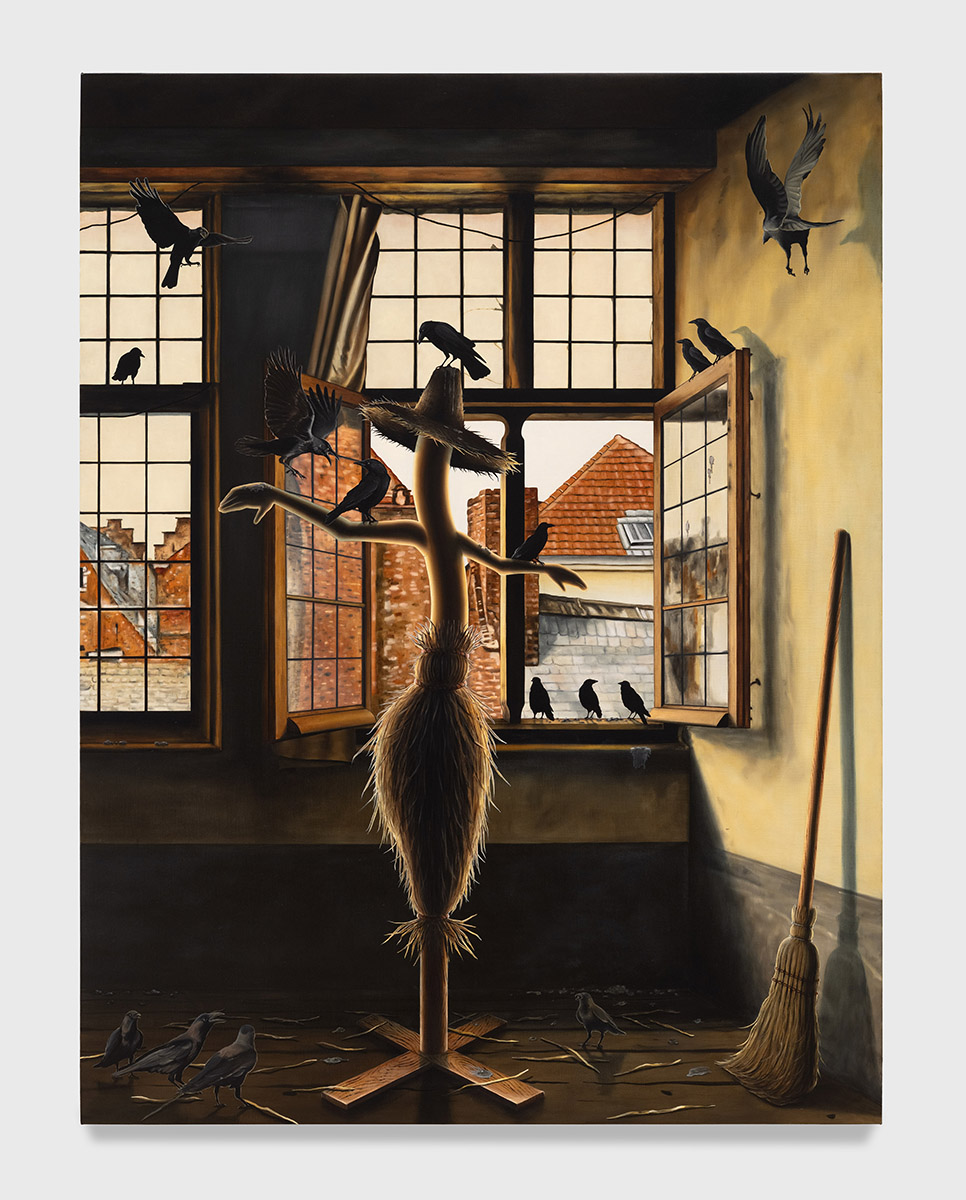 Straw Woman Problem, 2026, oil on linen, 67 x 51 in, 170.2 x 129.5 cm, Courtesy of the artist and Petzel, New York. Photo: Jason Mandella.
By MARGHERITA ARTONI October 3, 2026
Emily Mae Smith’s Transit of Venus turns visibility into a question of power. At Petzel, bodies appear as unstable composites—human, animal, vegetal, mechanical—whose shifting forms frustrate the impulse to classify. A broom acquires agency; organic matter becomes corporeal; the female figure slips between subject and object. Smith’s paintings occupy the moment in which recognition begins to fail.
That failure is the exhibition’s critical force. Rather than offering alternative identities for the viewer to decode, Smith unsettles the mechanisms through which identities become intelligible. Laura Mulvey’s proposition that “It is the place of the look that defines cinema” remains useful here: Smith makes the position of the viewer part of the problem. The paintings return the act of looking to us, exposing its appetite for certainty.
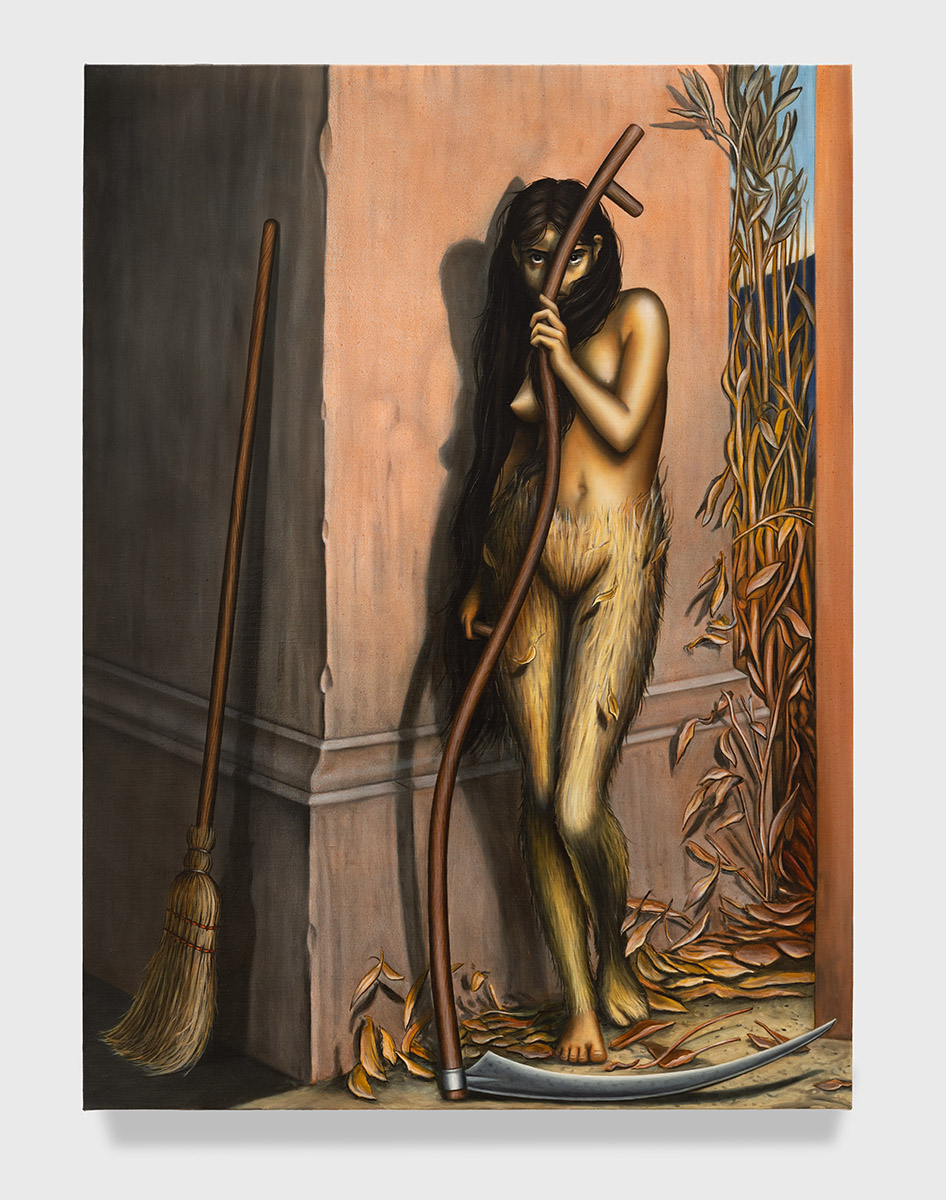 The Locust II, 2026, oil on linen, framed: 35 3/4 x 26 1/2 in, 90.8 x 67.31 cm, Courtesy of the artist and Petzel, New York. Photo: Jason Mandella.
The title Transit of Venus extends this inquiry into art history. Venus carries an accumulated visual history of femininity: goddess, nude, muse, emblem of beauty, allegory of nature. Smith takes that inherited figure somewhere less stable. Her women are neither classical ideals nor straightforward reversals of them. They inhabit a pictorial threshold where attraction, agency, vulnerability, and estrangement coexist.
The Locust II brings this reversal into the terrain of labor. A broom assumes an almost-human presence, emerging from straw and discarded material with a sickle in hand. The reference to Jean-François Millet evokes the history of peasant labor and its representation during industrial modernity. Smith shifts the position of the represented body: the figure associated with work becomes an agent within the image, confronting the viewer rather than submitting to contemplation.
This transformation recalls René Magritte’s description of painting as “making poetic images visible.” Smith inherits his capacity to estrange ordinary objects while directing it toward the politics of representation. A broom remains a broom and becomes something else; straw remains material and becomes body. Meaning resides in the instability between these states.
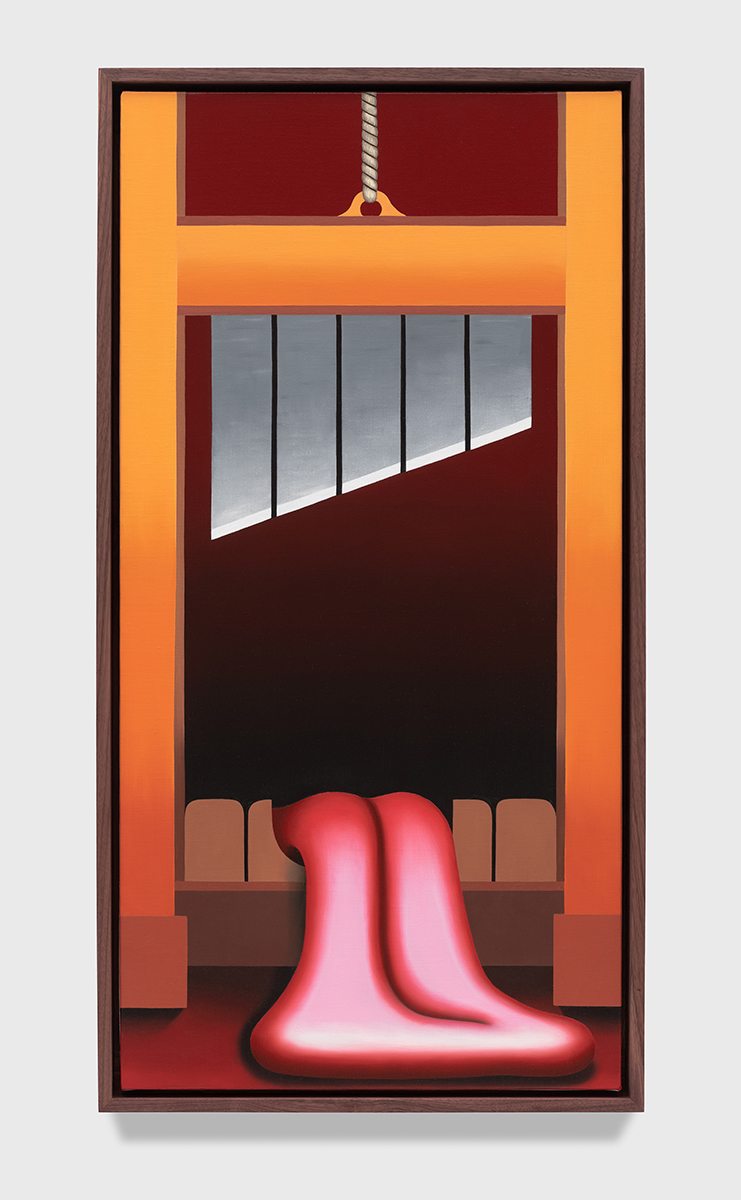 Authority, 2026, oil on linen, framed: 37 3/4 x 19 3/4 in, 95.8 x 50.1 cm, Courtesy of the artist and Petzel, New York. Photo: Jason Mandella.
Cindy Sherman’s observation—“To me, they’re other people. It’s like having a model while I’m working”—offers another point of contact. Smith’s figures similarly resist the idea of a stable self waiting to be recognized. They operate as constructed presences, neither portraits nor fixed allegories. Their ambiguity is structural.
In Straw Woman Problem, material, labor, and the body become inseparable. Straw suggests agricultural work, residue, shelter, fabrication. The title itself refuses a singular reading: “woman” appears as a category already entangled with the systems that produce and organize it. Smith gives that category a body while keeping its boundaries porous.
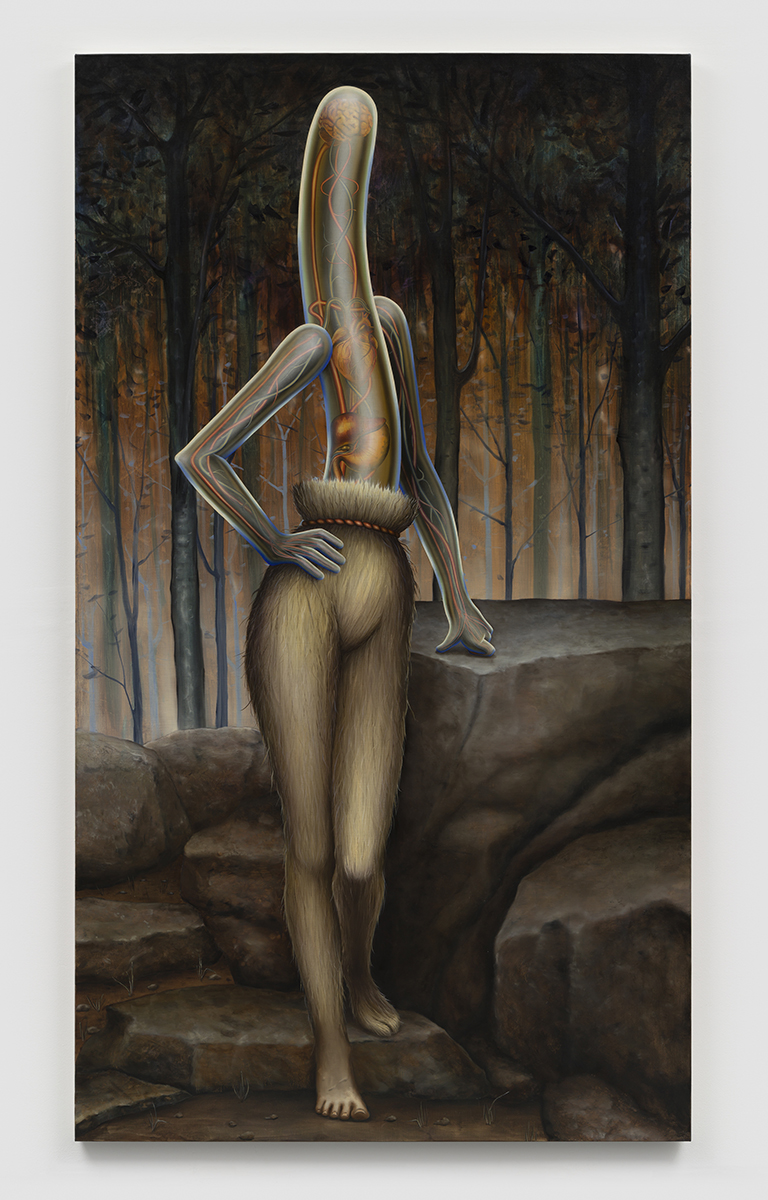 Venus (Inner Vision), 2026, oil on linen, 90 x 51 1/2 in, 228.6 x 130.8 cm, Courtesy of the artist and Petzel, New York. Photo: Charles Benton.
Louise Bourgeois once stated, “To me, a sculpture is the body. My body is my sculpture.” Smith’s paintings likewise collapse distinctions between body and object. Her figures are constituted through their attachments to things: tools, vegetal matter, frames, surfaces. The object becomes corporeal; the corporeal becomes material.
In Venus (Inner Vision), the exhibition’s central figure turns toward an interior register. The title suggests perception without external confirmation, a form of self-relation that precedes recognition by others. Here Smith’s question becomes less “Who is looking?” than “What remains of the self when recognition no longer provides its boundaries?”
The paintings’ surfaces intensify this tension. Built through successive transparent washes and glazes, they are seductive, polished, almost unnervingly luminous. Their beauty draws the viewer closer before complicating the very act that brought the viewer there. Seduction becomes a formal strategy: pleasure opens the image, then uncertainty takes over. Petzel describes these layered surfaces as inseparable from the labor of their making.
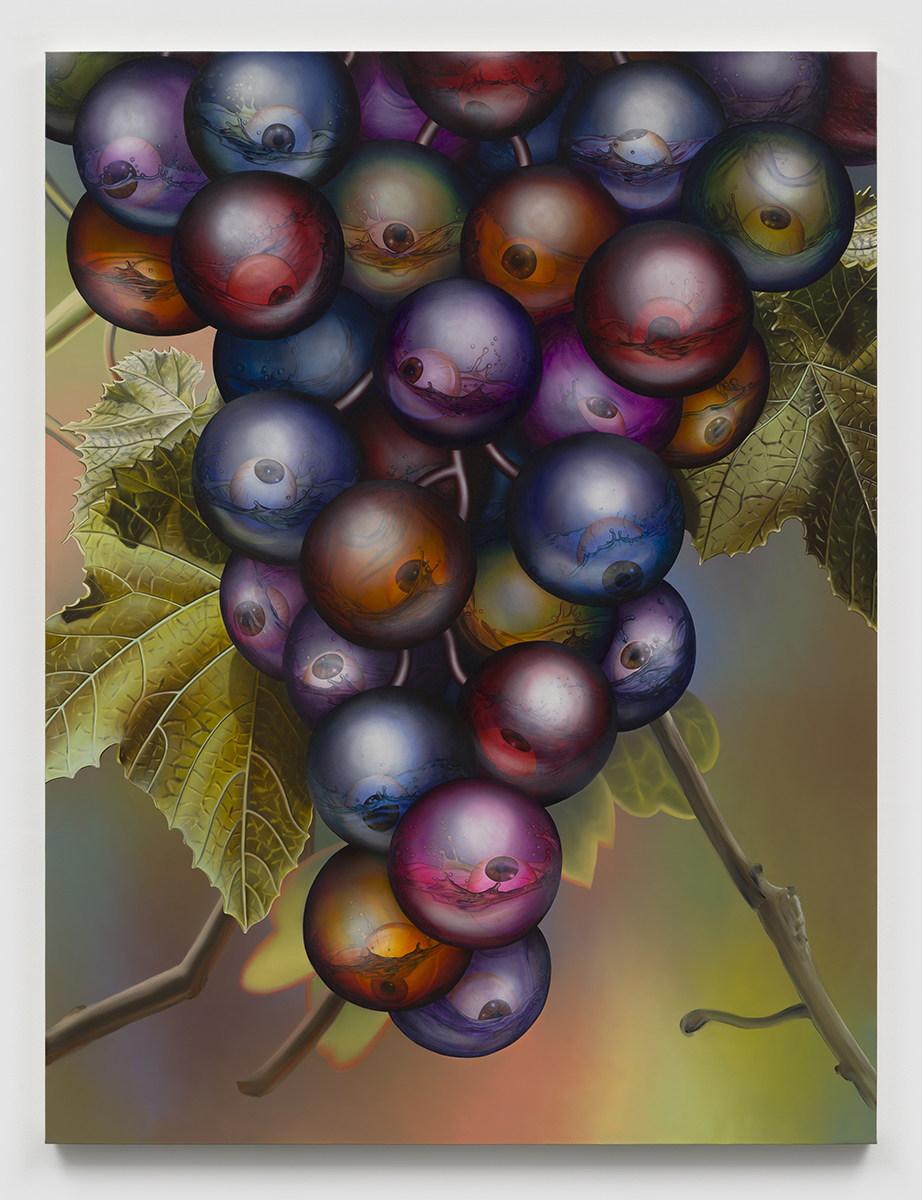 Only Human, 2026, oil on linen, 67 x 51 in, 170.2 x 129.5 cm, Courtesy of the artist and Petzel, New York. Photo: Charles Benton.
Smith therefore locates politics inside perception itself. Her paintings examine the passage from seeing to knowing, from knowing to categorizing, from categorizing to control. The figures resist that progression through transformation.
Their resistance does not require disappearance. It takes the form of sustained presence without full disclosure. To remain visible without becoming completely legible: this is the central proposition of Transit of Venus.
Smith’s achievement lies in making that proposition pictorial rather than illustrative. The paintings do not explain ambiguity. They make the viewer experience it.

Margherita Artoni
Margherita Artoni is a contemporary art critic and curator working between Italy and the United States. She began her career collaborating with Flash Art and currently writes for Segno, Juliet, Artribune, Exibart, Inside Art, ArteIN, part of cult(ure), The Art Fuse, and Whitehot Magazine.
She has directed galleries in Turin — including NEOCHROME and EDGE Art Space — and in New York at TEAM Gallery. Her curatorial work has included exhibition programs with international artists such as Rashid Johnson, Theaster Gates, Ali Banisadr, Angel Otero, Tim Rollins & K.O.S., Laura Owens, and Mika Tajima.