Whitehot Magazine
October 2026
"The Best Art In The World"
"The Best Art In The World"
October 2026
Takashi Murakami: Hark Back to Ukiyo-e - Painting as a Structure of Vision and Relation
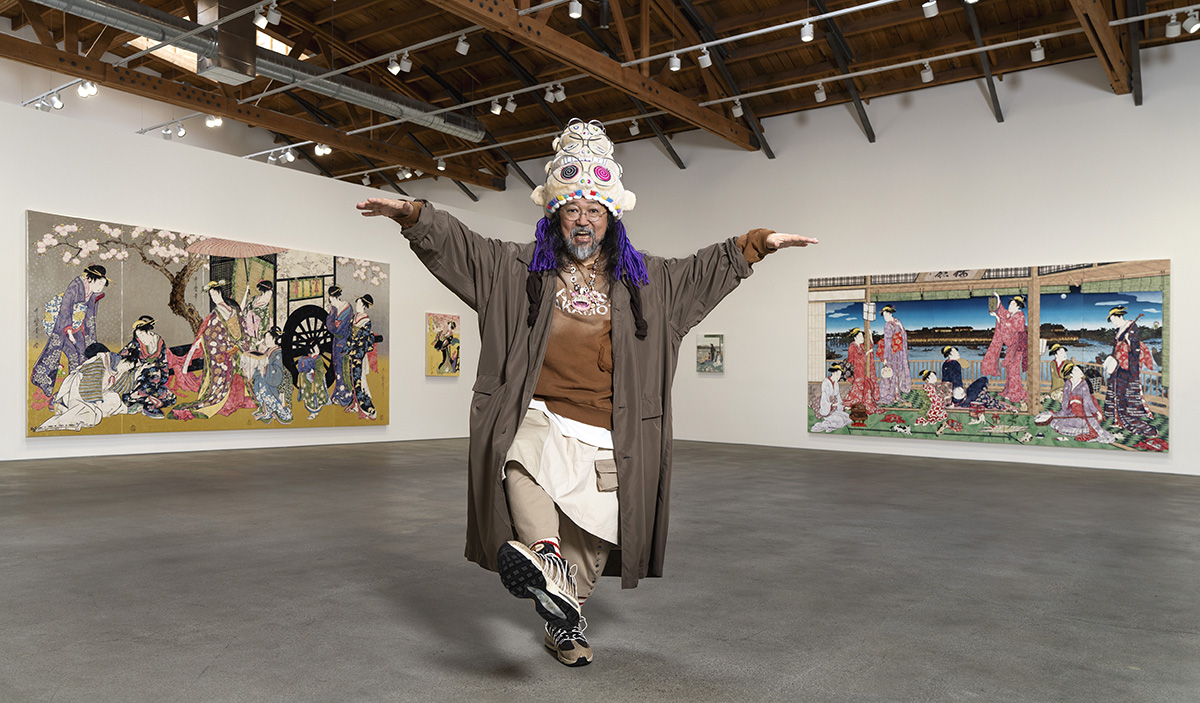
Portrait of Takashi Murakami Photo Guillaume Ziccarelli. ©︎Takashi Murakami/Kaikai Kiki Co., Ltd. All Rights Reserved. Courtesy Perrotin.
BY MARGHERITA ARTONI, March 11, 2026
With Hark Back to Ukiyo-e: Tracing Superflat to Japonisme’s Genesis, presented from February 14 to March 14, 2026, at Perrotin Los Angeles, Takashi Murakami inaugurates a significant phase in his practice, presenting 24 new paintings that articulate a broad theoretical and chronological inquiry. The exhibition redefines the act of painting as a medium of connection across epochs, geographical contexts, and visual systems. Each work functions as a node where iconographic heritage, execution methodology, and contemporary interpretation intersect—a space where memory and vision coalesce within a dynamic framework capable of capturing attention and amplifying critical reflection.
The exhibition’s conception draws on reflections developed during a visit to Claude Monet’s garden in Giverny, an encounter that underscored the depth of the relationship between classical Japanese prints and European modernity. The installation reactivates the past as a continual horizon of impression, situating each canvas within a moment of synthesis that merges iconographic corpus, plastic-compositional experimentation, and diverse modes of viewing. In doing so, the sequence suspends chronological linearity and presents art as a constantly evolving organism.
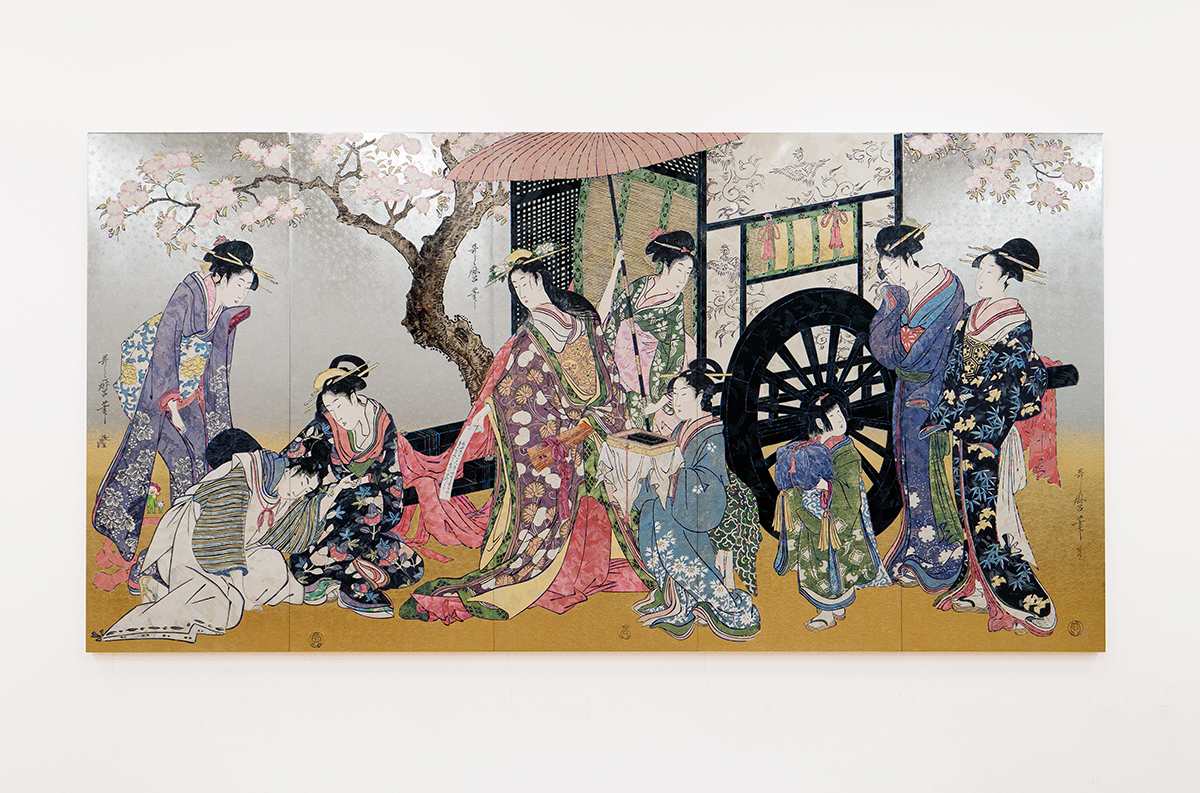
Takashi Murakami, Kitagawa Utamaro’s “Parody of an Imperial Carriage Scene” Cherry Blossoms Dancing in the Air - SUPERFLAT, 2025 - 2026. 235 x 463.8 cm. Acrylic, gold leaf and platinum leaf on canvas mounted on aluminum frame. ©︎2025-2026 Takashi Murakami/Kaikai Kiki Co., Ltd. All Rights Reserved. Courtesy Perrotin.
The opening section revisits bijinga by Kitagawa Utamaro and Torii Kiyonaga—including Snow in Fukagawa and Flowers of Yoshiwara—rendered on a monumental scale, where the pictorial plane vibrates between visual density and optical immediacy. Chromatic choices and the depiction of subjects act as vectors of stylistic construction, elevating flatness to a generative principle central to Murakami’s Superflat theory, formulated in 2000 and here extended across the project. The works offer a critical engagement with the intrinsic two-dimensionality of Edo-period images, transforming line and color into nodes of exchange between temporal registers.
The subsequent section juxtaposes Japanese motifs with Claude Monet’s Woman with a Parasol – Madame Monet and Her Son. Alongside prints by Utamaro and Kikukawa Eizan, Murakami’s compositions reinterpret the elements that captivated the Impressionists—tilted planes, sharp contours, and intense color fields—making evident the dialectic between divergent representational regimes. The pictorial apparatus functions as a conduit between distant topological spheres, with each intervention operating as a point of dialogue between heterogeneous historical moments.
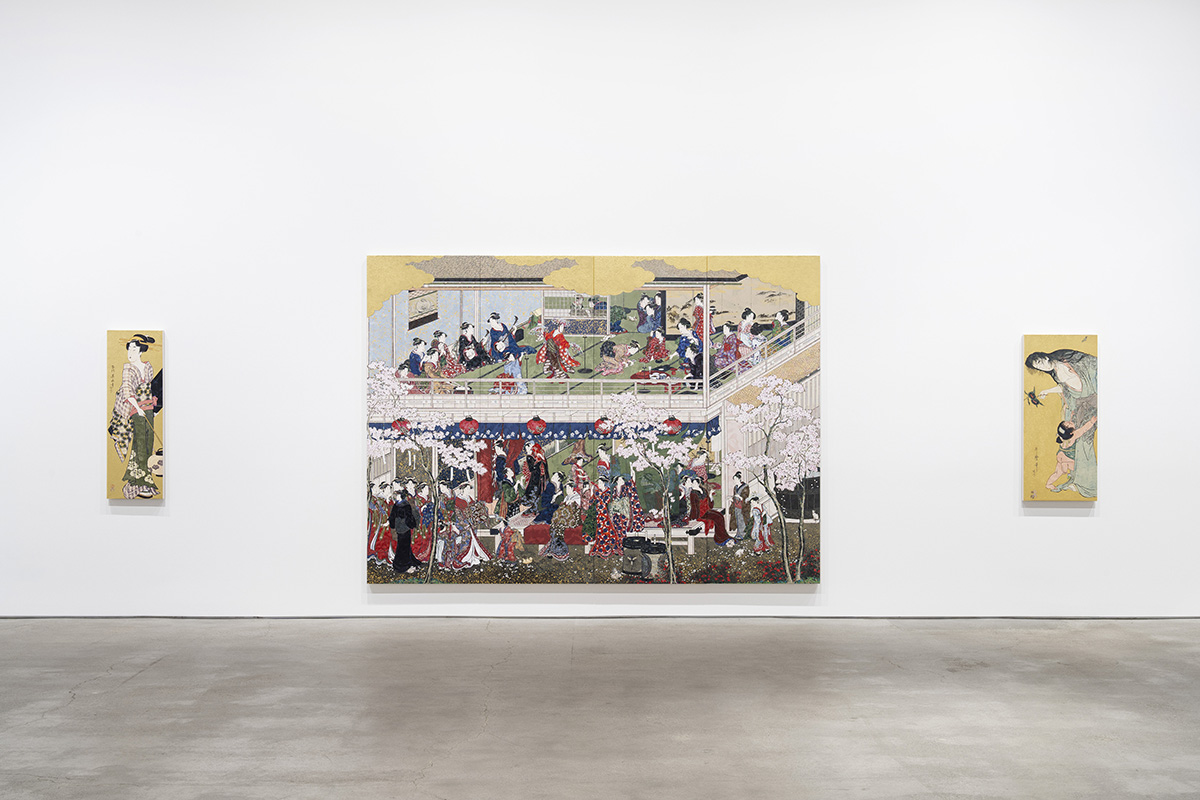
Installation view of Takashi Murakami’s exhibition Hark Back to Ukiyo-e: Tracing Superflat to Japonisme’s Genesis at Perrotin Los Angeles, 2026. Photo Guillaume Ziccarelli. ©︎Takashi Murakami/Kaikai Kiki Co., Ltd. All Rights Reserved. Courtesy Perrotin.
The segment devoted to contemporary kawaii visual idiom presents works such as Camille-Chang and Contrail and Ohana-Chang, derived from trading cards inspired by Hayao Miyazaki’s The Wind Rises. Animated figures and floral motifs intertwine visual languages drawn from traditional Japanese prints, European abstraction, and the global pop imaginary, outlining a practice that bridges alternative registers and situates the canvas as a space in which symbolic heritage and contemporary sensibilities can intersect.
The final section evokes Hokusai, Hiroshige, and Rinpa masters such as Ogata Kōrin and Kenzan. Reinterpreted through Murakami’s aesthetic, these references form the warp of his painterly practice as an architecture of graphic allusions, where forms from the past resurface in the present with renewed intensity. The arrangement of planes, modulation of light, and spatial relationships convey a scenographic environment conceived as a field of complex tensions, open to individual engagement.
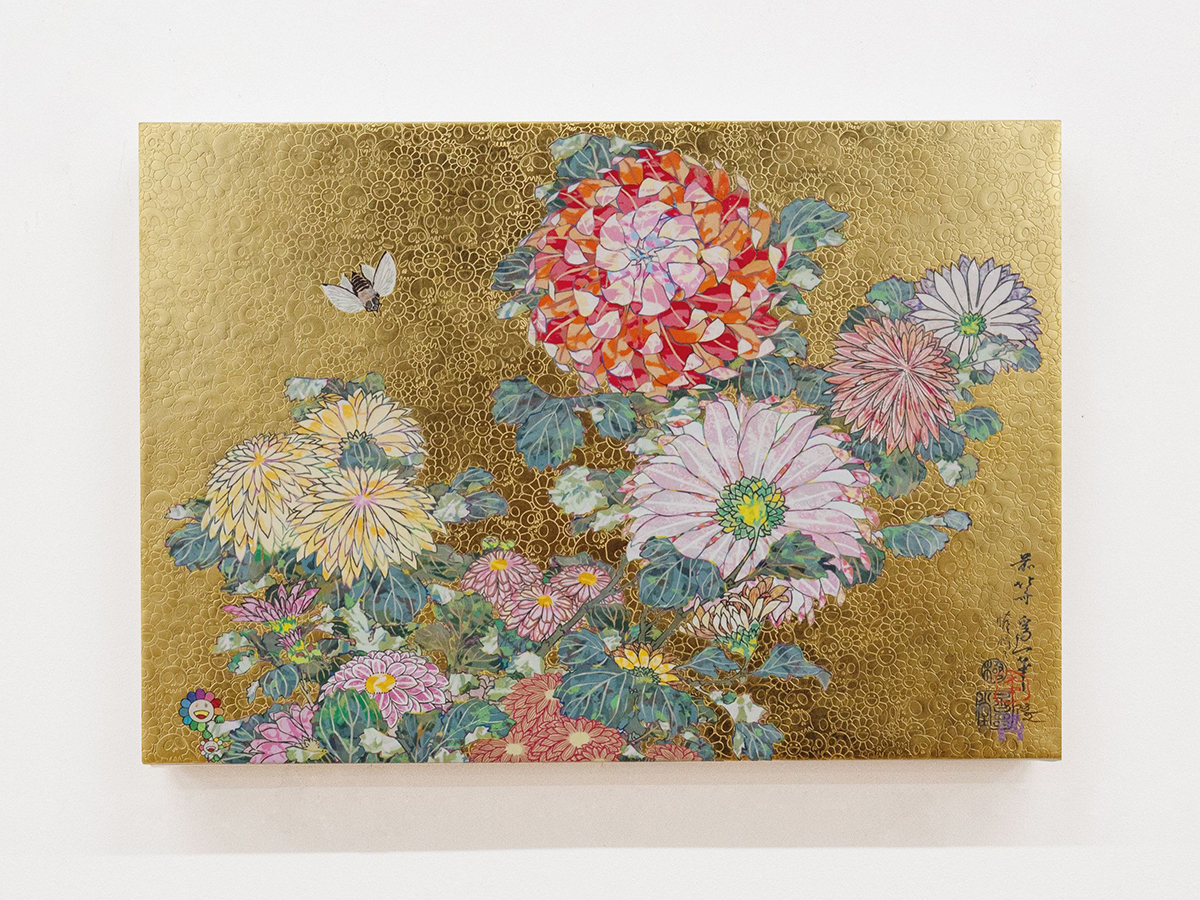
Takashi Murakami, Katsushika Hokusai’s “Chrysanthemums and Horsefly” - SUPERFLAT, 2025 - 2026. 41.6 cm x 60 cm. Acrylic and gold leaf on canvas mounted on aluminum frame. ©︎2025-2026 Takashi Murakami/Kaikai Kiki Co., Ltd. All Rights Reserved. Courtesy Perrotin.
In Hark Back to Ukiyo-e, Murakami presents the pictorial medium as an apparatus capable of traversing multiple imaginative orders, tracing a paradigm in which memory, form, and the act of viewing remain closely interdependent. The surfaces transfigure established repertoires within an organic continuity, assigning each historical reference an active presence in the contemporary moment.
The exhibition program underscores Murakami’s singular position within the contemporary landscape: a protagonist engaging with the global market and international pop imaginary as a sphere of critical amplification. It demonstrates how his recent work constitutes a pivot of reflective inquiry, capable of transcending temporal and aesthetic-figurative boundaries, endowing Hark Back to Ukiyo-e with the quality of an experience in which the pictorial idiom manifests as a vital principle in constant redefinition. WM
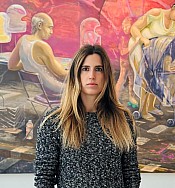
Margherita Artoni
Margherita Artoni is a contemporary art critic and curator working between Italy and the United States. She began her career collaborating with Flash Art and currently writes for Segno, Juliet, Artribune, Exibart, Inside Art, ArteIN, part of cult(ure), The Art Fuse, and Whitehot Magazine.
She has directed galleries in Turin — including NEOCHROME and EDGE Art Space — and in New York at TEAM Gallery. Her curatorial work has included exhibition programs with international artists such as Rashid Johnson, Theaster Gates, Ali Banisadr, Angel Otero, Tim Rollins & K.O.S., Laura Owens, and Mika Tajima.