Whitehot Magazine
October 2026
"The Best Art In The World"
"The Best Art In The World"
October 2026
Interview for Soft Instructions, three-artist exhibition at Art Cake
 Artists Yshao Lin and Soomin Kang. Curator Fanfan Yuxuan FAN. Installation view of Soft Instructions, New York. Courtesy of Weican Wang and FanFlus
By KUN SOK and CHUNBUM PARK February 12th, 2026
Soft Instructions is a three-artist exhibition at Art Cake curated by Fanfan Yuxuan Fan, featuring works by Yshao Lin, Soomin Kang, and Gabriel Siams. Across photography, sculpture, and video, the show asks how power moves through intimacy—not only through force or overt control, but through suggestion, etiquette, and the language of care. Instead of treating relationships as a simple flip between dominant and submissive, active and passive, Soft Instructions stays with the gray zone where consent, desire, and dependency overlap. What looks gentle can still shape behavior, expectations, and bodily experience. Here, “softness” is not the opposite of structure; it is often the way structure becomes livable, and therefore easier to accept.
Artists: Yshao Lin, Soomin Kang, Gabriel Siams
Curator: Fanfan Yuxuan FAN
Chunbum: How did you arrive at the concept of the Soft Instructions, and what was the curatorial logic behind bringing these artists together?
Fanfan: I first encountered Yshao’s work at Columbia MFA’s open studios and was immediately drawn to Not Even God Can Judge Me, in which he grips a white man by the neck in a gesture of erotic restraint. Yshao then suggested including Soomin Kang, whose work resonated strongly; both engage with power, identity, care, and control through different mediums, making the curation more nuanced.
I later included Gabriel Siams’s Madonna’s Runway (2025), to introduce sonic and auditory sensory experience. His use of sound of high-heels, religious references, and indirect erotic cues expands the exhibition toward an atmosphere suspended between absence and presence. During installation, I unintentionally placed Gabriel’s video in proximity to Yshao’s When the Cicadas Cry (2025). The unstable, flickering light above the cicada subtly echoed the video’s transitional moments of overexposure. Each artist became indispensable, opening dimensions the others could not fully access alone.
Kun: If you had to define “Soft Instructions” in one clear sentence, how would you put it? What would “Hard Instructions” look like in the real world?
Fanfan: “Soft Instructions” are subtle, indirect forms of power within relationships, operating through attachment or reliance. They are mutually consented to and gradually internalized, quietly shaping behavior and expectations without appearing as explicit commands. By contrast, “Hard Instructions” are more extreme, coercive, and unilateral. They leave little room for negotiation or consent, relying on direct control and obedience over relational attunement.
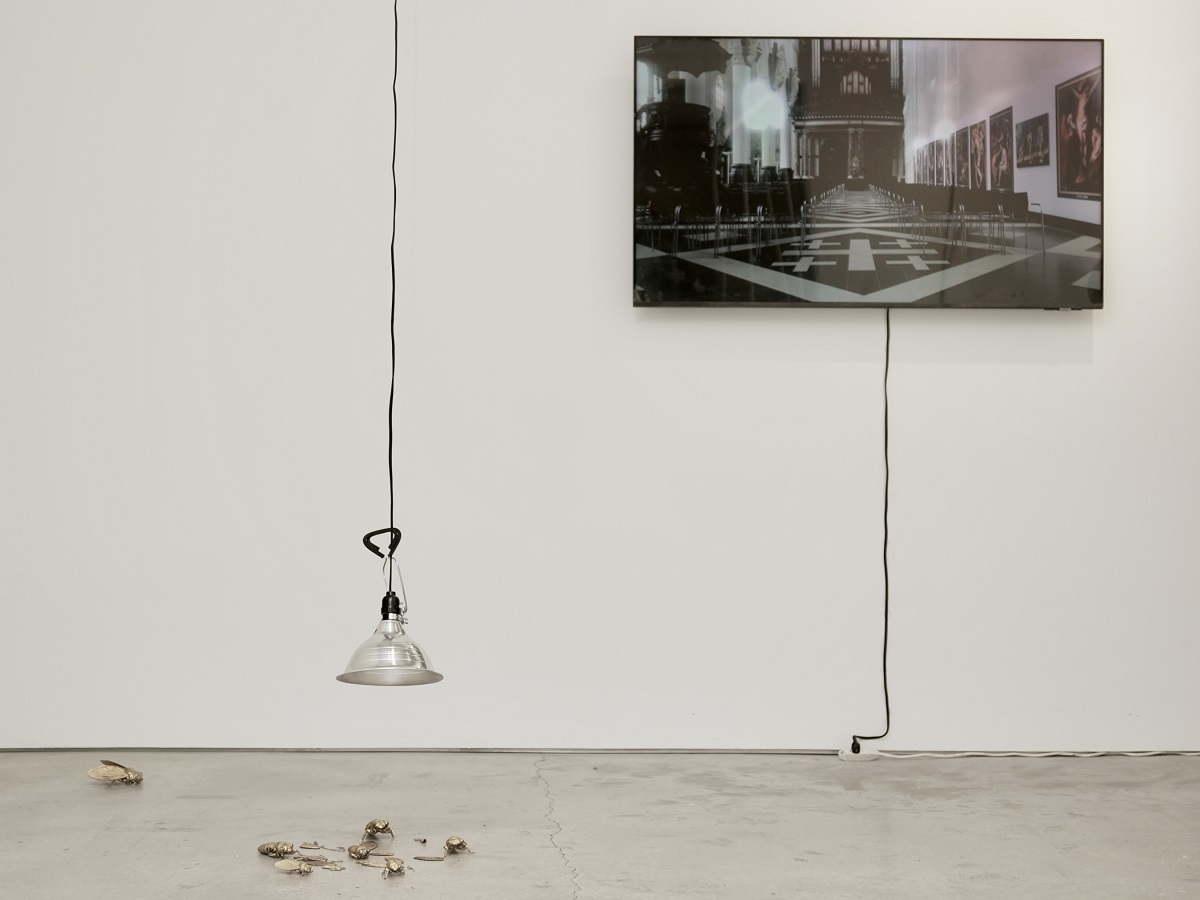 Installation view of Soft Instructions, New York. Artists Yshao Lin, Gabriel Siams. Curated by Fanfan Yuxuan FAN. Courtesy of Kon Zeng and FanFlus
Chunbum: How does the concept of Soft Instructions connect to your own lived experience?
Fanfan: When I am drawn to someone or deeply invested in a connection, I often find myself unconsciously following their cues, adjusting my behavior, or meeting their needs, even willingly allowing myself to be manipulated, sometimes without realizing it. Their soft instructions quietly guide my actions, showing how influence can operate subtly, with mutual consent, even when it feels almost uncontrollable.
Yshao Lin: For me, this style of asking is tied to vulnerability and safety. Growing up in a traditional environment, I learned that direct demands often trigger fear, shame, or defensiveness. When staging intimacy or power, I can’t “take” anything; I have to build a container where consent stays active. My direction becomes invitational but precise: “Would you be comfortable doing this?” “If anything feels off, we stop.” Role reversals to happen: power dynamic only works because it is granted moment by moment, not forced. Soft Instructions describe how I try to live, getting what I want through clarity and consent, not force.
Soomin Kang: I think of my childhood, especially kindergarten and the early elementary school. Everything was new then. The safety devices, the toys, and the books were all there. Being separated from my parents and entering an unfamiliar environment initially made me want to run away, and I simply had to endure it. Over time, as I adapted to its rules and routines, that gradual process of becoming comfortable settled into my body as memory. This experience shaped my sensitivity to situations where care and physical control coexist, such as how animals or infants are handled.
 Installation view of Soft Instructions, New York. Artists Yshao Lin, Soomin Kang. Curated by Fanfan Yuxuan FAN. Courtesy of Weican Wang and FanFlus 02
Kun: Do you see Soft Instructions as describing a kind of relational “stability” that people maintain, even when it’s uneven? What does that stability cost?
Fanfan: Soft Instructions describes how people negotiate their positions within relationships through affective adjustment and mutual dependency. People stay by anticipating others, adapting their behavior, and softening their own limits, not because the arrangement is equal or just, but because remaining connected feels more livable. This reflects a form of strategic self-adjustment that keeps a relationship inhabitable. Such stability is sustained through internalized consent, which may lack equality, revealing intimacy as a site where bonds are affectively negotiated and maintained because they feel familiar and difficult to refuse.

Kun: Soomin, your objects don’t simply invite touch—they often make viewers want to come closer and then hesitate. Is the primary sensation you’re building “play,” “boundary,” or “training”?
Soomin: This is a really interesting part for me. My work often starts from the moment you encounter an object and feel this urge to touch it, or to figure out how you might use it. That impulse, and the imagination that comes with it, is where the work gets activated. Sometimes it turns into a kind of push and pull over control between the object and the body, under the premise of play. Other times, it becomes a form of training that builds up through play. It comes down to how the language of systems plays out differently in each encounter.
Chunbum: Gabriel, I know Madonna’s Runway (2025) was initially conceived as a sound piece and later developed into a video work. How did it feel for you to make that transformation?
Gabriel Siams: Making this iteration of a work that was originally conceived as a site-specific sound piece was challenging, but felt like a necessary next step, both for my practice as a whole and the piece itself. Sound and site-specific works are always delicate in terms of documentation and “translation”: how they are recorded and recontextualized is never neutral. Rather than treating the video as a substitute, I approached it as an expansion. I was interested in how the work could remain alive in another form, detached from its original site yet still carrying its logic, and enabling it to circulate, adapt, and enter a different exhibition framework.
I see the sound layer creates an atmosphere through which previously invisible layers can surface. This sonic presence extends beyond the work itself, subtly affecting the room and the other works on display, tying them together while still allowing space for distance, friction, and alternative readings.
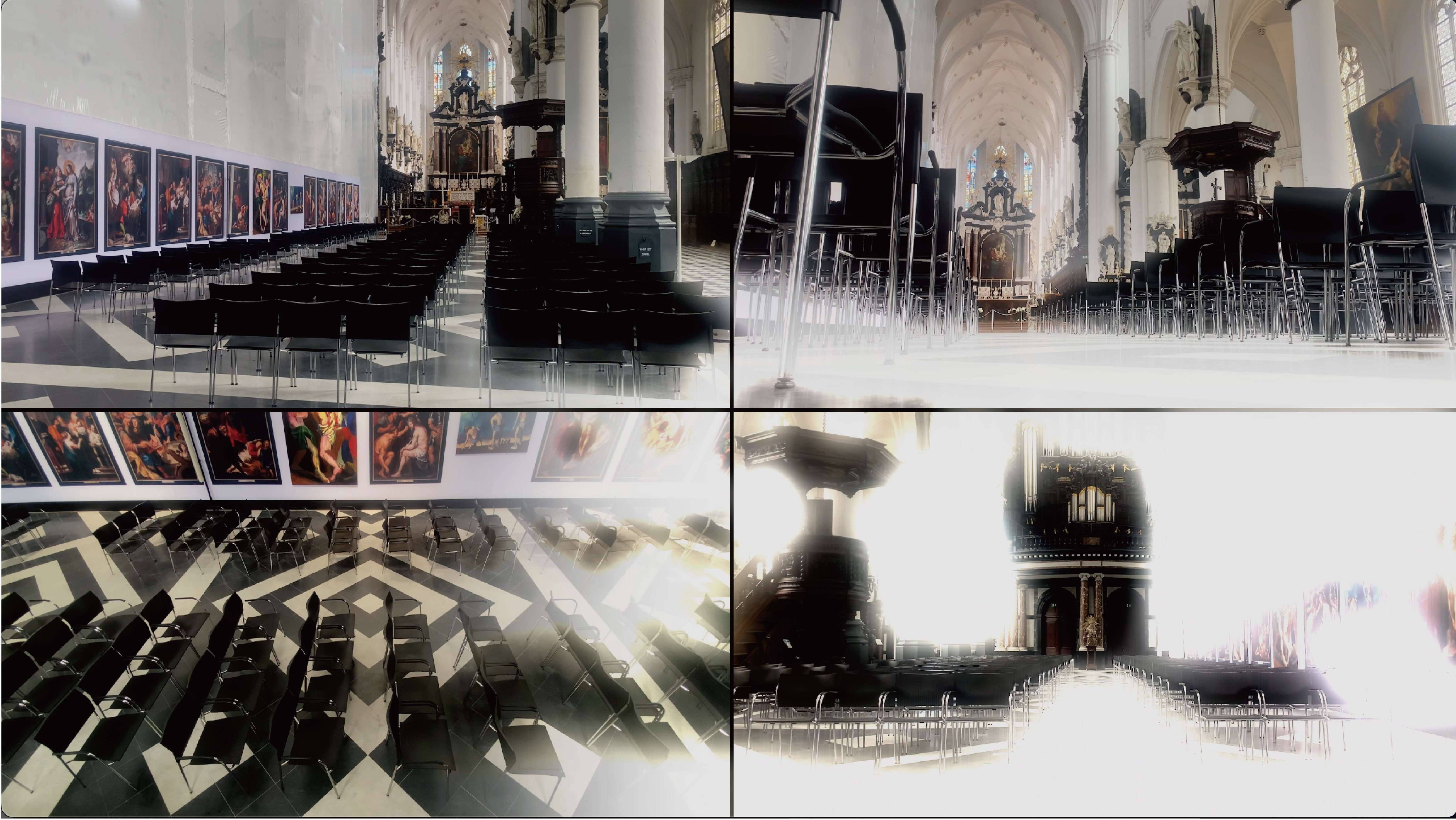 Gabriel Siams, Madonna’s Runway, 2025, 4K video and stereo sound, 50’’
Kun: The listener wants to classify the sound—gender, body, role. If that classificatory urge is itself a form of power, do you want the audience to recognize it, or to fail at it?
Gabriel Siams: I believe the audience should be open to “resolving” this question for themselves, without me explicitly offering an answer. Failure, or the willingness to acknowledge it, can be one of the strongest ways to grasp how power operates and how it can be subverted.
Kun: Once an encounter becomes an image, something changes. What is gained and what is lost at that threshold, and what are you trying to control most: the encounter, or the image’s “afterlife”?
Yshao Lin: When an encounter becomes an image, it stops being only mine and becomes something others can replay, possess, and judge, so the power shifts. What’s gained is distance and precision: the camera can hold a fleeting negotiation of desire, control, and shame, but loses everything the frame can’t carry—tone, tenderness, hesitation, consent as an evolving process. The photograph flattens complexity, and viewers may mistake the surface for the whole truth.
Early in Not Even God Can Judge Me, I showed my face and body clearly. Later, I became more concerned about the image’s afterlife: how it might be misinterpreted, taken out of context, or reduced to scandal. This fear led me to hide my face, not to deny the encounter, but to protect myself and to acknowledge that visibility is never neutral. I can’t control the encounter, but I try to shape how the image travels through framing, sequencing, and withholding identity, resisting easy consumption and moral judgment.
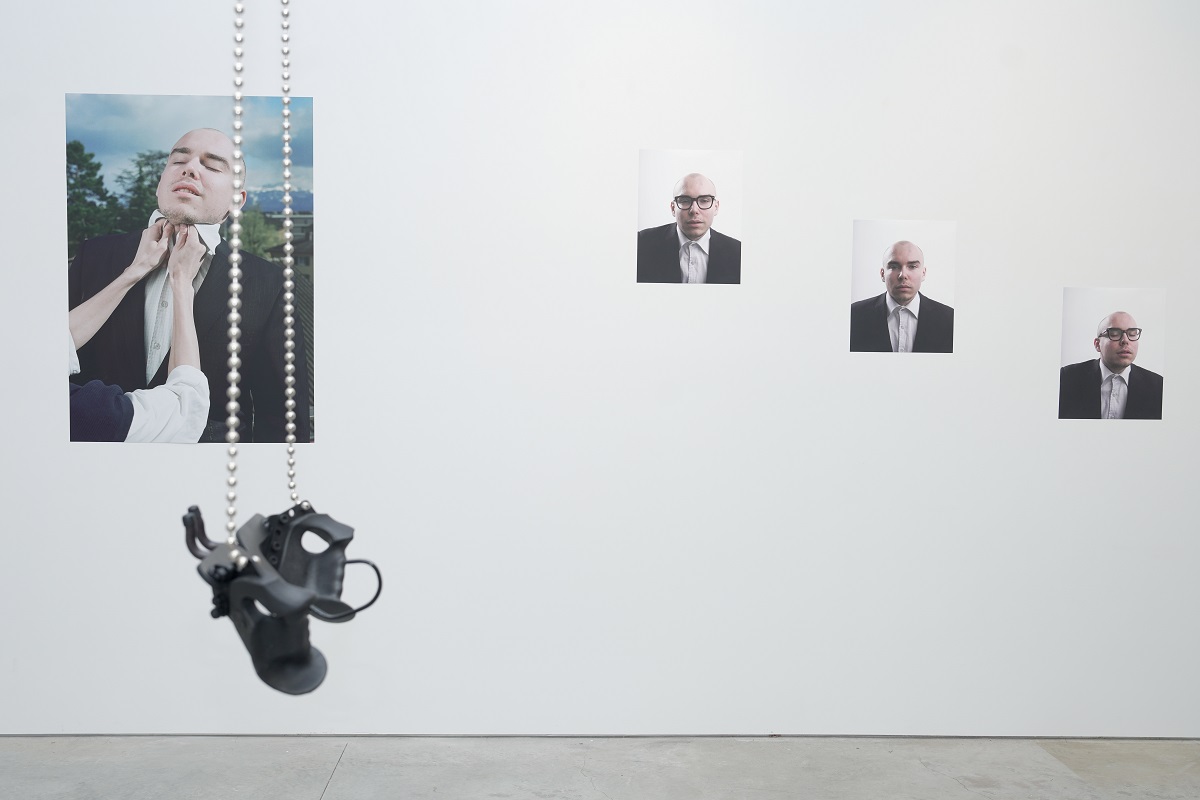 Installation view of Soft Instructions, New York. Artists Yshao Lin, Soomin Kang. Curated by Fanfan Yuxuan FAN. Courtesy of Weican Wang and FanFlus 00
Kun: When you say “soft,” do you mean an ethics (care), a technique (strategy), or an aesthetic (tone)?
Fanfan: “Soft” is not limited to a single register; it can be ethical, strategic, and aesthetic at once. I may understand it as a feminist sensibility: gentle, subtle, and barely perceptible, through which instructions are delivered via care or devotion, yet still function as a form of control. I also discussed the exhibition title with the artists, including Overexposed Intimacy, Intimacy as Arrangement, but ultimately settled on Soft Instructions. It best captures how power circulates in relationships, not through force, but indirectly, becoming acceptable and even desirable through promises of safety, belonging, and a sense of arrangement.
Kun: What kind of bodily or emotional experience did you hope the audience would have in the space? What “mixed state” did you most hope to produce?
Fanfan: It is hard to define. My curation is not meant to prescribe a single feeling. If anything, I hope to evoke a sense of entanglement, a paradoxical and incompatible state where desire for care and closeness coexist with subtle unease, hesitation, and resonance. The spatial arrangement also shapes bodily experience: Soomin’s Toys For (2025), floor-based works resembling a playground, require viewers to slow down and adjust their steps, heightening awareness of movements and posture. The experience becomes both emotional and corporeal, where sensation, attention, and negotiation blend together.
----------
Writers:
Kun Sok
Kun Sok is a Brooklyn-based visual artist and writer exploring relationships and collaboration. Informed by community development work in Cameroon, she creates rule-based participatory projects including My Right Hand & Your Left Hand, Paint-Pal, and Mother–Daughter–New York. Her writing has appeared in Two Coats of Paint, Tussle Magazine, and Hot Coffee Conversations. She holds an MA from SOAS, University of London, and a BFA/MFA from the School of Visual Arts.
Chunbum Park
Chunbum Park (b. 1991, South Korea), also known as Chun, is a writer and artist based in Cliffside Park, NJ. They received their MFA from the Rochester Institute of Technology in 2022, where they changed their pronouns and pursued a thesis on gender fluidity and anti-racist aesthetics through painting. They are the inventor of the Artbid art auction card game and the editor for Brooklyn to Gangnam magazine's visual segment. In addition, Park writes reviews and interviews for Two Coats of Paint, Art Spiel, Dart, and others.
Curator:
Fanfan Yuxuan FAN
Fanfan is currently pursuing her M.A. in Visual Arts Administration at New York University. She holds dual bachelor’s degrees in Arts Administration from the Central Academy of Fine Arts and KEDGE Business School. She has worked for Asia NOW Paris Art Fair in Paris as well as Eli Klein Gallery and Marc Straus Gallery in New York. Her curatorial approach is grounded in artist-practice–driven methodology, spotlighting emerging artists and examining the shared challenges and aspirations of her generation through nomadic, site-responsive projects. She has curated group shows: Subcurrents (Shanghai), Threshold in Relations (Nguyen Wahed, New York), and Soft Instructions (Art Cake, Brooklyn). Her curation has been featured in Whitehot Magazine, Hot Coffee Conversations, DART Magazine, TUSSLE Magazine, and LI TANG.

WM
Whitehot writes about the best art in the world - founded by artist Noah Becker in 2005.
view all articles from this author