
Whitehot Magazine
October 2026
"The Best Art In The World"
"The Best Art In The World"
October 2026
Antonia Papatzanaki: The Light of Nature
 Antonia Papatzanaki
, Structural 49, 2025,
Stainless steel, Plexiglas, light
, 120 x 120 x 10 cm | 47 ¼ x 47 ¼ x 4 in
Antonia Papatzanaki
, Structural 49, 2025,
Stainless steel, Plexiglas, light
, 120 x 120 x 10 cm | 47 ¼ x 47 ¼ x 4 in
By MARK BLOCH, December 2025
Antonia Papatzanaki is a sculptor of light, transforming that elusive “material” into both a palette to be drawn from and a vessel into which to build an unconscious channel of communication between her and the viewer. She seems less interested in constructing than uncovering a mysterious world that already lives invisibly beneath our existing realm.
Therefore she combines permanence, impermanence, motion, and non-motion. She told me, gesturing, as we walked toward one of her seemingly flat works for the first time that they are not smooth, even, sleek planes as they may appear but rather completely sculptural works that emit light into the softly lit room. I saw it immediately as we walked through their emanations at that moment; I could see and feel them in space, as we stepped through the third dimension toward a trio of works, yes, hanging on the wall but suddenly doing much more than that.
We had just explored her “Structural” series of 42 reflective white on black drawings presented as a single installation behind us. Six across, seven down squares, about a foot across, beautifully and intricately done with an oil pen, each featuring a different magnified microscopic image of matter that interests her; drawings of (mostly) organic things that that intrigue her before she has seen them through a microscope: plankton, parts of the human body (like neurons), celery, carrots, basil, other critters, plant roots, and stems. There are also four blowups of steel that re-“surface” in enlargements elsewhere in the show. In both cases she is interested in drilling down, looking under the rug, under our skin, as it were, beneath surfaces, to other levels.
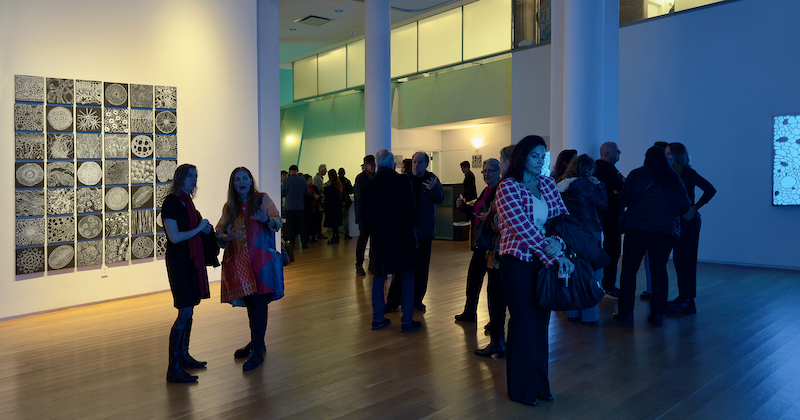 Antonia Papatzanaki: The Light of Nature
, Tenri Cultural Institute of New York
, Exhibition view
Antonia Papatzanaki: The Light of Nature
, Tenri Cultural Institute of New York
, Exhibition view
But in addition to reproducing images fresh from their states as scientific inspiration, she weaves a little magic. She takes liberties here and there as she draws. Fully embracing the scientific, and treating her subject matter as specimens, she also knows her drawings and the light works she makes from them are art. This very Greek and now American artist is aware that her countryman Plato viewed art with suspicion, seeing it as an imitation of reality and nature that leads people away from truth and reason. He believed, like his teacher Socrates, that art is mimesis, an imitation of the physical world and its perfect, ideal forms. Since the physical world is already a copy, art in any medium becomes a copy of a copy. But Antonia does not subscribe to that point of view as negative, nor did Plato’s student Aristotle, who saw art as crucial for learning and emotional development.
And so we walked through space toward the triptych of tall slender metal boxes with illumination emanating from between the laser-cut lacerations in the metal surfaces, forms right out of her finely drawn plant drawings and into our midst. The three well-constructed stainless steel boxes are derived from images of poplar trees cut in three different directions, up, down and across. Like these cross-sections, we pierce the light that engulfs us, moving closer. And as we approach them, the poplar tree specimens greet us like actors taking a bow on a stage.
This “Xylem-Poplar” installation of the three works uses translucent Plexiglas under the cut opaque stainless steel to accommodate the transmission and diffusion of light. Her light sculptures of the tree’s vascular system help the plants overcome gravity, transferring water and nutrients from their roots to the top of their foliage. Osmosis does the work. Upward pressure moves nutritious solvents along a membrane into the topmost reaches of trees.
 Antonia Papatzanaki, Xylem-Poplar Installation, 2025,
Stainless steel, Plexiglas, light
, 200 x 60 x 10 cm each | 79 x 24 x 4 in each
Antonia Papatzanaki, Xylem-Poplar Installation, 2025,
Stainless steel, Plexiglas, light
, 200 x 60 x 10 cm each | 79 x 24 x 4 in each
Papatzanaki points out that the Greek word xylem is transport tissue that conducts water and minerals. She likens the movement of those nutrients inside the organisms to what Greek philosophers, Democritus, and his precursor Epicurus, though they could not see it, suspected: that the natural world was full of tiny, invisible particles known as atoms moving and interacting in empty space. Similarly, abhorring a vacuum, light, whether a particle, wave or both, mysteriously moves through nothingness, just as we were then moving though space. These parallel tendencies at work in the Void since the beginning of time interest Antonia very much.
The show’s curator, Thalia Vrachopoulos explains that Papatzanaki “resturcture(s) the perceptual environment of the viewer.” She discusses “light as a metaphor for truth” and “light as a medium for experience” in a catalogue essay. She echoes Papatzanaki’s own admonitions to me about 3D space and goes a step further when she cites, “truth itself… as rhythmic and luminous becoming,” bringing the viewer’s experience and even the state of the world into the realm of the performative.
Antonia Papatzanaki was born in Chania on the island of Crete. At 18 she left to study in Athens, attending a pottery school. From the Athens School of Fine Arts, the only one in Greece at the time, she studied in Vienna, having already begun exploring the conceptual intricacies of light. She has since won both Panhellenic and international competitions for public art projects including her sculpture Lighthouse in the square of the Kato Patisia Metro Station in Athens.
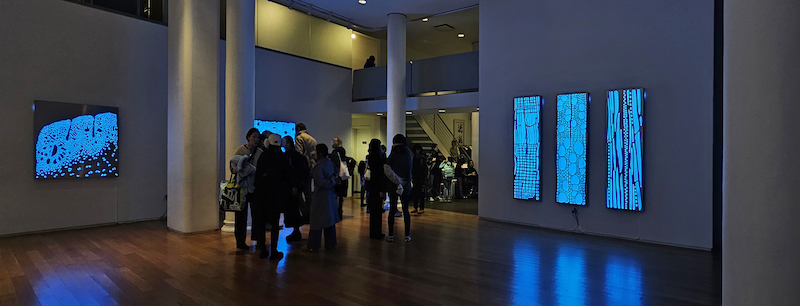 Antonia Papatzanaki: The Light of Nature,
Tenri Cultural Institute of New York
, Exhibition view
Antonia Papatzanaki: The Light of Nature,
Tenri Cultural Institute of New York
, Exhibition view
After a decade in Athens, she moved to New York and received an MFA from Pratt. Her 2021 project "Thank You for My Breaths!" in Manhattan, with the support of the New York Foundation for the Arts, screened day and night on bus stop screens. A public light installation “Agora” was fortuitously showcased at Battery Park before, during and after 9/11 in 2000-2001 as part of the Temporary Public Art Program of New York City. She was traveling on an airplane in Europe when she was informed of what had happened nearby at the World Trade Center. Rescuers later thanked her for the fact that her project was plugged directly into the ground and provided illumination when other light sources abruptly halted at Ground Zero, offering comfort and the courage to continue their difficult work.
Antonia calls light “an overcharged universal symbol.” It is a loaded global hierogyph and represenation, indeed, connecting life to truth. In physics, the speed of light measures cosmic distance, a transporter of memories of what has happened elsewhere. As it travels across time to reach us, it makes the passage of milliseconds, hours and years visible.
Papatzanaki’s exhibition "The Light of Nature" also marks the establishment of a Contemporary Sculpture Center she envisions to support young and acclaimed sculptors in Crete, with particular emphasis on female artistic creation. It will be located in Chania, “my place of origin,” she said, “which has for me deep emotional and symbolic importance.”
In the case of the steel, she suspected correctly that two renderings in light would look organic when blown up. She penetrated down to a level where they looked more like weavings or lace structures. One contains angular strata while the other depicted circular puddles or pools coalescing amongst the negative space which, to me, resembled cross hatching.
 Antonia Papatzanaki
, Structural 81, 2025
, Stainless steel, Plexiglas, light,
120 x 120 x 10 cm | 47 ¼ x 47 ¼ x 4 in
Antonia Papatzanaki
, Structural 81, 2025
, Stainless steel, Plexiglas, light,
120 x 120 x 10 cm | 47 ¼ x 47 ¼ x 4 in
This is an elegant show. Vrachopoulos was very careful about the way and where the work hangs, preventing reflections and stray light from interrupting the viewer’s experience of Papatzanaki's luminescent sculptures.
Because she likes to go beyond appearances and surfaces, for fun I asked her what she thinks about the art of, say, Alex Katz. I wrote about him recently and found his work to be unapologetically surface-y. She told me that she’s a fan. She says she liked all the artistic exercises she had done to get to where she's at. Because her current works are also very hard edged, even reminiscent of leaded stained glass windows, I asked her if she favors hard edge paintings. She replied that she's currently working hard edged, but in the past, she also used softer forms with softer boundary areas. She happily shared with me experiments with heat sensitive fax paper she had toasted with a hair dryer to create soft abstract shapes. When they started to fade, she scanned them.
In a similar vein, this exhibition halts Antonia Papatzanaki’s ideas in their tracks just long enough for her to share them with us, long enough so they don’t get away. Closest to the street and the daylight coming in the window in this gallery, a light work featuring a distinctive shape faced west, Structural 81, the only piece here with changing color. Slowly shifting from red to yellow to green to blue to purple and back to yellow, the piece, like this show, was alive and in motion, a secret world that vibrates beneath surfaces at 186,000 miles per second. WM
Antonia Papatzanaki:
The Light of Nature
Tenri Cultural Institute of New York
Curated by Thalia Vrachopoulos
November 6 to December 2, 2025

Mark Bloch
Mark Bloch is a writer, performer, videographer and multi-media artist living in Manhattan. In 1978, this native Ohioan founded the Post(al) Art Network a.k.a. PAN. NYU's Downtown Collection now houses an archive of many of Bloch's papers including a vast collection of mail art and related ephemera. For three decades Bloch has done performance art in the USA and internationally. In addition to his work as a writer and fine artist, he has also worked as a graphic designer for ABCNews.com, The New York Times, Rolling Stone and elsewhere. He can be reached at bloch.mark@gmail.com and PO Box 1500 NYC 10009.
view all articles from this author



