Whitehot Magazine
October 2026
"The Best Art In The World"
"The Best Art In The World"
October 2026
Anticipating Flesh: Ziyi Zhang’s PIXEL//FLESH
Installation view of PIXEL//FLESH, Ziyi Zhang, LATITUDE Gallery, 2026. Courtesy of the artist and LATITUDE Gallery.
BY LUMAN JIANG October 22nd, 2026
In 06/07/2024 Loving Vincent, a deep blue field approaches black beneath a pale upper section, with scattered points of light and thin, winding lines. The eye follows these cues in search of pictorial depth, then catches on the small raised script. Standing before the work, I began to imagine a contact that had not yet occurred: the reflections suggested the coolness of metal, while a fingertip passing over the lettering might encounter smoothness, then the slight discomfort of a raised edge pressing against the skin. The surface’s actual height and my imagined sense of touch became closely entwined.
In PIXEL//FLESH, Ziyi Zhang’s solo exhibition at LATITUDE Gallery, curated by Jinyi Freya Xu, Zhang begins with digital drawing, translating images through three-dimensional modeling and printing into relief surfaces, which she then works with oil paint, pigments, resins, and other materials. Images acquire physical form and become available to touch. Yet a step remains between thickness and “flesh”: how does matter lead us to think of the body?
10/17/2025 no structure no break offers another point of entry. A blue grid occupies the upper portion of the picture; below it, a silvery-gray field contains a rectangle with rounded edges. The grid recalls both the organization of a textile and the wireframe used to describe a form in modeling software. These associations depend on the same lines but invite different readings: one prompts us to consider how fibers connect, the other how a form is constructed. Looking moves between an object’s structure and the means of describing it.
This double recognition gives the form two functions: it evokes a material while also indicating how that material becomes an image. The silvery-gray area directs attention toward sheen and hardness. As we try to identify what we see, we also anticipate how contact with it might feel. Different parts of the picture prompt different judgments, without resolving into a single object whose properties we can confidently name.
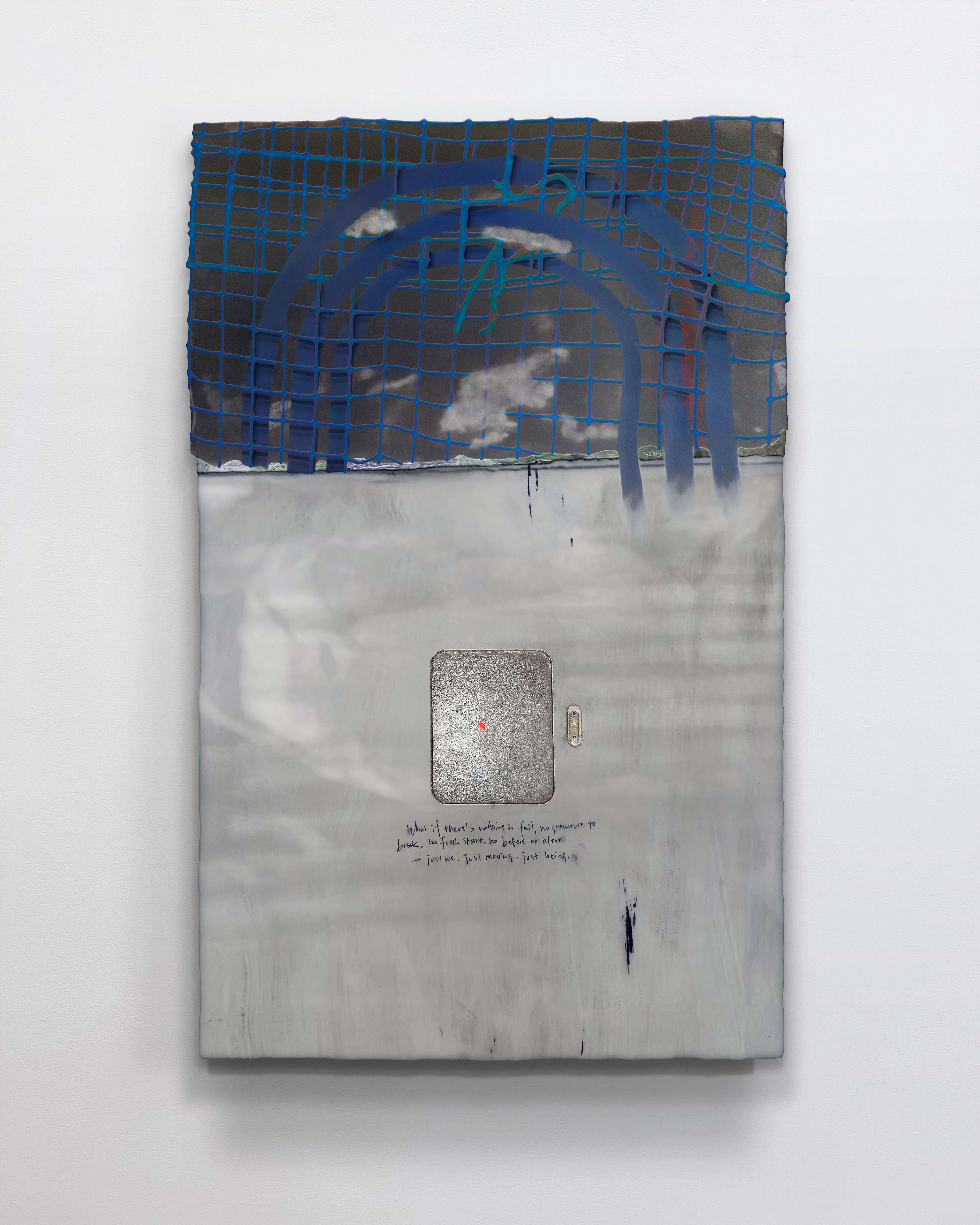 Ziyi Zhang, 10/17/2025 no structure no break, 2026. UV-polymer extrusion, oil, and epoxy clay on clay board; 18 × 28 inches. Courtesy of the artist and LATITUDE Gallery.
The anticipation of touch is not unique to digitally fabricated work. Zhang’s phrase “screen-native materiality” helps identify what is distinctive here. Digital drawing, modeling, printing, and subsequent painting subject the same form to different treatments. The resulting surface possesses actual height and contours while retaining the image’s representation of other materials. The image participates in making the surface and continues to participate in how we understand it.
Loving Vincent makes this coexistence more tangible for me. Its listed materials are UV-polymer extrusion, oil, and pearl powder, yet its reflections still suggest the coolness of metal. Knowing what the work is made with does not immediately dissolve the sensory expectations it has already elicited.
 Ziyi Zhang, 06/07/2024 Loving Vincent, 2026. UV-polymer extrusion, oil, and pearl powder on clay board; 17 × 21 inches. Courtesy of the artist and LATITUDE Gallery.
The small raised strokes give this anticipation a more specific form: how would these lines press against the skin beneath a fingertip? The more clearly I register their relief, the more aware I become that I have already made a judgment about the material before touching it. Sensation has begun, while my understanding of the material remains incomplete.
Laura U. Marks’s discussion of “haptic visuality” in The Skin of the Film offers a way into this experience: images can mobilize sensory memory, making looking an activity in which the body participates. From this perspective, the passage from screen to physical object cannot simply be understood as the body’s return to the image.
“Flesh” directs attention toward this bodily participation, but it may also bring looking to a premature conclusion. The grid engages our recognition of structure; reflections evoke memories of materials; raised script prompts us to imagine contact. Naming all these experiences flesh emphasizes their connection to the body, yet risks obscuring the differences among recognizing a structure, recalling a material, and anticipating contact.
PIXEL//FLESH thus raises a question about material expectations. We draw on things we have touched to understand images, then draw on images to anticipate things we have yet to touch. What emerges is a relationship between a fabricated surface and the bodily expectations brought to it. Returning to Loving Vincent, I find that its reflections and raised script have already given an imagined encounter specific qualities: before a hand reaches out, we have begun to imagine how it would feel to pass a fingertip over those strokes. WM
Ziyi Zhang: PIXEL//FLESH, curated by Jinyi Freya Xu, is on view at LATITUDE Gallery, New York, through October 17, 2026.
Luman Jiang
Luman Jiang is an independent curator and writer based in New York. Her work engages contemporary art, curatorial practice, and cultural theory across Chinese and English.
view all articles from this author