Whitehot Magazine
October 2026
"The Best Art In The World"
"The Best Art In The World"
October 2026
Xiaodong Zhang - Recluse at Upsilon Gallery
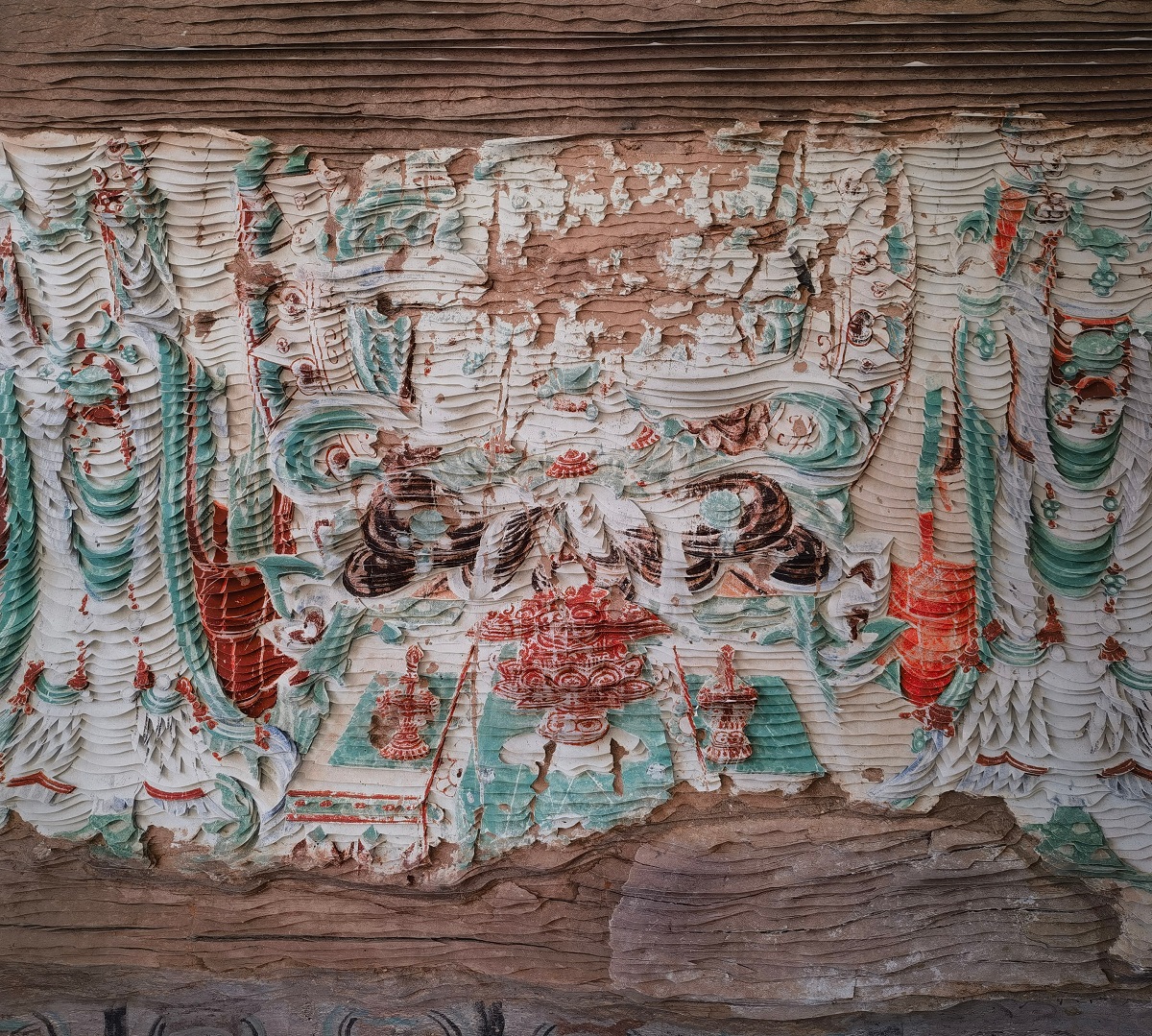 Dunhuang Music and Dance, 2022,Courtesy the artist and gallery
By YICHUN HUANG March 30th, 2026
Recently, Xiaodong Zhang presented his solo exhibition Recluse at Upsilon Gallery in Mayfair, London. Following his previous duo presentation, this exhibition offers a more comprehensive and systematic articulation of his artistic trajectory and methodology. With institutionally support from LUMINOR, the exhibition foregrounds key works from his “Thousand-Page Art” Dunhuang series, allowing this evolving body of work to unfold more fully within an international context.
Recognized for his revival of the Tang Dynasty dragon-scale binding technique, Zhang has gradually developed new forms such as “Jinglong binding” and “Thousand-Page Art.” The latter, as a previously non-existent artistic language, not only extends the material boundaries of book art but also redefines the relationships between the book, space, time, and modes of viewing.
Zhang Xiaodong’s “Thousand-Page Art,” as realized in the Recluse exhibition, constitutes a contemporary artistic system that integrates traditional craftsmanship, spatial construction, and perceptual philosophy. Its origin can be traced to a formative experience during an exhibition at the Potala Palace, where the natural curling of dragon-scale-bound pages - caused by the high-altitude climate - produced a shifting visual effect in which Buddhist imagery appeared and disappeared with the movement of the viewer’s hand. This oscillation between visibility and concealment inspired Zhang to transform the book from a linear reading medium into a generative structure embedded with temporality and spatiality. Within this methodology, thousands of sheets of handmade Xuan paper are layered, cut, and reassembled through dragon-scale binding and paper sculpting techniques, forming a surface that undulates like scales. Combined with mineral pigments derived from Dunhuang mural traditions, the works establish a complex visual tension between historical materiality and the translucent interplay of light and shadow.
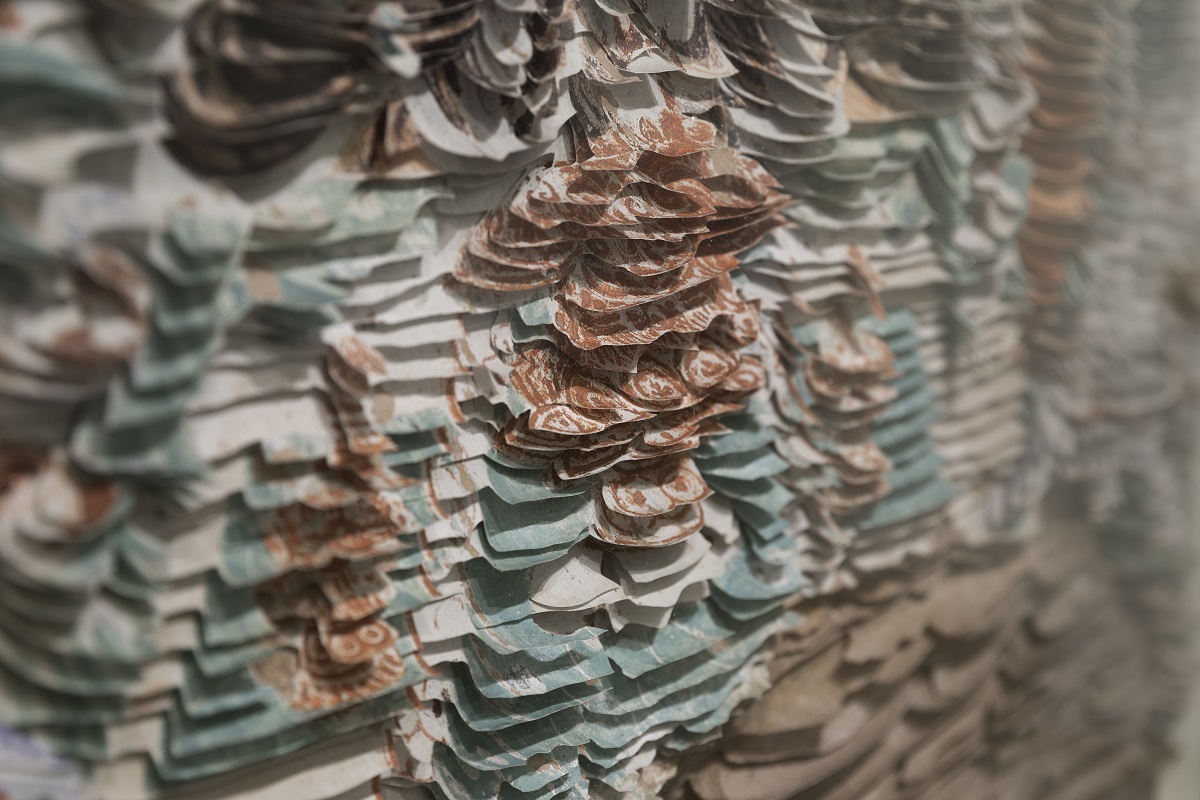 Detail view, Courtesy the artist and gallery
At the same time, the Mogao Caves of Dunhuang serve as a crucial prototype - not only informing the compositional schema of the traditional “preaching scene,” with a central seated Buddha flanked by bodhisattvas above a lotus pedestal, but also functioning conceptually as a spatial model of temporal accumulation and the formation of consciousness. In this framework, the cave is both a physical site and an interior structure shaped by memory and sustained practice. Within such a system, pages cease to function merely as carriers of images; instead, they constitute the very “body” of the Buddha, realizing the unity of scripture and Dharma - where the text is the teaching and the teaching is the text - thus enabling a transformation between image, material, and time. Viewing, accordingly, undergoes a fundamental shift: as the viewer moves, the layered pages subtly shift, causing the image to emerge and dissolve across different perspectives, turning perception into a durational experience rather than an instantaneous visual consumption.
Furthermore, under the thematic framework of Recluse, the notion of seclusion is redefined - not as withdrawal from the world, but as an active cognitive strategy that creates distance in order to deepen understanding. This perspective aligns with the artist’s emphasis on slowness, repetition, and inner accumulation, and, within a contemporary context defined by acceleration and hyper-visibility, operates as a counter-practice. Through material restraint, temporal delay, and perceptual deceleration, Zhang’s work resists the immediacy and superficiality of image consumption. Ultimately, his practice not only reinterprets the ancient technique of dragon-scale binding and the visual traditions of Dunhuang, but also fundamentally reconstructs the concept of the book itself: no longer a container of information, it becomes a spatial apparatus that integrates reading, embodiment, temporality, and contemplative experience, proposing a new artistic language centered on process, perception, and time.
Yichun Huang
Yichun Huang is a London-based Chinese artist and writer whose work explores spiritual practice and inner presence through painting and writing.
view all articles from this author