Whitehot Magazine
October 2026
"The Best Art In The World"
"The Best Art In The World"
October 2026
The Carnality of Love and Violence: Interview with Cecilia De Nisco and Vincenzo Della Corte for ‘I’m Very Into You’ at VIN VIN Vienna
 Cecilia De Nisco, ‘Not Titled Yet #4’, 2026. 30 x 15cm, oil on panel.
By GRACE PALMER September 7, 2026
“Poetry and painting are done in the same way you make love; it's an exchange of blood, a total embrace - without caution, without any thought of protecting yourself.” Full of the unbridled, carnal connection in Miró’s claim to art and love, VIN VIN Vienna’s 10th anniversary exhibition ‘I’m Very Into You’ investigates the complexities of intimacy, desire and violence. As part of Vienna’s curated by 2026 gallery festival, international curator Marta Papini offers an alternative perspective, facilitating a dialogue between two distinctive, yet resonant artists. Marking a sixty-year separation, ‘I’m Very Into You’ showcases a new body of paintings by Vienna-based Cecilia De Nisco (b. 1997) in dialogue with the 20th Century painter and sculptor Lydia Silvestri (1929-2018). Despite their generational differences, De Nisco and Silvestri speak to the unreasonable expressions of desire, rejecting perfection and embracing love “without caution, without any thought of protecting oneself.” Ahead of the exhibition, I spoke with De Nisco and VIN VIN Vienna founder Vincenzo Della Corte about the permeable strands between Cecilia and Lydia, the fluidity of the human form and the unescapable carnality of intimacy.
“The goat was called “Motin,” she didn’t have horns, she smelled like ferns, she had golden eyes, and she licked my hands.” Surrounded by the Rhaetian Alps in Chiuro, Italy, Silvestri’s childhood was steeped in the idyllic charm of her pastoral environment. Tasked with weaving baskets, whittling bowls, Silvestri’s hands became her interlocutors of logic, behaviour and intimacy. This tactile curiosity permeates Silvestri’s oeuvre: her semi-abstract painted forms and sculptural, amorphous fluidity contrast with the enduring strength of her bronze and marble materials. For Cecilia, this exploration of the quasi-figurative and the manipulation of fluidity captivated her at the Rome Quadrinnale in 2020. Although she works in different mediums, Cecilia was struck by the connection between their practices: “we were working on the same theme, same topic; this ambiguity, this body, this intimacy.” This “very explicit, very open, very physical way to depict love and desire” also fascinated founder Vincenzo Della Corte on his first encounter with Silvestri’s work. With Marta Papini advocating for Lydia Silvestri’s recognition in art historical discourse, ‘I’m Very Into You’ reveals the intergenerational dialogue between two artists unafraid to immerse themselves in the tempestuousness of longing and the mutability of the human form.
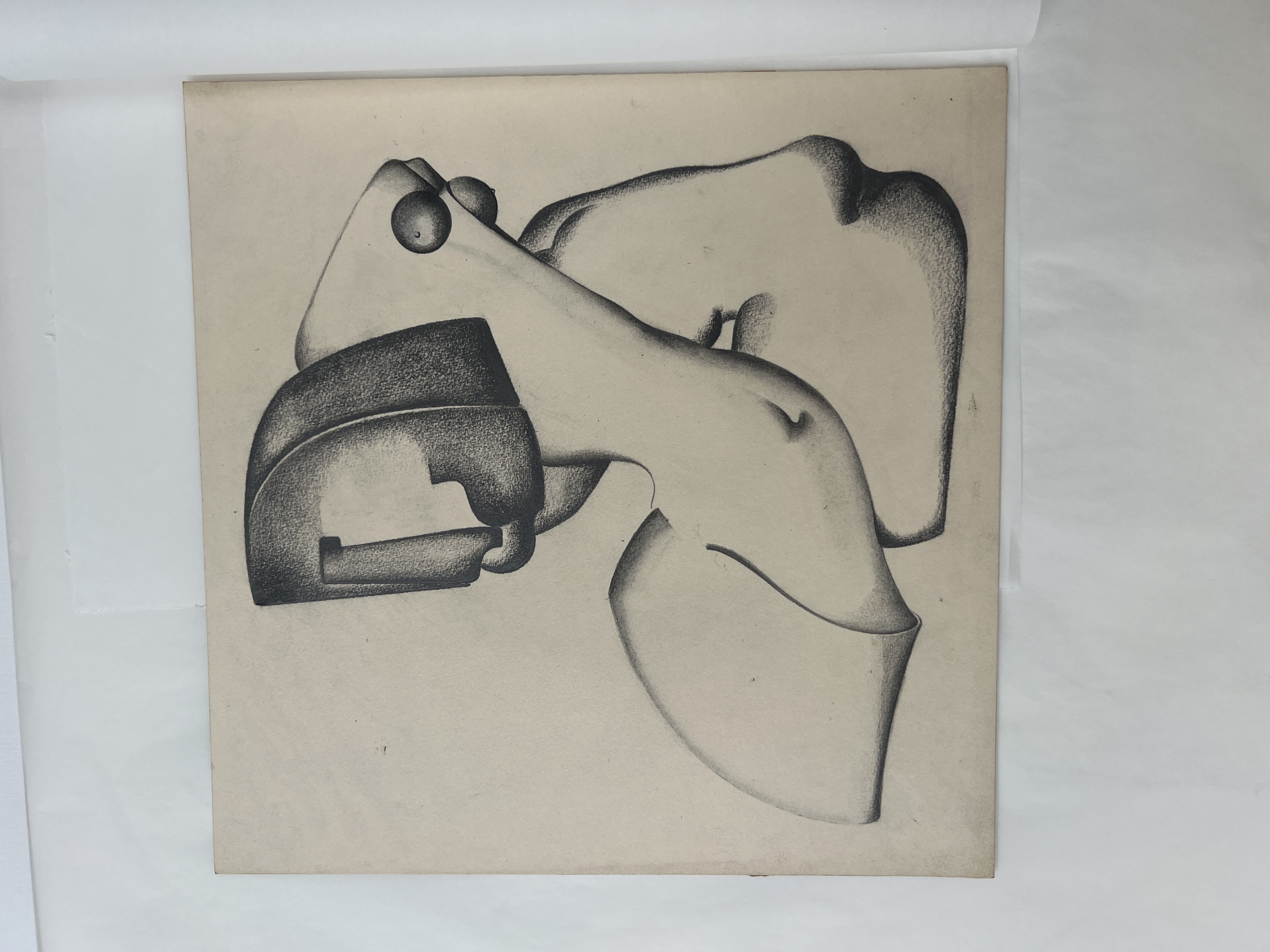 Lydia Silvestri, ‘Icontri’ (1982), Pencil and pastel on paper, 30 x 30cm. Courtesy of Lydia Silvestri Foundation.
Uninterested in conjuring an explicit narrative, Cecilia’s work explores the body as it exists suspended in time and place, “where the bodies are connected.” In one painting created for this exhibition, Not Yet Titled #2, Cecilia’s forms emerge from a singular flesh, with multiple heads clawing, gaping and shifting toward the centre. Both grotesquely gargoyle-like and evocative of the Hydra, this painting resists clarity, offering no certainty of figures, setting, history or consequence. For Vincenzo, even with the “final absence of a precise narrative”, each of Cecilia’s paintings is anchored by a single pillar: the body. Not Titled Yet #2 serves as a modern Guernica (1937), a mass of bodies converging and diverging. Yet, unlike Picasso’s virulent anti-war statement, Cecilia’s bodies remain ambiguous in their aftermath: “it could be after a war, after an explosion, after an orgy or a dance.” As Vincenzo describes, “it’s ghostly, it’s dramatic, it’s violent.”
 Cecilia De Nisco, ‘Not Titled Yet #2’, 2026. 70 x 40cm, oil on canvas.
It is hard not to discern traces of Silvestri in Cecilia’s exploration of the disfigured figurative, especially when viewed with her later sculptural forms. Despite working with rigid materials like marble and bronze, statuettes like Donna Blu (1989) achieve an unexpected fluidity. At just 9cm tall, Donna Blu merges rolling flesh, curving torsos and breasts into an object in perpetual motion. In Silvestri’s art, softness and hardness become interchangeable forces, each responding to the other. Cecilia’s depictions of love echo this duality: “One is explicit, violent. The other is soft, non-expressive. But both stay in this realm of suspension and ambiguity.” Aligned with curated by’s 2026 theme LOVE, Marta Papini unites two artists who approach this fundamental human emotion beyond one-dimensional formalism. By embracing uncertainty, fluidity and Miró’s carnality, these women conjure an abstraction rooted in the ambiguity of love and violence.
For Cecilia, the canvas serves as a space “where you can do what you wouldn’t be able to do in real life” – to visualise the subconscious. The evolution of her paintings reflects this surrender to the unconscious. She begins with numerous sketches, transferring these preliminary ideas to the wall. From here, “other images emerge, and sometimes with this shape I do other sketches or maybe realise something interesting is happening, so it gets recreated on the canvas.” Just as Cecilia treats the canvas as her confidant, Vincenzo recognises a similar exploratory attitude in Silvestri’s sculptural work:
“I don’t think that her gesture is so neutral to be just a formal response to formal investigation. She was immersed in a certain social environment where certain paradigms were not yet investigated […] This is similar to Cecilia. She has the freedom to give shape to certain ideas which sometimes you don’t want or can't express openly because of the structures of society.”
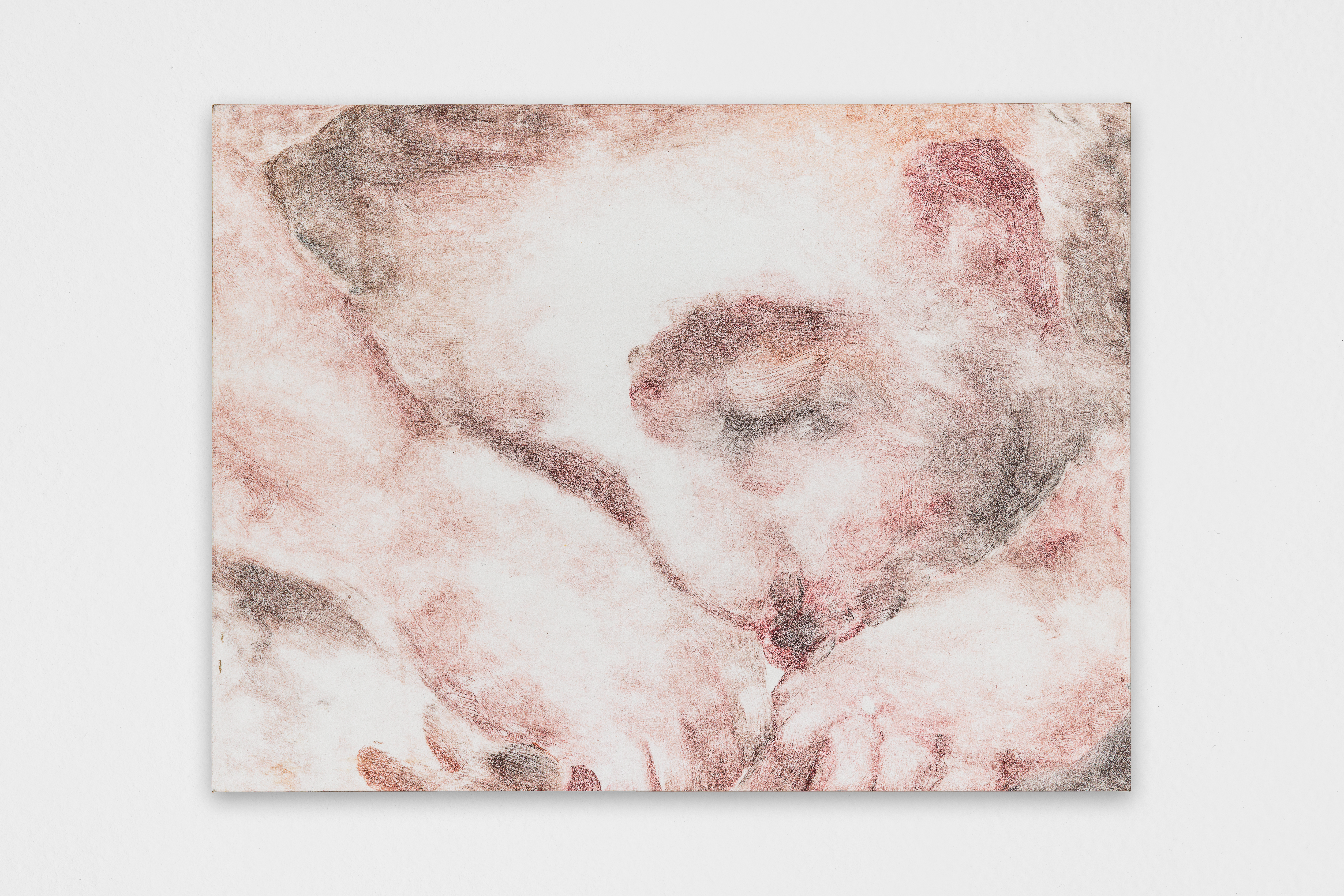 Cecilia De Nisco, ‘Not Titled Yet #6’, 2026. 24 x 18cm, monotype on panel.
Providing artists with space to express their ideas, creativity and inspirations has been the driving force behind VIN VIN Vienna since its founding in 2016. The gallery is firmly artist-centric, shaping its work around the needs and visions of its collaborators. As Vincenzo puts it, “The only way I could do this job was to be with the artist and at their complete disposal to grow together and to build discourse together. This means sometimes letting things go and accompanying the artists through a certain evolution to exist in the world.” In the case of ‘I’m Very Into You’, this dialogue now includes international independent curator Marta Papini. Vincenzo first met Papini during Cecilia’s inaugural institutional solo exhibition, ‘Stavo cercando il tuo cuore lì dentro ma ho trovato solo latte’ at the Bonollo Foundation for Contemporary Art in Thiene, 2024. “She’s deep when she talks about art,” Vincenzo notes, “she has a way to combine a certain depth with a poetic lightness, a kind of ethereal quality.” This four-way collaboration between Vincenzo, Cecilia, Silvestri and Papini has fostered a remarkable discourse – one that challenges curatorial singularity, questions the perfectionism of love and embraces the primality of desire.
My thanks go to Cecilia De Nisco and Vincenzo Della Corte for speaking with me about their work and their involvement with the gallery sector, respectively.
‘Curated by 2026: I’m Very Into You’ runs from September 11 – October 17, 2026, at VIN VIN Vienna, Vienna.

Grace Palmer
Grace Palmer, an art historian and writer, specializes in the history of contemporary art and 1960s New York performance art. She contributes to Whitehot Magazine and is currently located in London, England.
view all articles from this author