
Whitehot Magazine
October 2026
"The Best Art In The World"
"The Best Art In The World"
October 2026
Pay attention to the work of the New York artist Michael Alexander Campbell
 Michael Alexander Campbell, Church Work
By ANTHONY HADEN-GUEST January 7th, 2026
It was Asher Edelman, the Switzerland-based mega-collector, who suggested I pay attention to the work of the New York artist, Michael Alexander Campbell. I duly set up a meeting with Campbell, a fellow Brit in his 20s, in his studio on the Bowery, knowing I would see well executed work but not expecting anything particularly unusual. Wrong. Campbell first dug out a richly textured abstraction. “This is an older piece,” he said. “I painted it on my roof in the East Village. Which was really to do with I couldn’t afford a studio. The pigment melted in the summer and it froze in the winter and there are imprints from the rain. It’s got sand in it.”
How often did he check on the piece?
“I looked at it every morning. Sometimes I took it out of the rain and then put it back.” “How long was it up there?” “About a year,” he said.
The canvases stacked in the studio told Campbell’s art story. He had begun by painting abstractions. “I was just making marks and seeing what happens. It was a process thing, with marks and intuition,” he said. “There’s a bit of randomness with the mark making. I’m trying to make a precise mark but if the painting would look good with an extra mark somewhere, it comes down to that. And I think that’s really what separates painting from other visual media. The mark is intentional but some of them have randomness in them.” Campbell was living in Zuoz, a town in Switzerland, in 2019 and had a day job in a ski shop. Which was where he met Julian Schnabel, “I met him when I was selling skis” Campbell says. “He said what do you do? And I said I’m an artist.” So was he, Schnabel said. But Campbell didn’t recognize his name. “I guess he found my lack of knowledge very endearing or something,” he says. ‘We talked, he looked at my paintings, he said maybe one day you can come and work for me in New York.”
Schnabel left Switzerland shortly after. “I thought that it was never going to happen. I thought that was it.” Campbell says. But he was telephoned by Schnabel’s wife, Louise, and duly became his studio assistant in Switzerland and New York. ‘“He let me stay in his house and paint in his basement while he was in Italy,” he says. Schnabel also gave him a show in the downstairs space in his Manhattan home, the Palazzo Chupi, just after an Ai WeiWei show curated by his son,Vito.
 Michael Alexander Campbell, Self Portrait
In October 2023 Campbell stopped beginning a work by making a mark. His rejection of marks was extreme, “I don’t sign paintings any more. I sign them on the back,” he says, “I started working from images”. His process now begins with an online search for an image from which he can generate a painting nnd the resultant canvas usually features a sizable abstracted form derived from such an image, rendered on a flat wash. He builds these forms from a mix of pigment and wax, sometimes plus linseed oil and maybe with a touch of Liquin, a gel-like substance artists use to make paint dry. Such forms have have a quasi-sculptural presence and the flat wash is oil paint, sometimes sprinkled with turpentine.
He indicated such a canvas “This one is a cricket player,” he said. “I have never played cricket. But I saw an image of it and it looks great.” Another image suggests a dandified male figure with an explosion of ginger hair. What image ignited that? “It’s a self-portrait,” he said. It is indeed entitled Self Portrait.
What had propelled the marks to images transition? “Good question,” he said. “It could have been when I saw Dana Schutz’s exhibition at the Louisiana museum north of Copenhagen. I think what I wanted was to be able to paint anything.” He had also been affected by a striking visual experiencce. “I think that ultimately. It started when I was walking around Williamsburg and saw a statue of a baby in front of someone’s house which I thought looked amazing. It was kitschy, it wasn’t real stone, but I thought it looked fabulous. I was with two friends of mine, both of who are art dealers or curators. And they didn’t see it, they didn’t see anything special. But it didn’t look like a baby anymore. Its head had become something different.”
 Michael Alexander Campbell, Legless Jester
Campbell gleefully accepts that the body of work that evolved from this surreal moment could be characterized as “slightly obsessive”. He indicated a specific canvas, emphasizing the importance of chance in its making. “if I had it in my head I would not surprise myself, it would be a bad thing,” he said. “So it’s quite loosely thrown on and I had taken out his leg. And the colors are different and the shadow is different. So once I had painted him, The One-Legged Jester, I call him.”
When did he become one legged?
“When I made that mark. I like that mark” he said, adding “I decided where the shadow would go. So I took a picture of the shadow on the phone and sketched it in.”
The five canvasses in Campbell’s How to Worship series combine realism, such as the spectral images of slender standing tables, with the abstracted forms ignited by the downloaded images. And the title of the group? “ I grew up as an atheist,” Campbell says. “But I do believe that everybody has an innate desire to worship. It feels good to believe in something.”
So to the shadows.. Campbell’s purely realist elements tend to be spectral, like the standing tables in How to Worship, whereas the painterly forms he developed from the downloaded images have a sculptural presence. In 2023 he took to doubling down on their three dimensional punch by painting in a shadow. “I first introduced shadows in earnest this summer in Florence,” he said and indicated a canvas. “This one I thought was very self-indulgent. You need a whole second canvas just for the shadow. And I like that. It’s a bit strange.” He had got the idea from downloading photographs. “It did open up a new world,” he said. “But he shadow is usually not in the photographs. So it’s new.”
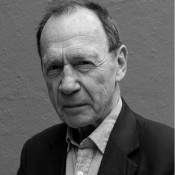
Anthony Haden-Guest
Anthony Haden-Guest (born 2 February 1937) is a British writer, reporter, cartoonist, art critic, poet, and socialite who lives in New York City and London. He is a frequent contributor to major magazines and has had several books published including TRUE COLORS: The Real Life of the Art World and The Last Party, Studio 54, Disco and the Culture of the Night.
view all articles from this author



