Whitehot Magazine
September 2026
"The Best Art In The World"
"The Best Art In The World"
September 2026
"Buddha and Shiva" - When Objects Outlive Their Worlds: Asia Society, New York
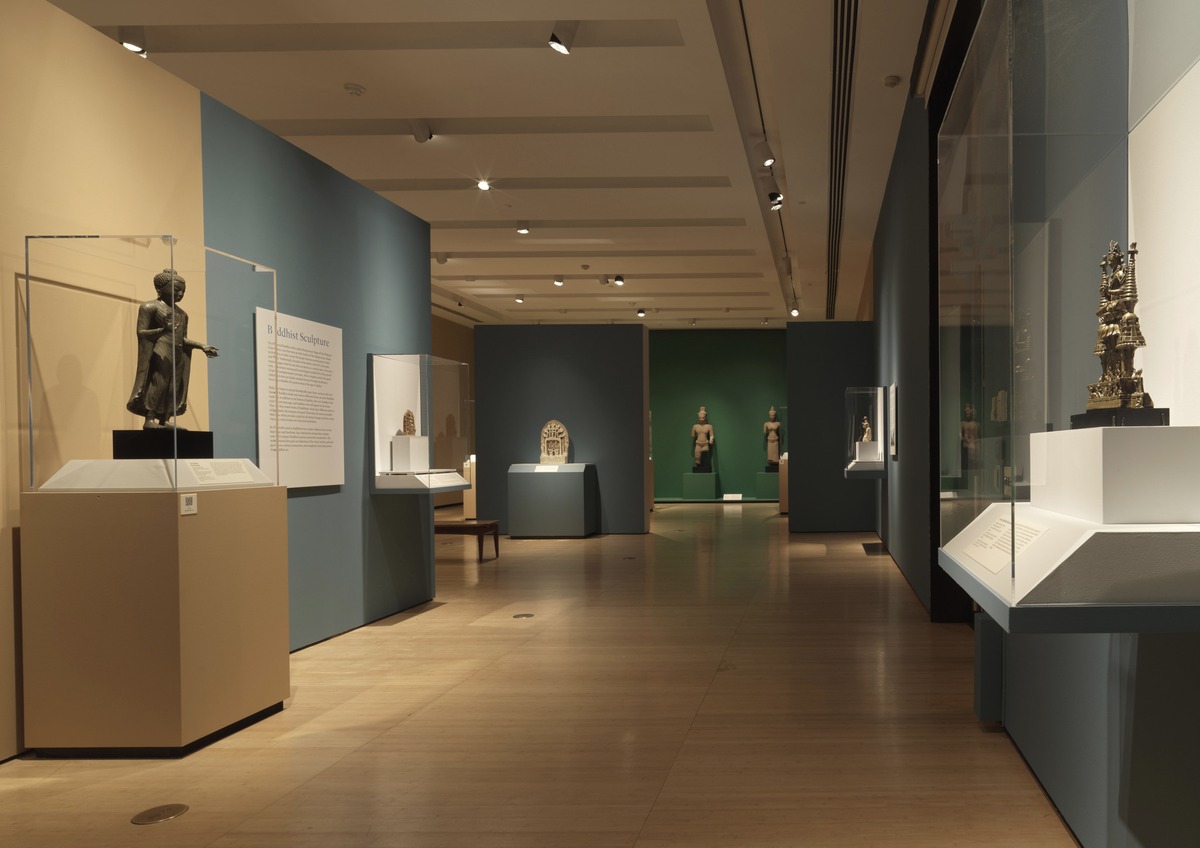 Installation view, Buddha and Shiva, Lotus and Dragon, Asia Society, New York. Photo credit: © Bruce M. White 2026, courtesy of the Asia Society.
By KUN SOK April 23rd, 2026
At first glance, Buddha and Shiva, Lotus and Dragon appears to offer the viewer a reassuring structure. On the second floor, Buddha and Shiva are distinguished within a single gallery, with the Buddha to the left and Shiva to the right; upstairs, vessels of metal and clay occupy a separate realm. That order is subtly reinforced by color. The blue walls surrounding the Buddha section lend it a quieter, contemplative air, while the deeper, brighter greens around Shiva give that side of the gallery a livelier charge. Buddhist sculpture, Hindu sculpture, and utilitarian objects are arranged into legible groupings, each with its own visual logic and historical frame. The exhibition is installed with admirable clarity. It does not overwhelm.
That clarity is one of the show’s strengths. Yet it also opens its central question. The longer one looks, the less these objects seem naturally contained by the categories that frame them. Buddhist, Hindu, vessel: the terms are useful, even necessary, but the works themselves suggest older, complicated lives—ritual activation, procession, domestic devotion, courtly use, maritime trade, and later reinterpretation. The exhibition is compelling not simply because it displays masterpieces of Asian art, but because its lucid divisions make visible how much these objects exceed the systems that now organize them.
The Buddhist section begins with a stable iconographic world. The visitor is taught how to recognize the Buddha through the ushnisha, the urna, elongated earlobes, and a downward gaze; bodhisattvas are marked by crowns, ornaments, and attributes. But the works quickly complicate any fantasy of fixed origins. A Gandharan Head of Buddhais clearly Buddhist, yet it also carries the visual memory of a region where Indian forms met the afterlife of the classical West and local traditions. Elsewhere, a Burmese seated Buddha surrounded by scenes from the life of Shakyamuni belongs to a devotional tradition while also hinting at a wider geography of movement: related examples have surfaced with inscriptions in Tibetan, Chinese, and Newari. Even within the stable category of Buddhist sculpture, the works keep pointing outward.
The Hindu section sharpens this tension by foregrounding the original life of the image. The Chola bronze Shiva as Vinadhara is especially revealing. In the gallery it appears as a poised sculptural masterpiece, but it was not made simply to stand still under museum lighting. Such bronzes were meant to move—to be carried during festivals, to enter public space, to make the deity visible beyond the temple sanctum. The category “Hindu sculpture” is accurate, but insufficient. It does not fully contain the performative life of an image once activated through procession and encounter.
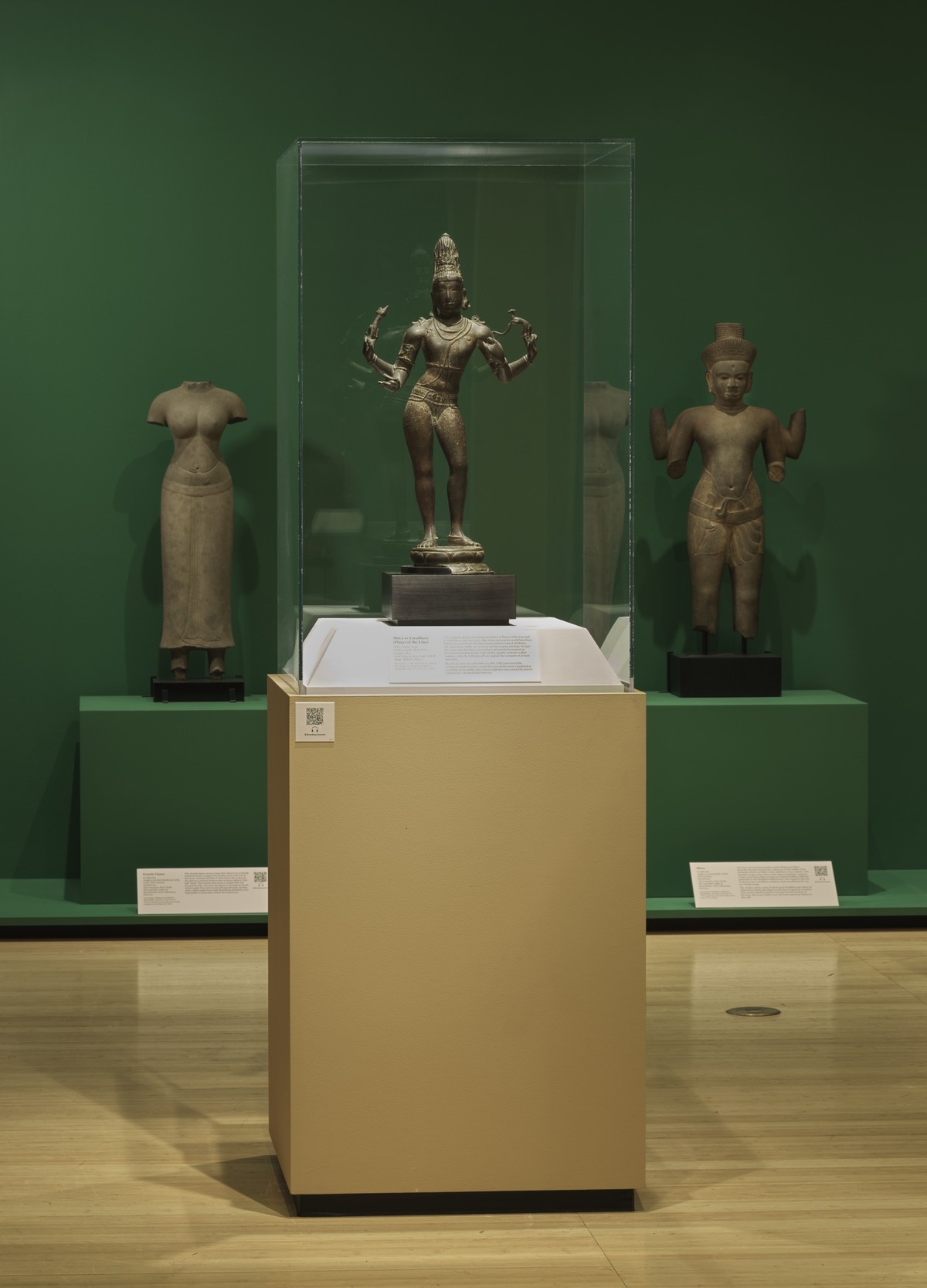 Shiva as Vinadhara (Player of the Vina), India, Tamil Nadu, Chola period, about 970. Copper alloy. Asia Society, New York. Photo credit: © Bruce M. White 2026, courtesy of the Asia Society.
A Cambodian Shiva pushes the matter further. The work is presented as a Hindu image, yet its surviving features suggest that it may originally have been Buddhist before later adaptation for Shaivite use. It matters not because it confirms a category, but because it unsettles one. Nearby Khmer figures identified only provisionally as male and female have a similar effect. Their uncertain status—royal, divine, or somehow both—suggests that the most interesting works in the exhibition are often those least content to remain where the labels place them. The show organizes with confidence; the objects themselves often remember layered histories.
The ceramics and metalwork galleries shift from sacred image to object of use, but they do not leave these questions behind. A Joseon storage jar from Korea, painted in underglaze cobalt with pine, crane, and moon, first appears within the frame of elite Korean taste, then opens onto its later afterlife in Japanese tea culture. What was once a vessel of storage and domestic handling became an object of contemplative display in another ritualized system of looking. A monumental Yuan blue-and-white platter from Jingdezhen offers another version of this expanded biography. It can be admired as a triumph of Chinese ceramic design, but its Persian inscription and Mughal association prevent it from remaining simply local. Even a Ming sacrificial red dish, now almost abstract in its concentrated surface, once operated within a ceremonial and dynastic world that gave its color a specific charge.
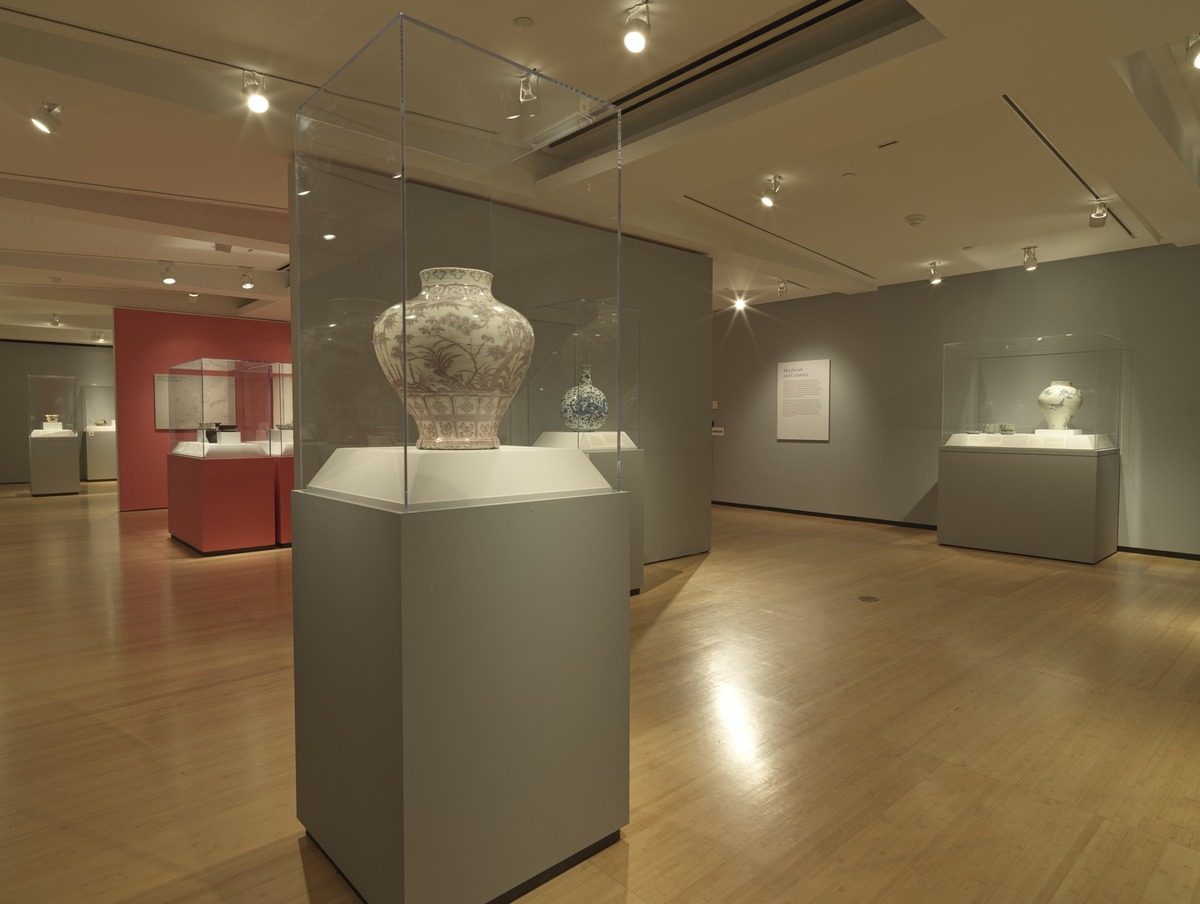 Installation view of the ceramics and metalwork galleries, Buddha and Shiva, Lotus and Dragon, Asia Society, New York. Photo credit: © Bruce M. White 2026, courtesy of the Asia Society.
What makes Buddha and Shiva, Lotus and Dragon persuasive, then, is the more complicated story that emerges beneath its orderly surface. They bear traces of worship, handling, trade, reinterpretation, and collection. In that sense, this is not simply an exhibition of Asian masterpieces. It is also an exhibition about what remains after ritual and after use—about how museums inherit objects whose original worlds are gone, and how new orders are built around what survives.