
Whitehot Magazine
August 2026
"The Best Art In The World"
"The Best Art In The World"
August 2026
Book Review: Women Artists: The Linda Nochlin Reader

Nameless and Friendless, Emily Mary Osborn, 1857. Oil on canvas, 103.8 x 82.5 cm. Courtesy of the Tate Britain, London & Newcastle.
BY DARYL RASHAAN KING August 6, 2025
My initial encounter with Women Artists: The Linda Nochlin Reader was like rediscovering a former self: the realization that my youthful hopes of advancing architecture through my art were met not with progress, but with a callous establishment ready to crush Queer Feminists such as myself. It was somewhat defeating to learn of Eva Franch I Gilbert’s dismissal from the Architectural Association during quarantine, a bitter fact I immediately recalled as soon as I opened the book. Nochlin's critique of institutions echoes with frustration—how can former acts of rebellion now feel like existential threats, under the weight of contemporary cultural gatekeeping?
Nochlin’s writing exposes the dissonance between the Modern Art Movement's accessibility and the elitism embedded in too much of Contemporary Art and the industry. The rapid commodification of art—where pieces once bought for $1,000 now trade for millions—has further alienated artists from the communities they aim to represent. For me, spaces like the Brooklyn Museum and Brooklyn Central Library are more than institutions; they are childhood habitats, grounding me amidst an art industry that often feels intent on erasure and gentrification.
 Liza Lou, “Maximum Security,” 2007-2008, glass beads on steel, (276 x 276 x 80 inches,) courtesy the artist and Lehmann Maupin, New York, Hong Kong, Seoul, and London.
Making fine art, Nochlin reminds us, is dangerous—not because of the tired cliché that “very few people make it,” but because of the real, material conditions: the hazardous materials, the unaffordable studio spaces, the indifference of cultural institutions. It was in this climate of increasing obstruction that I stumbled upon The Linda Nochlin Reader in a Williamsburg bookstore, retreating into my studio to sharpen my craft, desperate to find some clarity.
Nochlin’s dialogues, particularly with editor Maura Reilly, are profound. Like Nochlin, whose grandfather encouraged her path, I was nurtured by my mother and grandmother, women who saw the potential in my art when the world refused to. Yet, upon returning to Brooklyn, I was hit by a harsh reality: breaking into the professional art world was far more arduous than anticipated, not because of a lack of talent, but due to entrenched “socio-cultural structures—access to arts education, definitions of genius, and greatness itself”—obstacles compounded by a lack of resources in my post-collegiate life.
 Rachel Ruysch, Fruit and Insects, 1711, oil on wood, 44 x 60 cm. Courtesy of the Galleria degli Uffizi, Florence.
 JULIE DE LIBRAN Haute Couture Constanza Dress, Jacquard & Lurex Silk Circle Dress with cape. Featured in “We’d Have Probably Done The Same To You, If You’d Come ‘Round Our Place, Photographed by Benoit Auguste, Styled by Nicolas Klam. Model, Iza Dantas de Melo at Premium Models . Courtesy of Flaunt Magazine.
It ripples at the surface of my mind alongside “The Feminist Table,” officially known as Judy Chicago’s The Dinner Party. As a Crown Heights native, I’ve felt the deep pull towards art intellectualism, only to be met with a rising tide of anti-intellectualism, a force that invades not only public discourse but the sanctity of private life. For those of us whose careers are built on “women’s work”—culinary arts, visual art, design, and architecture—Nochlin’s essays feel less like history lessons and more like manifestos for survival.

Sculpture by Rachel Whiteread, Jewish Holocaust Memorial, Judenplatz, Vienna, Austria, Europe. Opened, October 25, 2000.
The conversations in The Reader forced me to reflect on my orbit across the "margins" of the art world. Unlike those with institutional support from places like Columbia’s Earth Institute or the Critical, Curatorial, and Conceptual Practices program at GSAPP, I found myself questioning how to bridge art with science, architecture, and engineering on my terms. This dissonance is as glaring as the difference between paved roads and dirt paths—an infrastructural metaphor for gender politics and the shifting terrain of language and identity.
Nochlin’s critiques of patriarchal structures are timeless, yet the book also confronts contemporary challenges and tomorrow. I found myself contemplating the tension between identity, language, and respect—the way pronoun politics mirror the struggles within feminist art discourse. How is it that in an era of hyper-consciousness, artists still navigate expectations to conform, clarify, and justify the act of conceptualization?
Her reflections on minimalism—its so-called “purity, clarity, and control”— resonate deeply in today’s politics. Intellectual oppression, whether in the classroom, gallery, or studio, is alive and well. Yet, Nochlin never reduces art to propaganda. She acknowledges that forcing any artist, male or female, into a rigidly “politically correct” box is a death sentence.

Lynda Benglis sculpting, 1971, United States, Wisconsin, Milwaukee, Milwaukee Art Center, Photograph by Eric Sutherland, Courtesy of the MIT Museum.
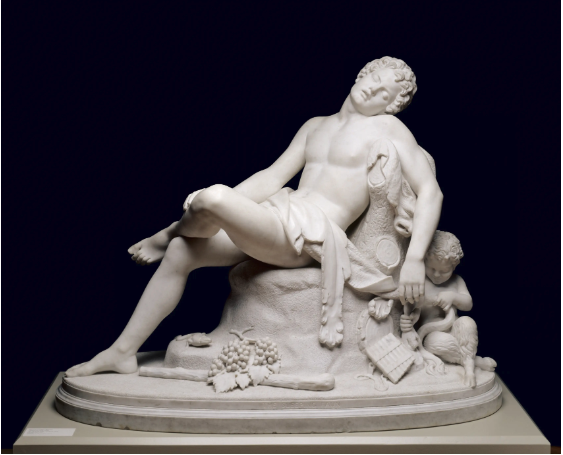
The Sleeping Faun, Harriet Goodhue Hosmer, Modeled 1864, carved c. 1870. Marble, 127 cm (50 in.). Leonard C. Hanna Jr. Fund 1997.15. Courtesy of the Cleveland Museum of Art.
However, the barriers to self-expression remain real. The patriarchal underpinnings of the art market, from the Paris Salon to today’s global auction houses, still dictate whose work is seen and whose is sidelined. Nochlin’s essays reveal how even “conceptual art,” often heralded as anti-institutional, is not immune to these forces. Psychoanalysis and psychology—disciplines Nochlin frequently engages with—become tools for artists to navigate and reimagine these constraints, transforming fantasy into substance.
One of Nochlin’s most powerful insights is the “unconscious link” between artists, collectors, curators, and institutions—a web of complicity that dictates what art is preserved, praised, or forgotten. This system, designed to avoid exploitation, ironically perpetuates it. Inclusion, therefore, becomes a competition, not a given.

Rumple, Lynda Benglis, 1977 Chicken Wire, Plaster, Cotton, Gesso, Gold Leaf, ( 36 x 9 x 4 inches.) Courtesy of Gandalf's Gallery

A.I.R. Group Portrait, Sylvia Sleigh, 1977–1978. Oil on canvas, 75 × 82in. (190.5 × 208.3 cm), Whitney Museum of American Art, New York; gift of the Estate of Sylvia Sleigh. © Whitney Museum of American Art
Nochlin’s refusal to romanticize the art world is impeccable: The “ghettoization” of art is not merely a historic footnote—it is a contemporary strategy of control. Preaching to the unconverted, as Nochlin suggests, may seem futile, but it is also a form of resistance against a system that thrives on maintaining its own hegemony.

Kiki Smith, Tale, 1992. Wax, pigment and paper-mâché, 160 x 23 x 23 in. (406.4 x 58.4 x 58.4 cm)
Women Artists: The Linda Nochlin Reader is not just a collection of essays—it’s a reflection of the persistent struggle creators face in confronting patriarchal, capitalist, and cultural authorities. Nochlin’s legacy reminds us that art is never apolitical. The most radical act is to create work that refuses to be co-opted, that challenges without capitulating to didacticism.
As an artist, architect, and chef navigating the tumultuous intersections of identity and creativity, I found in Nochlin not a roadmap, but a reminder. Her work is a call for those who remain on the margins—not to assimilate, but to interrogate, subvert, and redefine what it means to create in a world still intent on controlling who gets to be seen and heard. WM

Painters Progress. Elizabeth Murray. 1981. Oil on canvas, nineteen panels. 9' 8" x 7' 9" (294.5 x 236.2 cm). Acquired through the Bernhill Fund and gift of Agnes Gund. Courtesy of MoMA.

Reading Le Figaro, Mary Cassatt, 1877 – 78, Oil on canvas, 39 1/8 x 31 ½ in. (99.4 x 80 cm). Private Collection.

Daryl Rashaan King
Daryl Rashaan King currently works as a Teaching Artist with Leap NYC; a Chef de Partie at CUT by Wolfgang Puck, The Four Seasons Tribeca; and the Vice President of the Asian American Film Lab. He is the founder/ principal of kokuoroi, a multidisciplinary creative studio. The studio focuses on problems derived from urban living, viewed through the perspective of King, a Brooklyn native. A graduate of Columbia University, who originally specialized in painting, some of King’s goals include obtaining both an M. Arch and an Expert Diploma in Culinary Arts. He would also like to pursue various art and design programs and to live abroad. King has already earned certificates from Parsons in Streetwear; completed part of the Sustainable Design Foundation at Pratt Institute; and volunteered in Cusco, Peru at the construction site of a new Lower School. His work has greatly evolved since taking an Information Architecture course focused on Future Cities, hosted by the Department of Architecture at ETH Zurich. A former varsity wrestler, King has hopes of learning and practicing new martial arts. When he isn’t working, enjoying music, or playing video games, King’s focus is on the future.
view all articles from this author



