Whitehot Magazine
October 2026
"The Best Art In The World"
"The Best Art In The World"
October 2026
The Night Shift: An Interview with jiwoong - New York City
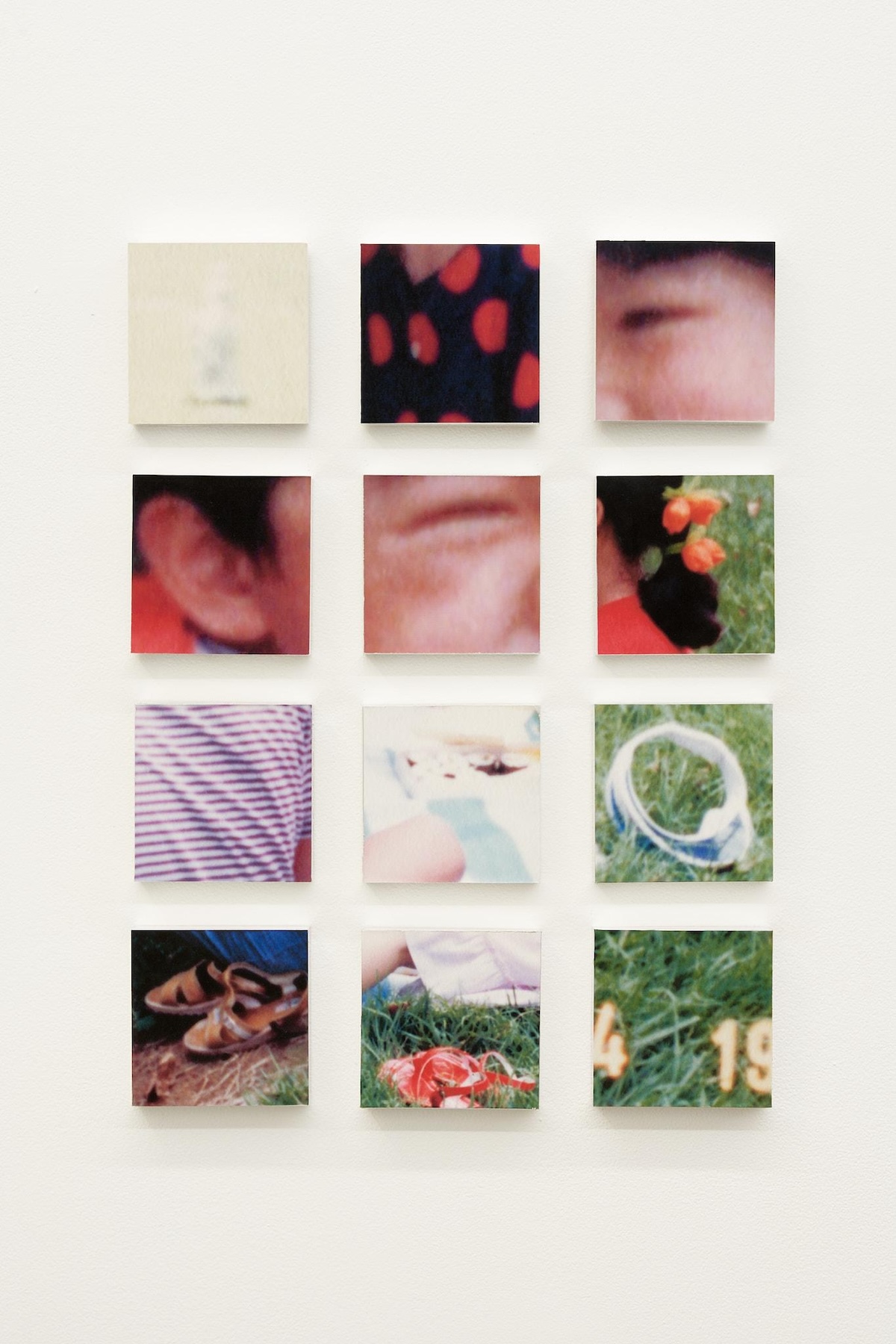
jiwoong. "Squint," 2025. Wood panel, Dibond, pigment inkjet print, aluminum tape, 17 x 23 x 1." Courtesy of Blade Study and the artist.
By COLLEEN DALUSONG February 25, 2026
Most of us do not choose what we remember of our childhood, but sometimes a trick of the light or a whiff of a familiar fragrance unexpectedly jolts us back into a nearly-forgotten memory. I may not remember my first day or school nor the majority of my birthdays; but I do remember the faint rumbling of the garage door signaling that my mom has come home from work, and I remember my dad's deep sighs whenever my little brother would make a mess in the kitchen. These are the kinds of everyday observations that form the foundation of jiwoong's practice, in which he transmutes evanescent yet seemingly-banal moments into unforgettable artworks.
Colleen Dalusong: I really love your night light vessels series, maybe because I find it so relatable. When I was in college, I liked walking around the city at night because there’s less people around and it’s a nice time to just think or listen to music. Your photographs remind me a lot of Patrick Modiano’s novels, they’re sort of familiar but mysterious, and there’s this moodiness to them that you only get when you’re alone late at night. How did you start this habit of walking at night?
jiwoong: It all began with a serendipitous encounter. During a difficult period when I had plenty of time but limited means, I happened to watch Julian Schnabel’s film The Diving Bell and the Butterfly, which was based on the memoir by Jean-Dominique Bauby. I was deeply moved by a particular line in the book: “Night walk is my own way of enduring my ferocious fate.” For some reason, I really wanted to believe those words. Since time was the only thing I had back then, it was something I could easily try. That was the beginning of a habit that has stayed with me for nearly twenty years. This project originated from a desire to return the solace I received; I wanted to create a space within my work where the audience could embark on their own night walk.That’s why hearing about the specific atmosphere you found in my work and your mention of Patrick Modiano really means a lot to me. That connection is exactly what I hoped to achieve with this project.
CD: Yeah, I’ve definitely had serendipitous experiences like that when I’ve walked alone at night. I remember a few summers ago, I had such a great day with my friends and I was in such a good mood that I just decided to walk home from Bryant Park all the way to Chinatown. On my way back, I saw a sign that said, “Time to be happy,” and I just remember thinking how I’d walked on that street countless times but this was the first time I had ever noticed that sign. I really couldn’t believe how happy I was that day, and I think I chose to walk back that day instead of taking the train because I wanted time to myself to just think about what had just happened, and seeing that sign during my walk really felt like fate.
 jiwoong. "Untitled (14 Panels)," 2023-2025. Pigment inkjet p rint on wood panels, 36 x 25." Courtesy of the artist.
J: Walking is the best thing to do when you have a lot to think about, whether it’s because you’re happy or because you’re worried about something. When I visited South Korea in 2021, it was my first time back in the country after seven or eight years, so of course the most important thing to me was spending as much time as I could with my mom, because we’re like soulmates and she gives me so much inspiration. During this visit, I realized that my mom really likes walking. Whenever we had free time, she would ask me to go for a walk with her by the mountain or the Han River, and she would always stack stones during our walks. Usually people stack only small stones, but my mom is really good at balancing bigger rocks on top of each other.
CD: She sounds like a natural sculptor. Maybe that’s where you get it from.
J: [Laughing] Oh wow, I’m going to let her know you said that! At first when I watched her stacking stones, I thought it was just for fun and I’d take some pictures of her to look back on later. Then one day, while watching her do this, I suddenly realized it was her own form of release. I know her life was not easy, but she seemed to release her tangled emotions through those walks and by stacking stones.
Since then, stacking stones has become a metaphor for walking. I was struck by the realization that while I was out on my night walks in New York, my mother was walking in the daylight in Korea. This sense of shared movement across different times and spaces gave the project a whole new meaning. Because of this connection, when I went back to New York for the Fall 2021 semester at Hunter College, I began a new part of my night walk project called Light Vessels. I started making numerous ceramic rocks and coating their surfaces with silver gelatin emulsion. In the darkroom, I would then expose the photographs I took on my night walks directly onto these rocks, effectively printing the images onto the surface of the ceramic forms.
CD: That’s so cool, this whole process really speaks to how you reach a sort of revelation in the dark — whether it’s a realization you have during a night walk, or how a photograph needs complete darkness so that the negative can become exposed and developed in order to bring out the actual image.
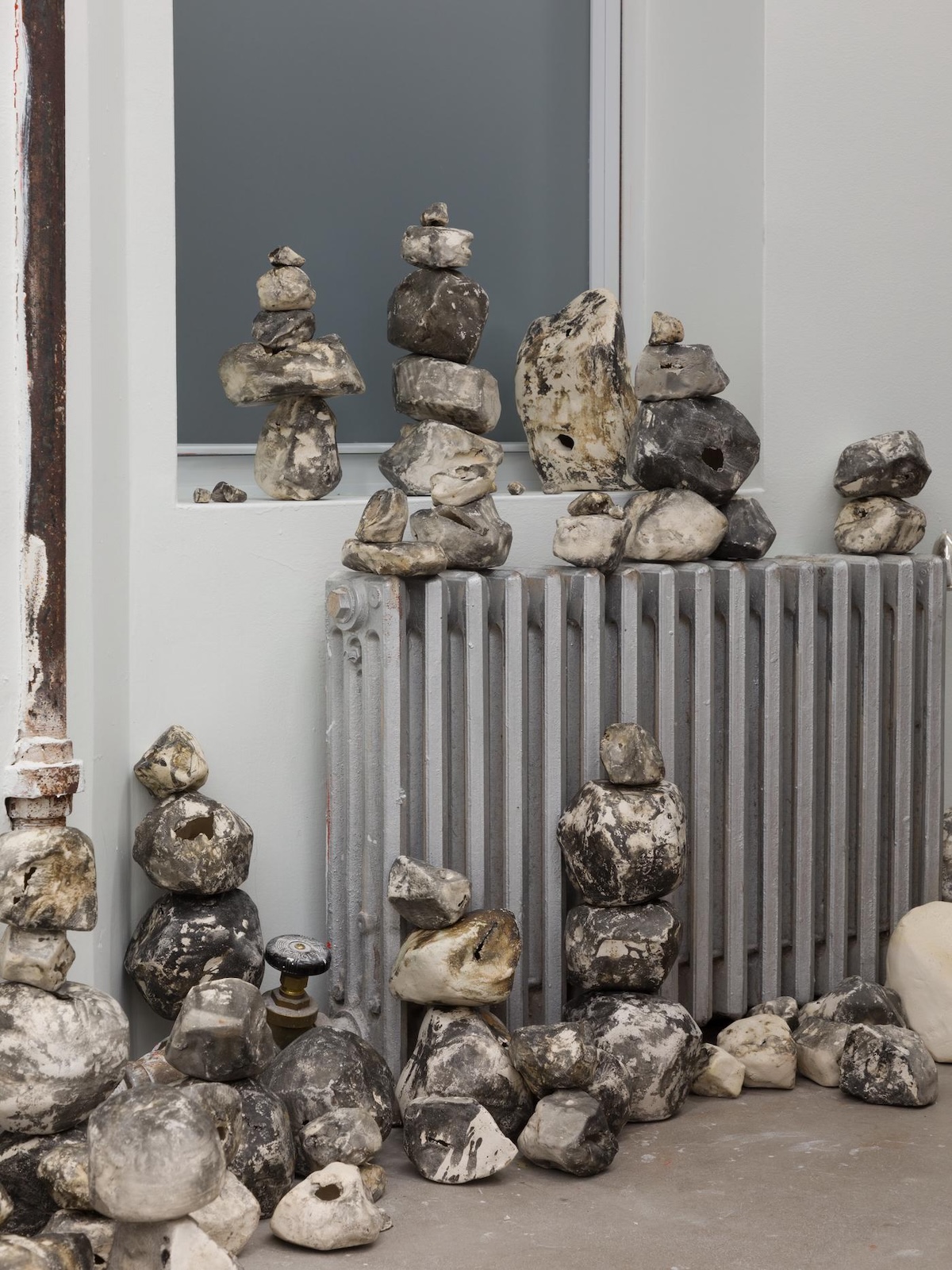 jiwoong. "Light Vessels," 2023. Silver gelatin print on ceramic, dimensions variable. Courtesy of Blade Study and the artist.
CD: When I saw your solo exhibit Tread Water at Blade Study last year, you somehow transformed that tiny gallery space in such a way that it made me feel like I was a kid again. Specifically, that exhibit reminded me of being at home in the afternoon, around the time the sun is setting so the light is this deep burnt orange, and you’re just bored in the living room and trying to pass the time while your parents are cooking dinner. That was my personal takeaway from the show, but I was curious what your initial inspiration and intentions were for Tread Water.
J: I’m really happy you thought of a domestic space, because I was thinking of my uncle when I made this show. One day when I was nine years old, I came home from school and all the lights were off. My mom was sitting in the corner and crying because she just heard on the telephone that my uncle got into an accident and he might not be able to walk again. So we cried together, but I remember at that moment, the house was so dark but the sunset outside was really beautiful and the lighting made our living room glow. I never forgot that. Thankfully my uncle was able to walk again, but he had a limp afterwards and he would spend a lot of time in his room. The Water Vessels in the show were very uneven and almost aggressive, because I was thinking about the way my uncle would walk, and that’s where the exhibition title Tread Water came from. He used to be a very bright and happy person, but after his accident his personality really changed and he mostly kept to himself. When I was in Korea, he would only sometimes come out of his room, then we would eat lunch together and in the evenings I’d give him a ride to his part-time job.
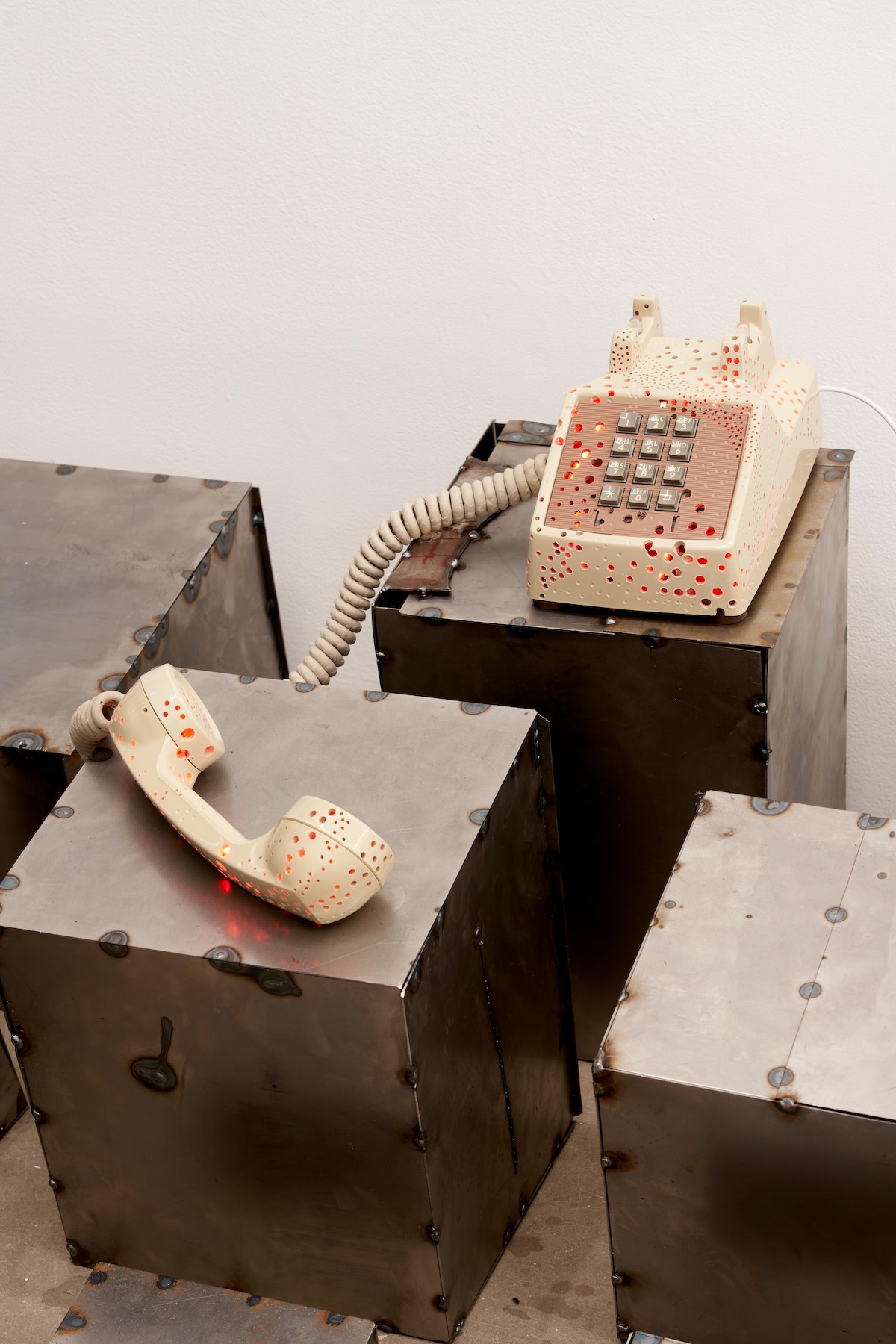 jiwoong. "Calling II," 2025. Found telephone, LED strip light, 8 x 4.5 x 9." Courtesy of Blade Study and the artist.
CD: Wow that’s so interesting, there’s sort of a connection between your uncle having the night shift for his job and your habit of walking around at night. It almost feels like you exist between sunset and sunrise. You seem to draw a lot of inspiration from your family members, so is there a reason why there’s this baseball imagery in the show?
J: Yes, my uncle would always talk to me about baseball. He didn’t root for a specific team, I think he just liked watching the American baseball games because he couldn’t sleep that much at night. This was a very vivid memory I had about my uncle, so for Sleep Field I combined his legs with a baseball bat to represent him.
CD: You have a talent for capturing this certain essence in your work. Whether it’s a bit more metaphorical in sculptures like Sleep Field, which feels like such an attentive portrait of your uncle, or in your photographs of seemingly mundane scenes. When I look at the night light vessels photo series, I can smell that sharp sting in the air when it’s really cold at night; and when I look at Squint, I can almost hear the sound of kids yelling and running around on the grass.
J: Wow thank you, that’s such a big compliment. I realized that the works in Tread Water serve as marks of time, capturing specific moments from my life and my uncle’s life that now create a dialogue with the present. I’m really happy that these emotions come through when you look at them. I always try to spend a long time living with my works in the studio to build a sense of empathy for each piece. It's really encouraging to hear you mention the scent, as it makes me feel that my time in the studio is translating to your experience. I really appreciate that.
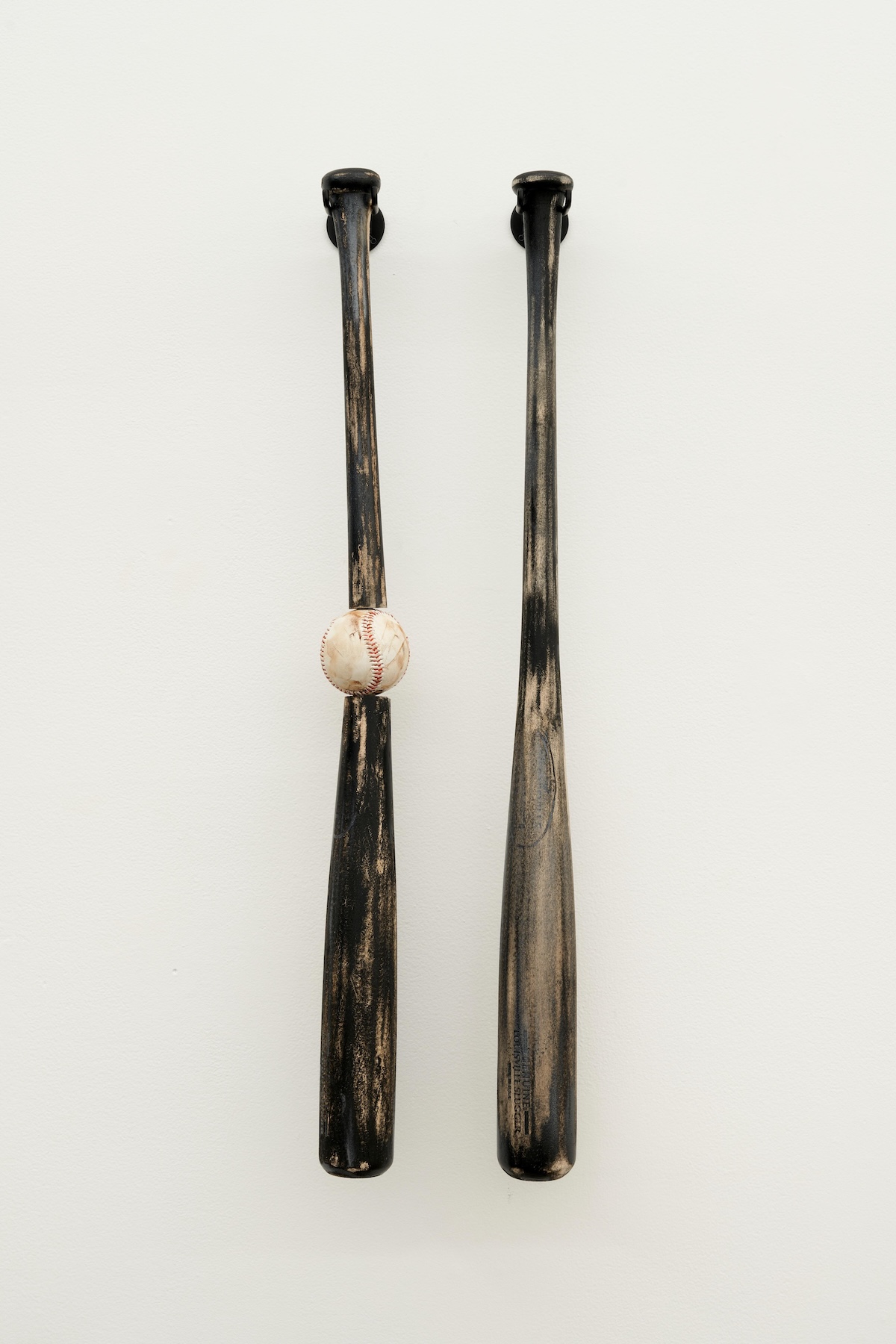 jiwoong. "Sleep Field," 2025. Baseball bats, baseball, wall mount display stands, spray paint, rust water, 5 x 33 x 3." Courtesy of Blade Study and the artist.
CD: There’s definitely a sense that your artworks create a dialogue between all the different moments in your life, yet they’re so relatable even if the viewer may not know you personally. What do you think your next series or project will be, or how do you think your art is going to evolve over the course of the coming year?
J: I learned a great deal while preparing for Tread Water, and that experience has motivated me to create even more work this year. My artistic practice does not center on constant studio production because reflection and contemplation occupy such a large part of my process. Although this makes my progress a bit slower, I want to expand my boundaries by learning new mediums and applying for various residencies. I hope to experiment in environments that are different from New York and eventually meet my audience with work that is unexpected and beyond anticipation. WM

Colleen Dalusong
Colleen Dalusong is a curator and writer based in New York City. She is the co-founder of Fruitality Magazine, and has curated exhibits at Think!Chinatown. She has previously been published in Cultbytes and Mercer Street.
view all articles from this author