Whitehot Magazine
September 2026
"The Best Art In The World"
"The Best Art In The World"
September 2026
An Interview with Curator Alison M. Gingeras
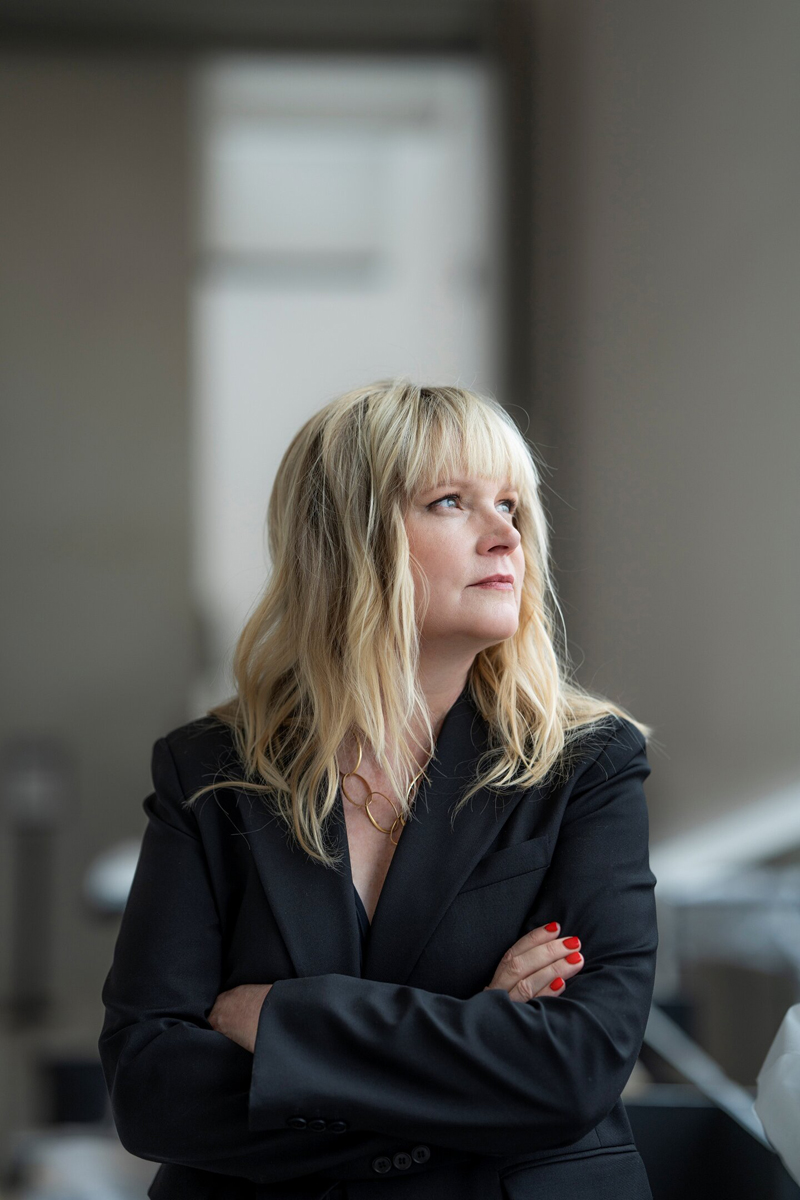 Alison M. Gingeras
photo by Magda Pawluczuk
By RUPERT RAVENS September 28th, 2026
As the Curator, of the exhibition The Woman Question 1550-2025 at the Museum of Modern Art in Warsaw (11.21.2025 - 5.3.2026), Alison M. Gingeras now carries the torch of Linda Nochlin, who singlehandedly launched the discipline of feminist art history, 50 years ago, with her essay Why Have There Been No Great Women Artists?
This exposition challenges the misconception of women being 'not present' in art history, as it re-imagines the enduring and dynamic personal voice/visual power of female artists.
Here, historic forerunner, Christine de Pizan (1364-1430), the first woman to be employed as a professional writer, with her proto-feminist publication Le Livre de la Cité des Dames (Book of the City of Ladies), (1405) becomes a legendary muse for a contemporary audience. (Sparked by Gingeras)
Ms. Gingeras champions women artists in Warsaw, because most museums across the globe are still hesitant to traipse into this territory.
Historically, the patriarchal mindset, pervasive as it has been throughout the art system, has stymied the use of terms such as ‘great woman artist', and ‘feminine artistic prowess’ in the fine art exhibition vernacular.
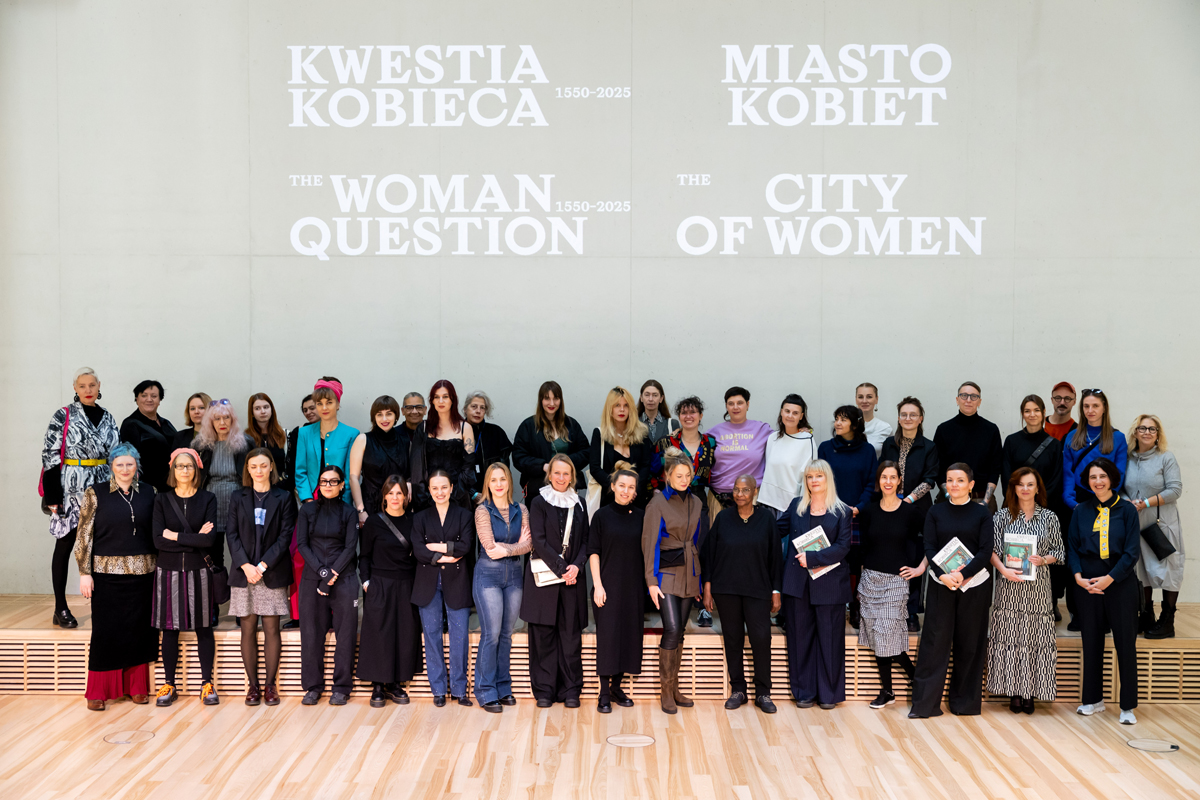
Artists & Participants in the exhibitions:
THE WOMAN QUESTION THE CITY OF WOMEN photo by Alicja Szul
In fact, The Woman Question could still be too transgressive for the current American museum landscape; any attempt to answer this query would reinforce its negative implications.
RR
You have succeeded in forging a real-life-moment ‘Cité des Dames’ (ala de Pizan). The museum must have become a ‘hive’ of humming communal activity during installation.
In fact, the rooms have been buzzing continually, as the Polish, international & regional artists, have participated in events with the public every weekend since the opening.
Moreover, this feminine art spirit has been richly bolstered by scholars such as art historian Ewa Klekot, and philosopher Chiara Bottici.
Feminist theorist Griselda Pollock (who coined the term “differencing the canon”) said, “A cité des dames is a vision not for women alone, but for creating an inclusive and shared project of making a world fit for the lives of all. Knowing about women artists, learning to see through their eyes and those of other Others, is urgent right now. It is not an art historical debate. It is a matter of life.”
I speak today with Alison about these tenets and discover how she feels about inheriting from Linda Nochlin, the world-wide gauntlet, for promoting women artists, in relation to shows she has envisioned and curated.
A multitude of women (and men) are inspired by your maverick curatorial adroitness…
AG
Thank you so much.
RR
You're an inspiration to me.
AG
I really appreciate that.
RR
I wouldn't have found you, become so intrigued by what you orchestrated if I hadn’t been slammed by a stroke, around the time I was looking up the artist Kristen Baker. I have a collector, who donated a work of hers, to the museum. When I was searching and researching her, your name kept popping up. Then, I delved into what you did with her in the shows - Kristin Baker, Espace 315, Centre Pompidou, June-August, 2004 and Francois Pinault’s Collection Sequence One, Palazzo Grassi, Venice, May - November, 2007. That's how I started on this odyssey…
AG
Well, I'm very happy to hear that the universe brought us together, because it sounds like it was a wonderful, serendipitous, and very generous act that connected us.
RR
You questioned Nobel Prize-winning author Olga Tokarczuk: “Do you think that—in literature, in culture, in politics—this form of “all-women’s” publishing, exhibitions, conferences is still vital and valid as a form of thinking or a methodology?”
She responded, “I find this form of reclamation both just and intellectually honest. The omission and erasure of women from the collective memory—as creators, discoverers, intellectuals, and innovators—unfolded over centuries, almost spontaneously and mechanically. The pervasive misogyny found in the vast majority of cultures and civilizations is, to me, appalling and incomprehensible.”
Tokarczuk, later in the interview with you, exclaimed, “Culture is a nutrient medium in which we swim, feeding on it while at once creating it.” Do you intuitively feel this metaphoric truth?
AG
There was a debate very recently here in Warsaw. The exhibition got a lot of very positive reception. But in this intellectual journal, there was, a kind of, I would say, an attack against me and the methodology of the all women exhibition, as being something that's dated. I really beg to differ because it's not just about gender. What, I tried to do was two things; one, which is to be as radically inclusive as possible, across not just international or racial lines, but also those of class and education, because art, as we know, is a domain of great snobbery and gatekeeping. In addition to this history of dismissing women outright as artists up until even, the 70’s.
You began by saying that you know Joan Semmel* and she was a teacher and mentor of yours.
RR
Yes.
AG
I remember interviewing Betty Tompkins and she was saying that they would walk all the galleries in New York City in the 70’s with their slides. And the answer was just “no,” by the virtue of the fact that you are a woman. Now there are also other kinds of gatekeeping that we see, whether it’s having to do with education and training, where we put artists who may be called folk artists or self-taught artists or, artists who are neurodivergent or disabled into a different category.
Here, I wanted to make a very intersectional exhibition. It is an exhibition that has male artists in it, because the second thing the exhibition tries to do is not just look at the authorship, but to look at the iconography that has to do with women’s agency over the centuries, and seeing differently through lines of experience and emotion within that iconography.
I think that there are still new ways to visit this question of an all-women format, or a mostly-women format. And furthermore, it's an exhibition that sees the gender spectrum as being very valid. There are several artists in the exhibition who are gender nonconforming or trans people, both trans women and a trans man are included in the exhibition.
And to me, this is something that has to do with the humanism that feminists methodologies urge us to take up.
RR
Yes. Like Puppies Puppies (aka Jade Guanaco Kuriki-Olivo).
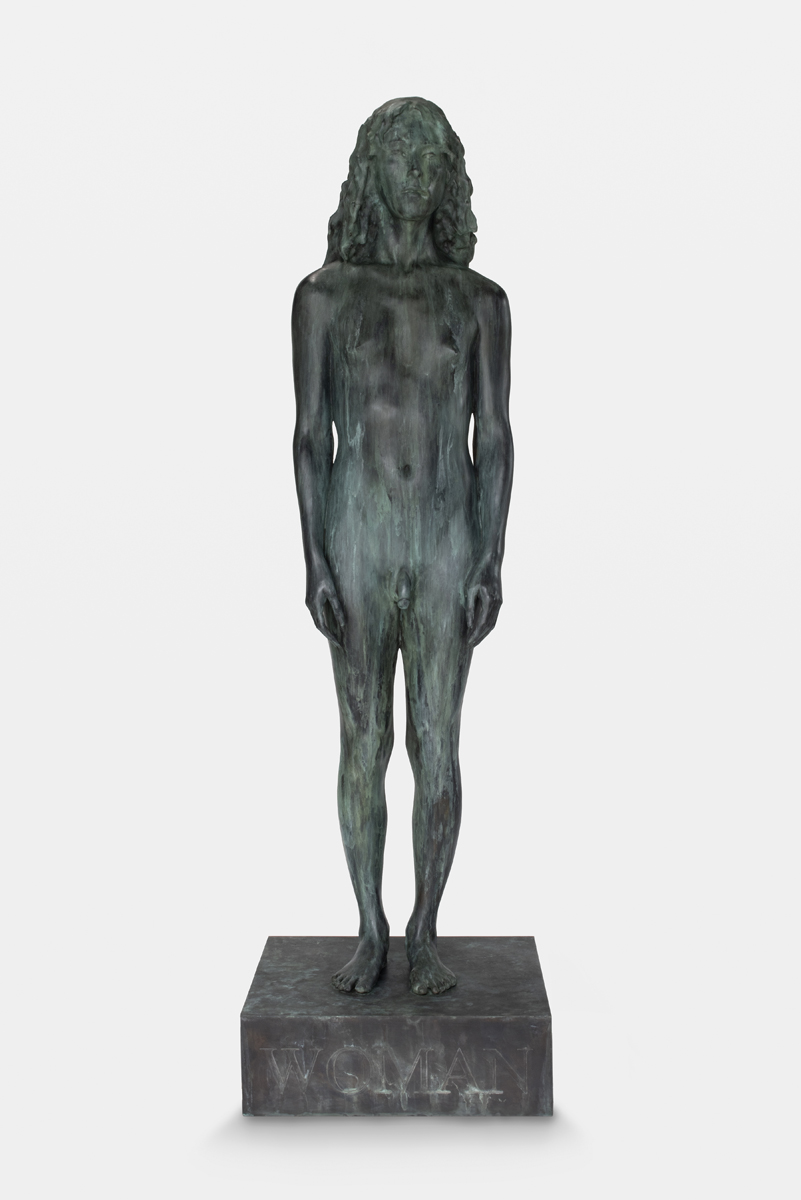
A MUSE OF HER OWN
Puppies Puppies
(Jade Guanaro Kuriki-Olivo) (b. 1989)
A sculpture for Trans Women A sculpture for the Non-Binary Femmes A sculpture for Two-Spirit People • I am a woman. I don’t care what you think • (Transphobia is everywhere and everyone is susceptible to enacting it at any moment) (Unlearn the transphobia brewing within) I am a Trans Women. I am a Two-Spirit Person. I am a Woman. This is for my sisters and siblings everywhere. History erased many of us but we are still here. I will fight for our rights until the day I die. Exile me and I’ll keep fighting, 2022 bronze cast on engraved base, 190 × 60 × 60 cm,
Collection of Casandra Hermann
AG
Yes, the other is Malgorzata Mycek with, Ghost Feasting with Ants in an Orchard During a Frost, 2024. S/he is a trans man who lives in rural Poland who made a self-portrait depicting himself as what they call in Polish, an ‘Upiór’ or, a kind of a living dead. The ‘Upiór’ is a folk category that came about in, even in the Middle Ages to describe someone who is a living dead person or like a kind of proto-vampire.
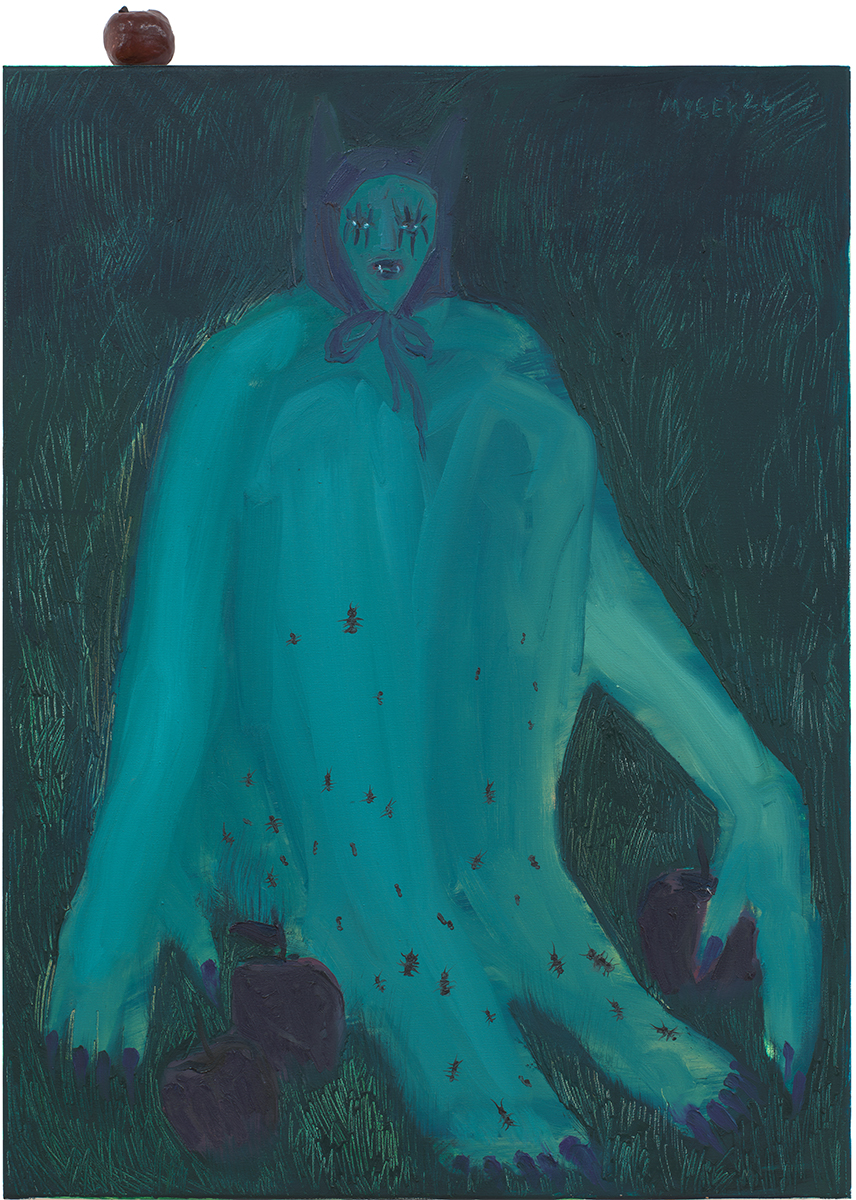
SURREAL SELVES, MYSTICAL ME
Małgorzata Mycek (b. 1993)
Ghost Feasting with Ants in an Orchard During a Frost, 2024
oil on canvas, 80 × 60 cm, Private collection
AG
And what Mycek says is that as a trans person living in this rural Polish society, “I am like a living dead person, living on the on the edge of the literal edge of the society.” So, there are these two portraits, one from the 16th century, by ‘Artist Once Known’, Portrait of Bearded Helena Antonia, 1621, and another from the 18th century, by another ‘Artist Once Known’, of women who were bearded, like Saint Wilgefortis, 1816, that Olga Tokarczuk wrote about in one of her most prominent novels. I think it's about giving… looking for these people in history; they're there! We just have to look for them.
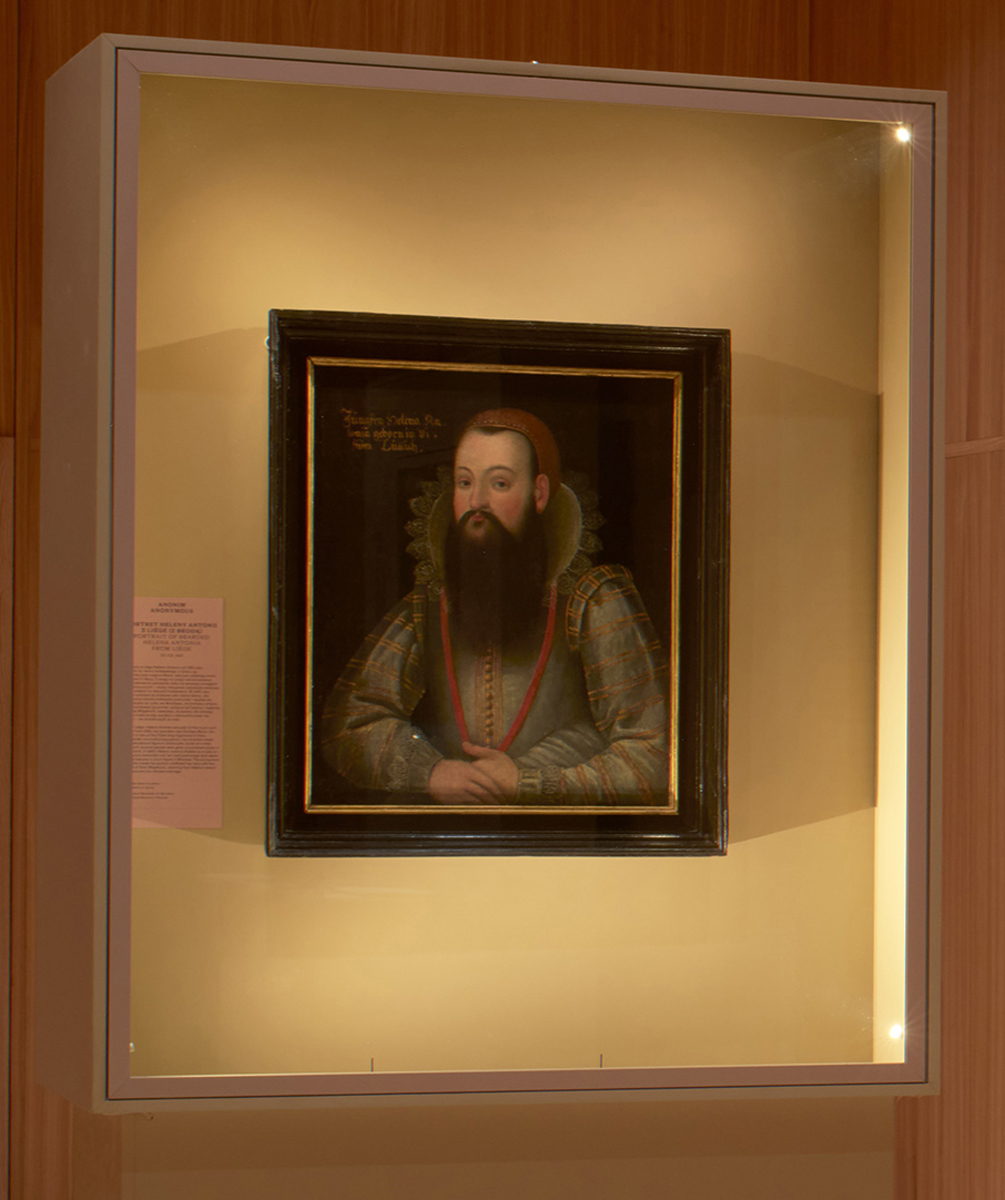
ANONYMOUS WAS A WOMAN
‘Artist Once Known’, Portrait of Bearded Helena Antonia from Liège, 1621 oil on canvas,
82 × 70 cm, National Museum in Wrocław
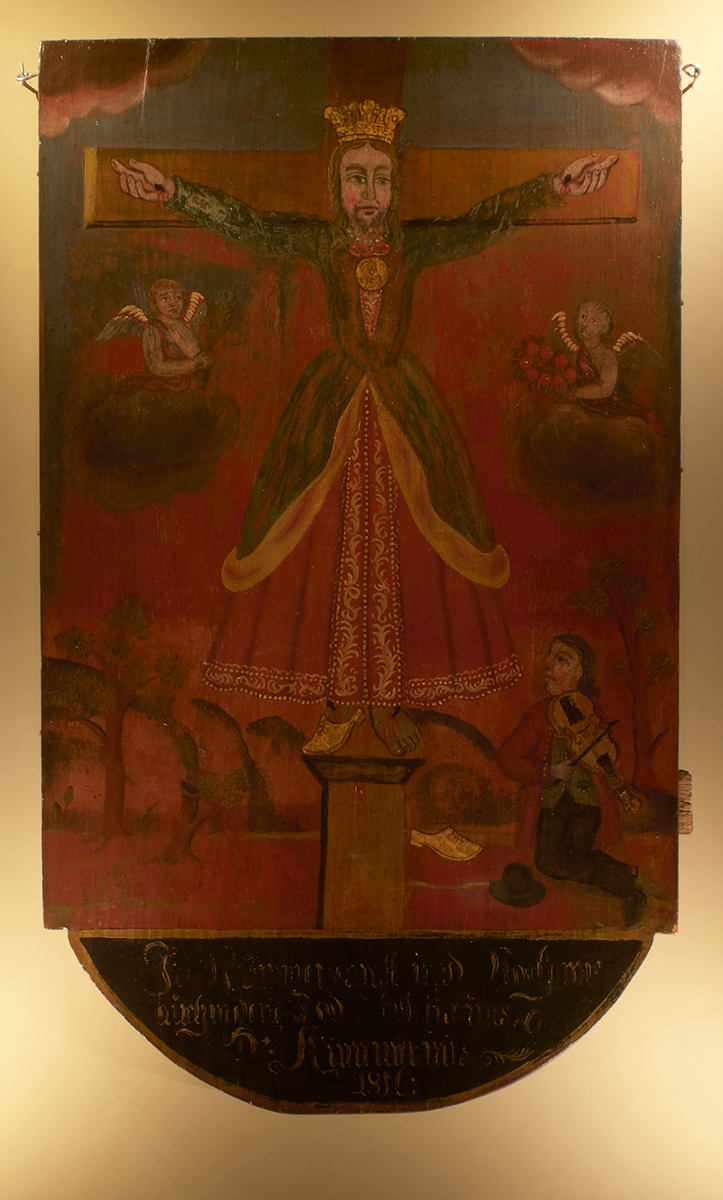
ANONYMOUS WAS A WOMAN
'Artist Once Known’ Saint Wilgefortis, 1816 Oil on canvas, 100 x 58.5 cm,
Ethnographic Museum – National Museum in Wrocław
RR
You made this transfiguration earlier in an exhibition that you did at Blum Gallery - Pictures Girls Make: Portraitures, Los Angeles, September-November 2023, that was really satisfying to witness. That's where I noticed your curatorial shift. If I can call it that, from, what, mostly one gender and/or, the one gender idea, and, the thought process associated with it, Yes?
AG
Yes.
RR
This show presents nearly 200 artworks in a nine-part narrative, highlighting women artists over the last 500 years.
You claim, “…one of the last frontiers in exercises of feminist art historical scholarship would be to banish traditional aesthetic and class hierarchies by integrating self-taught artists—including those who have been classified as folk, naive, outsider, neurodivergent—with schooled, so called fine artists.” “Disregarding any distinction between those who trained and untrained, the artists of The Woman Question are organized through thematic and iconographic dialogues in keeping with the idea of ‘feminism as a politics of alliance’ against all forms of oppression.” Do you feel this combination is an accomplishment?
AG
Yes, it's been a journey of my own as a citizen of this planet to really think about how the discipline of art history has traditionally been founded upon creating hierarchies of aesthetic value or historical meaning. In some ways, I would like to dismantle some of those hierarchies. If you take the question of iconography, in fact, the study of, images and what they mean across time and how, drawing upon, for instance; the ideas of Aby Warburg that, there are these, vessels that artists create that communicate, emotions across time. I think that all humans have that capacity. Yet as humans, we also have this kind of enlightenment inheritance of wanting to classify everything, put it in a box and give it, a pecking order. In fact, when we liberate ourselves from the pecking order, we start to see connections that are very inspiring and moving.
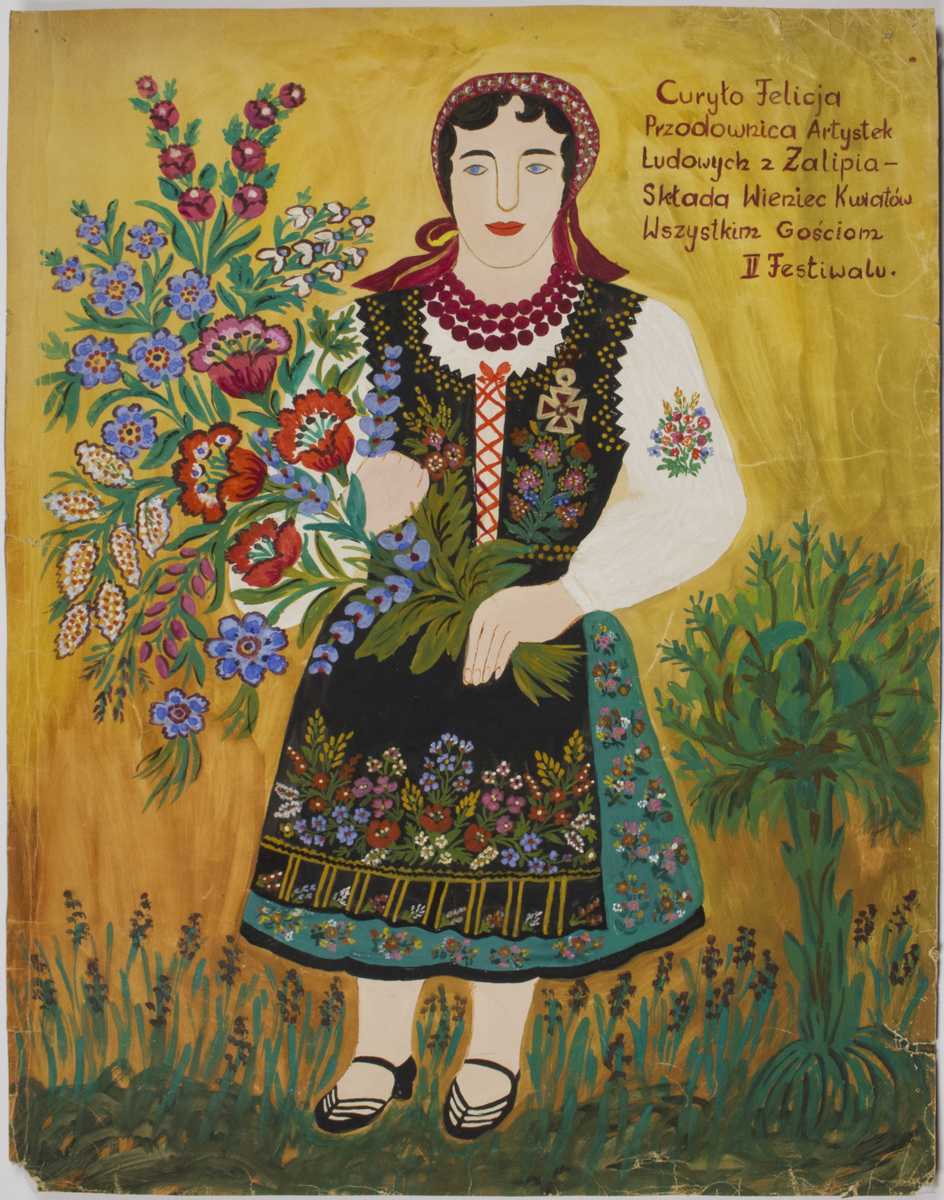
And, to hang, a painting by someone like, Élisabeth Vigée-Lebrun, Self-Portrait 2nd half of 18th century, who was, an artist to Marie-Antoinette and the King of France, before the French Revolution, next to a Polish “folk” artist Felicja Curyło, Self-Portrait 1950-1959, who made a self-portrait that was very similar in gesture and in presenting oneself as an artist…
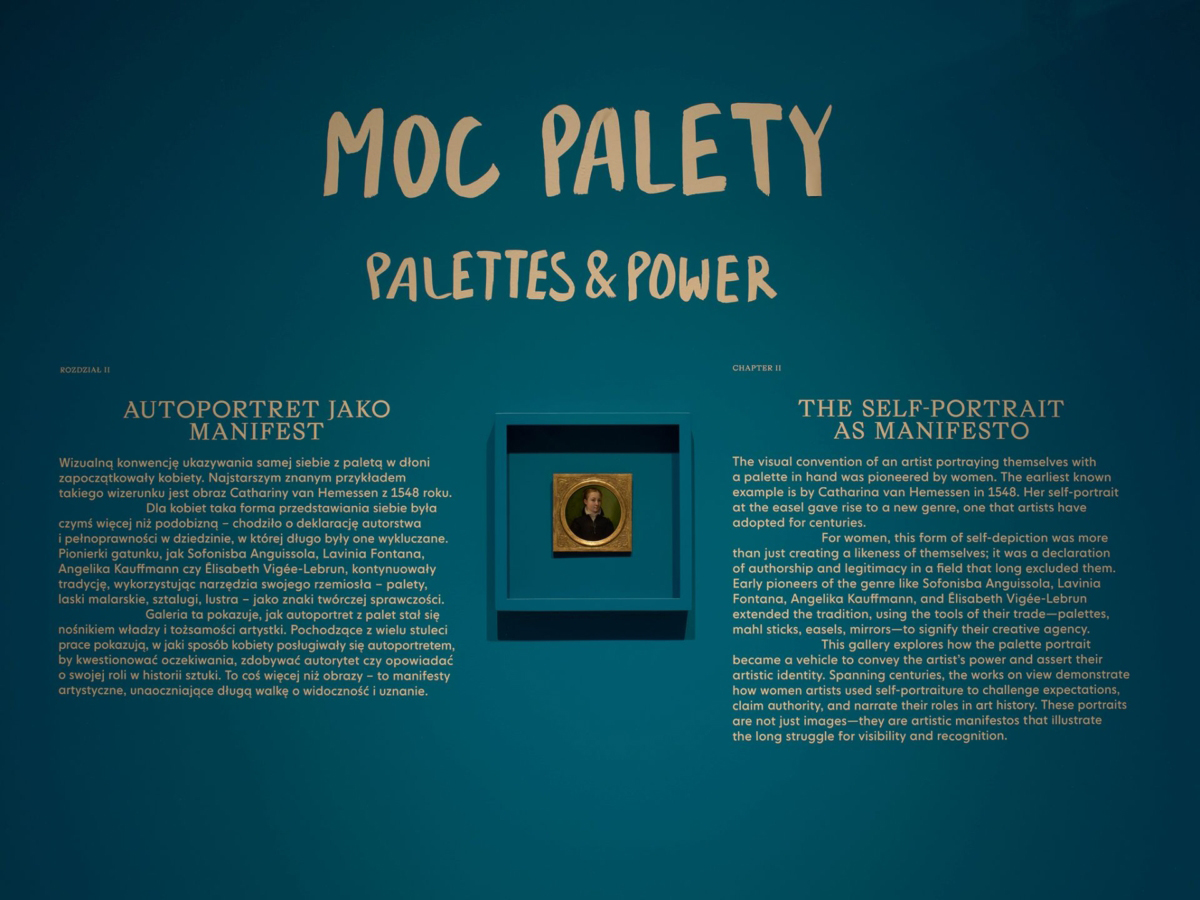
PALETTES & POWER: SELF-PORTRAIT AS MANIFESTO (installation shot)
Sofonisba Anguissola (1532–1625)
(Self-Portrait (The Ashburnham Medallion)), 1556 or 1558
oil on panel, diam. 13.2 cm, Frits Lugt Collection Fondation, Custodia, Paris
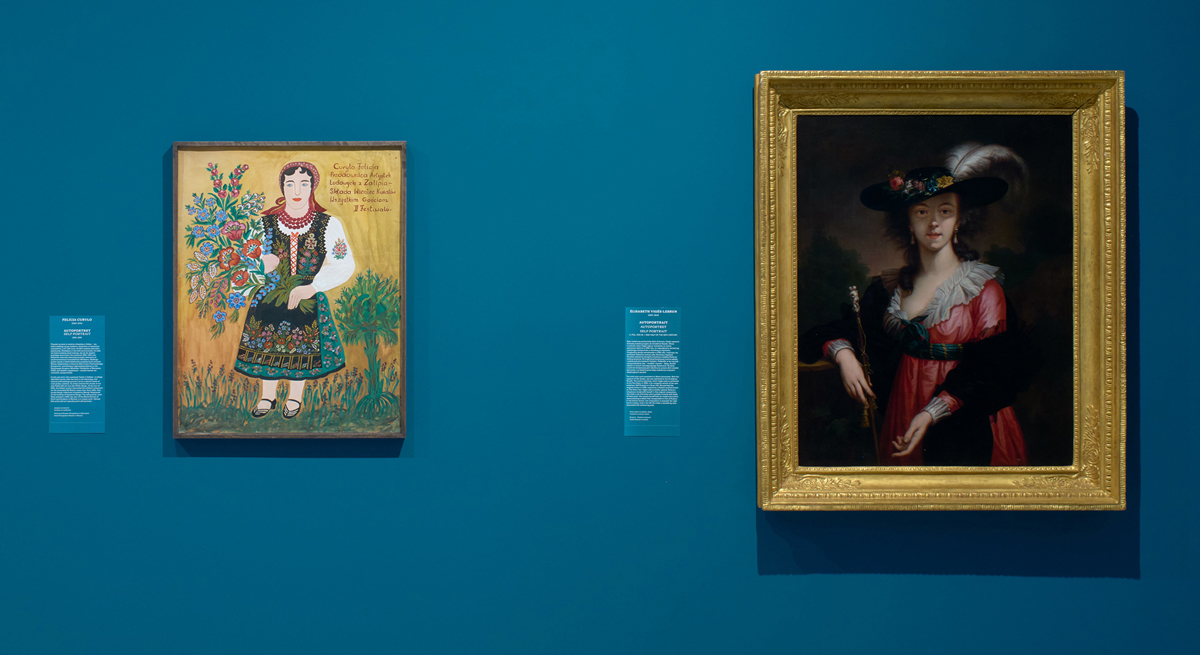
PALETTES & POWER: SELF-PORTRAIT AS MANIFESTO (installation shot)
L to R:
Felicja Curyło (1903–1974) Self-Portrait, 1950–1959
tempera on cardboard, 78 × 60 cm,
State Ethnographic Museum in Warsaw
Paired with: Élisabeth Vigée-Lebrun (1755–1842) Self-Portrait,
2nd half of the 18th century oil on canvas, panel, 117.5 × 97 cm,
Muzeum – Zamek w Łańcucie Castle Museum in Łańcut
AG
There's something very moving about that commonality that cuts across culture, centuries, class divides, educational divides. And that's something that I feel is worth doing. It's also fulfilling the mission of a public museum, whose mission is really to speak to the broadest public possible, and to make the work accessible. And by also including artists who have traditionally been left out of the canon, it will touch people. It will make them see themselves in the work. And that was really important to me.
RR
You re-contextualize women’s paintings from the Renaissance, Baroque and 19th-century periods, by hanging them alongside the works of contemporary artists.
(i.e. Artemisia Gentileschi Susanna and the Elders, 1610, paired with Miriam Cahn Must Strike Back, 2004; Macena Barton (1901–1986) Salome, date unknown, paired with Betty Tompkins (b. 1945) Women Words (Artemisia Gentileschi #2), 2024; Yoko Ono (b. 1933) Cut Piece, 1964-1966 paired with Angelika Kaufman (1741–1807) Princess Giuliana Pubblicola Santacroce, 1791 )
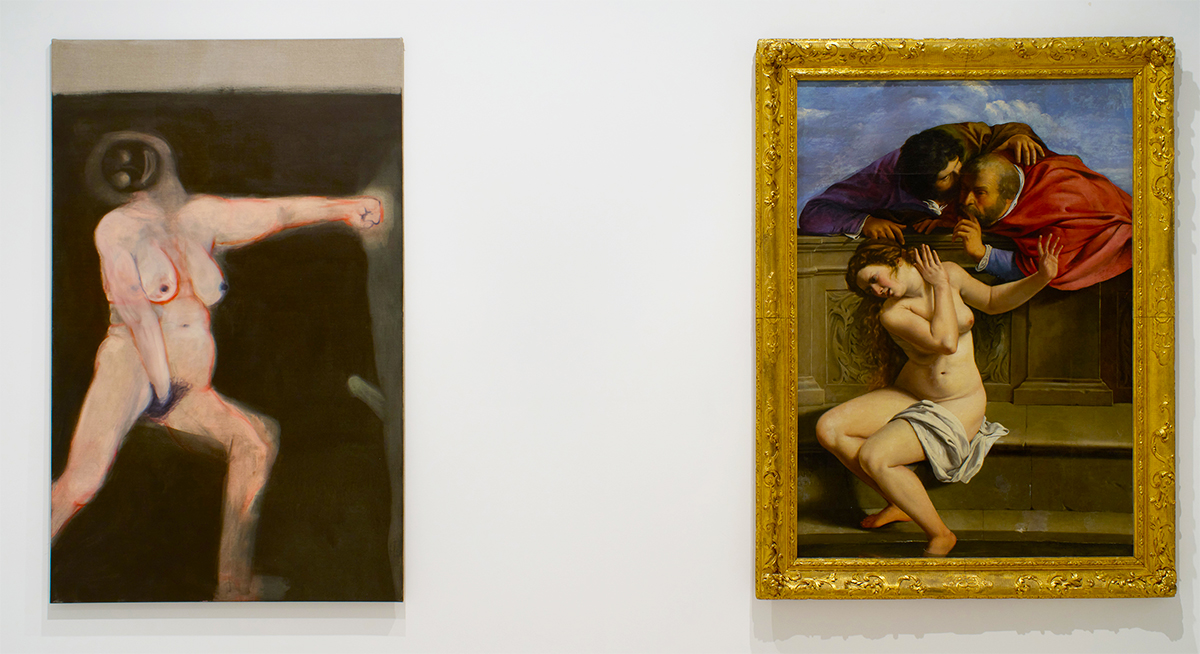
FEMMES FORTES: ALLEGORIES AND AGENCY (installation shot)
L to R:
Miriam Cahn (b. 1949)
Zurückschlagenmüssen (Must Strike Back), 2024
oil on canvas, 200 × 125 cm, Courtesy of the artist and Meyer Riegger
Paired with: Artemisia Gentileschi (1593–ca. 1656)
Susanna e i vecchioni (Susanna and the Elders), 1610
oil on canvas, 170 × 121 cm,
Kunstsammlung Graf von Schönborn Gemeinnützige Stiftung
Schloss Weissenstein in Pommersfelden
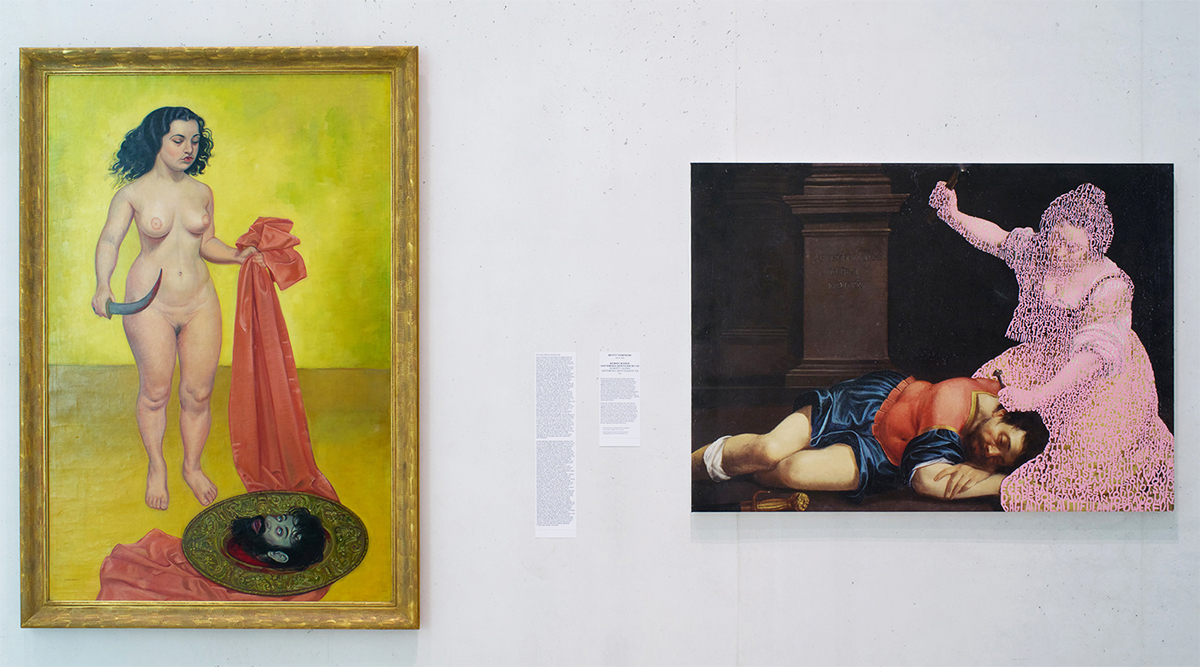
FEMMES FORTES: ALLEGORIES AND AGENCY (installation shot)
L to R:
Macena Barton (1901–1986)
Salome, date unknown
oil on canvas, 194.3 × 128.3 cm, Strilky Collections, Chicago
Paired with: Betty Tompkins (b. 1945)
Women Words (Artemisia Gentileschi #2), 2024
acrylic on digital print on canvas, 177.2 × 127 cm,
Courtesy of Betty Tompkins and P·P·O·W, New York
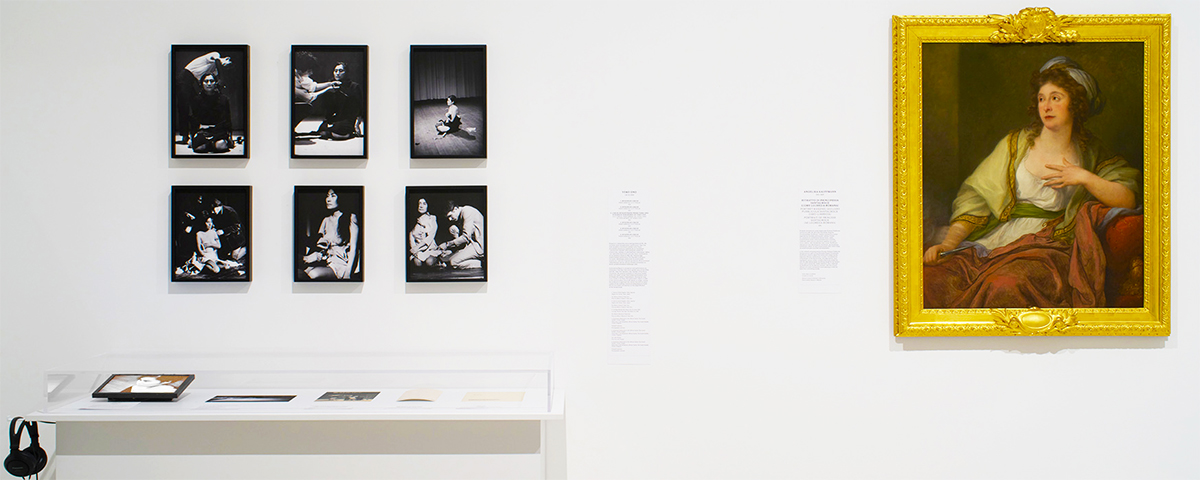
FEMMES FORTES: ALLEGORIES AND AGENCY (installation shot)
L to R:
Yoko Ono (b. 1933)
Cut Piece, 1964 Sōgetsu Art Center, Tokyo Photo: Minoru Hirata © Yoko Ono
Cut Piece, 1964 Sōgetsu Art Center, Tokyo Photo: Minoru Hirata © Yoko Ono
Cut Piece, 1965 Carnegie Recital Hall, New York Photo: Minoru Niizuma © Yoko Ono
Cut Piece, 1966 Destruction in Art Symposium, African Centre, London
Cut Piece, 1966 Destruction in Art Symposium, African Centre, London Photo: John Prosser
Cut Piece, 1966 Destruction in Art Symposium, African Centre, Covent Garden, London
Cut Piece, filmed March 21, 1965 black and white, mono performed in New Works of Yoko Ono
Carnegie Recital Hall, New York Filmed by Albert Maysles and David Maysles
My Body is the Scar of My Mind, sign held up by Yoko Ono at the conclusion of her
Cut Piece performance, 1966 African Centre, London Photo: Nigel Hartnup
Paired with: Angelika Kauffmann (1741–1807)
Principessa Giuliana Pubblicola Santacroce (Princess Giuliana Pubblicola Santacroce), 1791
oil on canvas, 114 × 96 cm, Royal Łazienki Museum in Warsaw
RR
Suddenly, we bear witness to these pairings as a validating vision, overcoming the stagnation of centuries of oppression in the chapter:
Femmes Fortes: Allegories and Agency.
What inspired you to contextualize the background colors in sync with guiding viewers’ experience through the nine chapters of the exhibition?
AG
You’re asking me about the wall colors? Yes, and of the pairings?
RR
You seem to utilize a specific curator’s palette, as you previously did with: Pictures Girls Make: Portraitures, Blum Gallery Los Angeles, September-November 2023; The Avant Garde Won't Give Up: CoBrA and Its Legacy, Blum & Poe, New York & Los Angeles, September - October, 2015; and My Name is Maryan, retrospective presented November 2021 - September 2022, at the Museum of Contemporary Art in North Miami, where every chronological period has a unique background brilliance, including black & brown which completes the experience (& composition).
This visually effective guide is evident in the deep-turquoise background of Palettes & Power: The Self-Portrait as Manifesto, at once the crown & compelling central core of the exhibition.
Was your color selection technique unique to say a Paula Modersohn-Becker or other artist’s palette?
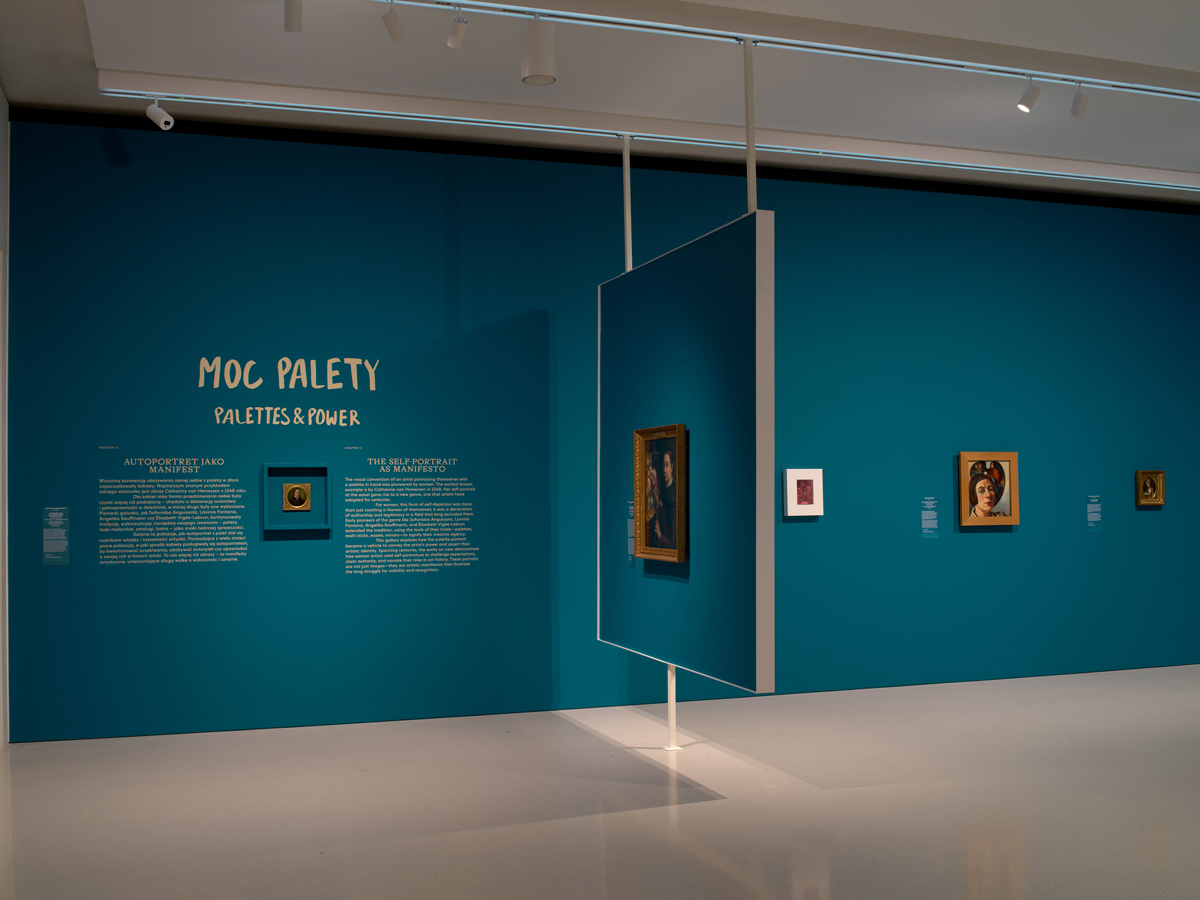
PALETTES & POWER: SELF-PORTRAIT AS MANIFESTO (installation shot)
L to R:
Sofonisba Anguissola (1532–1625) (Self-Portrait (The Ashburnham Medallion)), 1556 or 1558
oil on panel, diam. 13.2 cm, Frits Lugt Collection Fondation, Custodia, Paris
Sofonisba Anguissola (Self-Portrait at the Easel) 1554 –1556 oil on canvas, 65.7 × 59 cm,
Muzeum – Zamek w Łańcucie Castle Museum in Łańcut
Somaya Critchlow (b. 1993) X Studies the Work of Pythagoras, 2022 oil on linen, 17.8 × 12.5 cm,
Private collection, courtesy Maximillian William, London
Charley Toorop (1891–1955) (Self-Portrait in Front of a Palette), 1934
(Pictured below also)
oil on canvas, 45.6 × 40.3 cm, Kröller-Müller Museum, Otterlo, The Netherlands
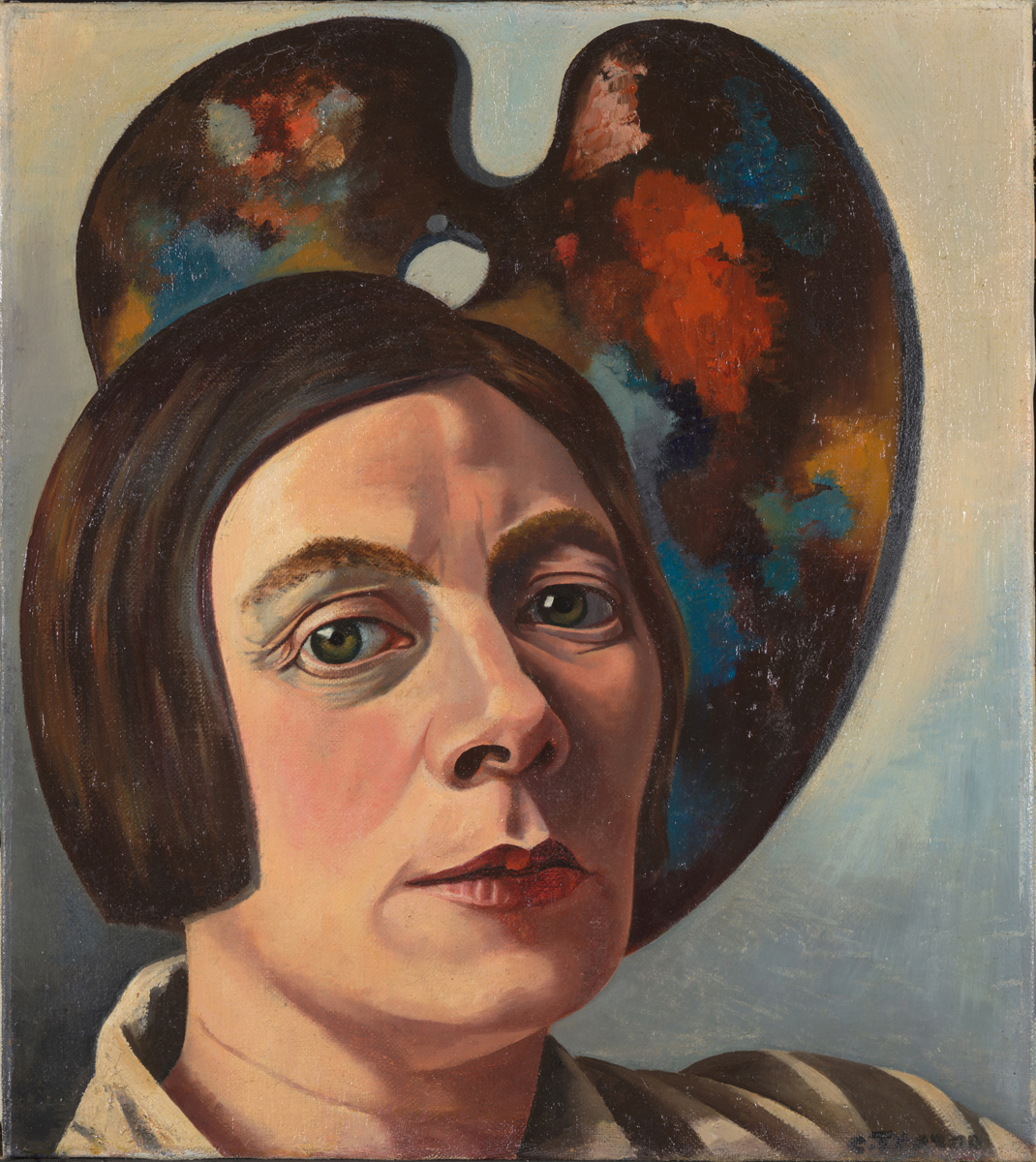
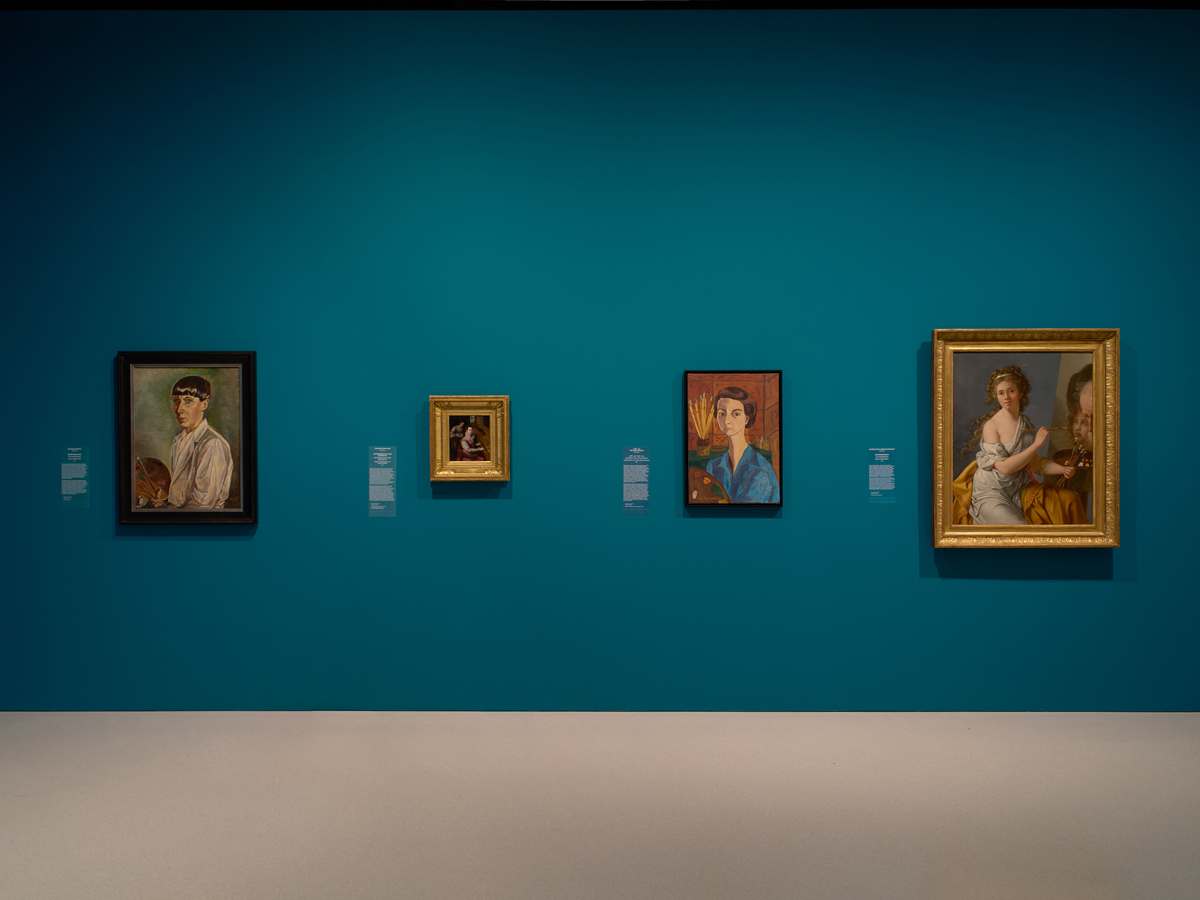
PALETTES & POWER: SELF-PORTRAIT AS MANIFESTO (installation shot)
L to R:
Hannah Höch (1889–1978) Self-Portrait 1937 oil on canvas, 77 x 57.5 cm, Stadtmuseum Berlin
Lavinia Fontana (1552–1614) (Self-Portrait at the Spinet), 1577 oil on canvas, 27 × 23.8 cm,
Accademia Nazionale di San Luca, Roma
Inji Efflatoun (1924–1989)
صورة شخصية لأنجي أفلاطون Portrait of Inji Efflatoun, 1958
oil on canvas, Mathaf: Arab Museum of Modern Art, Doha – Qatar
Marie-Guilhemine Benoist (1768–1826) Self-Portrait 1786
oil on canvas, 95.7 × 78.5 cm, Staatliche Kunsthalle, Karlsruhe
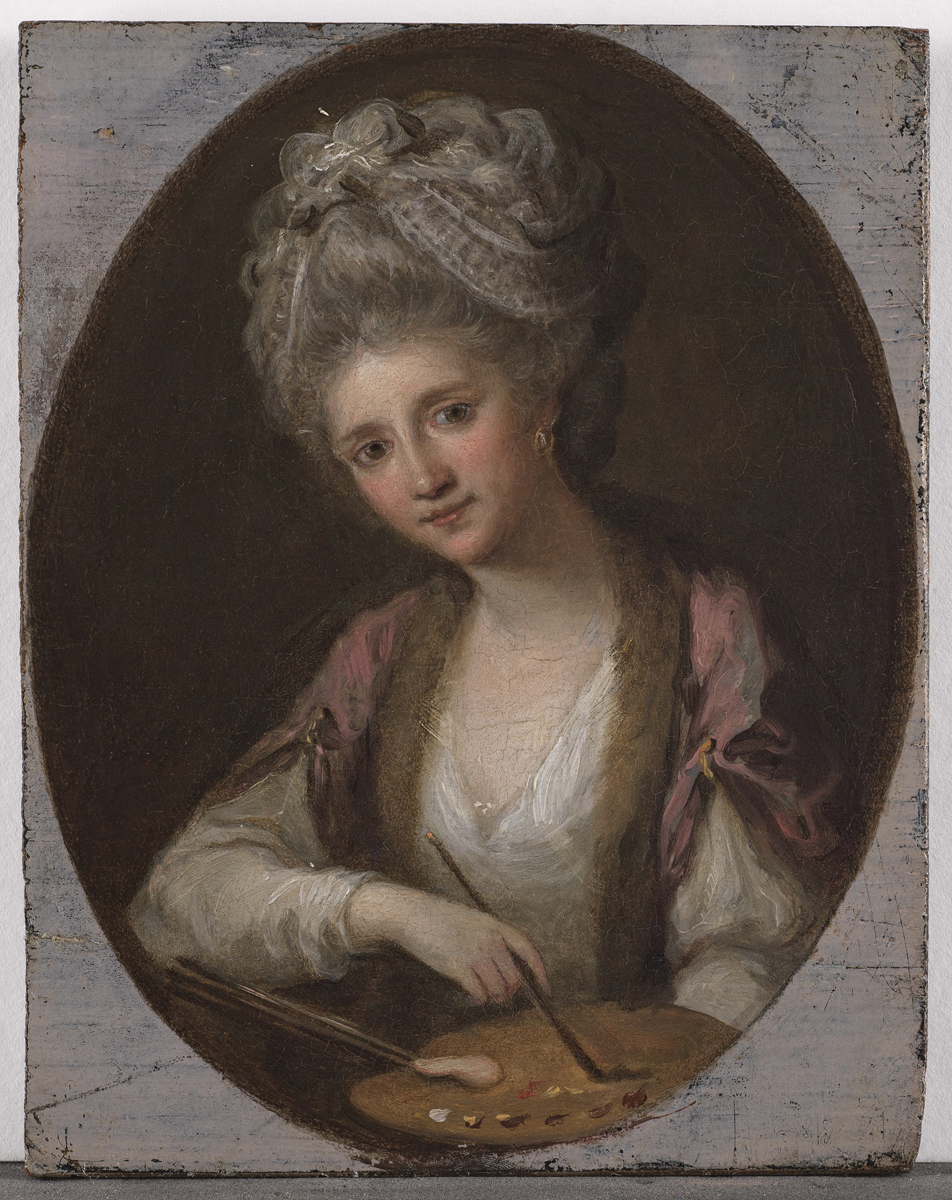
PALETTES & POWER: SELF-PORTRAIT AS MANIFESTO
Angelika Kauffmann (1741–1807) Self-Portrait, 1780
oil on panel, 18.1 × 14.2 cm, Phoebus Foundation, Antwerp
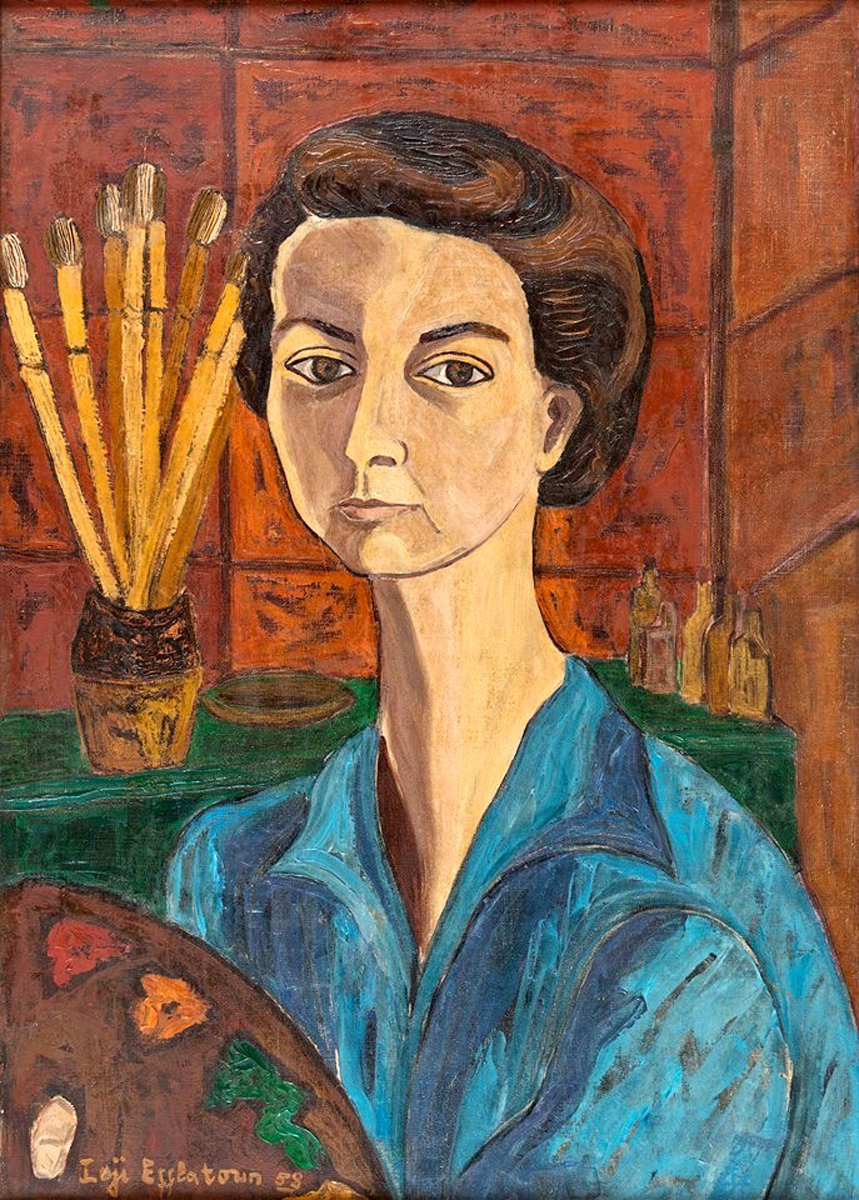
PALETTES & POWER: SELF-PORTRAIT AS MANIFESTO
Inji Efflatoun (1924–1989)
صورة شخصية لأنجي أفلاطون Portrait of Inji Efflatoun, 1958
oil on canvas, Mathaf: Arab Museum of Modern Art, Doha – Qatar
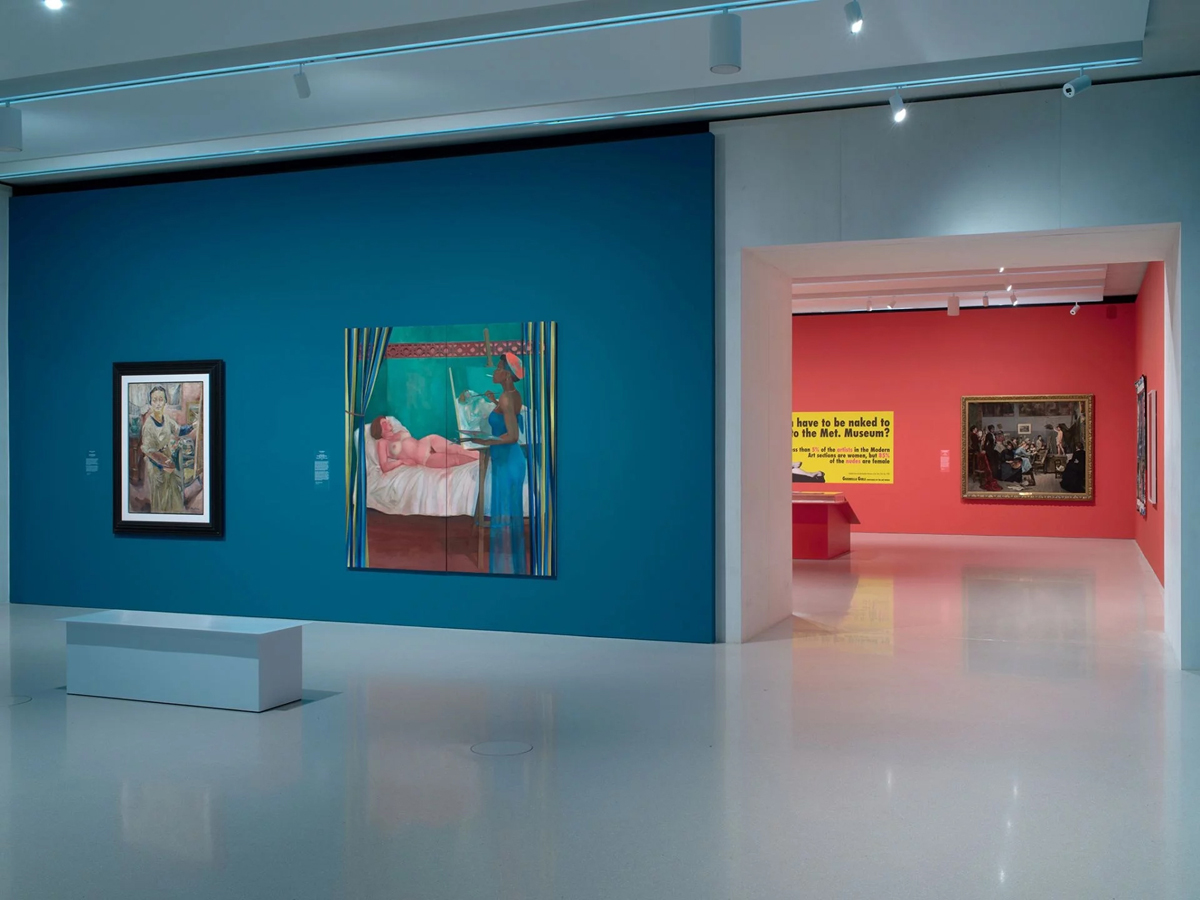
PALETTES & POWER: SELF-PORTRAIT AS MANIFESTO (installation shot)
L to R:
Mela Muter (1876–1967) Self-Portrait, ca. 1921
oil on canvas, 117 × 81.5 cm, ASOM Collection
Lisa Brice (b. 1968) Untitled (After Vallotton) 2023
pigment and oil on canvas, 2 panels: each 200 × 95.2 cm, Nixon Collection
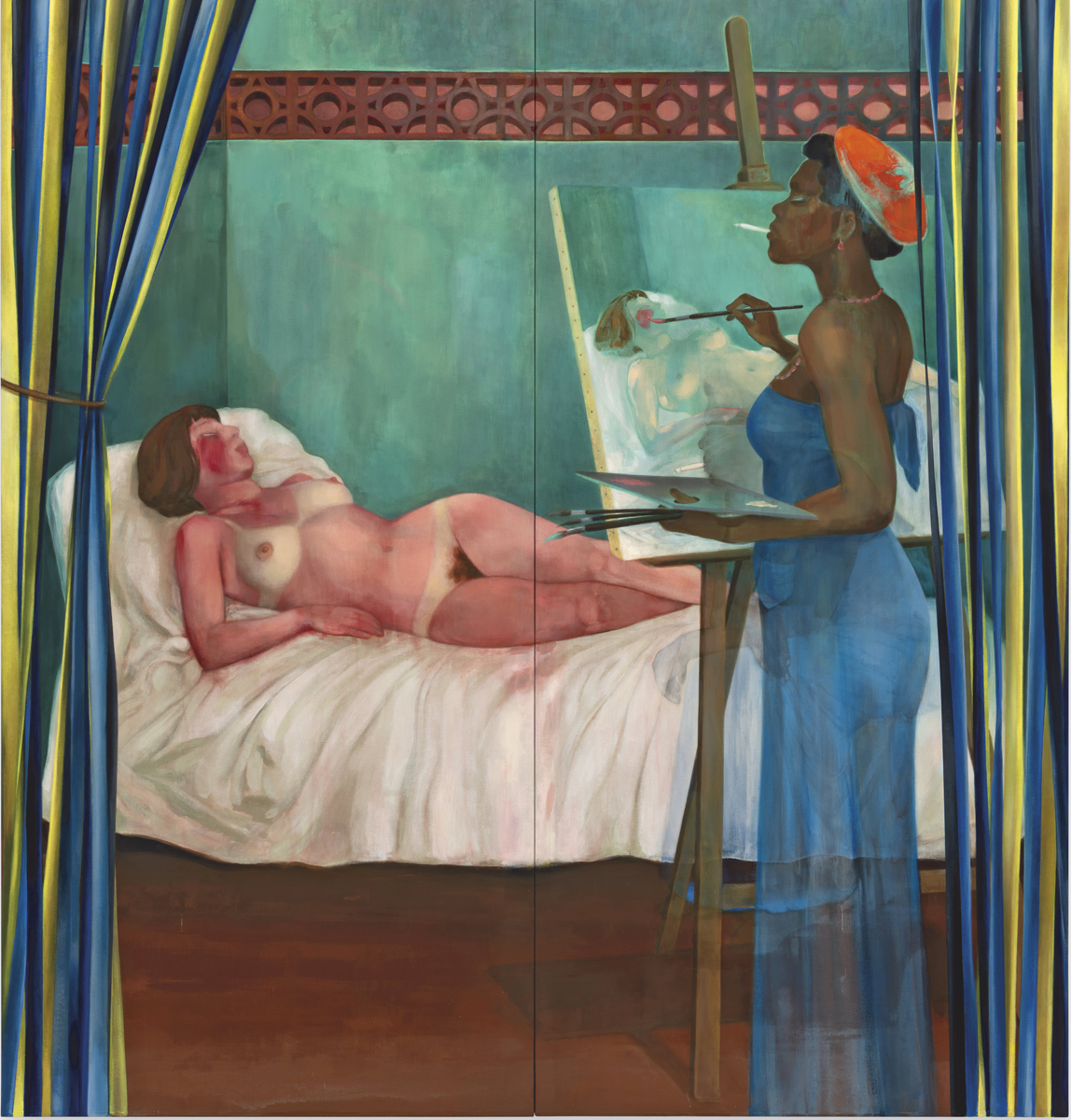
PALETTES & POWER: SELF-PORTRAIT AS MANIFESTO
Lisa Brice (b. 1968) Untitled (After Vallotton) 2023
pigment and oil on canvas, 2 panels: each 200 × 95.2 cm, Nixon Collection
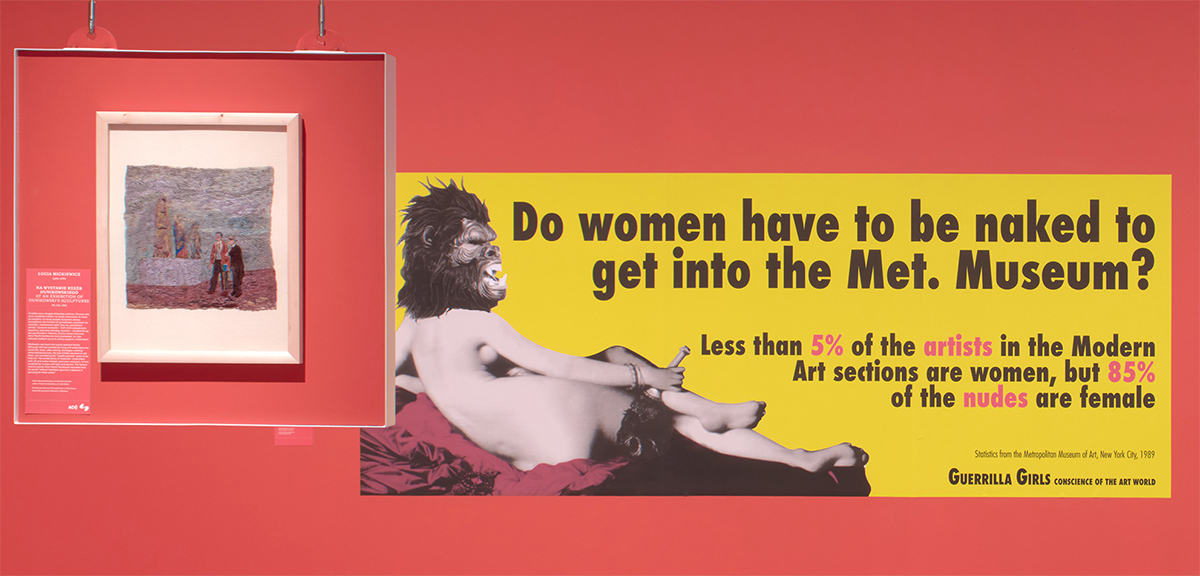
EDUCATION & THE CANON (installation shot)
Foreground:
Łucja Mickiewicz (1894–1979)
Na wystawie rzeźb Dunikowskiego (At an Exhibition of Dunikowski’s Sculptures) ca. 1965
cotton thread embroidery on tulle fabric 32.5 × 30 cm
State Ethnographic Museum in Warsaw
Background:
Guerrilla Girls (est. 1985)
Do Women Have to Be Naked to Get into the Met Museum? 1989
commercial offset lithograph on cardstock 27.9 × 71.1 cm
© Guerrilla Girls
Courtesy of Guerrilla Girls
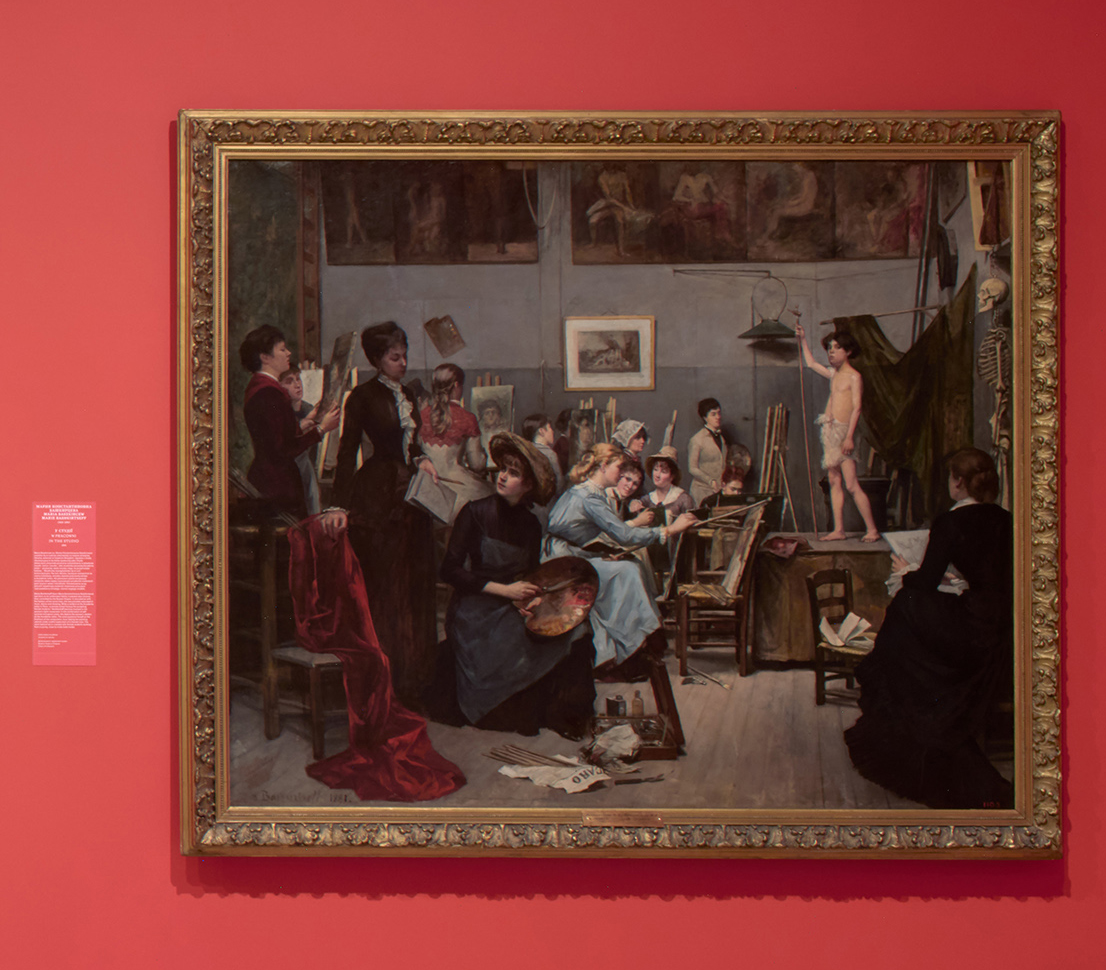
EDUCATION & THE CANON
Marie Bashkirtseff (1858–1884)
У студії (In the Studio), 1881
oil on canvas, 154 × 186 cm, Dnipro Art Museum—Дніпровського
AG
First of all, I really felt it was a new building in Warsaw, and the architect, Thomas Phifer, based his whole architectural vision on this special white concrete that they made for this building. And it immediately conjures this kind of ghost of modernism and the white cube and the supposed kind of more neutral frame of this modernist vision.
I felt that my exhibition had to speak a different language; it had to paraphrase the language of the old Masters Gallery. Whenever I go anywhere, to see art around Europe or in the US, I'm taking photos of not just the paintings, but the wall colors. I’m totally obsessed with it… and it took a lot to convince the team in Warsaw to allow us to do this, because they were at first horrified.
We have this brand-new building and it's a beautiful white box. The team asked, “Why would you want to do this?” I felt we have to surprise the public because the public, they've seen this new building and they're going to expect this pristine whiteness and then to give them an experience that will remind them more of going to the National Museum or to the Louvre. It was very much part of my seduction campaign. It's part of my tendency—I guess I have a kind of horror vacui. I don't like white spaces. I need to fill them with something. And color, to me, is also a great unifier. It kind of levels the playing field when you're putting together artworks from not only different periods, but also, very different types of figuration, different painting styles, different materials.
For inspiration, I also used this book that became very trendy here in Poland: the Japanese color book.

Japanese Color Book
A Dictionary of Color Combinations, Seigensha Publisher
ISBN978-4-86152-247-5 C2070, en.seigensha.com
RR
Oh, I have that…
AG
Yes, people are obsessed with it. I studied the Japanese color book and I came up with this palette kind of based on specific museums I had been to, but also, the sensibility of the combinations of the colors.
For a year, we did tests in the basement, testing the different colors and, making scaled reproductions of the paintings to make sure it would work together. And it was more to convince the museum's team than to convince myself. But it was a great fun to do it.
RR
Well, the color actually makes the artworks ‘sing’, especially the vanessa german sculpture, The Blood & the Animals, the Mirror & the Sky; An Ode to the Un-Language-Able Truth of Is-Ness, 2017, because it's on a plinth that’s the same color as the walls.
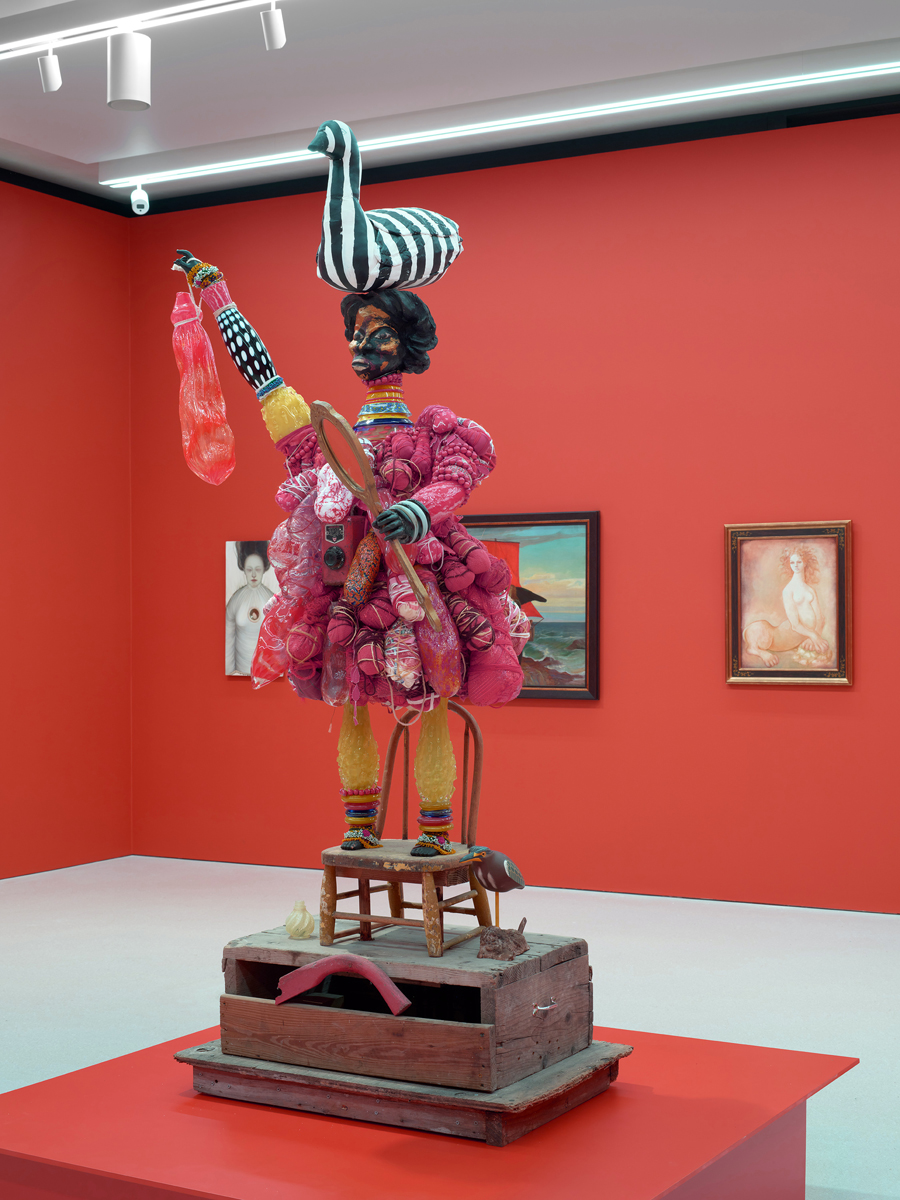
SURREAL SELVES, MYSTICAL ME
vanessa german (b. 1976)The Blood & the Animals, the Mirror & the Sky;
An Ode to the Un-Language-Able Truth of Is-Ness, 2017
Found pieces of wood, benches and old used things from the back of Wheaton glass in New Jersey, prayers for deep peace and wholeness—as in prayers for harmony and coherence, in an effort to quench the blood thirst of those whose internal despair is wracked in external turmoil: a mirror, a mirror surrounded by proof of life, a mirror surrounded by the glass of consciousness, a mirror of consciousness come into form, infinite possibility, rage, cloth, twine, wire, plaster, grace, heartache, tears, plaster gauze, gold paints, tar, black pigment, found goose painted black and white upon the top of the head, acknowledgement that more than one thing is happening at the same time, steel infrastructure, fracture of ego, light at the end of the tunnel, chair parts, doll parts, old blankets, sorrow, found wooden shorebird, liberty—as in the Soul’s right to breathe, the blood that binds us all together, light, light, light, glee, the glory of creativity, the deep truth that we are all here together, 196.8 × 91.4 × 88.9 cm
Courtesy of the artist and Olney Gleason, New York
AG
Yes
RR
Including the rest of the artworks in chapters: Surreal Selves, Mystical Me: Symbolism, Surrealism, and Mysticism, along with Education and the Canon, and No Lock, No Bolt, No Key: Imaginaries Unleashed, — (all ‘blaze’ with the salmon/orange colored background)
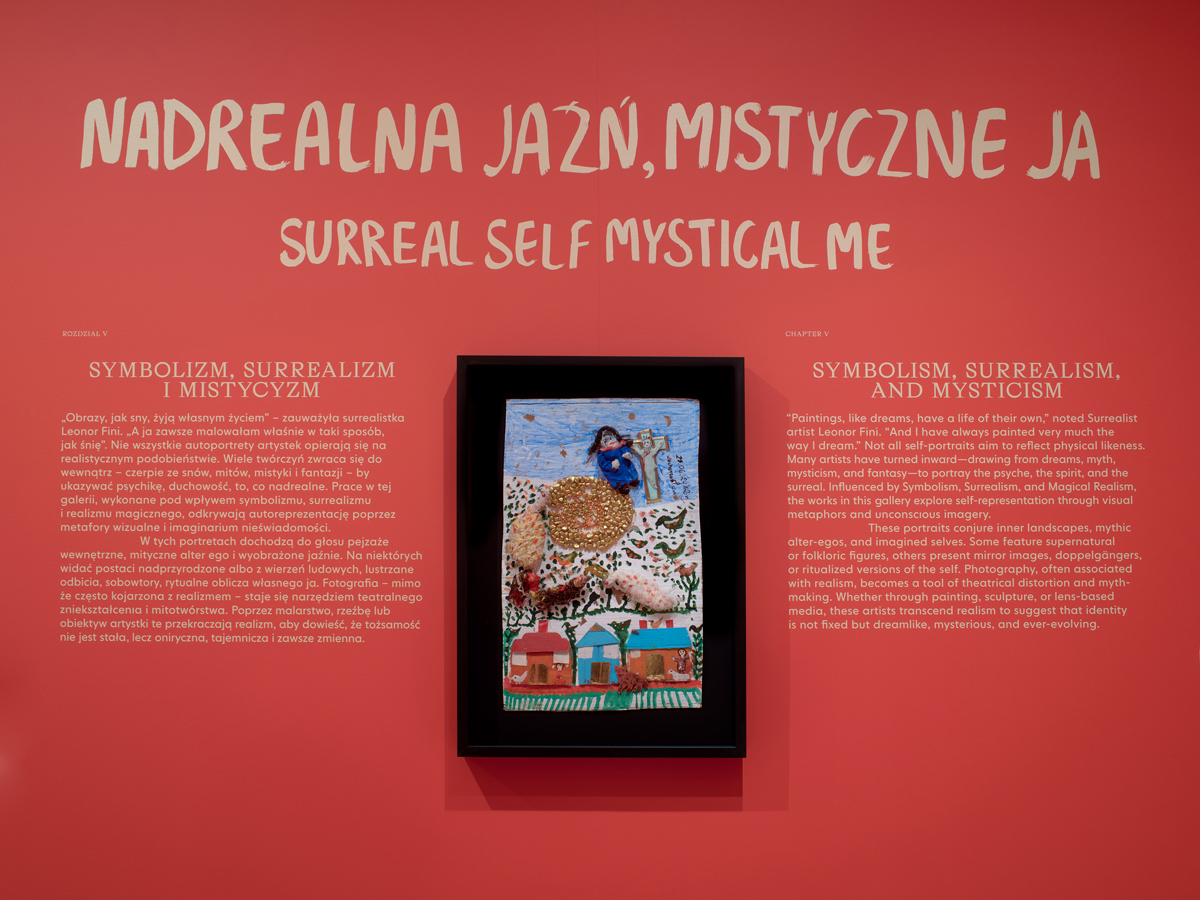
SURREAL SELVES, MYSTICAL ME (installation shot)
Genowefa Magiera (1921–2019)
Jak zachorowałam, (How I Got Sick), June 28, 2016
mixed technique on cardboard, 75.5 × 48.7 cm, Silesian Museum
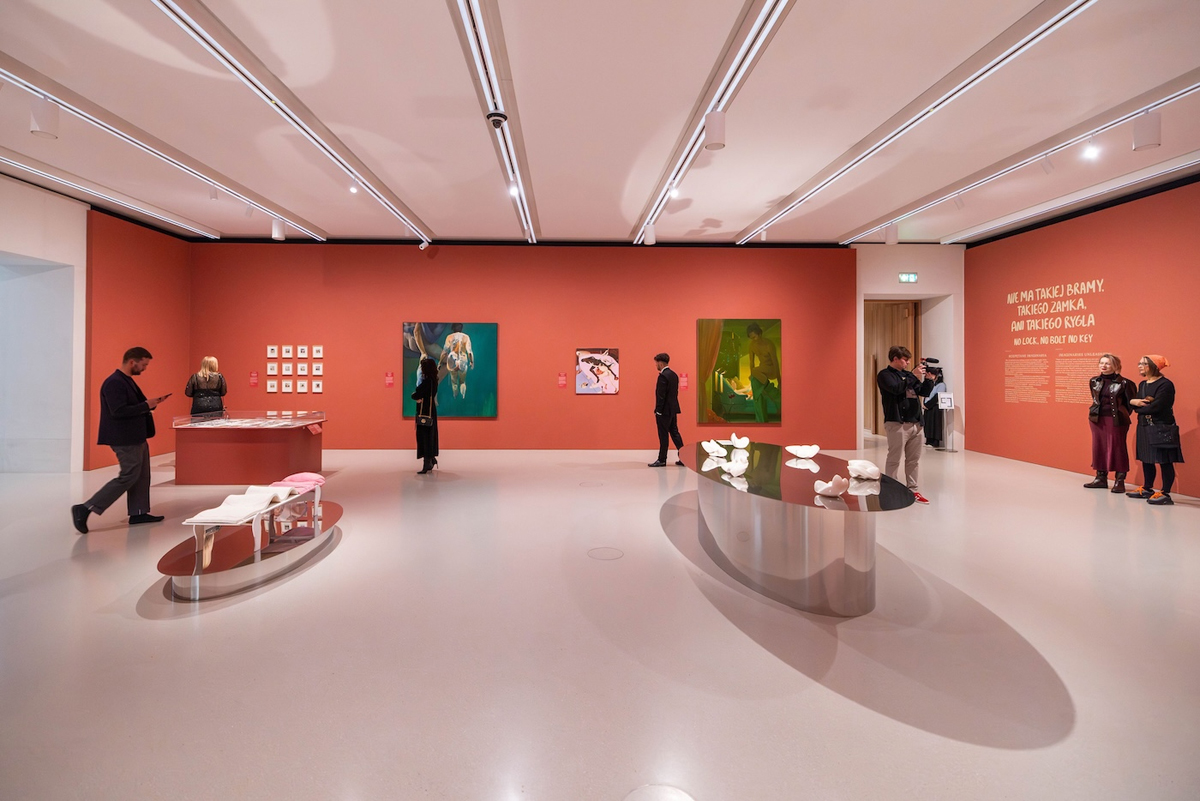
NO LOCK, NO BOLT, NO KEY (installation shot)
L to R background:
Agata Bogacka (b. 1976) Photographs from the Sketches to Paintings series 2001–2003
color photography, Polaroid, 10.9 × 9 cm Museum of Modern Art in Warsaw
Joan Semmel (b. 1932) Green Field 1970s/1992 oil on canvas, 175 × 175 cm,
Private collection
Ambera Wellmann (b. 1982) In Medias Res 2019 oil paint and soft pastel on linen,
80 × 85 cm, Courtesy of Defares Collection
Lisa Yuskavage (b. 1962) Bedheads 2018 oil on linen, 196.5 × 157.8 cm,
Courtesy of the artist and David Zwirner
L to R foreground:
Maria Pinińska-Bereś (1931–1999) Becik erotyczny (Erotic Swaddling Blanket) 1974
plywood, sponge, canvas, polychrome, Courtesy of the artist’s family
Barbara Falender (b. 1947) Poduszka erotyczna (Erotic Pillow) 1974 Carrara marble,
40 × 153 × 41 cm, Galeria Studio Collection
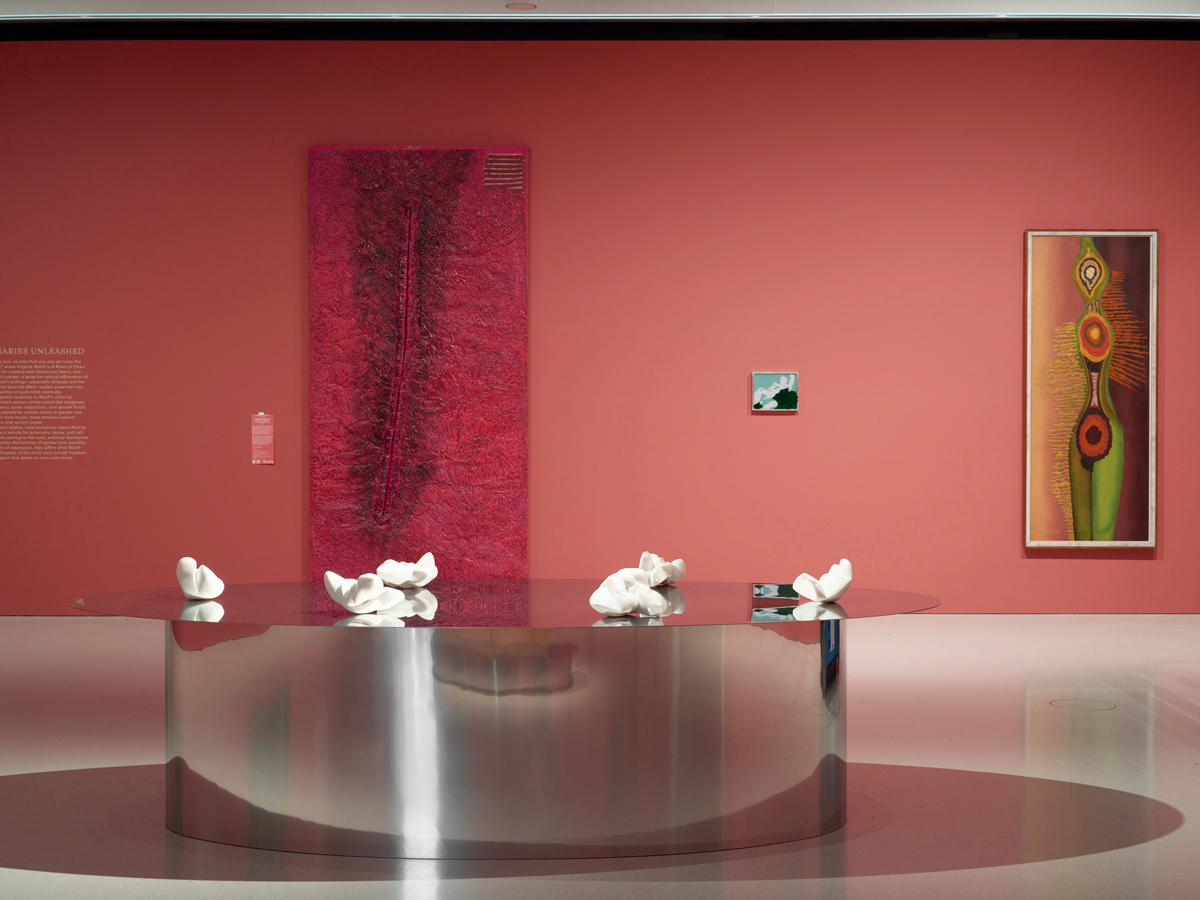
NO LOCK, NO BOLT, NO KEY: Imaginaries Unleashed (installation shot)
L to R background:
Teresa Tyszkiewicz (1953–2020) Rouge 1 (Red 1) 1986–1987 pins, paper, acrylic
and oil paint on canvas, 292 × 147 cm, Private collection
Evelyne Axell (1935–1972) Tableau à caresser 2 (Painting to Be Caressed 2) 1970
enamel paint on Plexiglas, synthetic fur, 25.5 × 31 cm (framed) Private collection
Ithell Colquhoun (1906–1988) Autumnal Equinox 1949 oil on canvas, 206 × 81 cm,
RAW (Rediscovering Art by Women)
Foreground:
Barbara Falender (b. 1947) Poduszka erotyczna (Erotic Pillow) 1974 Carrara marble,
40 × 153 × 41 cm, Galeria Studio Collection
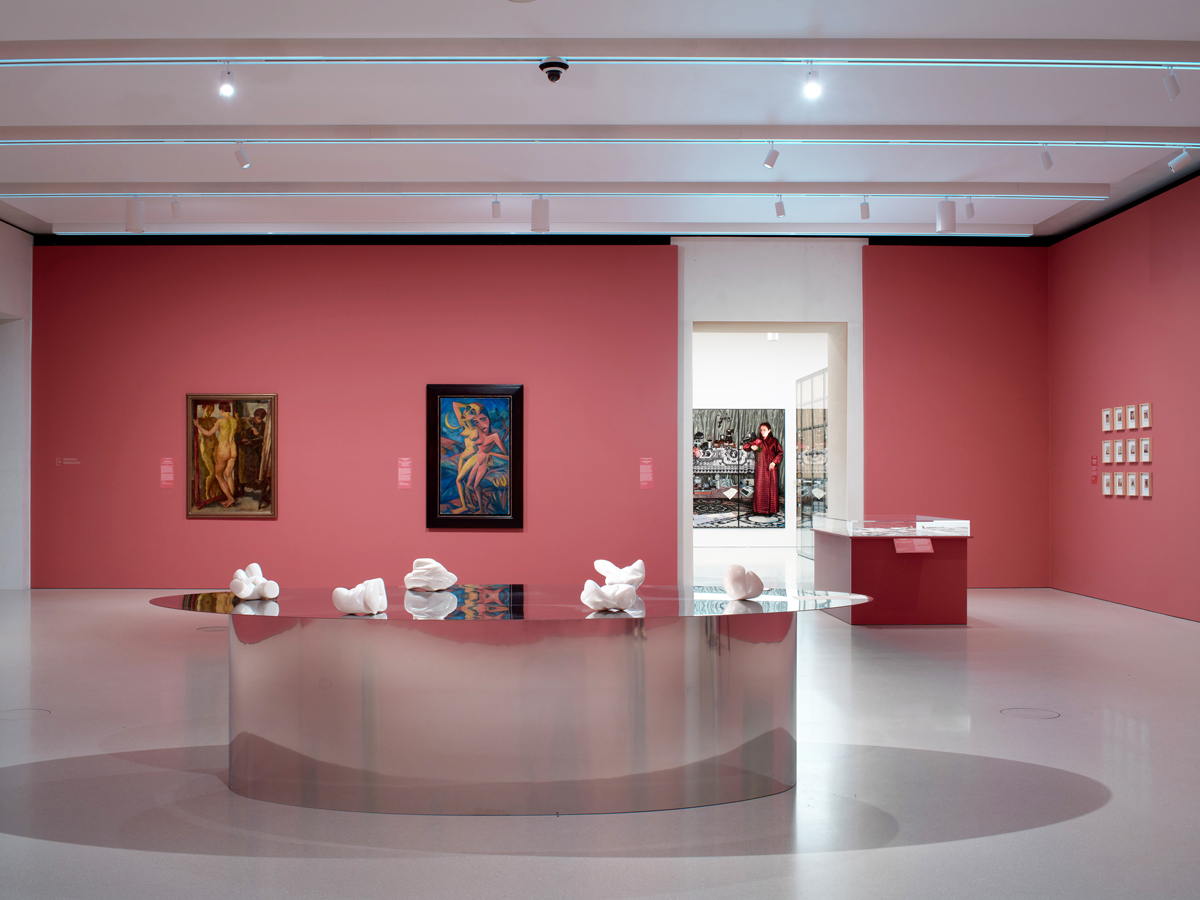
NO LOCK, NO BOLT, NO KEY (installation shot)
L to R background:
Lotte Laserstein In Front of the Mirror (Vor dem Spiegel) 1930/1931
oil on canvas, Private collection, courtesy of Agnews, London
© Bildupphovsratt, Stockholm / ZAIKS, Warszawa
Dorothea Maetzel-Johannsen (1886–1930) Zwei Akte mit Mondsichel
(Two Nudes with a Crescent Moon) 1919
oil on canvas, 129.2 × 76.7 cm, Hamburger Kunsthalle,
on permanent loan from the Stiftung Hamburger Kunstsammlungen,acquired,2017
Foreground:
Barbara Falender (b. 1947) Poduszka erotyczna (Erotic Pillow) 1974
Carrara marble, 40 × 153 × 41 cm, Galeria Studio Collection
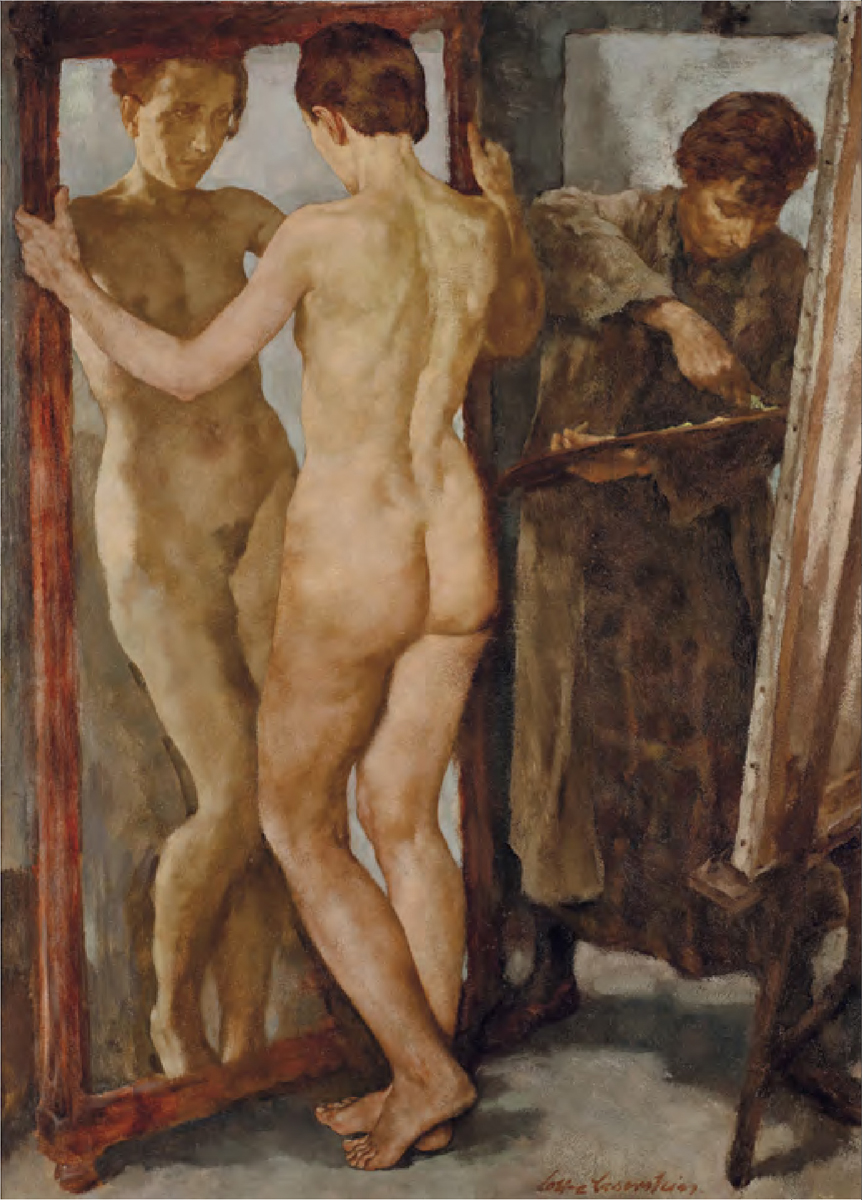
NO LOCK, NO BOLT, NO KEY
Lotte Laserstein
In Front of the Mirror (Vor dem Spiegel) 1930/1931
oil on canvas, Private collection, courtesy of Agnews, London
© Bildupphovsratt, Stockholm / ZAIKS, Warszawa
RR
At the same time the neutral/beige background for A Muse of Her Own section offers visitors a visual respite from the number of historically charged works.
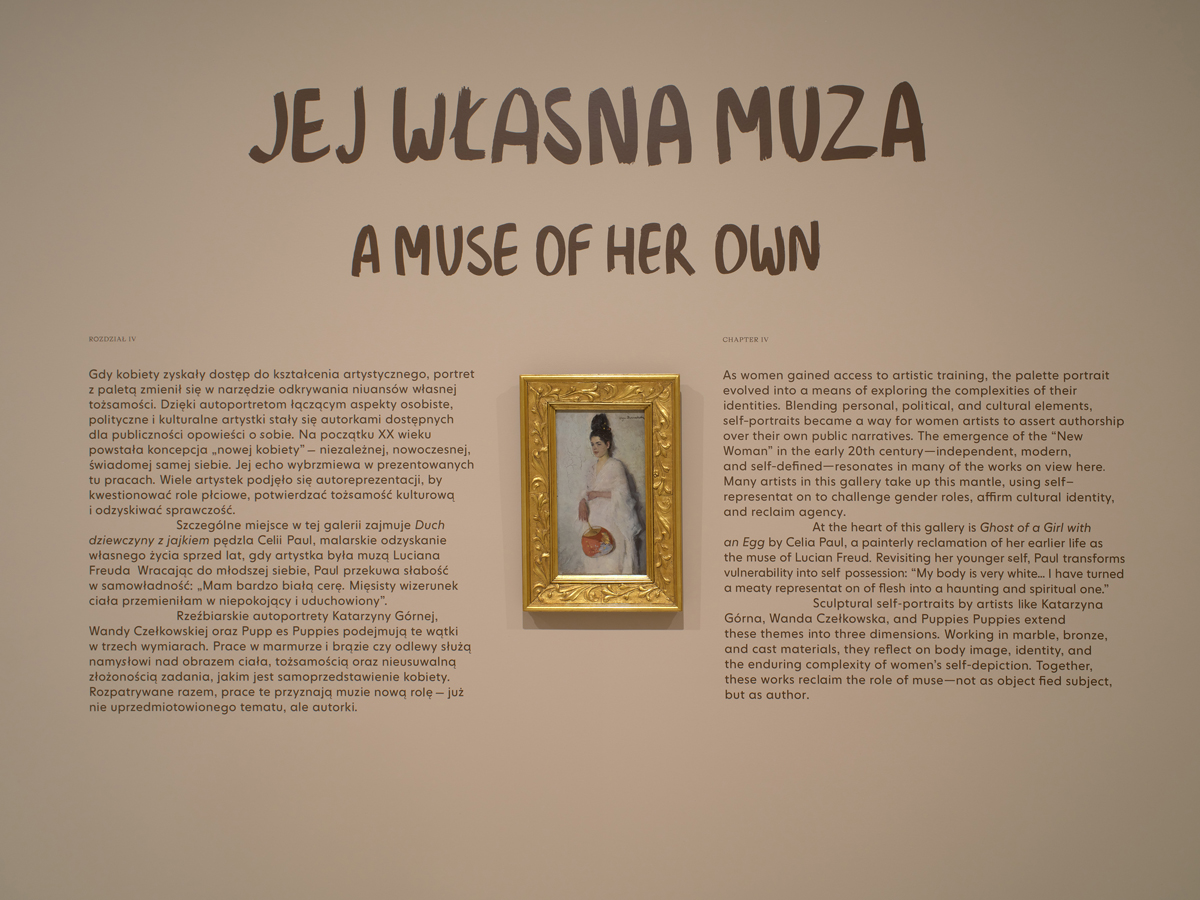
A MUSE OF HER OWN (installation shot)
Olga Boznańska (1865–1940)
Wnętrze pracowni (In the Studio) 1913
oil on cardboard, 68 × 44 cm, National Museum in Warsaw
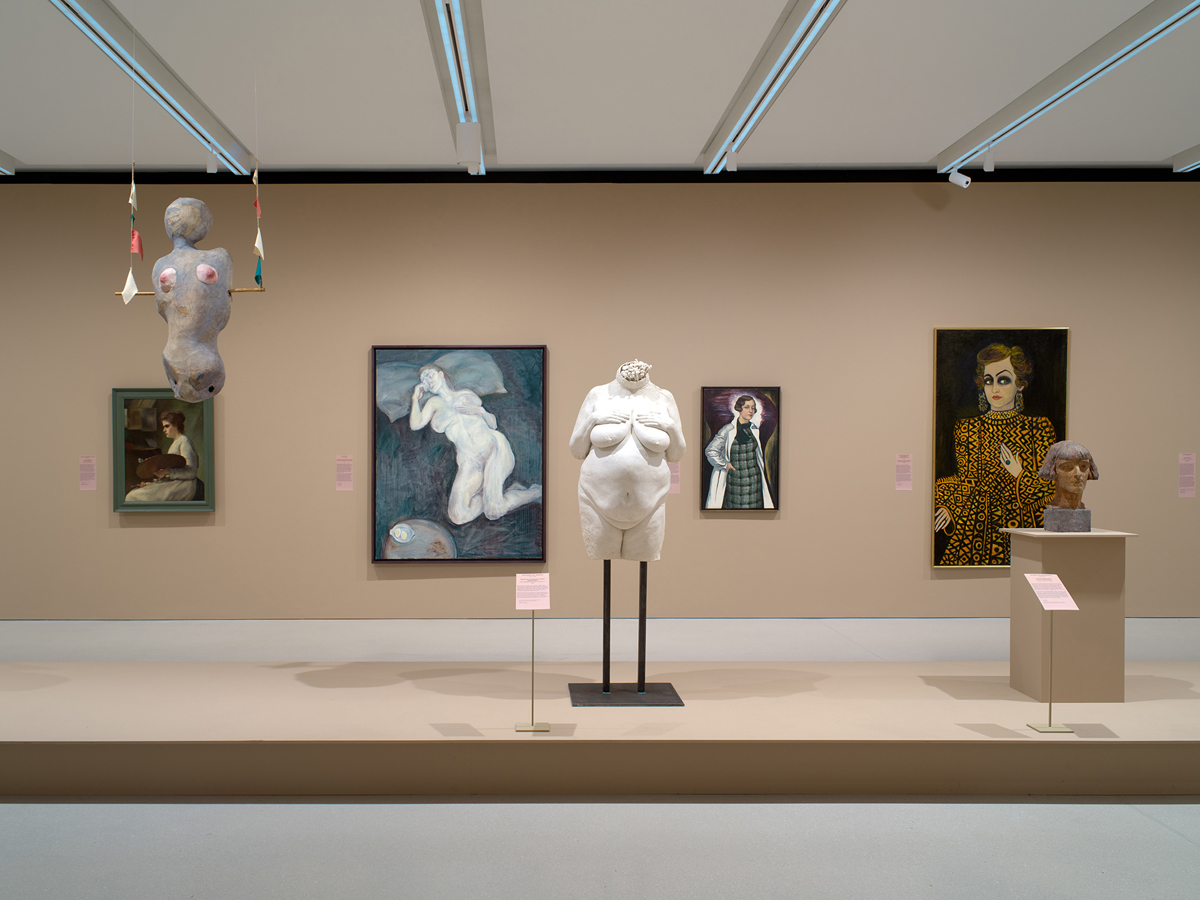
A MUSE OF HER OWN (installation shot)
L to R background:
Aniela Biernacka Poraj (1858–1918) Self-Portrait 1886–1890 or 1878–1883
oil on canvas, 91 × 72 cm, National Museum in Warsaw
Celia Paul (b. 1959) Ghost of a Girl with Egg 2022 oil on canvas,
182.9 × 147.3 cm, Private collection
Maria Nicz-Borowiak (1896–1944) Self-Portrait mid-1930s oil on canvas,
105.5 × 66.5 cm, Courtesy of the artist’s family
Fahrelnissa Zeid (Fahrünissa Şakir Kabaağaçlı) (1901–1999) Someone from the Past 1980
oil on canvas, 208 × 117 cm, Fahrelnissa Zeid Estate
L to R foreground:
Maria Pinińska-Bereś (1931–1999) Gorset (Trapez) (Corset (Trapeze)) 1966
paper, paper-mâché, wood, 135 × 77 × 27 cm, National Museum in Kraków
Katarzyna Górna (b. 1968) Wenus antropocenu pierwsza (Anthropocene Venus I) 2023
cast polymer plaster, quartz, sand, steel, 170 × 60 × 50 cm, Collection of the artist
Wanda Czełkowska (1930–2021) Popiersie (Autoportret) (Bust (Self-Portrait)) 1959
painted plaster, 60 × 45.5 × 20 cm, Courtesy of Monopol Gallery
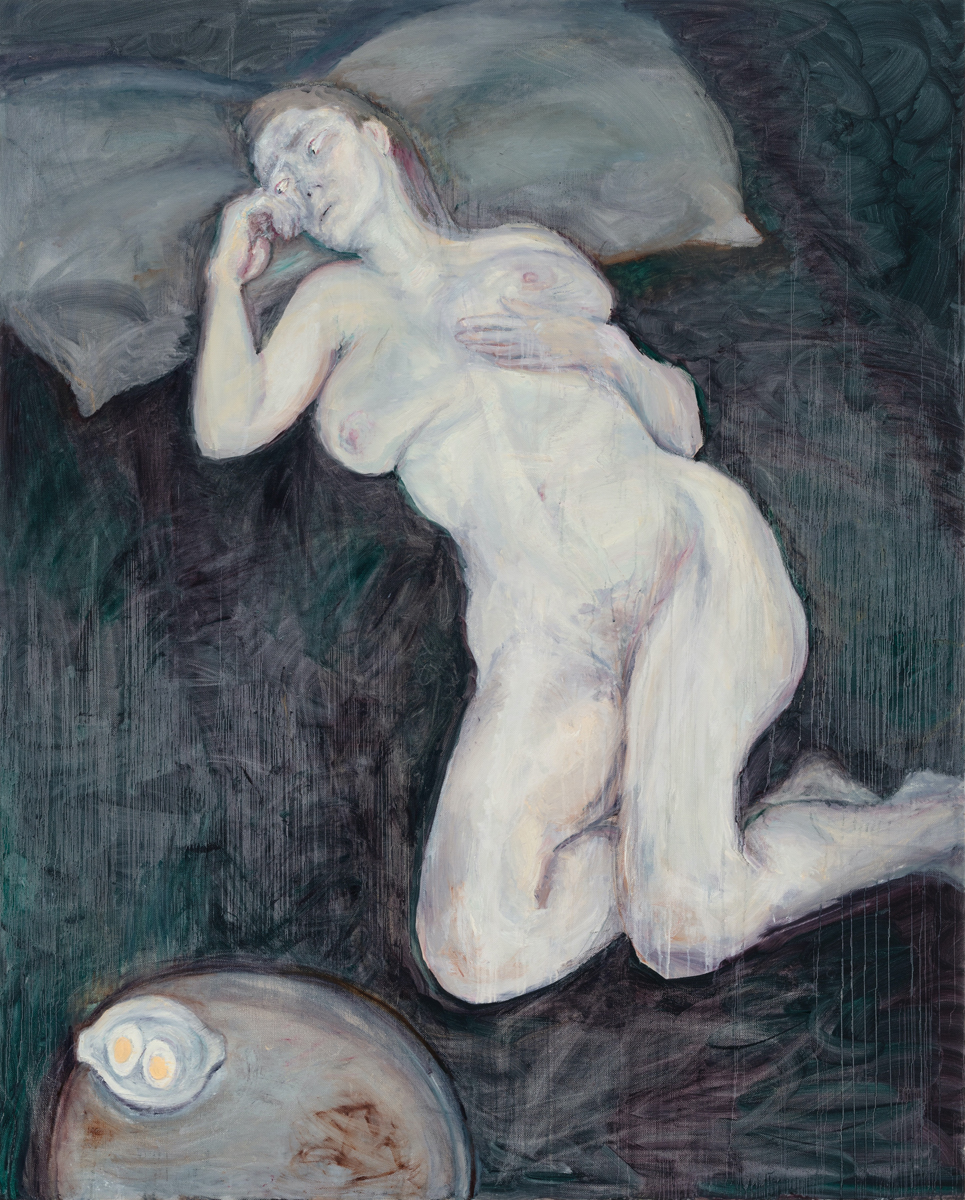
A MUSE OF HER OWN
Celia Paul (b. 1959)
Ghost of a Girl with Egg 2022
oil on canvas, 182.9 × 147.3 cm, Private collection
RR
I was enamored by your use of black & white background, clearly an ‘either or’ choice, not a neutral subject matter, for the Wartime Women section. There’s no gray area, when it comes to war.
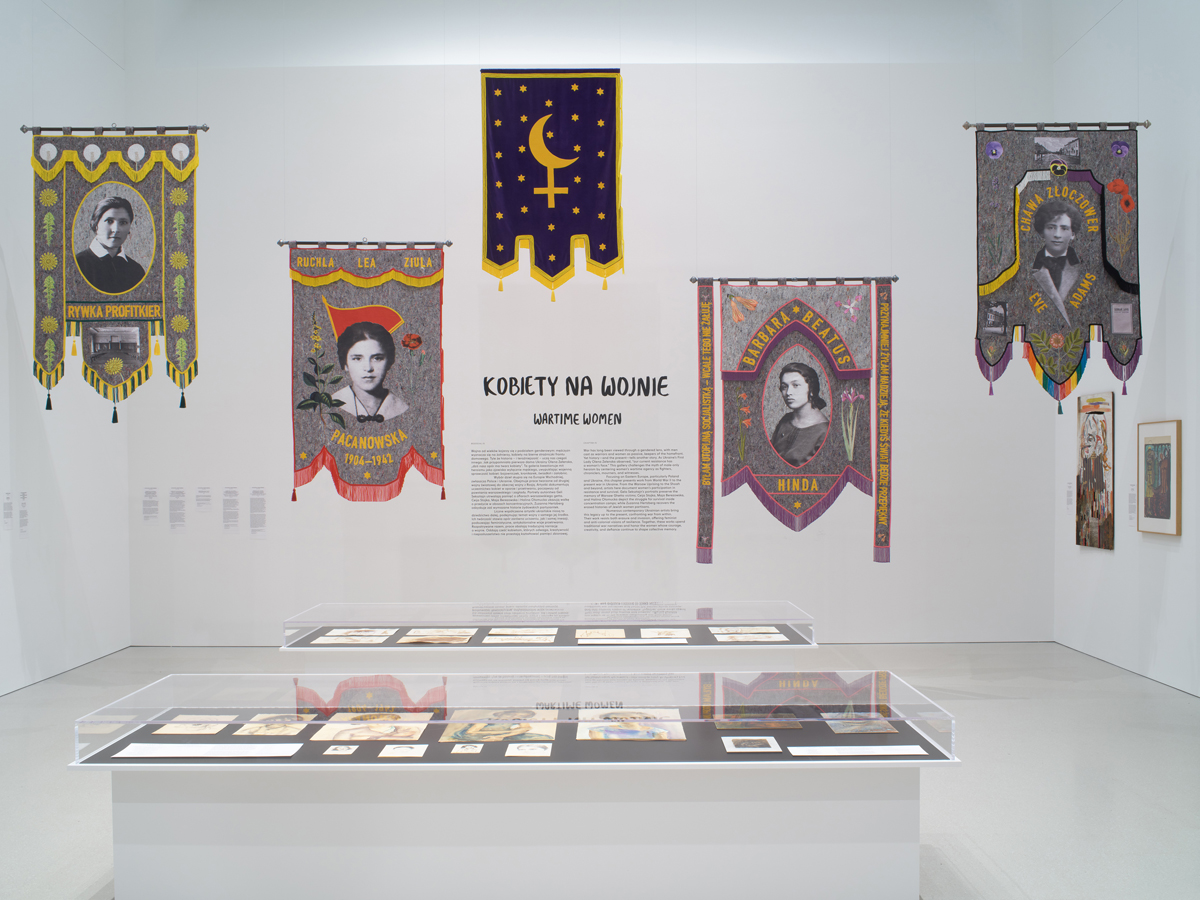
WARTIME WOMEN (installation shot)
Zuzanna Hertzberg (b. 1981)
Tribute to Hinda / Barbara Beatus, z cyklu Żydowskie szmaty
(Tribute to Hinda /Barbara Beatus, from the series Jewish Shmates [Rags]) 2024–2025
textile banner, appliqué, collage on fabric made from recycled cotton for use as
a floor rag, 175 (187 with tassels) × 114 cm, Courtesy of the artist
Zuzanna Hertzberg (b. 1981)
Tribute to Ruchla Lea "Ziula” Pacanowska, z cyklu Żydowskie szmaty
(Tribute to Ruchla Lea “Ziula” Pacanowska, from the series Jewish Shmates [Rags]) 2024
textile banner, appliqué, collage on fabric made from recycled cotton for use as a floor rag
Banner created for an artivist action on the 80th anniversary of the liquidation
of the Litzmannstadt Ghetto, Łódź (August 29, 2024)
175 (187 with tassels) × 114 cm, Courtesy of the artist
Zuzanna Hertzberg (b. 1981)
Przywołując Lilit (Summoning Lilith) 2024
velvet banner, appliqué, created for a Pro-Choice / Pro-Abortion artivist action
165.5 (181.5 with tassels) × 108 cm, Courtesy of the artist
Zuzanna Hertzberg (b. 1981)
Tribute to Chawa Złoczower / Eve Adams, z cyklu Żydowskie szmaty
(Tribute to Chawa Złoczower / Eve Adams, from the series Jewish Shmates [Rags]) 2025
textile banner, appliqué, collage on gray fabric made from recycled cotton for use as
a floor rag, Courtesy of the artist
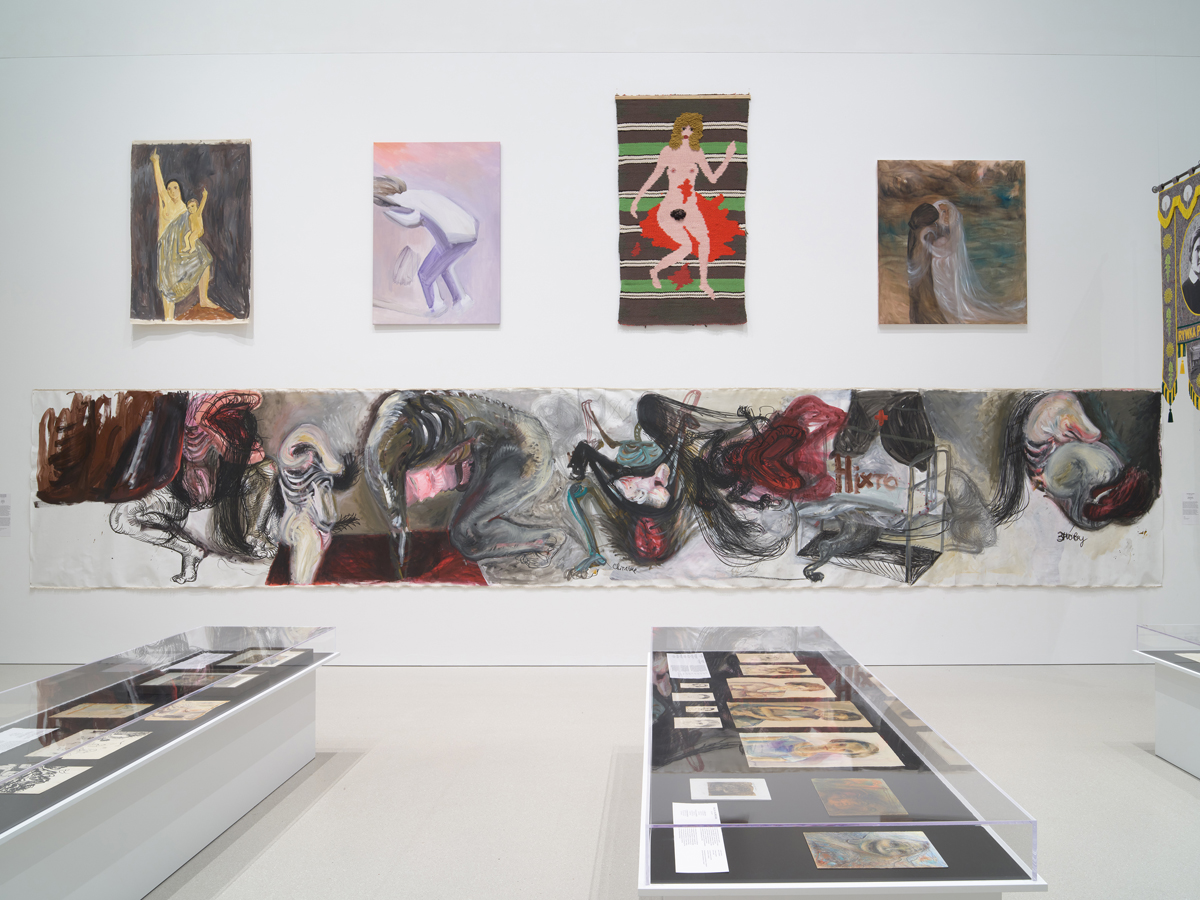
WARTIME WOMEN (installation shot)
L to R upper:
Kateryna Lysovenko (b. 1989) Untitled, 2022 acrylic paint on canvas, 160 × 110 cm,
Ukrainian Museum
Lesia Khomenko (b. 1980)(A Woman in the Middle of an Explosion (Kharkiv) 2024
acrylic on canvas Collection Waltraud Leopold, Vienna,
Courtesy of the artist and Voloshyn Gallery
Kinder Album (b. 1982) Bleeding 2023 Tapestry, 118 × 195 cm,
Courtesy of the artist
L to R lower:
Vlada Ralko (b. 1969) (Guests) 2022 acrylic paint, oil paint stick on canvas,
176.8 × 1004 cm, Courtesy of the artist
RR
Your all-white background for the Of Women Born area is unequivocally thoughtful (sensitive) in enabling us to witness the elemental mother moment without romanticizing it…
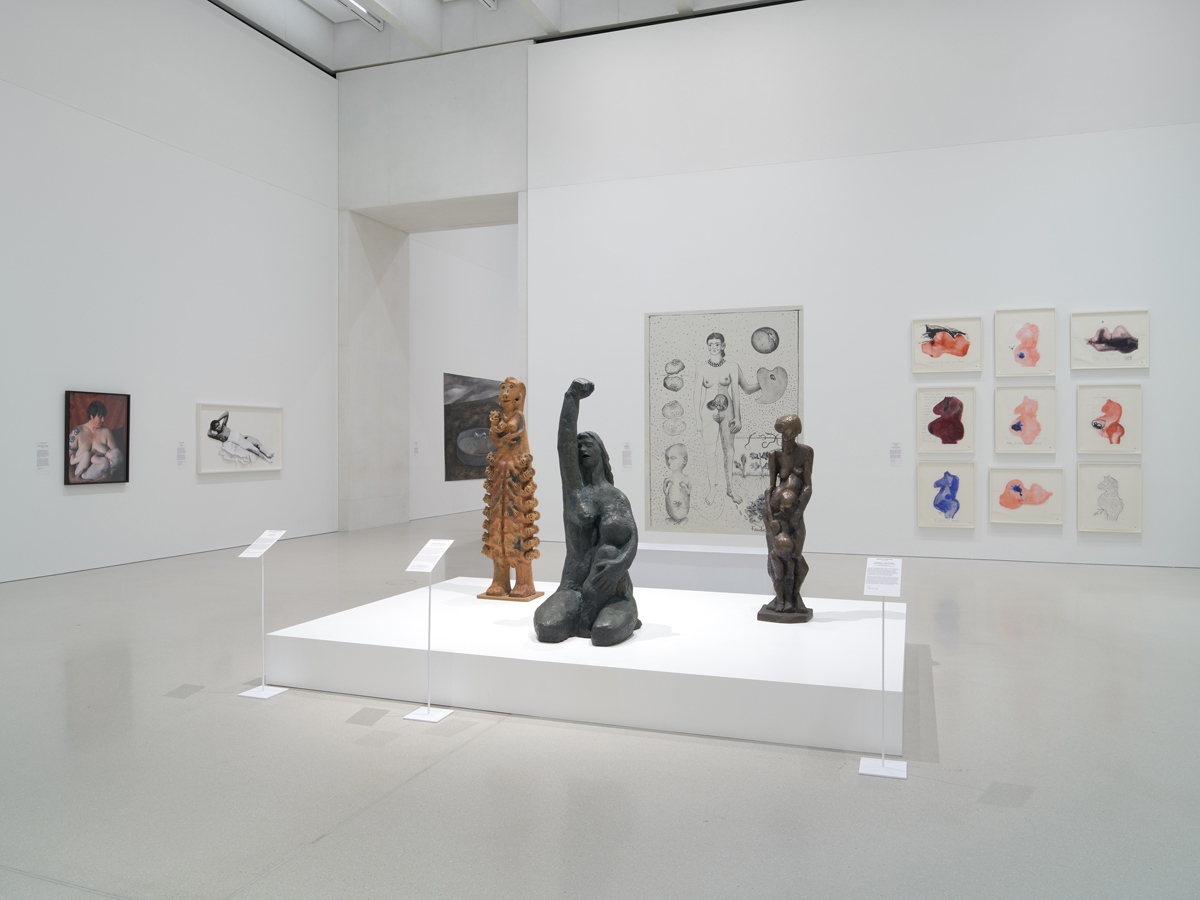
OF WOMEN BORN (installation shot)
L to R background:
Catherine Opie (b. 1961) Self-portrait / Nursing, 2004 color photography,
chromogenic print, 101.6 × 78.7 cm, Private collection
© Catherine Opie, Courtesy Regen Projects, Los Angeles; Lehmann Maupin, New York,
Hong Kong, London, and Seoul; Thomas Dane Gallery,
London and Naples; and Peder Lund, Oslo
Frida Orupabo (b. 1986) Untitled 2019 pigment print on acid-free cotton paper,
mounting tape, split pins, 92 × 160 cm (framed)
Collection Ingebjørg & Ådne Kverneland
Courtesy of the Artist and Galerie Nordenhake Berlin / Stockholm / Mexico
Frida Kahlo (1907–1954) El aborto (Frida and the Miscarriage) – Reproduction
1936 wallpaper Fine Arts Museums of San Francisco, Museum purchase,
Dr. R. Earl Robinson Estate and
Achenbach Foundation for Graphic Arts Endowment Fund 1996.38
Louise Bourgeois (1911–2010) & Tracey Emin (b. 1963) Do Not Abandon Me 2009–2010
Archival dyes printed on cloth, suite of 16
Six prints: 61 × 76.2 cm Ten prints: 76.2 × 61 cm
The Easton Foundation, New York
L to R foreground:
Seyni Awa Camara (b. 1945) Untitled 2023 terracotta, 163 × 47 × 32 cm,
The Gallery of Everything, London
Magdalena Więcek (1924–2008) Matka (Protest) (Mother (Protest)) 1955 plaster cast,
160 × 60 × 73 cm, Zamoyski Museum in Kozłówka
Maria Jarema (1908–1958) Matka i dziecko (Mother and Child) 1978 (cast), original ca.
1932 bronze, 138 × 38 × 46 cm, Muzeum Sztuki, Łódź
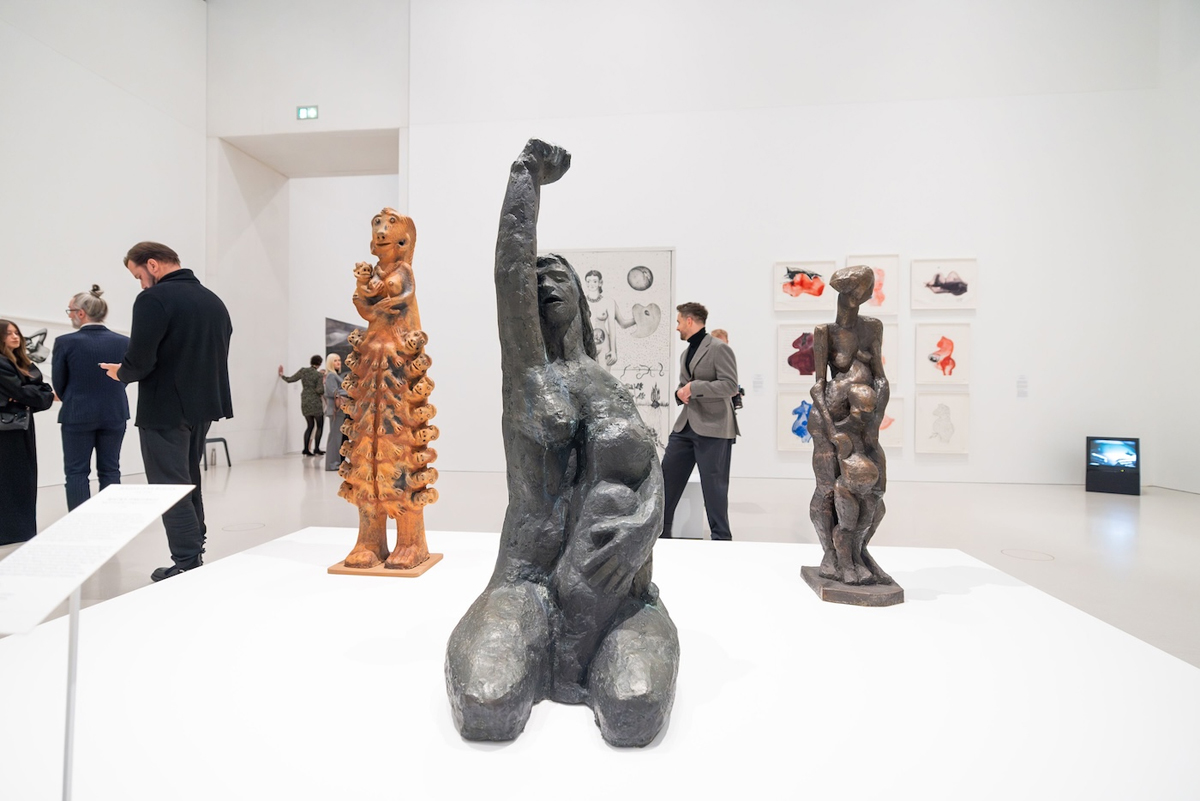
OF WOMEN BORN (installation shot)
L to R foreground:
Seyni Awa Camara (b. 1945) Untitled 2023 terracotta, 163 × 47 × 32 cm,
The Gallery of Everything, London
Magdalena Więcek (1924–2008) Matka (Protest) (Mother (Protest)) 1955 plaster cast,
160 × 60 × 73 cm, Zamoyski Museum in Kozłówka
Maria Jarema (1908–1958) Matka i dziecko (Mother and Child) 1978 (cast), original ca.
1932 bronze, 138 × 38 × 46 cm, Muzeum Sztuki, Łódź
AG
Those rooms are monumental. Some have seven meter high ceilings. So actually there was a practicality, on that side of the museum; it would have been just so expensive to paint such tall walls, along with the possibility of existing skylights. I also wanted to play with the light and with the height of the architecture.
RR
Can you expand on this, being a mother yourself?
AG
Yes. I didn't read Adrienne Rich's book Of Woman Born, Motherhood as Experience and Institution, until I started to work on the exhibition. I was raised Irish Catholic and grew up with the archetype of the Madonna and child. To me, since the end of the 19th century, artists, women artists particularly have been demolishing the archetype and complexifying it.
I had a wonderful experience to interrogate the archetypal, to find other representations like the elderly matriarch of Village Life by Paula Modersohn-Becker, where you really feel the weight of the world in her portrait of this woman, to more transgressive, depictions of the reality of being a mother. In Marlene Dumas’ image of her daughter nude, Birth, 2018, that's three meters tall or, Clarity Haynes, Big Birth III (J’s Birth), 2023, a queer American artist created this photo-realist depiction of a child being born, at the moment of crowning. These are all images that are so central to humanity and to our survival, as animals. Yet, they’ve long been excluded from visual culture where seen as too taboo or not, as you said, they’ve not been idealized or romanticized enough.
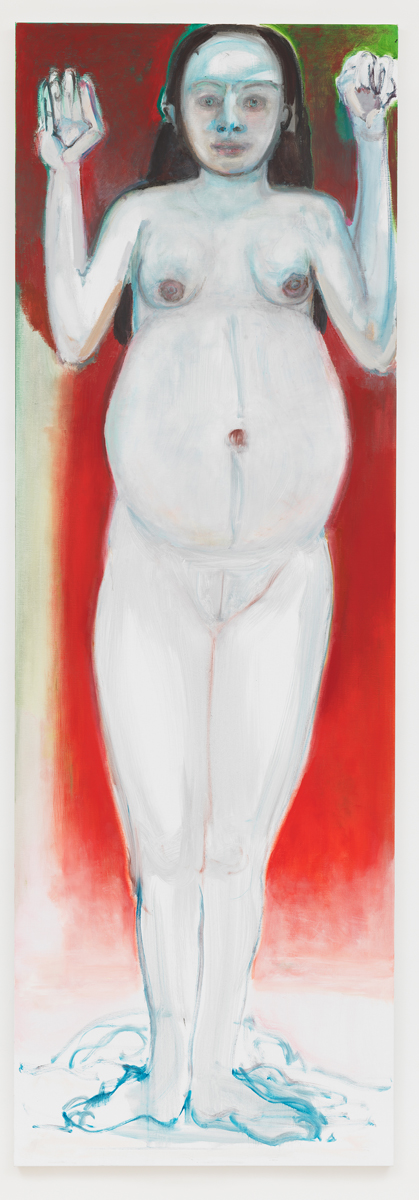
OF WOMEN BORN
Marlene Dumas (b. 1953)
Birth, 2018
oil on canvas, 300 × 100 cm, Pinault Collection
AG
This was a really important chapter to get right. And then, of course, even the choice of being a mother or not, in a country like Poland, which used to have access to abortion under Communist rule but then some years after the church became involved in politics, they came to have the strongest ban on abortion in all of Europe.
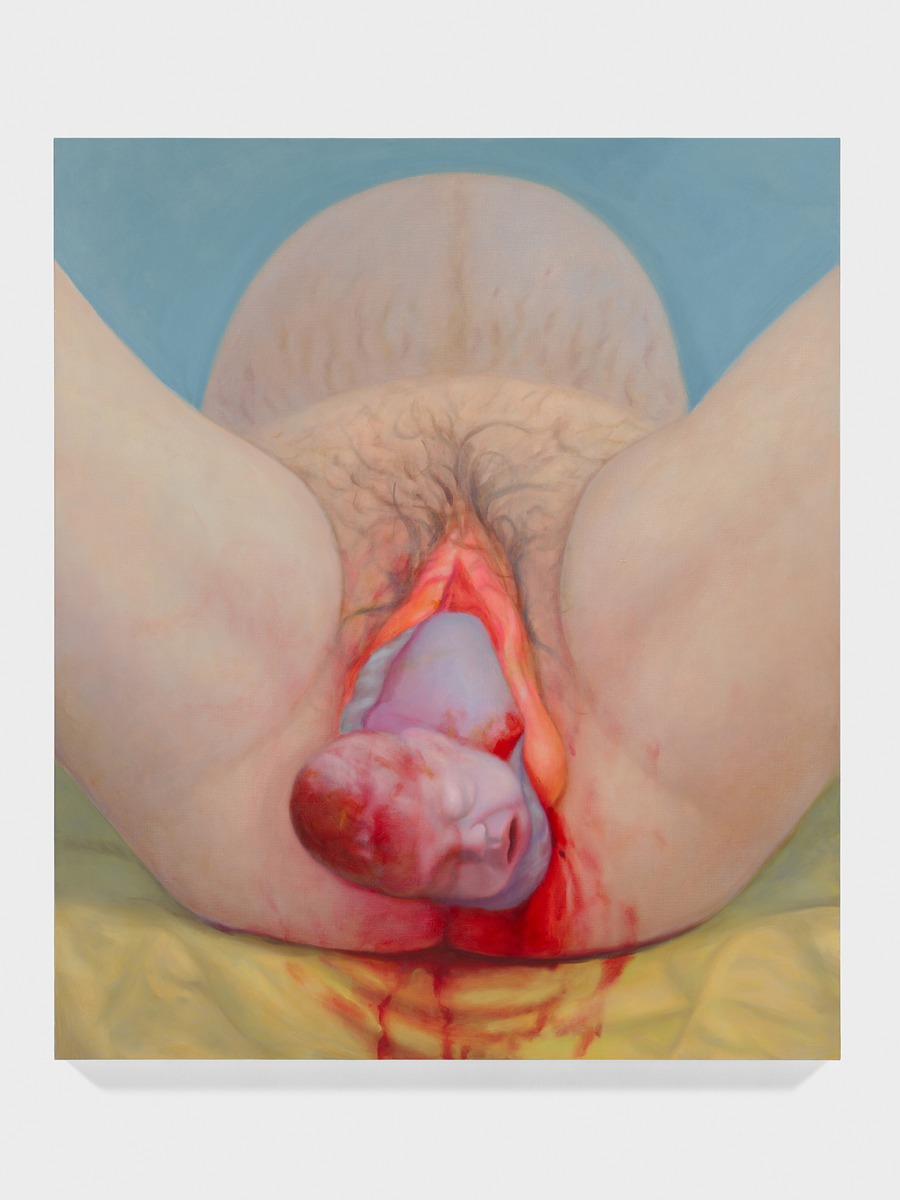
OF WOMEN BORN
Clarity Haynes (b. 1971)
Big Birth III (J’s Birth), 2023
oil on linen canvas, 179 × 152 cm, Courtesy of New Discretions
AG
This is a topic that is part of everyone's lived reality here. And for me, I had to have that doll made by Madame du Coudray, who from the 18th century called La Machine, because it shows us that since time immemorial, women have been struggling to have autonomy over their own bodies to know how it works.
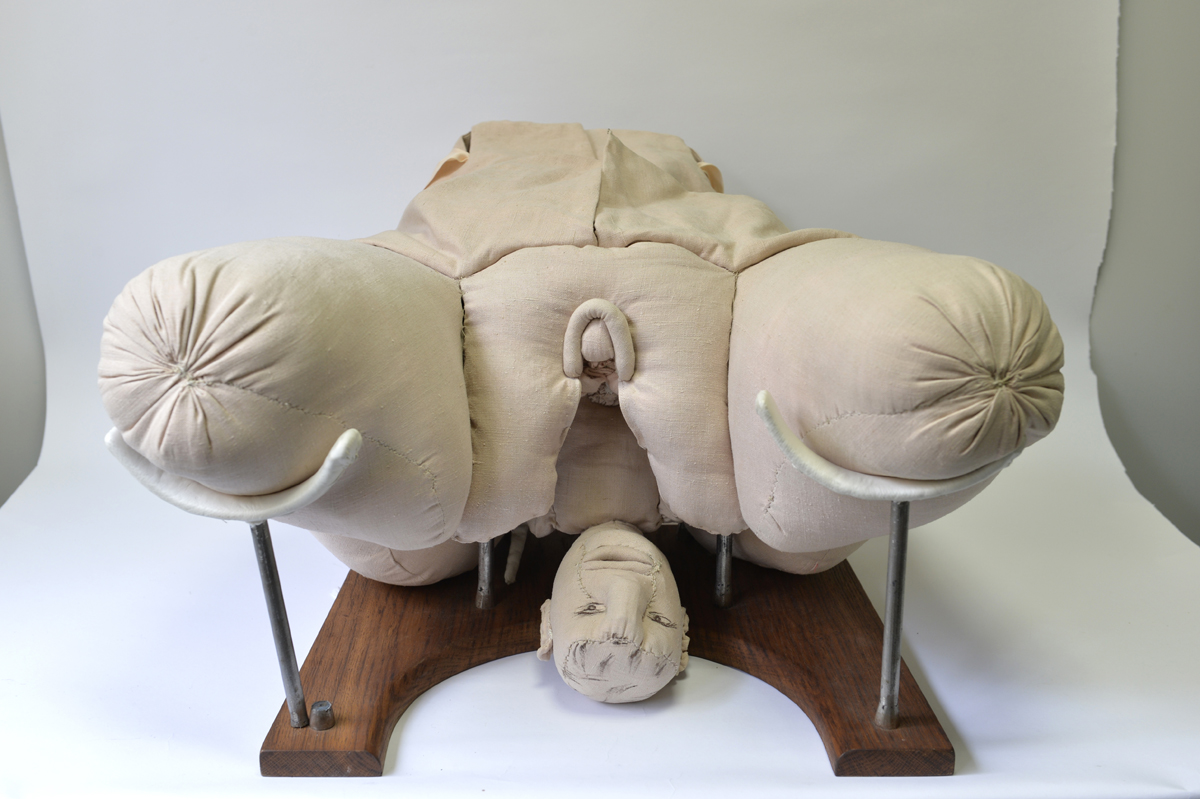
OF WOMEN BORN
Angélique Marguerite Le Boursier Du Coudray (1712–1794)
Madame du Coudray La Machine, from the 18th century
Copy by Rebecca Campeau executed in 2003
35 × 60 × 45 cm, Muséum national d’histoire naturelle, Paris
AG
Du Coudray invented this didactic object to teach women how to give birth safely and things that the male medical establishment didn't want them to know. So, I think it gives us an incredible sense of the agency of particular women in that regard.
RR
In your ‘other essays’ book, you talk about taking your son to the Met Museum and looking at a Dieric Bouts painting, Virgin and Child, (circa 1455-1460), that is, 8.5 x 6.5in, and, I'm paraphrasing, but, he said, “…that’s you and me, mommy?

Dieric Bouts
Virgin and Child, (circa 1455-1460)
oil on canvas, 8.5 x 6.5 in, Collection Met Museum, New York City
AG
Yes.
RR
That was celebratory. I have two sons. I had a moment when my first son was being born, his head was crowning through the birth canal, and I experienced, in a millisecond, all the secrets of the universe.
AG
Right?
RR
It was gone in a flash…
AG
Yes and it’s amazing because it's not just about women. It's about humanity. Right? There's not yet an artificial womb that can carry a child to term. So, until then, we're all coming into the world this way. It's something, we need to embrace, normalize and cherish.
Even in that depiction, it was a Dieric Bouts painting from, the 1400’s, that was my first love of art, Primitive Flemish art. Though it was the Madonna and Child, there's something profoundly, not just romanticized in that that portrait of the Virgin and baby Jesus because it was based on real people. It's a time machine! Maternal child love is something that travels across millennia, and sometimes the artists can capture it.
RR
Well said…
Are there any artists who inspire you that you would have liked to have included besides Michaelina Wautier (in the Anonymous was a Woman section) whose mastery of painting surpassed most of her male counterparts of the 17th century?
AG
There are a lot of artists, (my husband always laughs at me because he says I go down rabbit holes, and I start collecting images.) We go on these road trips to try and find all these things.
And, you can have regrets. But then, there are also so many things still to find, that's also, my wish is to keep working and to not necessarily discover new things, but just to have encounters with artists that you don't expect, that you didn't know about, that are hiding in plain sight.
RR
Can you discuss the Gina Birch, Super 8 film, 3-minute Scream, 1977, and how it sets the pervasive auditory tone of the show?
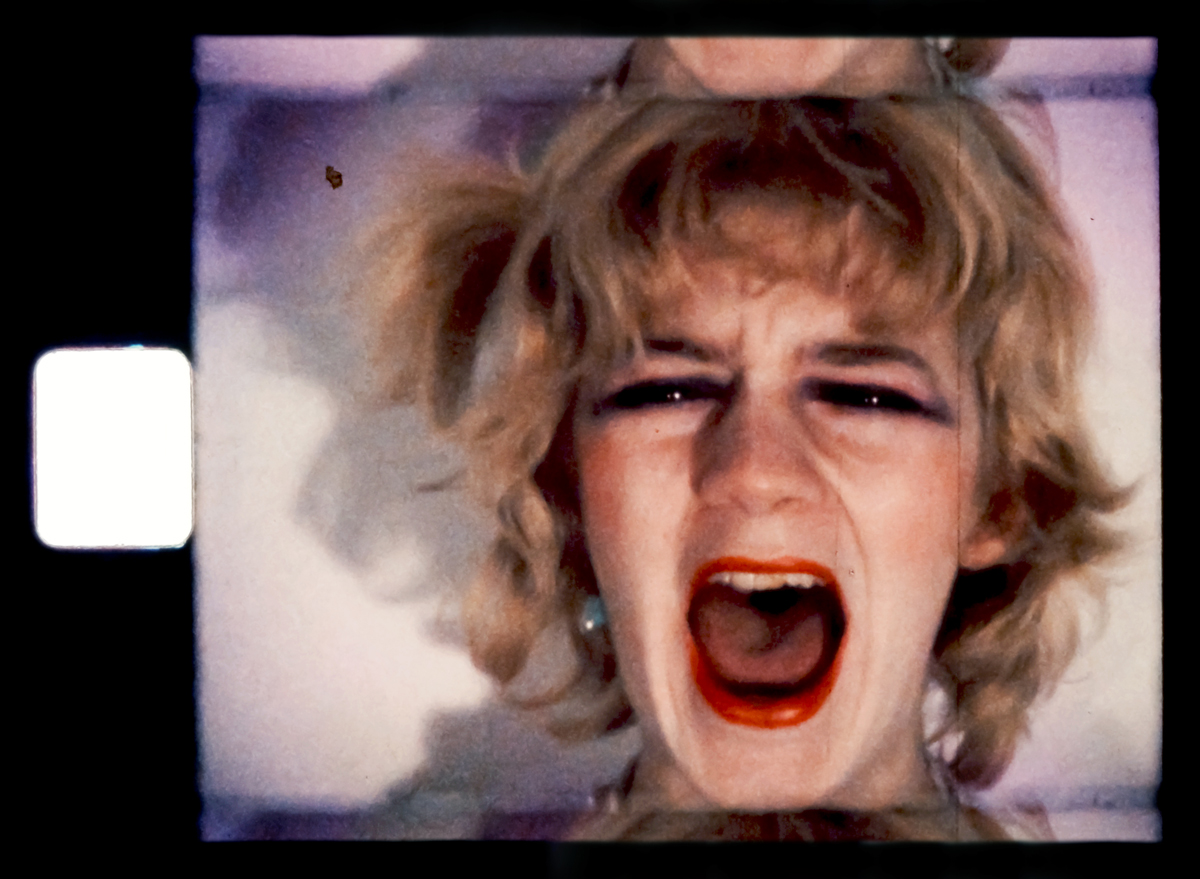
FEMMES FORTES: ALLEGORIES AND AGENCY
Gina Birch (b. 1955)
3 Minute Scream, 1977, Super 8 film, transferred to digital video; color, sound 2'50"
Courtesy of the artist
AG
Yes, the Gina Birch work is projected above the first door. So, when you walk into the exhibition, she is pulling you into the space. Then you walk into a room that has five works that are all these biblical scenes of sexual violence but with women exercising their power. Gina Birch is both a musician and an artist.
She was in the first women’s punk band in the UK, the Raincoats. I was delighted to find this movie; I felt that by playing her in the background, she provides the soundtrack of this primal scream of the agency of women, trying to break out of the box that they've been put in. That that kind of scream worked for every work in the show as well as that part of the exhibition.
RR
How does Karolina Jabłońska’s mural, Weathering the Storm, 2025 work to become a visual support for the entrance of the exhibition?
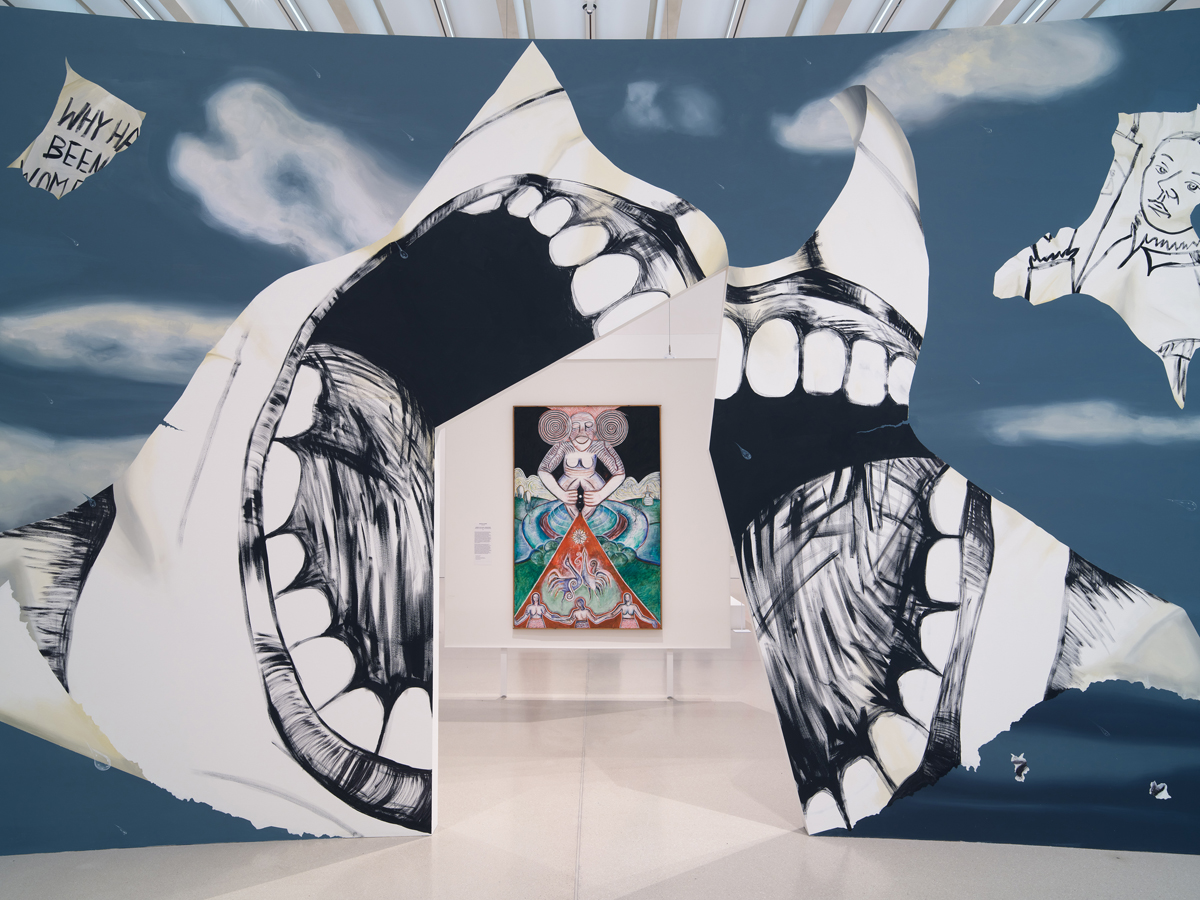
OF WOMEN BORN (installation shot)
Karolina Jabłońska (b. 1991)
Przetrwać burzę (Weathering the Storm), 2025
acrylic on wall, Courtesy of the artist
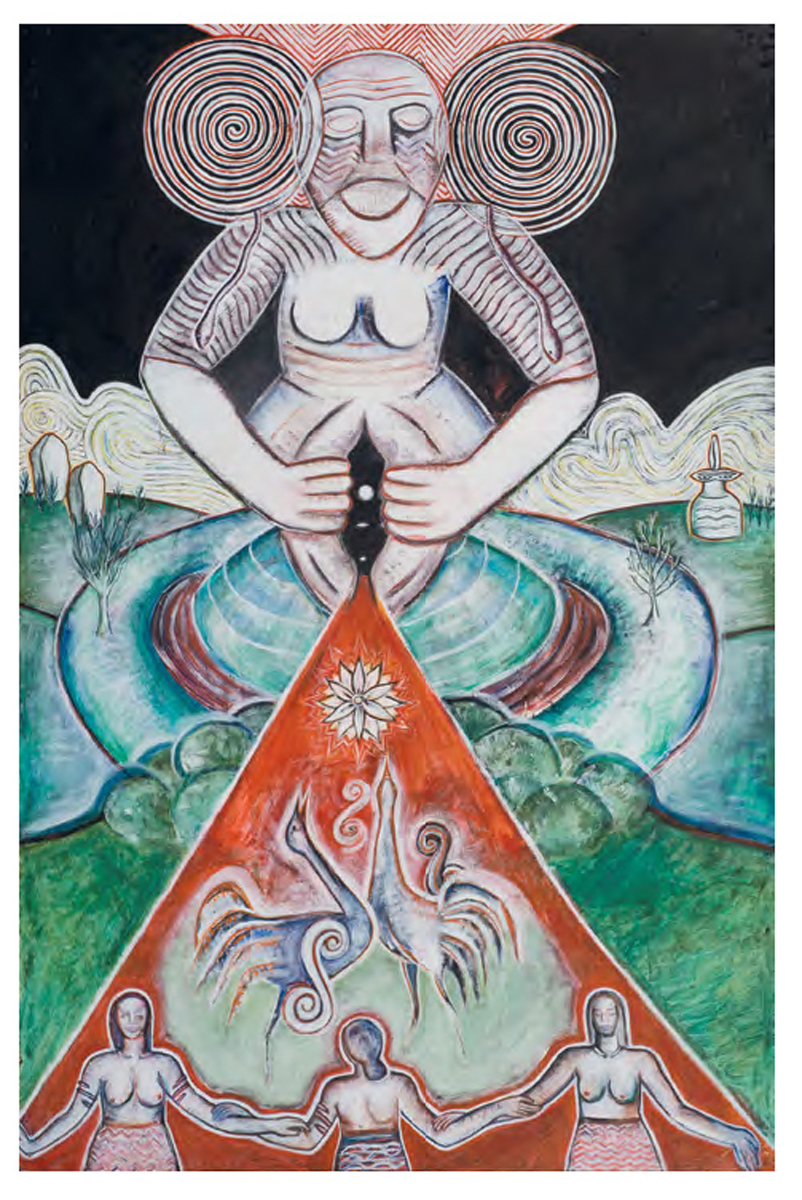
OF WOMEN BORN
Monica Sjöö
Sheela na Gig, Creation, 1978
oil on board, Courtesy of Monica Sjöö Estate and Alison Jacques Ltd.
© Monica Sjöö Estate
Photo: Michael Brzezinski
AG
Her work is a kind of a panorama painting that you walk through to access, Of Woman Born. I was inspired, by Niki de Saint Phalle, a French artist, known mostly for her work from the 60’s and 70’s. Niki had created this giant sculpture of a pregnant woman. In order to enter her sculpture you had to walk through the birth canal. I had asked Karolina Jabłońska, I told her my idea, and I said, “I want to walk through your work to get into, this second half of the exhibition, and this is what's going to be in the show.”
And I thought she was going to literally riff on the Niki piece. But in the end, she was, thinking more about all this new information, she was so overwhelmed to see the list of works in the exhibition and that there were so many artists she didn't know. She felt that she was almost like a student again who had to relearn art history.
She created these drawings, which appear to blow in the wind. We walk through her face. Her mouth is open, like in this state of, screaming, like Gina Birch. She explained to me, that when she was a student in the academy, she would draw paintings that she had to memorize for her art history classes. She had kind of cherry picked works from the show that she felt were a part of this new canon of art history.
They’re swirling around her screaming face, and we're walking through her to enter the exhibition.
RR
You exhibited 12 of 84 artists in Linda Nochlin and Ann Sutherland Harris from Women Artists:1550-1950, the first international art exhibition made up entirely of art created by professional female artists.
As an undergraduate, it was my first venture to get to the Brooklyn Museum, for that show, from Rutgers in New Brunswick.
AG
Well, I was so happy when, we installed the Artemisia painting, Susanna and the Elders, 1610. The owner of the painting, who's a German baroness, came with it. We had to be extremely careful, as you can imagine, as we were unpacking it. I asked if I could see the back before we put it on the wall.
When I saw the back, there was a typewritten sticker from the Brooklyn Museum from that exhibition, I got chills because I felt this is literally the baton being passed to us, I knew somewhere in the back of my mind that the painting was in that show, but it wasn't in the front of my thought.
So, when I saw the sticker, it was a great little moment, connecting us!
RR
You curated 2 out of 87 artists from Linda Nochlin and Maura Reilly’s, show ‘global feminisms, new directions in contemporary art’, where you chose the exact photo print from Catherine Opie, Self-Portrait/Nursing, 2004.
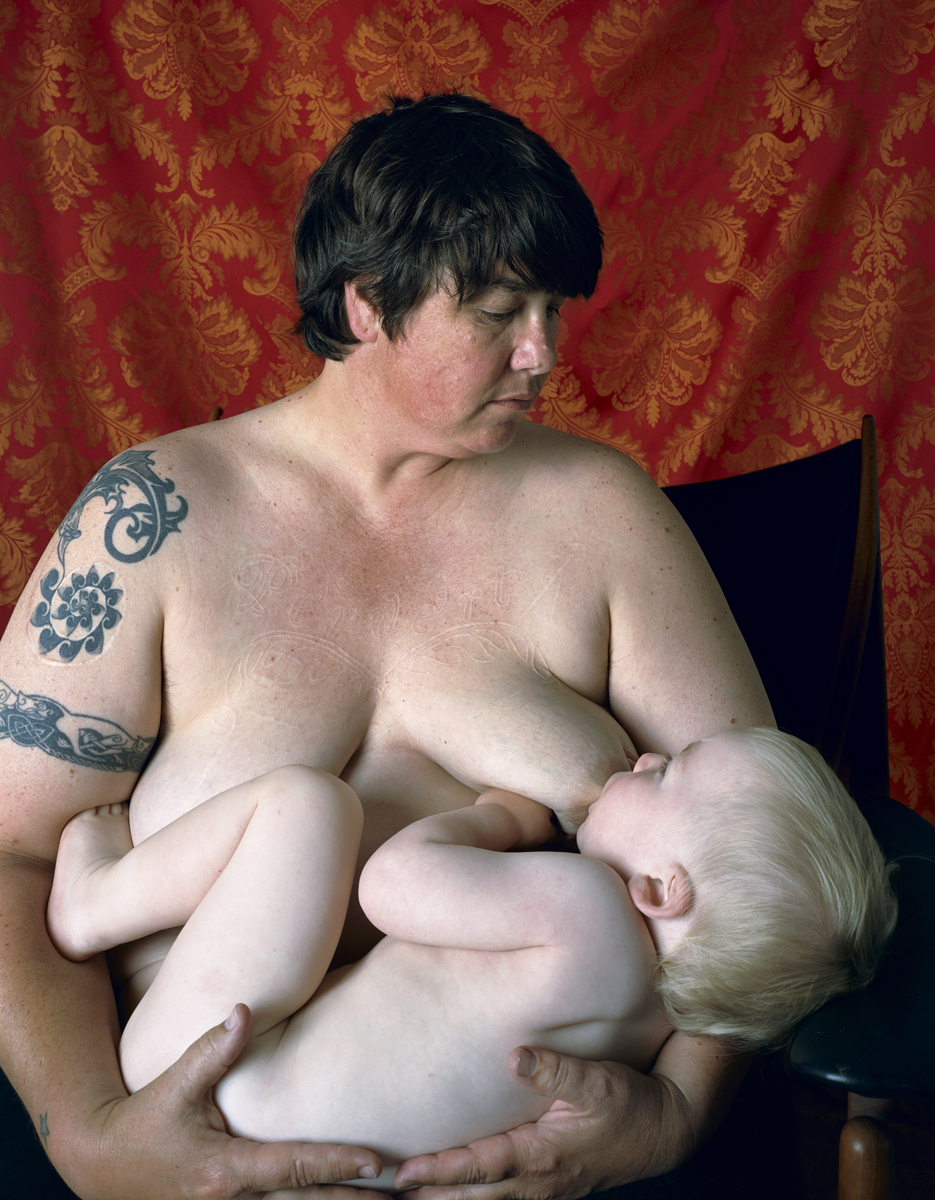
OF WOMEN BORN
Catherine Opie (b. 1961)
Self-portrait / Nursing, 2004
color photography, chromogenic print, 101.6 × 78.7 cm, Private collection © Catherine Opie,
Courtesy Regen Projects, Los Angeles; Lehmann Maupin, New York,
Hong Kong, London, and Seoul; Thomas Dane Gallery, London and Naples;
and Peder Lund, Oslo
AG
Yes, it's an icon. Cathy Opie's self-portrait nursing her son is a 21st century icon. It's a Madonna and child that acknowledges that moms come in all shapes, sizes, sexualities and interests. It’s a very important image.
RR
You shared 8 out of 120 artists with WACK! Art and the Feminist Revolution, which premiered at the MoCA in L.A. in 2007. I ended up seeing that show, multiple times, at PS1 when it was there, and, I embraced that show, more than any of the others. I didn't bond, in the same way, with the ‘global feminisms, new directions in contemporary art’ exhibition, because there were too many unknown artists.
I grew up with the artists from WACK! though… I was in New York, every weekend, going to see myriad exhibitions. Even visiting Hannah Wilke and other WACK! artists’ studios too. In addition, I was an apprentice for conceptual artist Agnes Denes.
AG
Wow. Well, you've met the legends…
RR
I was drawn to WACK!, as a result, felt in-tune with the Feminist Revolution message.
How did being the editor for the Phaidon publication; Great Women Painters, 2022, inspire your passion and vision for this museum undertaken in Warsaw?
AG
I wrote the introduction to the book. I wasn't really asked to choose the artists that were included, but of course I wrote about some of them in the in the introduction. And that was really the moment where I spent a considerable amount of time thinking about Christine de Pizan and this allegory of the ‘City of Ladies.’
To me, this image of a medieval woman saying that we need to create the city to protect the women of the past, the women of the present and the future which she's envisioning in 1405. This is the first moment that “woman” becomes a political category, because before that ‘woman’ was not part of the political discourse.
What she's describing could easily apply to the discipline of art history, because cities are always being built. They're never static. And they're a collective endeavor. There's not one architect, there's not one construction worker. It's this collective effort over many centuries and that's what art history is… I mean, I'm just one bricklayer, along with Linda Nochlin and, Griselda Pollock and countless other women and men who have worked in this field.
I had the great fortune to know Robert Rosenblum, who was also very much of a dissident art historian who, went up against what was supposed to be high academic taste. He taught me to trust my intuition and to work, to lean into the things that I'm attracted to…
We, as art historians working together, we're constantly reshaping the city. When I wrote that essay (as an introduction to ‘City of Ladies’) I was thinking about that it's not about just Linda Nochlin or just Griselda Pollock. It's about, all of their students, all the people who continue to work, all the people who are just starting out, who are adding to the discourse, who are expanding it, who are calling us out on things that we are myopic about.
I got interested in feminist art history because I was interested in who was left out of WACK!. That's how I really started. I got really interested in the fact that in the early 70’s, there were women artists who were being censored by other women because their work was seen as being too sexual or too close to pornography.
That was a beginning point for me. When I started to think beyond the orthodoxy of high, second wave feminism, both in terms of the writers and in terms of the artists, there's more than just Judy Chicago and The Dinner Party, 1974-79. There's so much work out there.
Now living, and coming to Eastern Europe for 20 years, there's this whole field of, feminist scholarship around the socialist period. How different it was from Western feminism and how under communism, women were much more emancipated. So, their concerns and the kinds of works they made were different in really interesting ways.
I’m interested in that plurality. That's why I think the ‘City of Women’ is such a great, allegory for us to use to describe what we need to do.
RR
What is that wall of over 3,000 photos?
AG
This is a work by, Carmen Winant, who is an American artist and an activist. She's part of the exhibition about reproductive justice entitled Her Heart by Karolina Gembarra that is at the same time as mine and is interrelated. But I didn't, choose her work. Her work is called The Last Safe Abortion, 2025, And this collection of thousands of photos comes from her collecting it.
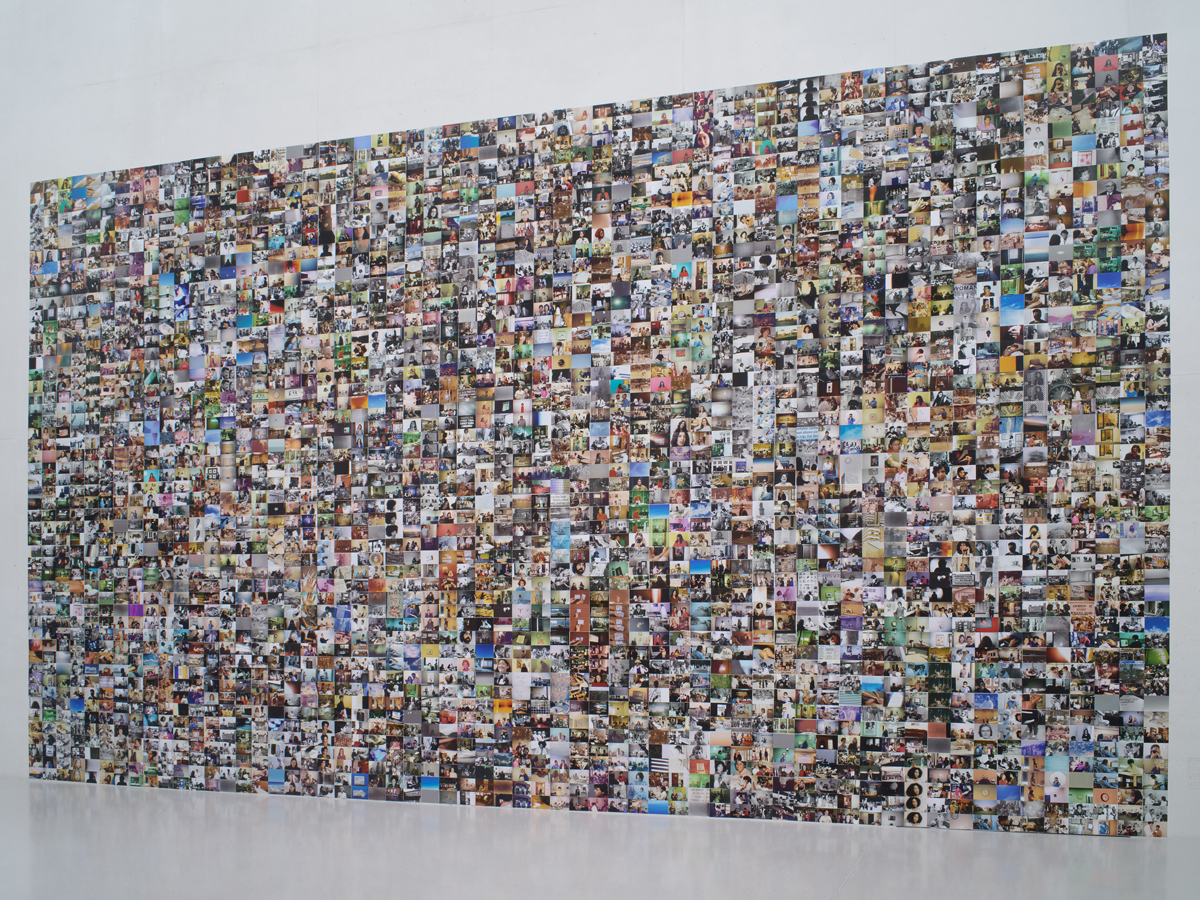
Carmen Winant
The Last Safe Abortion, 2025
AG
Basically, it's about the impossibility of picturing abortion, in a single image. It shows all of these different vignettes and snapshots of, both health care workers and patients and activists who, have contributed to providing reproductive health care to women. And Carmen has worked on this for… I actually heard a talk that she gave at the museum back in November. Carmen has worked in this, area for a very long time. I think it's a very moving artwork and where it is situated is right before you walk into the second part of my show and the room that is called Of Woman Born. It's kind of this perfect passage between these exhibitions dealing with issues around women.
RR
I'm always amazed that women were the first people to do self-portraits with the palette…
AG
Yes. I can't believe it's not something you learn, the first day you start studying art history, right?
RR
I learned it through doing the research for this interview.
Museum Director Joanna Mytkowska said, “The Woman Question presents iconographic research on specifically gendered ways of choosing and depicting certain topics which reflect the political, social, and cultural conditions of their times, as well as the limitations that women had to face.” “…in contrast to particular, identity-based, or group methods of fighting for equal rights. It is once again becoming one of the burning human issues that cannot be ignored, obscured, or erased from heart and mind.”
Do you think, that you confirmed this with your selections of artists?
AG
Well, you can always do better. I think I did the best I could, but if I could do it again or if we do a different version of the show somewhere else, there are lessons we can learn. There are things we can revisit. I almost think that the next step for, for me is to think about this iconographic methodology, to choose images that are allegories about us as humans and as the body politic.
About, the inherent diversity of humanity across centuries, and a project that would draw from both male and female artists. This process has been very, humbling for me. I still have so much more to learn and to study and I want to give it another go in a different iteration at some point,
RR
Do you believe the art & artists in this show can truly change misogynistic art historical world views, or at least encourage, or inspire a younger generation of multi-gendered visual artists?
AG
Yes, because seeing oneself in art is powerful and political, and that's why I am, always into figurative painting and portraiture, because it's one of the most accessible and profoundly humanist forms of art making. And even though the avant-garde, holds it at a distance and it's often thought of as being, conservative or traditional, I actually think that, it's the perfect Trojan horse for complicated messages.
This might look like very classical work that, people don't find threatening, but you can still teach people or show them very complex social and political meanings within that so-called traditional art. So, I'm all for the Trojan horse!
RR
Yes. Well, that was my next question. Why are there limited abstract artists included? Are you saving them for The Woman Question v2?
AG
Because it's such a big subject to do it. There wasn't space to do both, and at one point, I did have a chapter that would have dealt with abstraction, especially too because women were pioneers in this area. And abstraction specifically coming out of occult's belief systems and things like that.
But that’s a whole subject unto itself, it really needs serious scholarship and space and research. I just can’t kill all birds with one stone. I also decided not to include some of the most canonical works of so-called feminist art made in the 70’s, because there have been so many shows about that.
In Poland there was just a huge show of Polish feminist art coming from this neo avant-garde perspective. I felt that job was well done and mine was about a different subject. It doesn't mean that it's not valid or not interesting or not good art. It just wasn't part of the story that I tried to tell this time.
RR
Is the show going to be extended?
AG
I don't think so, because the loans were just so difficult to negotiate, otherwise, it would be great. We couldn’t keep, the band together long enough to extend it.
RR
Are you satisfied with the results your show has gotten?
AG
I'm more than satisfied. There are many weekends that I'm there or even during the week, and it's always full of visitors, not just packed with women or children. It's full of families, and people of all sorts. And that was our goal. It's great to have wonderful reviews and people who are your colleagues to say good things. But the true success is the fact that we won a new audience. It has been a phenomenal amount of attendance. That feels really great. Because that's what I really wanted to do is to, expose people who haven't been to a museum before, to something that hopefully touched them.
RR
What question haven’t you been asked about the exhibition that merits your response?
AG
Oh, I don't know.
RR
In all the interviews you've done… I know the answer to this is, “go look at the show…”
AG
I was asked in a very aggressive way numerous times - Why do we need this? Do we really still need this? And it was interesting because geopolitics play into such questions. A German, mainstream newspaper was very condescending, writing ‘…of course, in Poland they need a show like this. But here in Germany, the question is resolved.’ There's no - ‘we don't have misogyny anymore in Germany.’ You just want to, roll your eyes. It's a never-ending struggle… it's not about Eurocentric white women. It's about, this expansion of the canon and it’s not enough.
There's not enough room, to do true justice. There's not enough budget. I had a whole unrealized section about early modern Chinese and Japanese artists. While women were entering the academy in the late 19th century in Europe, in parallel Japanese women, for instance, started to paint in the Yōga style, which is called Western painting, which, just arrived in Japan. This style was embraced by women because they could have access to it because it wasn't the domain of the ‘Masters.’ It was a new thing. So, there's so many things we still haven't done. There was an Indian artist who was an important South Asian modernist called Amrita Sher-Gil. She was she was often called the Indian Frida Kahlo because she painted herself, repeatedly. We had some discussions with the National Museum in Delhi about loans but in the end we had to be pragmatic about logistics and cost.
RR
After living with the exhibition over these months, have you come upon a room or artist that continues to romance your soul and stimulate your mind in new ways?
AG
I'm in love with Sofonisba Anguissola because I think every time I look at those paintings, the two paintings we have, Self-Portrait (The Ashburn Medallion) 1556 or 1558, and (Self-Portrait at the Easel) 1554-1556, I feel her there. She is also just this exceptional figure in that she was born in the 16th century. And her father, went against the grain and had she and all of her sisters educated. I think the way she used her image was not just about her creating a legitimacy for herself, but she created a persona that survives still today. I'm still beguiled by it. She did it before Rembrandt. She did it, before Warhol. She was super famous in her time because of the way she crafted this image and charmed us, across the centuries.
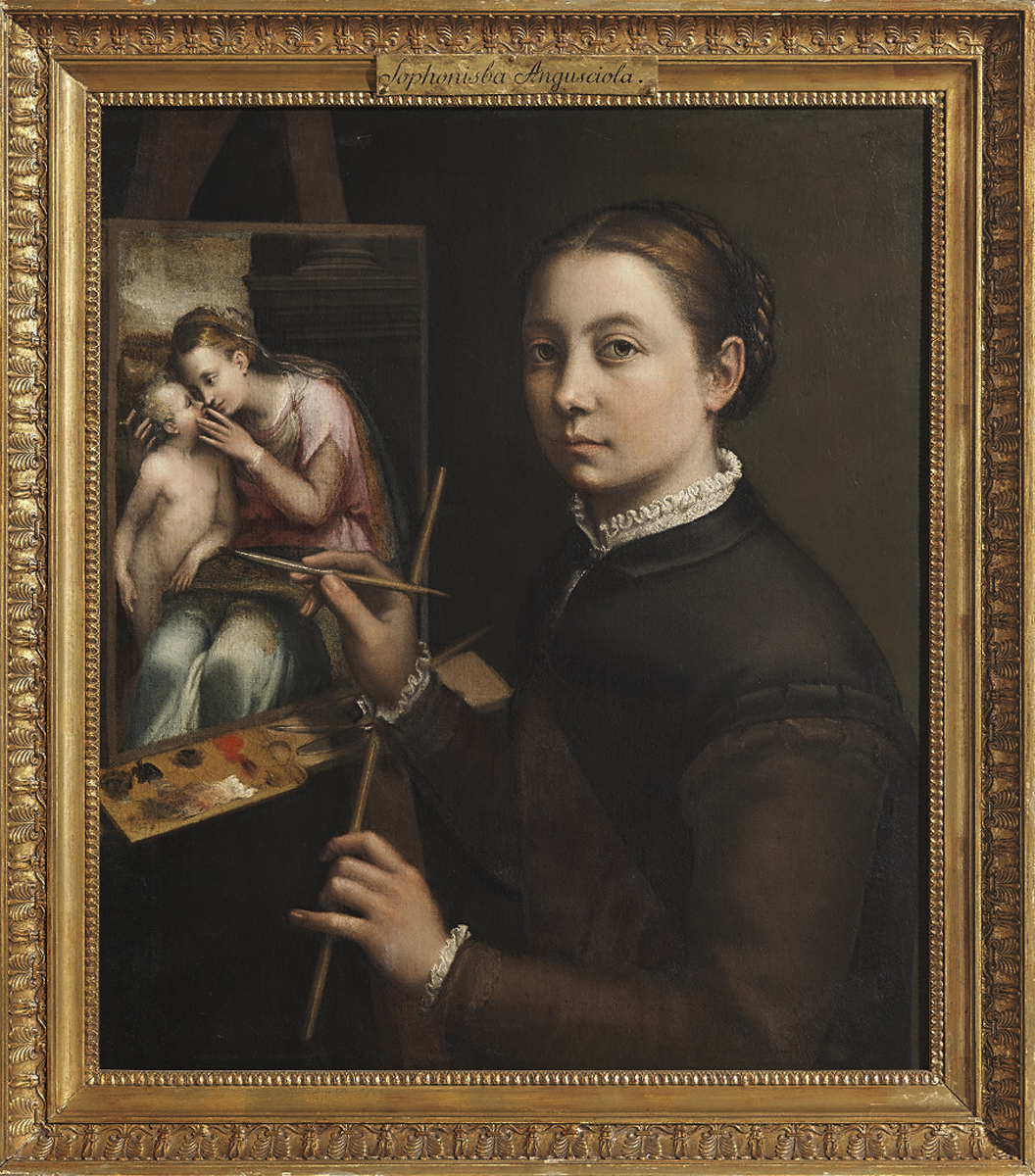
PALETTES & POWER: SELF-PORTRAIT AS MANIFESTO
Sofonisba Anguissola (1532–1625)
Autoritratto al cavalletto (Self-Portrait at the Easel) 1554–1556
oil on canvas, 65.7 × 59 cm, Muzeum – Zamek w Łańcucie Castle Museum in Łańcut
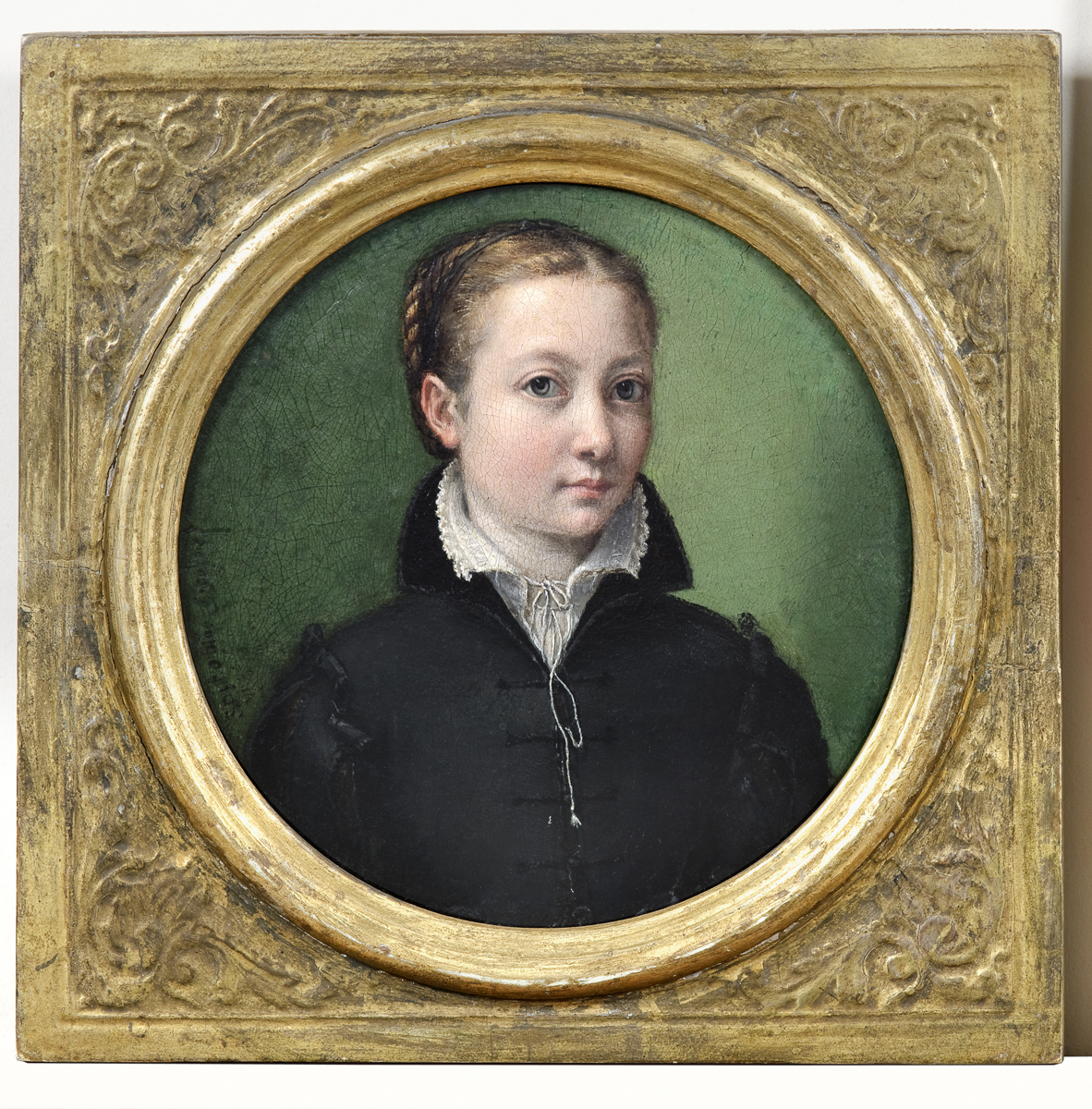
PALETTES & POWER: SELF-PORTRAIT AS MANIFESTO
Sofonisba Anguissola (1532–1625)
Autoritratto (Il “Medaglione Ashburnham”)
(Self-Portrait (The “Ashburnham Medallion”)) 1556 or 1558
oil on panel, diam. 13.2 cm, Frits Lugt Collection Fondation, Custodia, Paris
RR
I was happy to read that artist; Lubaina Himid is representing Britain in the Venice Biennale.
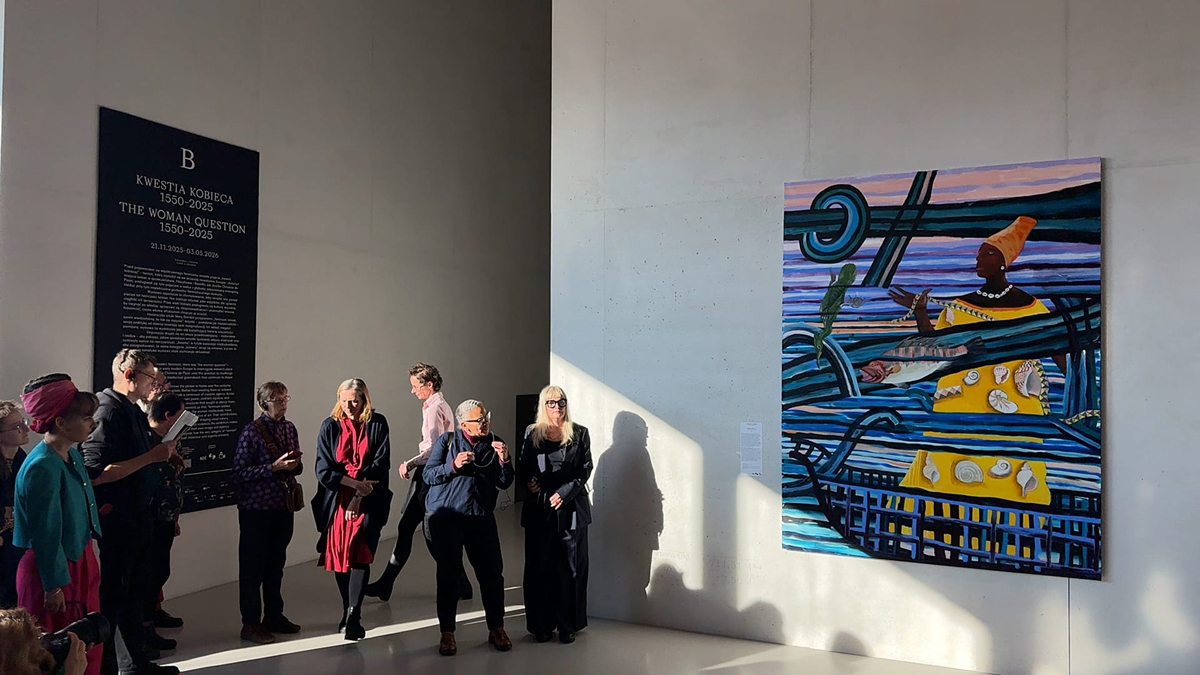
The Woman Question 1550-2025
Installation shot - Entrance
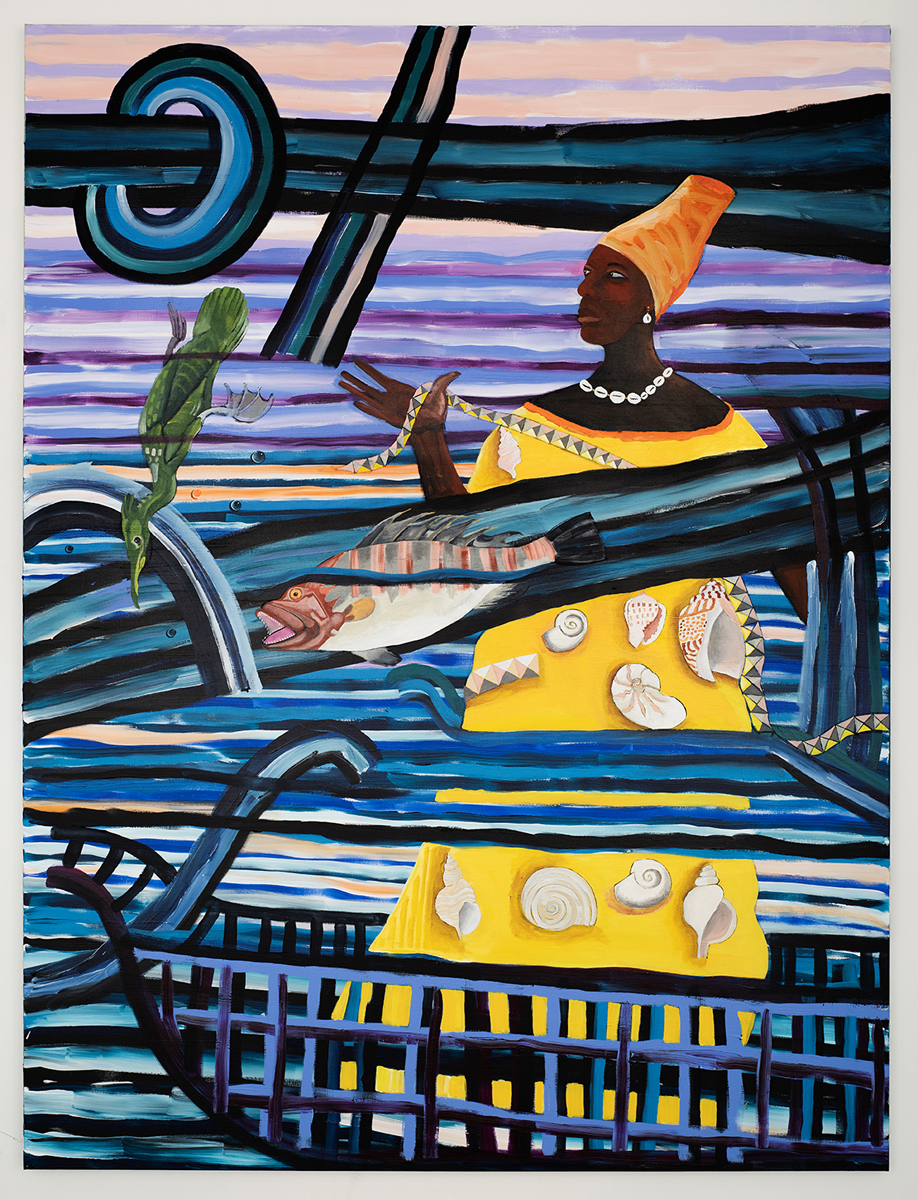
FEMMES FORTES: ALLEGORIES AND AGENCY
Lubaina Himid (b. 1954)
Amphitrite, 2025 acrylic on linen, 244 × 183 cm
Courtesy the artist, Hollybush Gardens, London and Greene Naftali, New York
AG
Yes. It's great.
RR
Yeah. Well, thank you for your time.
AG
I'm very touched that you read so many articles and catalogs. It really means a lot to me.
RR
Thank you for your expertise, sensitivity. Along with your little bit of the ‘fuck you’ attitude in there.
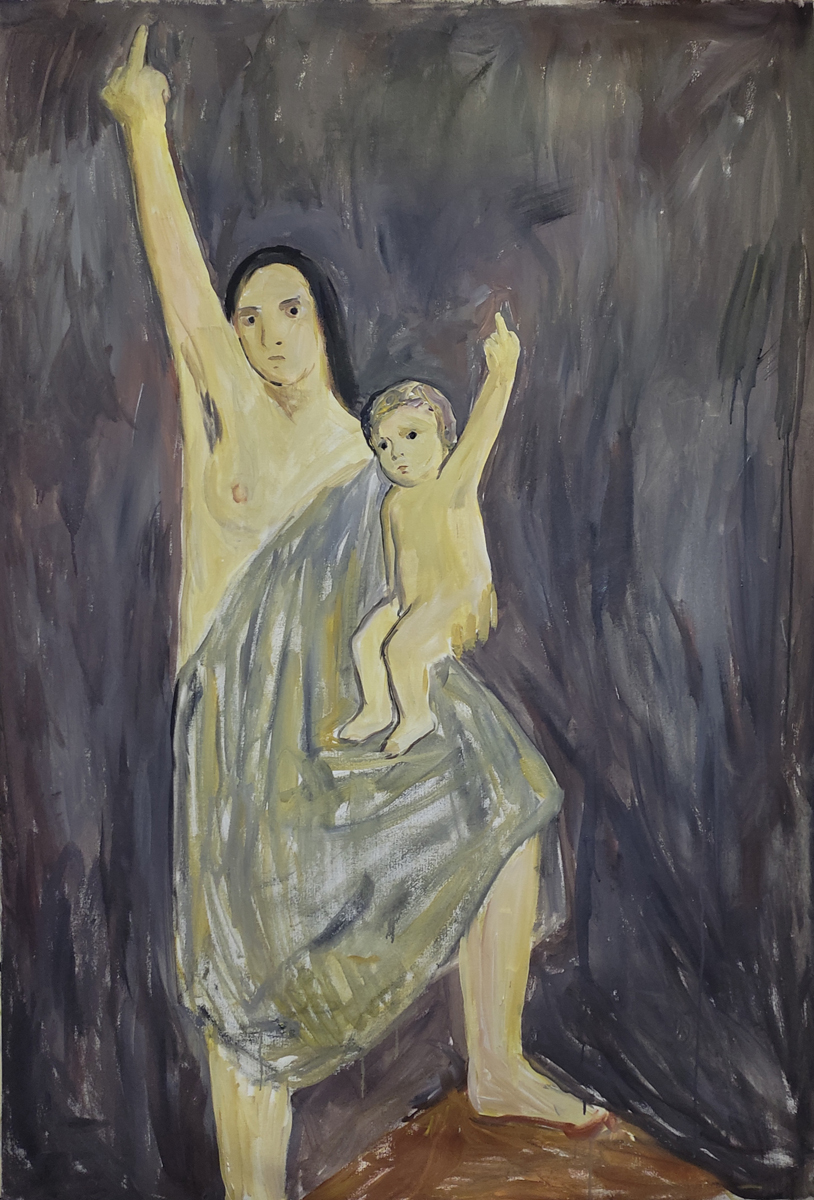
Kateryna Lysovenko (b. 1989)
Untitled, 2022
acrylic paint on canvas, 160 × 110 cm, Ukrainian Museum
AG
You know it's there. Yeah. Thank you so much. Okay. Take care. And, please, I hope your health continues to improve. It's really been great to talk to you. Very inspiring.
RR
In some way you're instrumental in my recovery because I've been focused on this, for so long.
AG
Oh, that's so moving.
Thank you sir. Bye
______________________________________________________
*Joan Semmel, was my mentor at Rutgers, Mason Gross School of the Arts, (graduate), who AG also curated in: Black Sheep Feminism: The Art of Sexual Politics, January - March, 2016
Alison M. Gingeras is a curator and writer based in Warsaw. She currently serves as Curator at Large at the Museum of Modern Art in Warsaw (Muzeum Sztuki Nowoczesnej). Her previous institutional positions include curator at the Solomon R. Guggenheim Museum in New York, the Centre Pompidou in Paris — where she organized Cher Peintre: Painting the Figure Since Late Picabia (2002–2003) and a Daniel Buren retrospective (2002) — and Palazzo Grassi in Venice. In 2009, she co-curated Pop Life: Art in a Material World at Tate Modern, London.
Working as a guest curator, Gingeras has organized a number of significant monographic exhibitions devoted to Polish and Eastern European artists, including Once Upon a Time, Erna Rosenstein at Hauser & Wirth, New York; My Name is Maryan at the Museum of Contemporary Art Miami (2022) and the Tel Aviv Museum of Art (2023); and The Dark Arts: Aleksandra Waliszewska and Symbolism at the Museum of Modern Art Warsaw (2022) and the M. K. Čiurlionis National Museum of Art, Kaunas, Lithuania. Her most recent exhibition, The Woman Question 1550–2025 (Museum of Modern Art Warsaw, 2025–26), received the O!Lśnienia award.
Over the past thirty years, Gingeras has contributed essays to a wide range of books and periodicals, including Artforum, Tate Etc., Spike, Mousse, and Playboy.
**Unless otherwise noted, photos provided by Robert Glowacki and/or
Museum of Modern Art in Warsaw
The Woman Question 1550-2025
______________________________________________________
The Woman Question 1550-2025
Museum of Modern Art in Warsaw
(11.21.2025 - 5.3.2026)
Rupert Ravens
Rupert Ravens is an intuitive curator, collector, writer and passionate patron of the visual arts.
view all articles from this author