Whitehot Magazine
October 2026
"The Best Art In The World"
"The Best Art In The World"
October 2026
An interview with Canadian Painter Roy Green
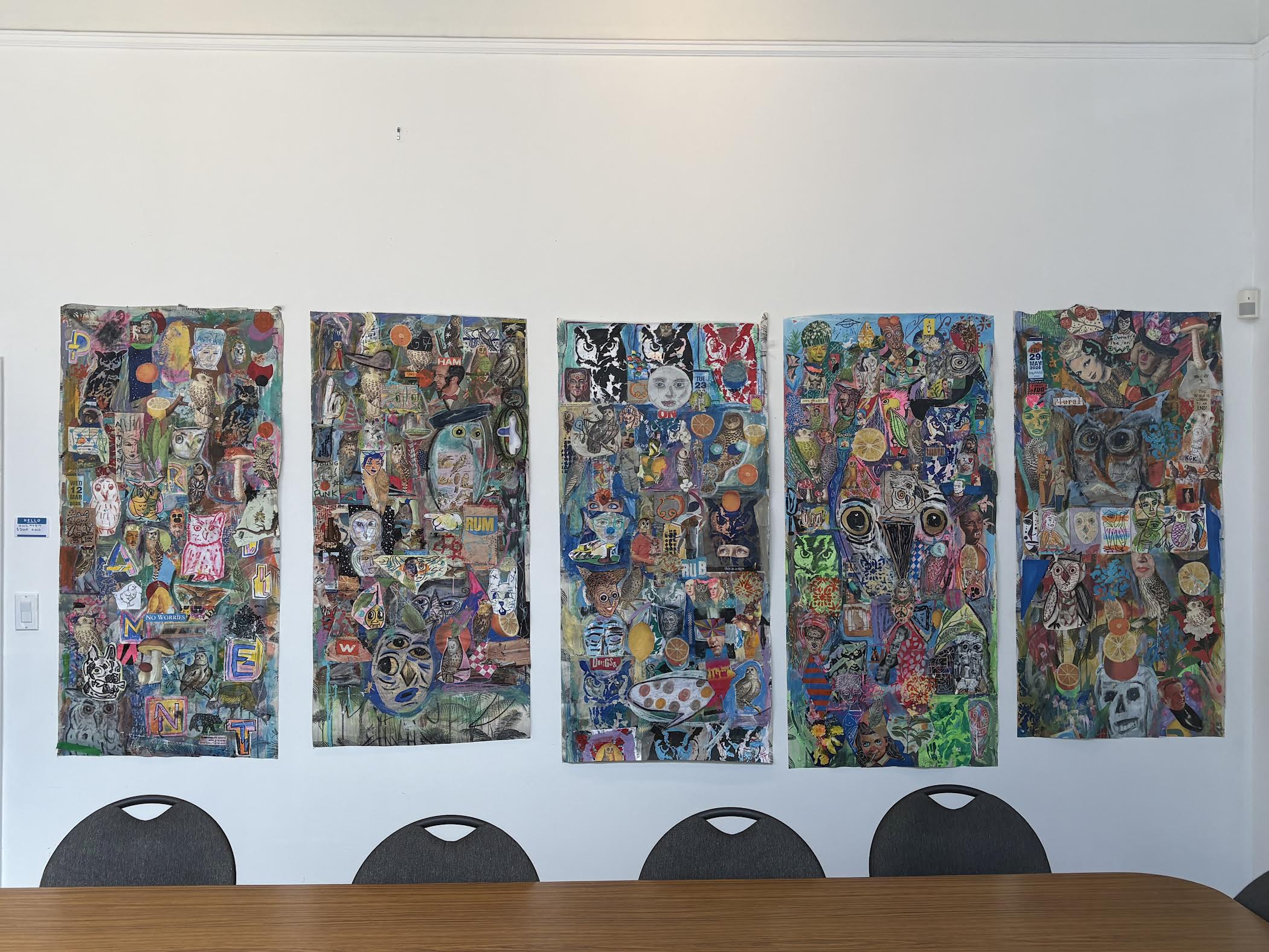 Installation view of Owltopia, mixed media on wallpaper, Store Front Studio, Victoria, BC
By ERIK VOLET June 6th, 2026
For more than three decades, Canadian painter Roy Green has quietly built one of the most distinctive painting practices on the West Coast. Unconcerned with trends or market fashions, Green has consistently pursued an intuitive visual language that moves fluidly between abstraction, figuration, and symbolic imagery. His latest exhibition, Owltopia, continues that restless exploration through works that transform found materials and everyday references into richly layered paintings filled with wit, mystery, and invention. Whitehot Magazine spoke with Green about the exhibition, the rhythms of studio life, and why painting remains an endlessly open field of possibility.
EV: Hey Roy we’re here at your show, what's the name of your show?
RG: The name of my show is Owltopia.
EV: When did your last show close?
RG: About a month an a half ago, it was on for six weeks.
EV: So you like to do ‘em back to back?
RG: Just kind of... how it happens...that way. Because I had some travel plans, but they fell through, and then I thought, June would be a good time. Things just kind of unravelled.
EV: Keeps it dynamic, though, right?
RG: You know? It's always good to have a goal.
EV: So tell me about Owltopia.
RG: The main focus of Owltopia are these scroll pieces that are about two and a half feet wide and five feet tall, made on some found wallpaper. And the wallpaper, you can barely see it. There’s a sort of black and white, old timey engraving of,peacocks and palm trees.
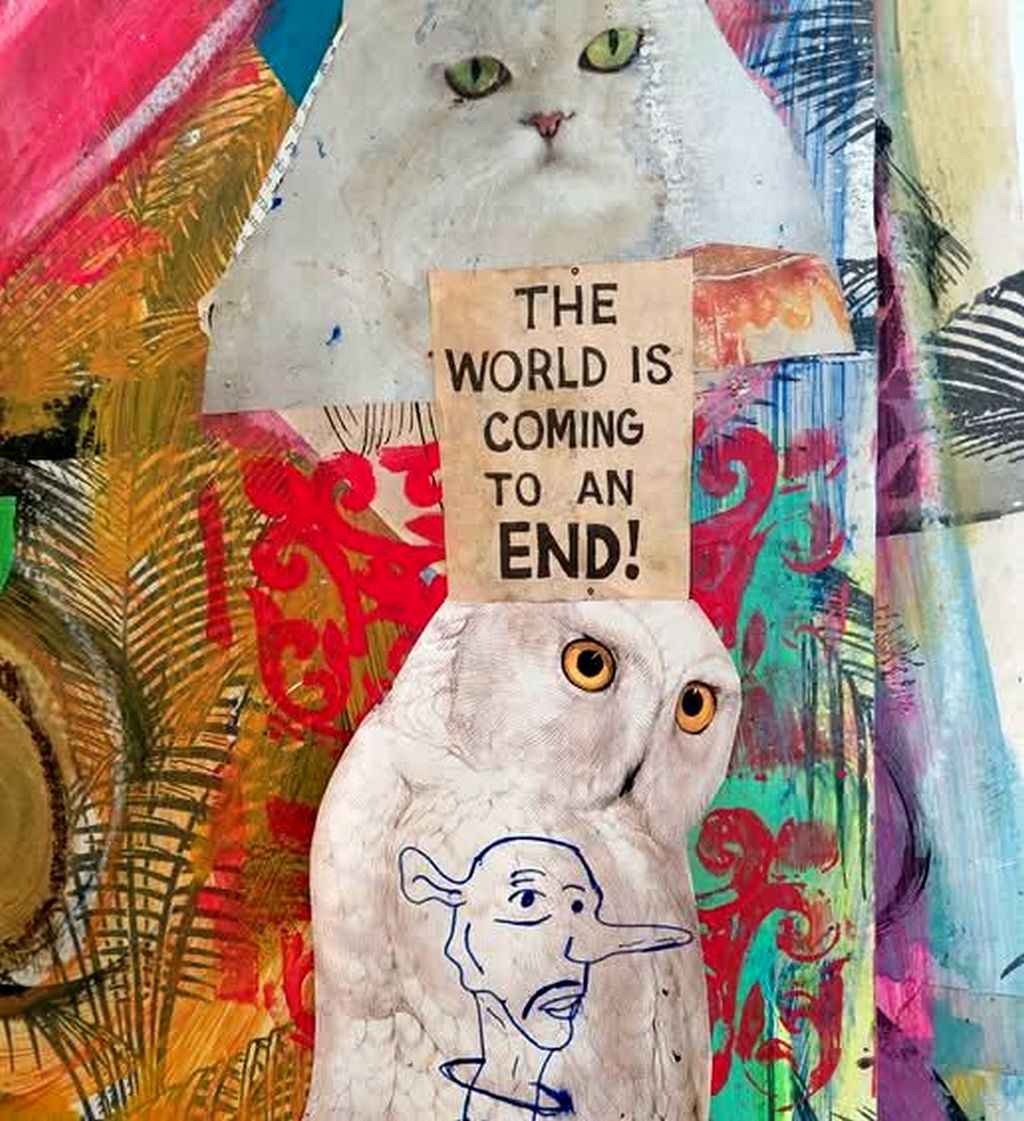 Owltopia (detail) mixed media on wallpaper, 27" × 60"
EV: I see some remnants there.
RG: There's some remnants there.
EV: Dragonfly, tropical palm fronds...
RG: Yeah, yeah.
EV: Is it the texture you're drawn to, or you like these remnants, or...?
RG: I've always liked working with found objects, and it's nice to start with something that already has something printed on it, rather than just totally blank. It already comes with a history embedded in it before I begin. A lot of the people who do works on paper they usually show a lot of the paper, that seems to be an intrinsic thing, if you do works on paper that you have a lot of white space. Of course, I do the complete opposite of that.
EV: Right. These are more, like, paintings that happen to be collages.
RG: Yeah, I think a lot of people collage just collage, just scissors and glue, but these are more multimedia, ink, acrylic paint, oil pastel, glue, and sort of making my own collage elements. Little drawings.
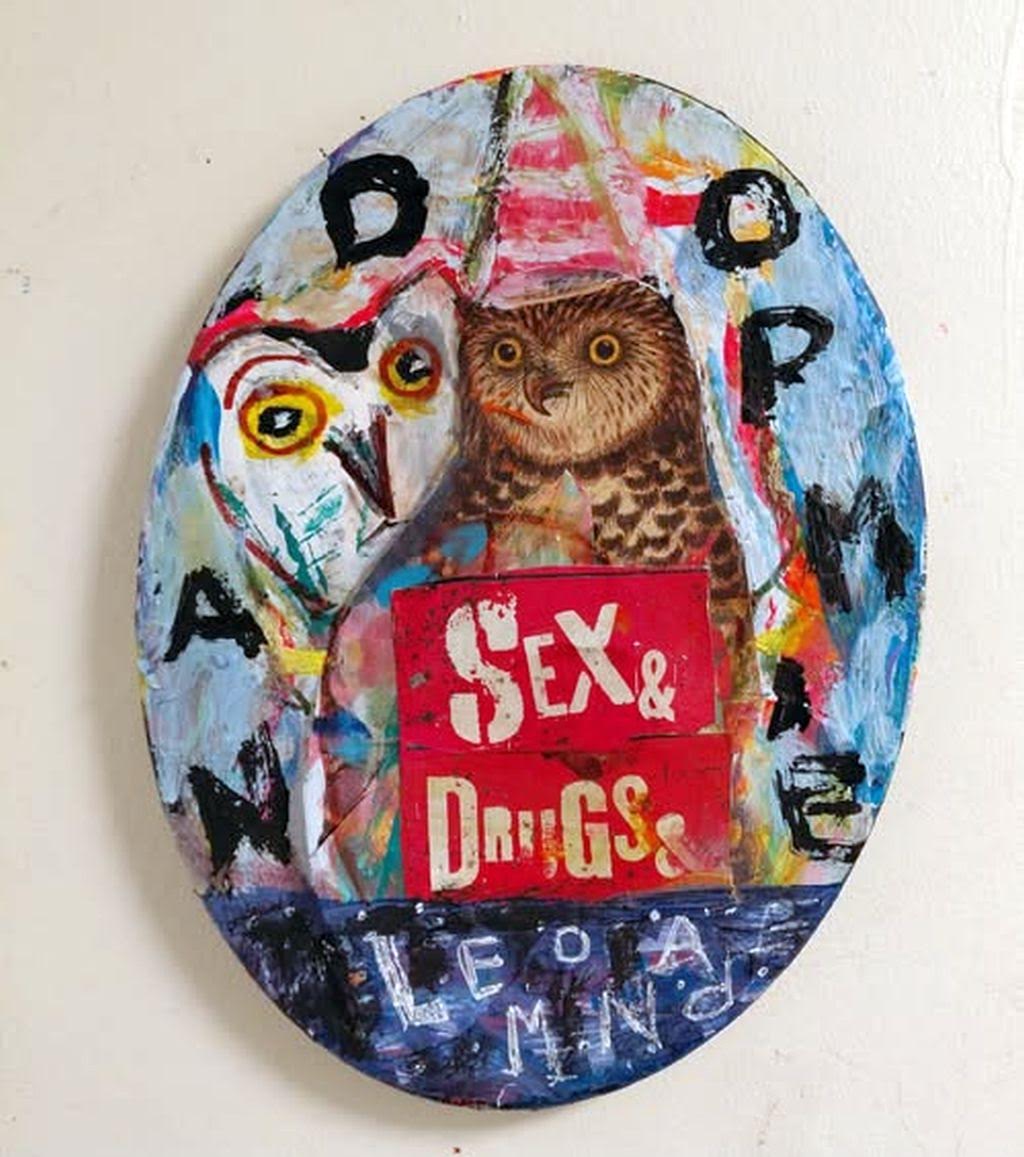 Dopamine Lemonade, mixed media on canvas, 9" x 12"
EV: Collaging yourself, too.
RG: Yeah. And then some of the ones that didn't work in the series got cut up and were put into these.
EV: Reassembled.
RG: Yeah, and when I do my little collage workshop, talk thing... I'm gonna bring in the remnants so people can, like, re-collage myself. [laughs]
EV: So, I found a book of your poetry a few years back at a secondhand bookshop. Can you tell me about the importance of poetry or how that plays out for you still in your work?
RG: I would say... I used to do a lot of poetry readings, and a lot of performance art. I would say more music is more of a model. Like, say, a group like Stereolab, there is a lot of different elements in it from, like, African percussion to, you know, avant-garde electronics to, like, '60s pop song. So there's all these different elements, but it's held together by a pop song. So I have all these different elements held together in a vertical scroll format. So it's not, like, totally amorphous where, you know, there's things on the floor, things standing on the wall. It's in a, I guess, recognizable format, right? Anything can happen in that format. But I guess I need those boundaries.
EV: Right, with the consistency of these formats, even though they're very maximal and busy, and there's chaotic energy, you're containing them in the same format.
RG: Yeah, yeah.
EV: Well, I also saw you as part of a play years back, right next door.
RG: Right next door.
EV: And it was Andre Breton and Tristan Tzara.
RG: Tzara's Heart it was called.
EV: And who were you playing?
RG: I played Andre Breton.
EV: Yes.
RG: And also a DADA dancer.
EV: Yes. That's an interesting kind of objective chance moment from knowing that you did that next door.
RG: And in art school, in my photography class, at Emily Carr, one day, our teacher, Randy Bradley, brought in baseball caps that had names of famous philosophers on them. And we have to critique each other's work as that character. And, of course, I was Andre Breton.
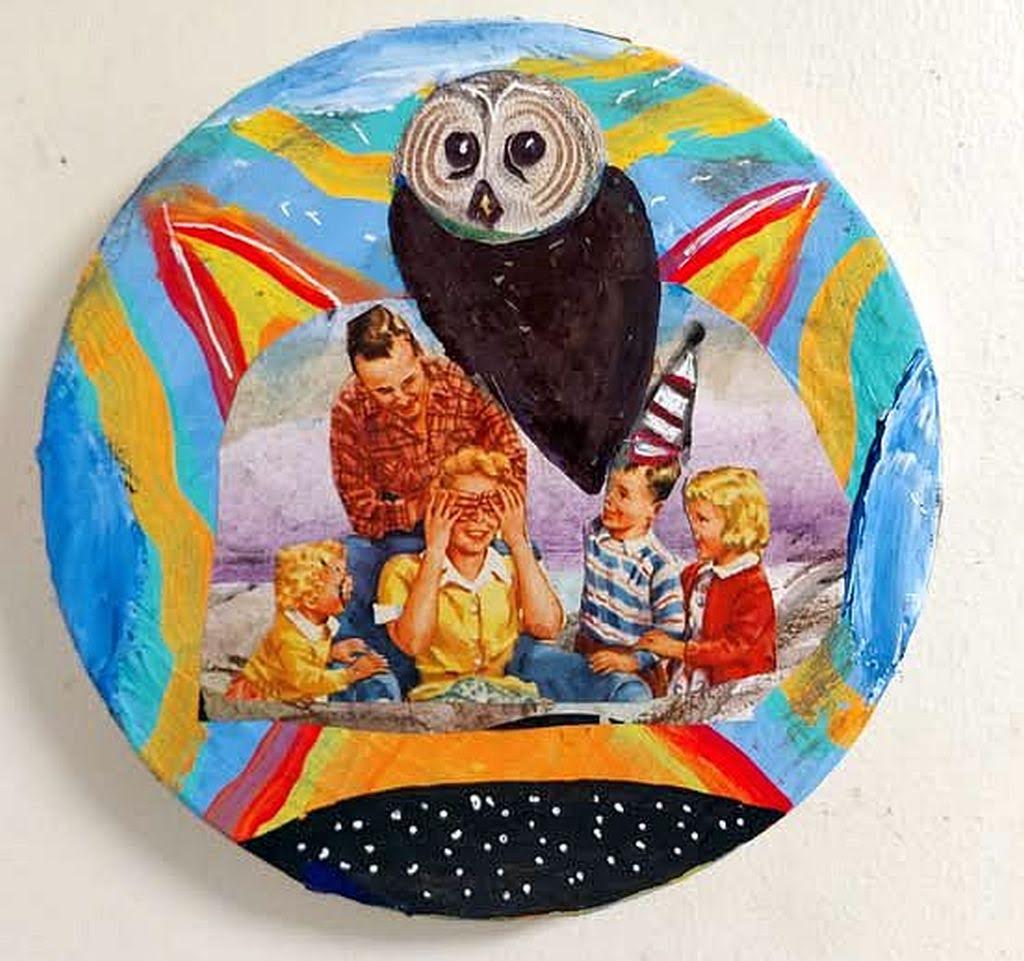 Vision Quest, mixed media on canvas, 8" diameter
EV: Happened again. But you just pulled the name out of a hat?
RG: Well, I knew who Andre Breton was.
EV: So you chose that...
RG: Right. Better than Merleau-Ponty. [laughter]
EV: Oh yes, perfect, So you got to look at everyone's work through that scope of dreams or something.
RG: Yeah, and since I was a surrealist I could say anything, right?
EV: Yeah.
RG: Which is, like, a great gift rather than having to, pretend I'm Wittgenstein or something.
EV: Sure. Yeah. And I also know just from our own conversations that, uh, that you met a lot of the original Beats when you were...
RG: I went to Naropa, in Boulder, Colorado. I guess, 1989, 1990, uh, Jack Kerouac School of Disembodied Poetics, Summer Intensive.
EV: What year was that?
RG: It was, like, ‘89?
EV: Mm hmm.
RG: Super hot, but, um... Ginsberg was there, Burroughs, Michael McClure, Diane de Prima, uh... Poetry morning and night 100 degrees every day. Beautiful young people from all over the world. Yeah, it was pretty intense.
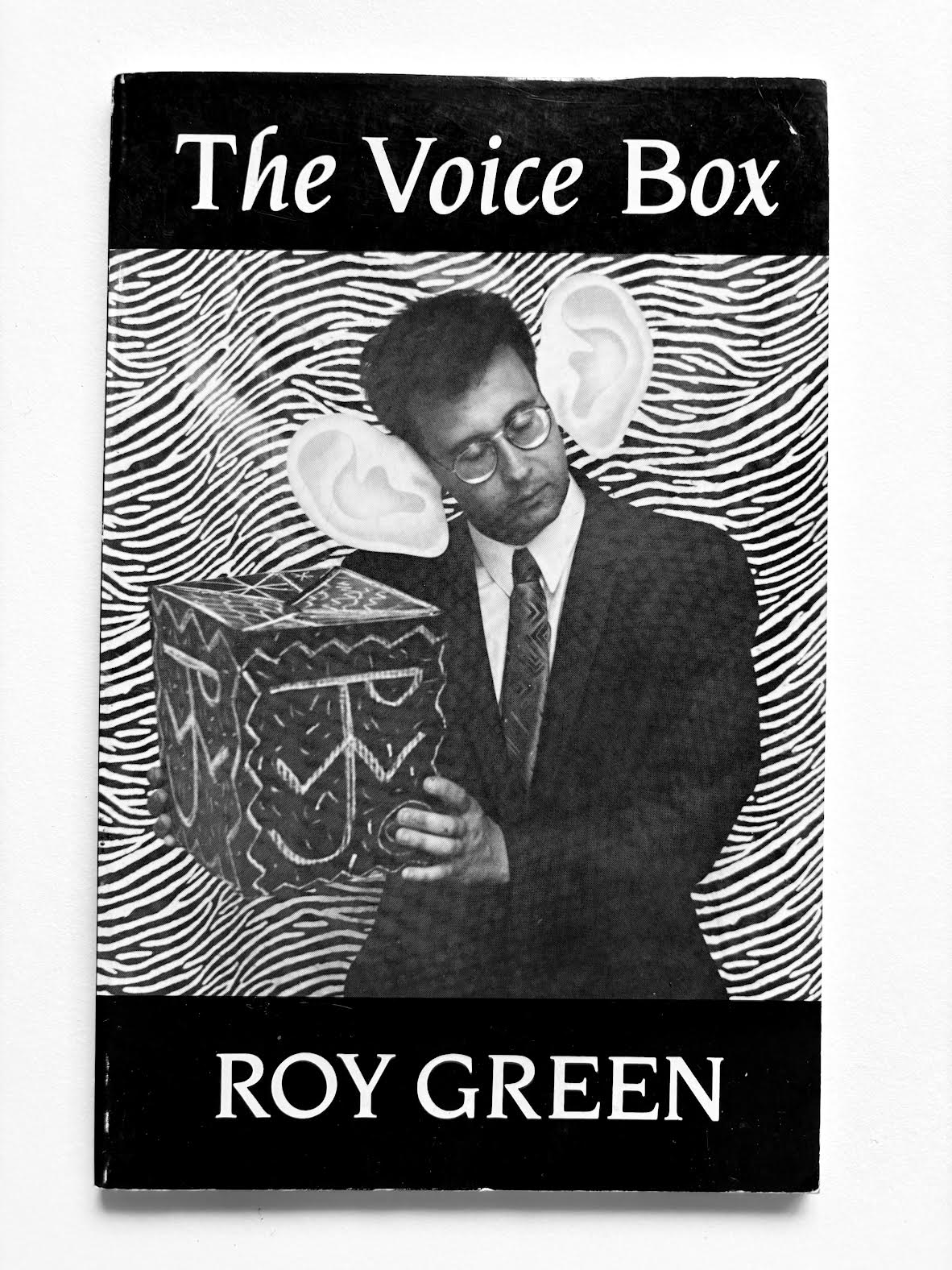 The Voice Box, Book of Poetry by Roy Green, 1989
EV: In what way does that continue to inform your work or what effect do you think it's had on how you work?
RG: Um...
EV: If any.
RG: I would say I'm, uh... familiar with a lot of Buddhist teachings. Mostly, like, Tibetan Buddhism, and I would investigate it all. Longer than I've been painting.
EV: Yes, okay.
RG: So I've been, like, meditating every day for, like, 50 years. So, it's not about meditation. It's not specifically about the mantra or practice. It's more just, it gives you, like, access to creative joy, I guess. And also, it gives me some silence, which is like the total opposite of these works. Right? But I sort of have to have that meditation to have, you know, a sort of blank mind before I can fill it up.
EV: Mm hmm.
RG: Empty the cup, right?
EV: Yeah, well, that sort of resonates with a lot of those Beat artists who were far from what we would associate with, like, serene...
RG: Yeah.
EV:... you know, they were navigating, uh, chaotic lives and artistic practice...
RG: Especially somebody like Herbert Huncke.
EV: Right.
RG: Or Harry Smith...
EV: But, like, you're saying, also, most of them were, in one way or another, investigating different streams of spirituality
RG: Yeah, and, um... Psychedelics, meditation, and I think also the, ah...in art school, I had a great mentor, Gary Lee-Nova.
EV: Oh, yeah! I know his work...
RG: He was kind of like the collage king of Vancouver in the '60s. He was my semiotics teacher. So he was like, Here's a book on Joseph Cornell. Here’s a book on Burroughs and Brion Gysin. So I started doing cut-ups. Like, National Enquirer magazines, and that went to me performing these cut-up poems.
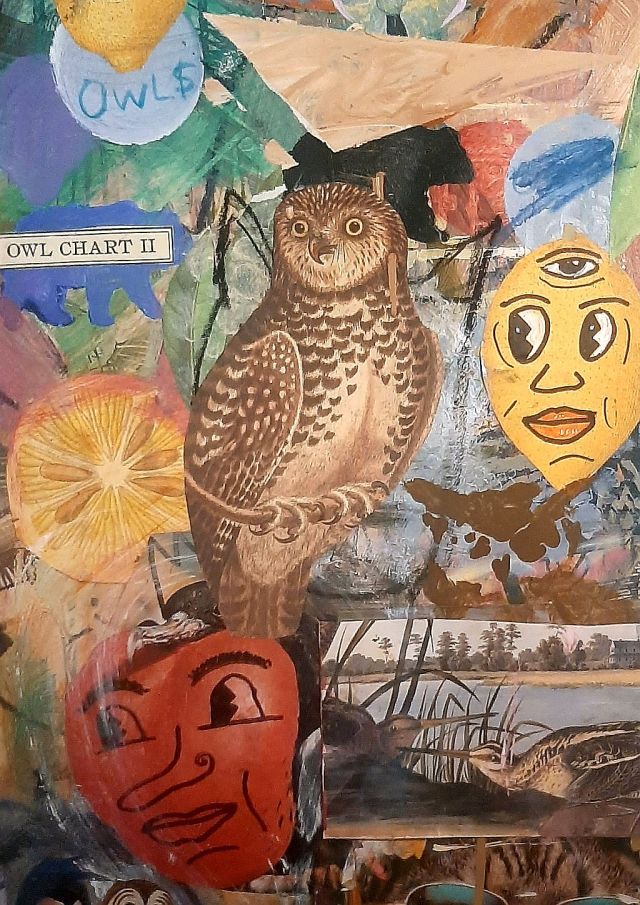 Owltopia (detail), mixed media on wallpaper, 27" x 60"
EV: Right. Well, I remember first encountering your work when I was around 16 and probably 1996 at the Victoria Art Gallery. And that's the same time I encountered Noah Becker's work, and maybe starting to see Herbert Siebner and some of the older generation.
RG: Right.
EV: So I was just starting to tune into art in the city, regional artists, and outside of what I'd been into before then, you know, comic books, and what have you.
RG: Yeah
EV: And yours stuck out and still does, for the same kind of reasons that, uh, sometimes in Victoria, it seems like you're seeing either sort of genteel... artists, the old model, or if it's contemporary art, it often can be sterile, academic art...
RG: Smart Art.
EV: Yes, and yours stuck out because it was...even though I was a lot younger, you could tell that it was informed by art history, but not bogged down by it...
RG: Yeah.
EV:...It had a playfulness...for me as a 16 year old encountering art possibilities...
RG: Right.
EV: Yeah, yours was one of a small number of artists that showed more...it was serious, but it had play...
RG: Yeah. Uh-huh, and I like to play with that... serious, but non serious, absurd, I guess, and, you know, studied photography in the '80s in Vancouver, was heavily, you know, Jeff Wall, Rodney Graham, Ian Wallace who was my art history teacher, it was very serious.
EV: Couldn’t be a further stream from your kind of mode, really?
RG: Yeah, it was, like, very much into, like, the appropriated image, and Richard Prince, Barbara Kruger, all that stuff was, like, really big, right? And I just found photography was kind of a dead end, and also extremely expensive to do large coloured prints once you're out of art school. So I still did photography, showed in galleries in Vancouver and then met people who were in the Grunt gallery, and the Helen Pitt Gallery, and that was much more of a downtown East Side, collage, garbage, dumpster diving, aesthetic, very kind of like Rauschenberg. And people who really are not reading Walter Benjamin, right? They're going to punk rock shows and having spontaneous events. And there's a big overlap between the music scene, the poetry scene and the art scene. So I think I've always preferred the company of poets or musicians rather than artists, because it's more collaborative, more celebratory, rather than let's crack these books on theory.
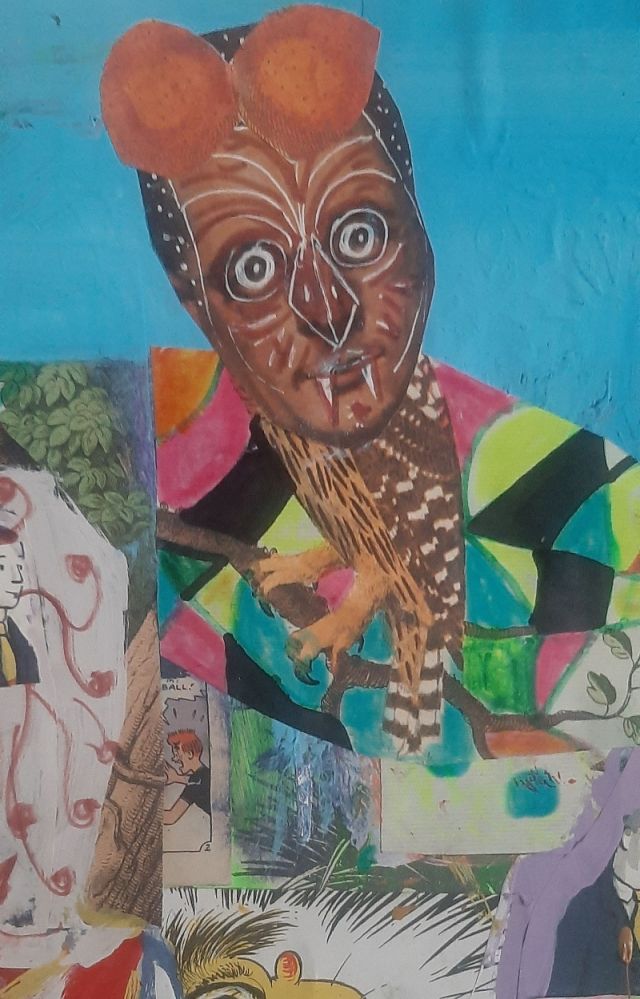 Owltopia (detail), mixed media on wallpaper, 27" x 60"
EV: Do you think some of that, the way you describe Stereolab working, some of our talk about the Beats, and now what you're saying with music and performance, and the energies that accumulate, and those kind of scenes, do you think that can be seen in your visual language? Do you think painting can kind of approximate sound or try to play with things outside of static images?
RG: I think I probably do have a form of synaesthesia.
EV: That's what I'm wondering, yeah.
RG: And I know other artists who definitely have synaesthesia. I think a lot of painters have that... 'cause, you know, you're combining colours that are like chords or melodies. And, uh, and that's just my own electronic music, experiments under the name Apple Pipe, which is all, like, collage, stuff, you know, beats, some loops, and samples. So it's, you know, it's all me, whatever it is. It's all collage, whether it be poetry or performance. There's always disparate things happening. And I think the more disparate, the better.
EV: Do you leave the TV on when you're working on stuff? Or the radio?
RG: I usually like headphones on. Yeah. And, um... like these little ones, I do those during commercials of basketball games. So I have the headphones on, basketball game’s playing, I might have a recreational beverage. Got some chicken in the oven. So it's multitasking ADHD, you know?
EV: Yeah, 'cause, you know, I'm sure you know how, apparently, Basquiat would have four TVs on and a radio.
RG: Yeah.
EV: And a record playing, and be painting.
RG: Yeah.
EV: And, I mean, yeah, you kind of remind me of that with that informal kind of, I guess you could call it irreverent attitude to just, you're making, you're living, you're breathing, you're eating, you're listening, and you're painting.
RG: And my studio is my apartment.
EV: Yeah.
RG: So I can just wake up in the morning and look at what I’ve done. I have had the studios where I do, you know, commute, there, and back. But...
EV: Do you have a preference?
RG: I would like to have, like, a huge... giant studio, everybody would.
EV: Sure.
RG: I would like to... you know, oil paint on linen, right? But what do you do with them, right? As you get older, it's like, what? Where do these go?
EV: Sure.
RG: You know?
EV: And what's with the circular format? What are those about for you?
RG: I guess if we go back to the classical tondo, which was used for, like, portraits of the famous, and bucolic landscapes, and they're, they're just sort of, a challenge, 'cause there's no corners.
EV: Mm hmm.
RG: Right?
EV: Mm hmm.
RG: So I think the circles work...best if they do have an iconic image, and then stuff kind of swirling around them.
EV: Yeah, it's a different relationship to the edges, I guess.
RG: Yeah.
EV: And, I have to ask...tell us about owls?
RG: Owls...Well I've always done a lot of bird paintings. Years and years of bird portraits, bird people, hybrids, and... Since, you know, the good old days of ancient Rome and Greeks, you know, companions of Artemis and Diana, companions of Lakshmi, and then the kind of more sinister Bohemian Grove, conspiracy...owl...you know, that kind of, like, dark thing. I did, like, a giant owl painting,that I called New World Order a few years ago. And so I was kind of making fun of that dark conspiracy thing. I think in some cultures, if you see an owl it could be a harbinger of death, or something about to happen, but in other cultures, owls are like wisdom.
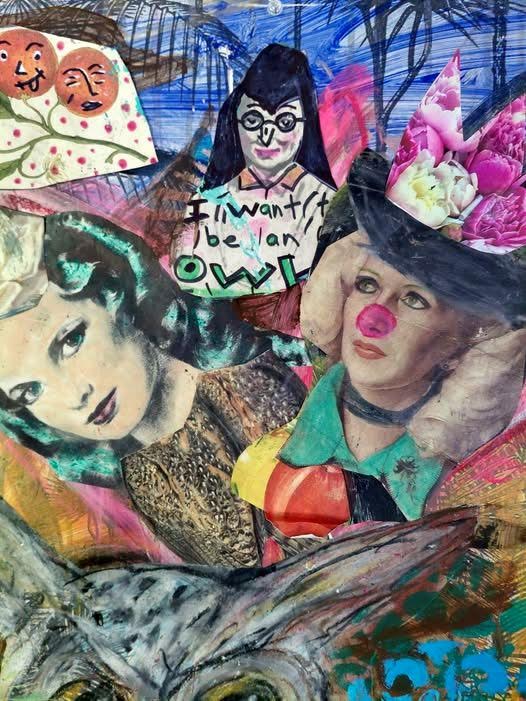 Owltopia (detail), mixed media on wallpaper, 27" x 60"
EV: Crows seem to have a similar kind of dichotomy or ambiguity, don't they?
RG: Yeah. I'm friends with a couple of crows, Larry and Willy...who I see every day. And there has been an owl serenading me at midnight in the woods beside my apartment. I can't see him 'cause it's dark, and he's in a tree, but there's something... uncanny about that hooting, you know?
EV: Why do you think...you're obviously fond of owls, why do you think people, or some cultures, project all this darkness onto the owl?
RG: Could be ‘cause of the swivelling head thing.
EV: Yes.
RG: It's perhaps supernatural.
EV: Yes.
RG: And the eyes, and...
EV: Very still and stoic.
RG: Still, stoic, silent, assassins of vermin.
EV: Yes. And Owltopia, so... that's a cool fusion word. Tell us about that.
RG: Um... I think I just like the way it looks and the way it sounds. Owltopia. You can put “topia” at the end of thing, and it sounds good. Like, Eriktopia, you know?
EV: Do you think... is art utopian for you?
RG: I think it's, maybe not...maybe not, utopian, but perhaps an antidote to our extreme dystopia.

Erik Volet
Erik Volet (b. 1980) is an artist based in the West Coast of Canada and is a member of the Inner Island Surrealist Group. He has shown in Canada, the United States and France. His primary focus is on painting and drawing. He has also produced and illustrated books, zines and has been active in outdoor mural painting. Influences which continue to be important to his process of art making are early twentieth century art movements, comic book art, graffiti, and an ongoing engagement with Surrealism. https://www.erikvolet.com/ https://www.instagram.com/erikvolet/
view all articles from this author