Whitehot Magazine
August 2026
"The Best Art In The World"
"The Best Art In The World"
August 2026
"Agency within Objecthood": A conversation about embodiment and creation with artist Andrius Alvarez-Backus
 Photo of Alvarez-Backus's exhibition.
BY EMMA CIESLIK March 19, 2026
This past February 21st, Eli Klein Gallery opened Andrius Alvarez-Backus’s solo exhibition “I Want to Know, I Need to Know.” Alvarez-Backus is an interdisciplinary artist working in sculpture, drawing and painting, who explores everyday object’s associations with and as allegories of intimacy, embodiment, and memory through mixed media assemblage. In this exhibition, he dissects a series of health issues experienced by the artist and his family over the past year through six major multimedia sculptures and works on panel.
Created during his current residency at Smack Mellon, these works of art explore the dichotomy--false and true--of kinship and separation through the lexicon of surgical medicine. And also how in opening ourselves up and exploring our own flesh and blood, we often come to more questions than answers. Works on display investigate dissection, incision, suturing and grafting as conduits to understand relationships with our families and our bodies--whether scars can be both evidence of trauma and healing. After the show opened, I sat down with Alvarez-Backus to learn more about his artistic practice and the intersectional impact of his art.
Emma Cieslik: Would you mind introducing yourself however you feel comfortable?
Andrius Alvarez-Backus: My name is Andrius Alvarez-Backus. I use he/him pronouns, and I am an interdisciplinary artist working across sculpture, painting and drawing. I grew up in upstate New York and central Massachusetts before coming to New York City for college and grad school. Now I’m based in Brooklyn.
I’m an artist by choice but an Aquarius by birth. I often like to make work from, rather than about, my identity as a gay Filipino-American because I think often in mainstream art markets, queer artists of color are expected to explicitly picture their difference, or make legible their otherness, and so I tend to use to use abstraction and surrealism to challenge that expectation of hypervisibility.
It’s hard because sometimes visibility is the point and it’s powerful and impactful to be radically seen, and then other times, what’s kept private is most sacred in some respects. It’s definitely different strategies that I toggle between.
I’m also the communications director at Queer Art, which is a local nonprofit here in the city that connects and empowers LGBTQ artists across disciplines and generations.
Cieslik: You mention that these works explore you and your family’s medical issues over the past year. If you feel comfortable sharing, what happened and how is the art a reflection and examination of those experiences in the medical complex?
Alvarez-Backus: Yes, I myself have experienced a series of dermatological issues as well as a few incidents regarding my sexual health over the past year, and those moments definitely kind of gave shape to the embodied perspective that I brought to themes of vulnerability and mortality. But the main inspiration for the show was my mother, who last October was diagnosed with anti-MDAR encephalitis, which is an acute autoimmune disease where antibodies sort of attack the brain, causing a lot of inflammation, psychiatric illness symptoms, speech and memory issues.
It was a really terrifying time, but luckily my mother had a fantastic care team and made a complete recovery in the months since. But it was really an accelerated crash course in caregiving for my family, especially since my mother has always been kind of the one taking care of us my entire life. To have this reversal of caregiving was a really big paradigm shift for me and my whole family.
In those first few days of my mother’s health crisis, where we didn’t know what was happening, I remember this desperation to understand what was happening and to act, and I remember being so defeated and frustrated when that desperation was met with slowness, ambiguity, uncertainty, confusion, and bureaucracy in the medical complex system. Being met with all of that red tape was so incredibly frustrating for me and my whole family, and that primal desire to understand the complex environment that is our bodies is what drove the conceptual impact of the show.
Over the course of my own treatment and my mother’s treatment, I was overwhelmed with these scenes of clinical procedure, with environments of sterility and cleanliness, with really unfamiliar language that was being used to describe intimate parts of myself, and so that entire process is reflected in the exhibition from the transformation of the surgical into the sculptural, to a color palette informed by flesh and membranes, infection and warning, hospitals and clinics, and things like that.
 Photo of Alvarez-Backus's exhibition.
Cieslik: You also mention that your family are medical workers. How are their experiences of both witnessing and facilitating medical treatment and experiencing it reflected in your art?
Alvarez-Backus: I’m sure many members of the Filipino diaspora can relate to this lineage of medical practitioners. My grandfather was an orthopedic surgeon. My other grandfather was a pharmacist. Several of my aunts are nurses and physicians. My uncle is a surgeon. My sister is now in medical school, so the history of medical practice definitely runs deep in my family, and I’m very proud of that lineage.
Growing up around that language is what I believe led me to probe questions of the body and its maintenance now as an artist. The medical undertone in my practice brings a level of precision and organization in the formation of the work. But there also is this other side that is full of mystery and confusion and surrealism, especially in this show, that I think is attempting to highlight the reality that the body is never fully knowable, or transparent, that we will always be met with more questions and ambiguity the more we venture beneath the surface of our skins.
That degree of anxiety is what I gleaned from growing up around relatives both witnessing and facilitating medical treatment. They can know all of the science behind these conditions, yet that doesn't negate the very real emotions that come with confronting our fragility as humans. So I would say there is kind of a process-driven part of the work that feels very medical and meditative, but there’s this emotional undertone to the work that balances practice and care with anxiety, dread, and fear in that sense.
 Photo of Alvarez-Backus's exhibition.
Cieslik: As a disabled museum worker and frequent visitor, your work recalled Panteha Abareshi’s 2025 exhibition Careotics where medical objects puncture, retract, and tether the body to a medicalized system and the sterilized space of the gallery. There is an overt criticism or play surrounding medical processes in the show. How is this both traumatic and healing? How is the body--your body and that of your family--represented in this show?
Alvarez-Backus: I remember seeing images of Abareshi’s show, and I remember being quite moved by it. I really loved how they presented the body as this commodifiable, fetish object, and then how this state of objecthood in turn connects to themes around vulnerability and sexual currency. So that was definitely a big reference point in the show’s making.
A lot of the gestures in the show feature translated surgical gestures--dissection and resection, incision and excision, sutures and stitches. One of the paintings is heavily inspired by the color palette of x-rays and MRI imaging, and one of the sculptures features a cross-section of a human thigh. So there is an effort to remix or hybridize these clinical techniques and references into something more novel or even whimsical in a way. I think there’s a tinge of humor in the show, just to speak to that as a healing tactic, as a survival tactic, using humor and camp to combat the abject.
I never want to recreate the harm that inspired these works, in the works themselves. I’m fine with my pieces being born from a place of fear and trauma, but I ultimately want to transform them into moments of repair and remedy, something more optimistic in a way. I think that is where the “aesthetics” come into play, using beauty and seduction as visual tactics for healing. The viewer can sense a level of violence, but the overall impact is a positive one in my mind, and hopefully in the viewer’s mind.
All of the bodily fragments in the show are cast directly from my own body. I like using my body as both subject and instrument, often to conflate the roles of muse and maker, or I guess in this context, doctor and patient. I think there’s something so productive in the level of disembodiment that comes when one sees their form rendered beyond the boundaries of their body. It’s very surreal. It’s rendering yourself immortal in a way that you’ll never be. It’s kind of a fun yet disturbing rehearsal of disappearance. And then on another level, it’s a way to instrumentalize my form, to free myself from the essentializing burdens of being a subject and instead just exist as an object.
In centering what I call “thingness,” I hope to find an unexpected agency within objecthood, one that exists between agency and passivity in a way. I also see my own body as a vessel that contains the history of my family, and in that light, it operates as a corporeal metaphor for entire lineages and legacies. So rather than using my relatives' bodies, I prefer using my own as a proxy, or in some cases, found objects as surrogates for their experiences.
Cieslik: In this vein, you investigate everyday objects as affectors and things affected by our bodies, carriers and preservers of memory. How can and do these objects hold pieces or reflections of ourselves, as you explore in this show?
Alvarez-Backus: I am obsessed with things. I am a big fan of object-oriented ontology, object-attachment theory, writing about tchotchkes and trinkets and all things cute. In this show, I’m considering how fiercely and how easily we become attached to objects of comfort, and how they bear witness to some of the most important moments in our lives. I believe that just through sheer proximity, everyday objects become talismans, and so I’m invested in foregrounding that process in which things remember intimate histories.
I also like integrating family heirlooms into my work. Things that have been passed down between generations carry a more temporal significance, as if they themselves have survived decades of volatile conditions or oppressive systems. In this light, objects can also transmit latent stories of migration and legacy. I am really interested in highlighting that capacity of objects.
I think also what’s beautiful about things is that we each have subjective ways of relating to them. So when I put a disco ball in the exhibition, it’s my way of paying homage to a very special memory during a special time with a special person, but the viewer will ascribe their own projections onto that very same disco ball and bring with them their own conceptual baggage and poetic associations. I’m really fascinated by the capacity of this simple, glass-tiled sphere of foam to evoke all of these narratives and allegories just simply by being.
I think that’s why I’m drawn to sculpture, because it is this dimensional encapsulation of objects as markers, as signals, as metaphors.
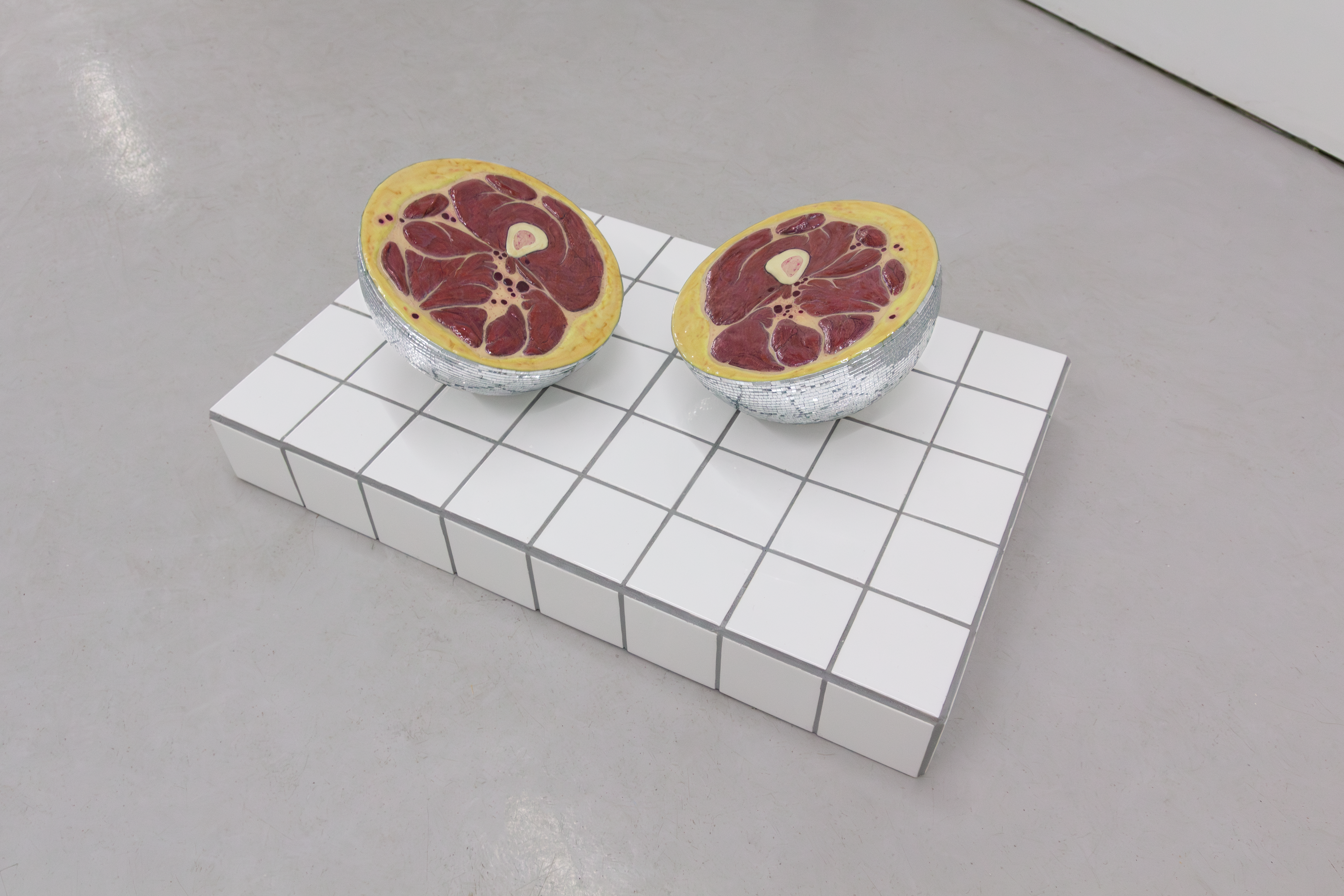 Photo of Alvarez-Backus's exhibition.
Cieslik: What does the process of identifying, collecting, and assembling found objects look like for you? How are they transfigured under your care?
Alvarez-Backus: Hunting for objects is becoming a more and more significant percentage of my practice these days. You’ll often find me lurking in scrapyards, junkyards, dumpsters, thrift stores, stoop sales, or my parents’ basement. This city [New York City] is the best city for found object users, because even just things left on the street have such a magical quality to them. People will throw out literally anything, which is wonderful, so I’m searching and searching for objects with some kind of spiritual charge. More often than not, I don’t immediately understand why they resonate with me.
I have to just trust my instinct, that one day it will work itself into a composition, and this usually doesn’t happen for months or even years. It requires a lot of patience and willingness to listen to these relics and not force them into an uncomfortable arrangement.
I made a piece that used these two garden sculptures that my great-uncle brought over from the Philippines before I was born. They stood outside of my home for my entire life and my mom was going to get rid of them, and I was like, ‘no, I’ll take them,’ and I used them in a sculpture, so these things are older than me. They’ve preceded my birth and now they’re in my studio. Now, I’m guarding them in a strange role reversal.
When it comes to transfiguring them, it really depends on the project. Sometimes, I want to center the past life of an object, so not much handling is really required, but other times, I want to queer its intended purpose, or treat it against the grain of its prescribed use value. In those instances, I’ll intervene. So I’ll cut and I’ll graft it onto something, or I’ll mold it and cast it in another material, I’ll bring it into conversation with another object from a different world to create some kind of new dialogue. It almost feels like I’m the steward or the caretaker for these objects, just searching for a new life to give them in the studio. It’s definitely a long and intuitive process. I’m still learning how to trust that muscle when it comes to using these objects.
Cieslik: What do you envision for the future of your work surrounding medical care and dissection, resection, and suturing of found objects together--physically and metaphorically?
Alvarez-Backus: Because my own form is directly referenced in the work, I think my relationship to the art will change drastically over time. These casts act as documents and records of this particular moment in my life, and I’m sure as I myself age and my body evolves, I’ll look back on this body of work as sort of an uncanny time capsule.
But in a more universal sense, I hope viewers kind of walk away from the show being more attuned to the ways in which our bodies need careful effort to be maintained. I hope they pay attention to the ways in which they’re constructed and disciplined through material culture and object attachment, and I also hope they have a greater appreciation for the collaborative nature of individual health and collective wellbeing. It takes a village. I hope I’m able to give them more of an acceptance of the body’s unpredictability and mystery, and reframe it into something beautiful and not something that should be feared.
“I Want to Know, I Need to Know” will run through May 9th, 2026 at the Eli Klein Gallery.

Emma Cieslik
Emma Cieslik (she/her) is a queer, disabled and neurodivergent museum professional and writer based in Washington, DC. She is also a queer religious scholar interested in the intersections of religion, gender, sexuality, and material culture, especially focused on queer religious identity and accessible histories. Her previous writing has appeared in The Art Newspaper, ArtUK, Archer Magazine, Religion & Politics, The Revealer, Nursing Clio, Killing the Buddha, Museum Next, Religion Dispatches, and Teen Vogue
view all articles from this author