Whitehot Magazine
October 2026
"The Best Art In The World"
"The Best Art In The World"
October 2026
Where the City Slips from View
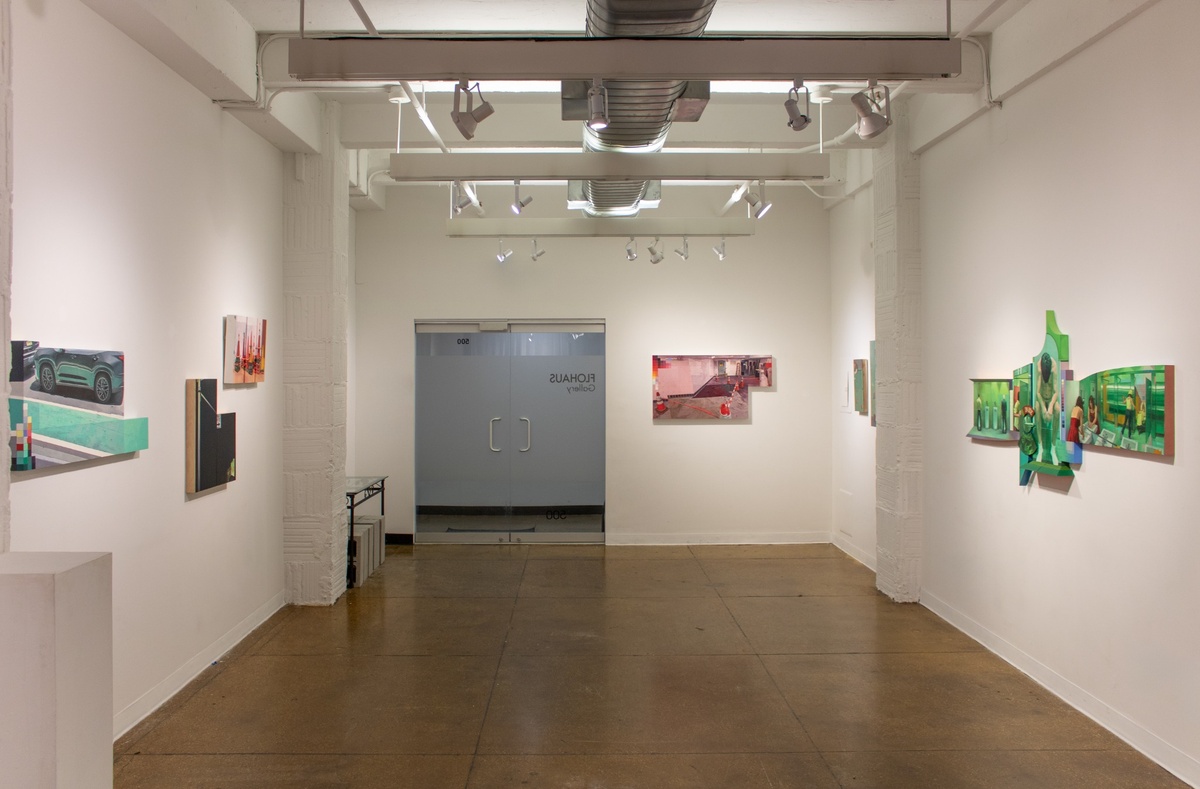 Installation View of Side Glance. Courtesy of the artist and FLOHAUS Gallery.
By SHUHAN ZHANG August 17th, 2026
Once, I lost my car in an underground parking garage. When the elevator doors opened, I saw the same gray columns, low ceiling, fluorescent lights, and arrows pointing in different directions. I remembered passing several traffic cones and vaguely recalled a blue sign, yet I could no longer tell whether I had already seen them. At every turn, I thought I was getting closer, only to enter another nearly identical section. Even after finding the car, I could not reconstruct the route I had taken.
Public restrooms, elevators, subway passages, parking garages, and construction zones receive countless bodies each day, yet they rarely remain in memory as complete images. We recognize their signs, fixtures, and rules of movement, and we know how to behave within them. Describing what these spaces actually look like, however, can be surprisingly difficult. They appear briefly as we pass through and quickly recede once we leave.
From August 19 through August 26, 2026, FLOHAUS Gallery presents Side Glance, Jarvis Hua’s debut solo exhibition in New York City. Bringing together paintings completed between 2024 and 2026, the exhibition traces Hua’s sustained investigation into overlooked urban spaces and the ordinary movements that shape everyday life. FLOHAUS selected Hua for a solo presentation in recognition of the maturity and distinctiveness of his practice. His engagement with neglected urban environments, together with his use of fragmented compositions, shifting perspectives, and multi-panel structures, gives his work a distinctive position within contemporary painting and introduces a critically engaged perspective to the gallery’s program. Through these formal strategies, Hua examines perception as an experience continually shaped by bodily movement and changing viewpoints.
The title Side Glance suggests a brief, off-center mode of looking. While walking, the eye sweeps across a street corner, a piece of maintenance equipment, or a fragment of architecture. The gaze may last only a moment, yet certain shapes, colors, and distances remain. Hua’s paintings begin with these incomplete impressions. Toilets, traffic cones, parking garages, and anonymous architectural structures recur throughout the exhibition, bringing the urban background into focus.
Anthropologist Marc Augé used the term “non-place” to describe airports, highways, hotels, and transit hubs structured by circulation, waiting, and temporary occupation. Hua brings this idea into the field of perception. His paintings consider how such environments enter vision and slip from consciousness just as they begin to become legible. Everyday objects retain traces of their functions while their practical context is suspended, leaving them somewhere between utility, form, and gesture.
In Three Magi (2024), three toilets occupy an almost entirely dark setting. Arranged at the center of the composition, they emerge under limited light. The religious association suggested by the title sits uneasily beside the ordinary function of the objects. Humor appears through this displacement, then gives way to a more complicated emotional register. Toilets belong to one of the body’s most private activities, yet here they are displayed with the solemnity of an altar arrangement. Once their function pauses, their volume, outlines, and spatial relationships begin to command attention.
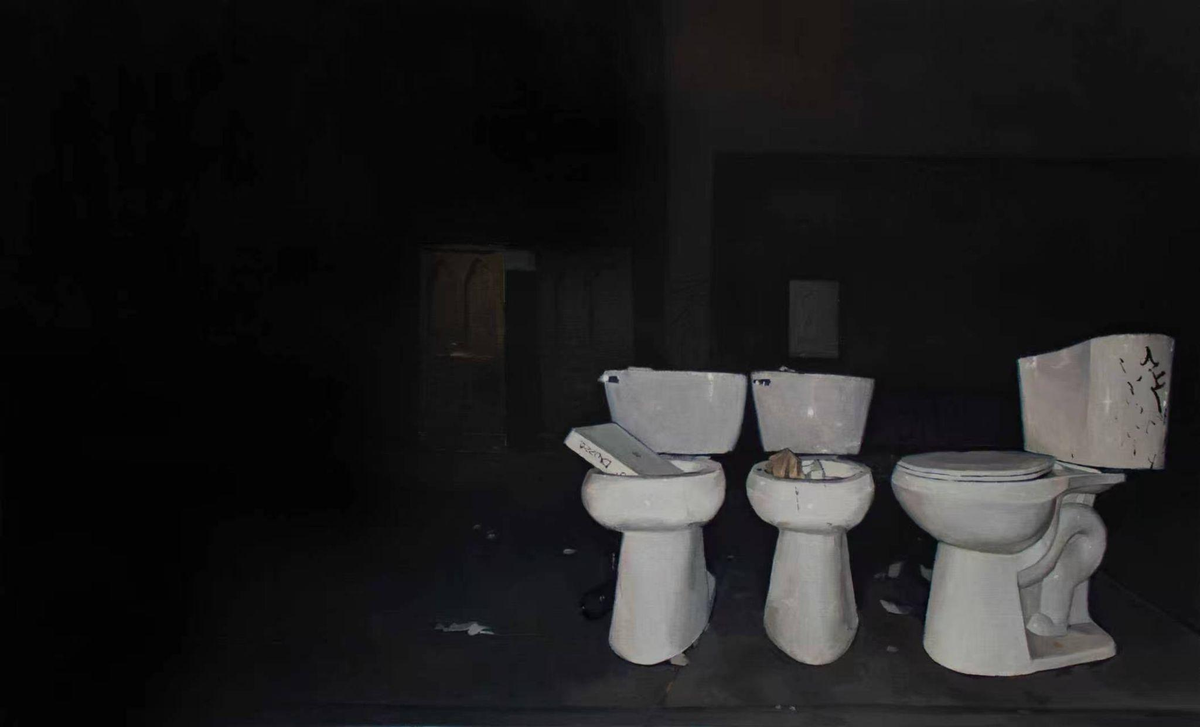 Jarvis Ruoxi Hua, Three Magi, 2024. Courtesy of the artist. © 2026 Jarvis Ruoxi Hua.
This incompleteness also enters the physical construction of Portrait of Mme. H Flower in the White Room (2024). The work consists of connected pictorial units that differ in scale and direction. A figure, a public restroom, and sections of an interior are dispersed across adjoining surfaces. The viewer moves between these fragments, trying to understand how the space fits together. The title presents the work as a portrait, though the figure remains inseparable from the surrounding environment. Her presence develops through stalls, fixtures, colored planes, and the seams between panels, then disperses through those same structures.
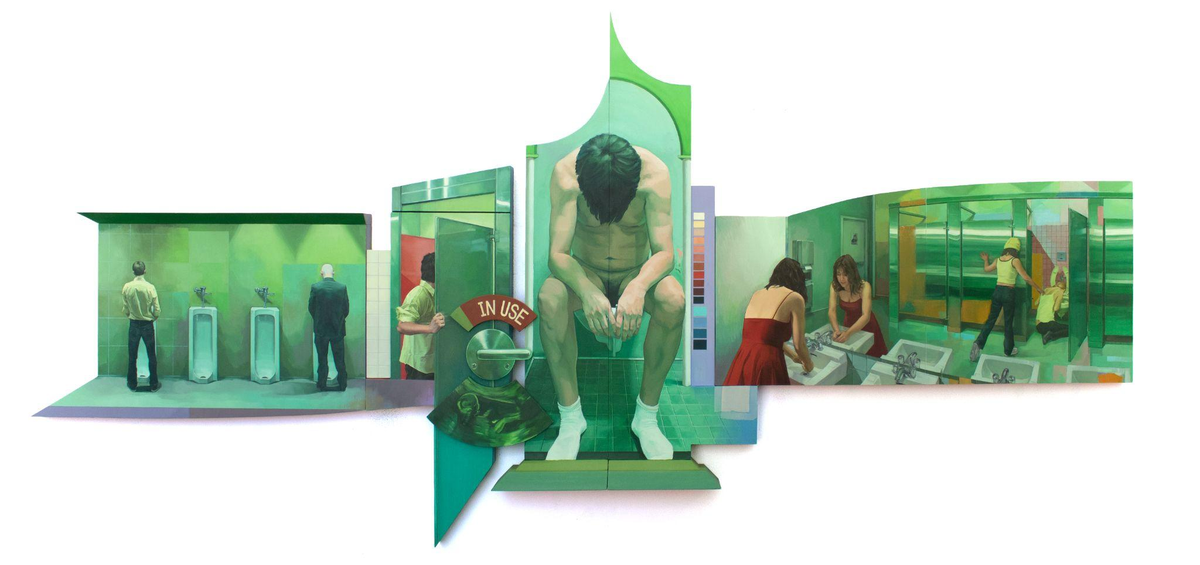 Jarvis Ruoxi Hua, Portrait of Mme. H Flower in the White Room, 2024. Courtesy of the artist. © 2026 Jarvis Ruoxi Hua.
This displacement forms a central viewing mechanism within Side Glance. The exhibition’s engagement with parallax refers to the apparent change in an object’s position when the viewer’s vantage point shifts. Moving closer, stepping back, and shifting sideways all affect the apparent coherence of Hua’s paintings. Works constructed from multiple wooden panels resist a single position from which the whole composition can be mastered. Each angle offers partial information and exposes another rupture. Viewing develops through continuous adjustment, with the viewer’s movement participating directly in the formation of the image.
Maurice Merleau-Ponty describes the body in Phenomenology of Perception as the primary means through which we enter the world. Vision involves an ongoing negotiation between body and environment. Hua’s cropped images, panel seams, conflicting perspectives, and missing information slow recognition. In daily urban life, habit directs us efficiently: an arrow prompts a turn, a traffic cone redirects a path, and a restroom stall organizes movement. Such efficiency pushes the environment to the edge of attention. Side Glance interrupts this automatic mode of looking and returns time to objects usually consumed by their functions.
Within the exhibition, the non-place becomes an environment awaiting sustained attention. Reflections from overhead lights, distances between fixtures, and arrangements of traffic cones record how the city operates and how bodies pass through it. We may remain unable to recall the complete structure of a parking garage or the color of a particular public restroom. Forgetting creates the conditions for looking to begin again. Hua’s repeated and difficult-to-locate spaces reveal how rarely reality arrives as a complete image. It is divided through walking, rearranged through looking back, and reconstructed through memory. Side Glance holds open the brief interval before these environments disappear once again, allowing the city to move from background to image and the act of passing through to become a way of seeing.

Shuhan Zhang
Shuhan Zhang is a curator and writer based in New York. Her work focuses on contemporary art, digital culture, and the politics of exhibition-making.
view all articles from this author