Whitehot Magazine
October 2026
"The Best Art In The World"
"The Best Art In The World"
October 2026
When the Internet Begins Dreaming for Us
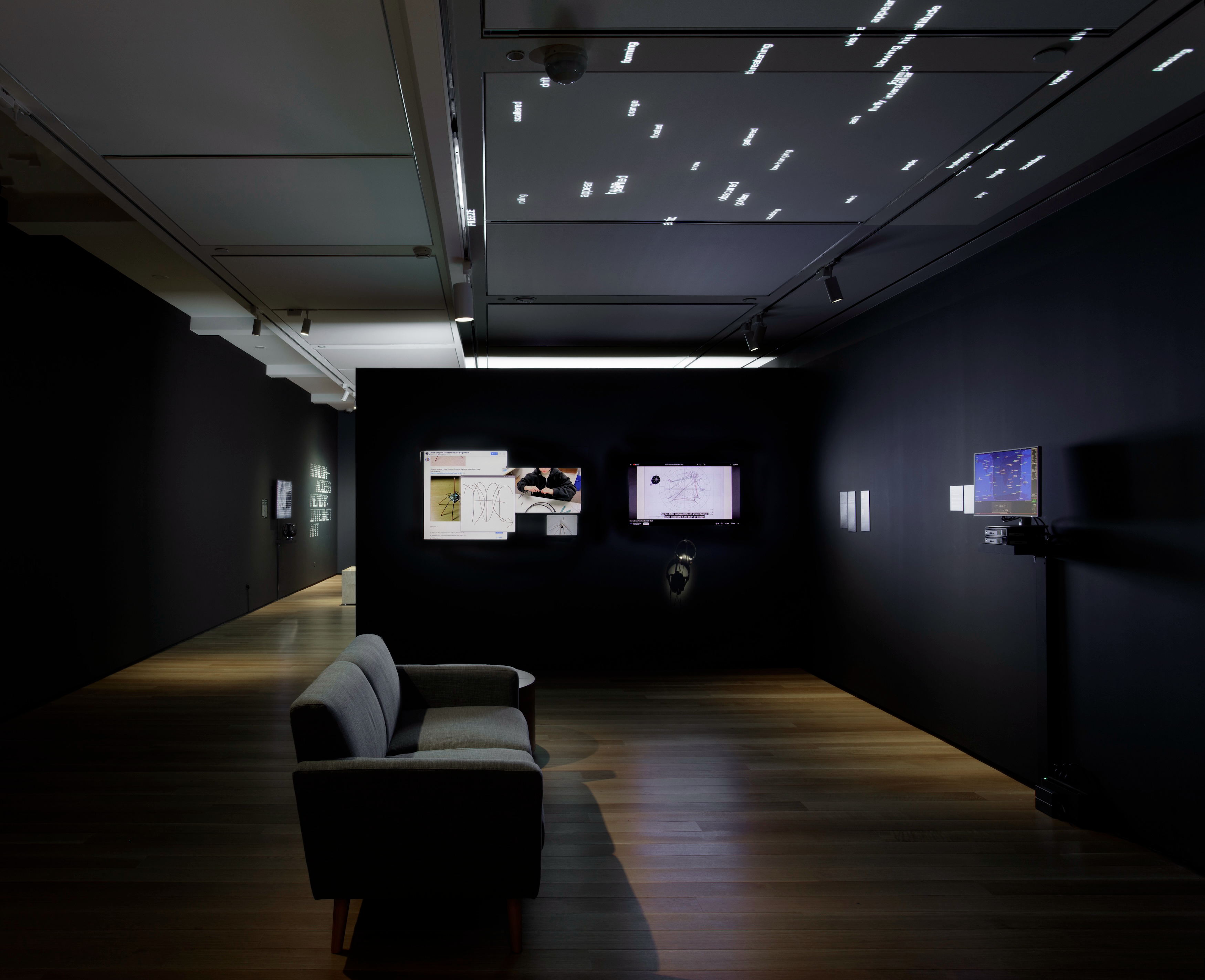 Installtion view of RANDOM-ACCESS MEMORY: Internet Art. Photo by Brian Forrest. Courtesy of the artist and Santa Barbara Museum of Art.
By SHUHAN ZHANG May 31st, 2026
The first thing I felt upon entering RANDOM-ACCESS MEMORY: Internet Art at the Santa Barbara Museum of Art was not familiarity, but a strange sense of weightlessness. The gallery was dark. Cold light from screens flickered slowly from different directions, words drifted across the ceiling, and faint sounds from the artworks could be heard through headphones. Interfaces, tutorial videos, stock footage, satellite data, and YouTube imagery, all of these belong to the most ordinary structures of contemporary information culture. Yet once relocated into the exhibition space, the internet no longer appeared simply as a tool, but rather as a perceptual system slowly absorbing reality itself.
 Installtion view of RANDOM-ACCESS MEMORY: Internet Art. Photo by Brian Forrest. Courtesy of the artist and Santa Barbara Museum of Art.
French philosopher Bernard Stiegler once described digital technology as a form of “tertiary memory”, a condition in which human beings increasingly outsource experience, time, and perception to technical media, while those same media simultaneously reshape the structure of human consciousness. The internet does not simply store information; it gradually becomes a system that remembers for us, sees for us, organizes emotion for us, and even imagines the future on our behalf. What makes RANDOM-ACCESS MEMORY particularly compelling is that it does not treat the internet as a “virtual space.” Rather, it understands it as an infrastructure already embedded deeply within reality itself: at once archive and ruin, connection mechanism and machine of distortion.
Claire Hentschker’s Ghost Coaster: The Star Jet Coaster, 2002–2012, may be the work that comes closest to what might be called “internet nostalgia.” Using surviving ride-through screenshots found on YouTube, Hentschker reconstructs a roller coaster that no longer exists. Because photogrammetry depends on large amounts of complete visual data, the missing information causes the reconstructed environment to collapse into glitches, ruptures, and blurred geometries. Tracks melt. Architectural edges dissolve like fading memory. What makes the work so moving is not that it successfully “rebuilds” the coaster, but that it reveals how digital preservation is itself a form of continuous degradation. The internet is never a perfect archive. It is closer to a collective ruin, constantly compressed, uploaded, overwritten, and forgotten.
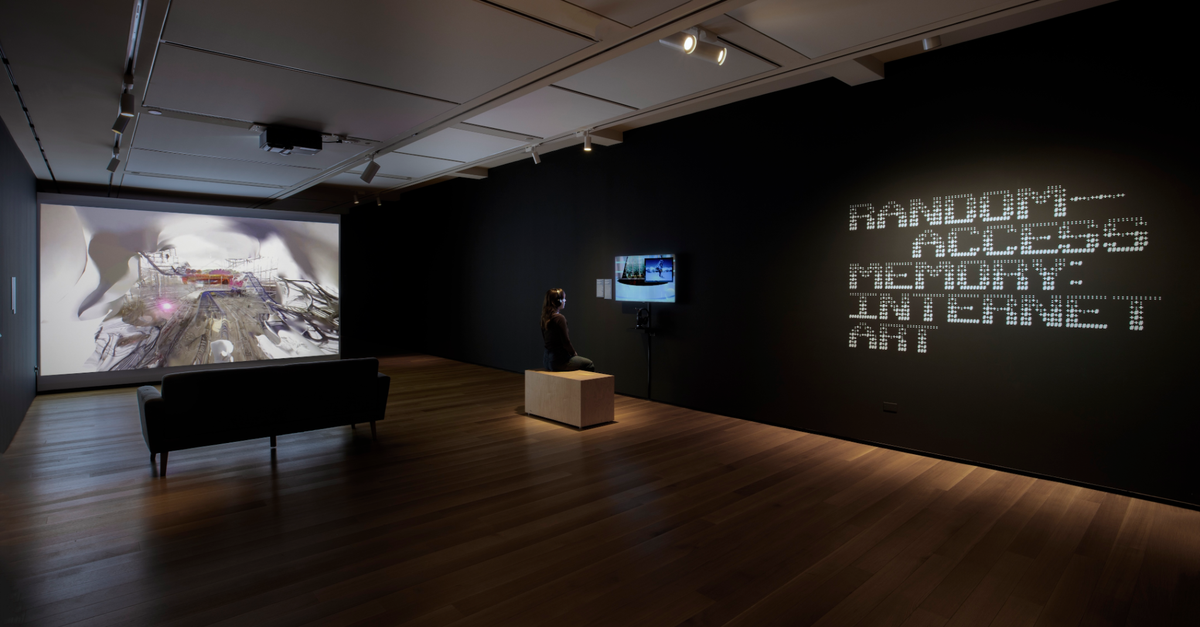 Installtion view of RANDOM-ACCESS MEMORY: Internet Art. Photo by Brian Forrest. Courtesy of the artist and Santa Barbara Museum of Art.
Andrew Norman Wilson’s Global Countdown presents another face of the internet: one emptied by the automated logic of media systems. News footage, countdown graphics, background music, and stock imagery loop endlessly, yet almost no actual “event” ever occurs. As the artist has noted, the piece resembles “a news broadcast without humans.” Today, we are surrounded by information at all times, yet information itself increasingly drifts away from lived experience. Wilson does not directly critique the media. Instead, through repetition and visual rhythm, he allows viewers to recognize that the internet’s promise of “real-time” connectivity often functions less to bring us closer to reality than to maintain a permanent state of attention, a condition of endless updating.
Yet the work that held me the longest was Zhanyi Chen’s. If the previous artists examine how the internet stores, circulates, and produces information, Chen seems more interested in reviving a far older human impulse: the desire to establish contact with something invisible.
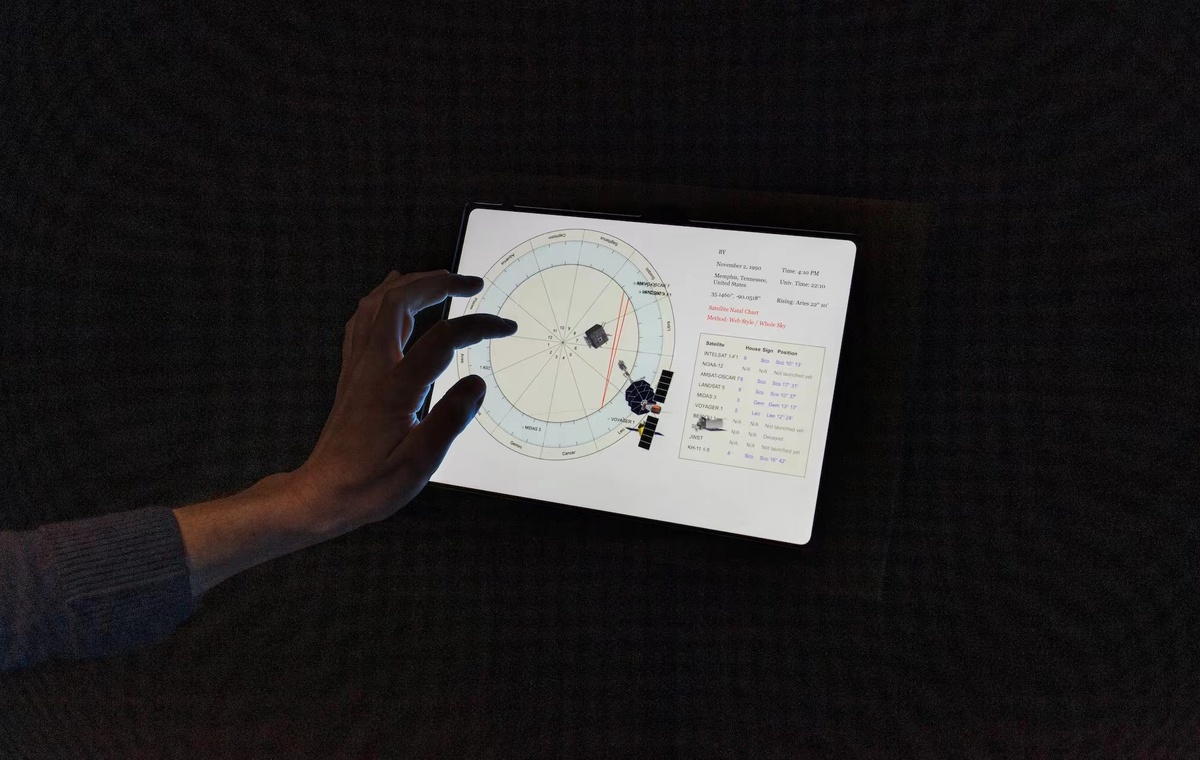
How to Create Your Satellite Birth Chart unfolds in the familiar language of an online tutorial video. The tone, interface, and pacing resemble the astrology content that saturates today’s digital platforms. But instead of calculating celestial constellations, Chen maps the positions of satellites. At first, the work appears humorous, a pseudo-astrological system built from technological infrastructure. But gradually, it becomes clear that the work is not really about whether divination is “real.” Instead, it asks why human beings continue to need divination in the first place.
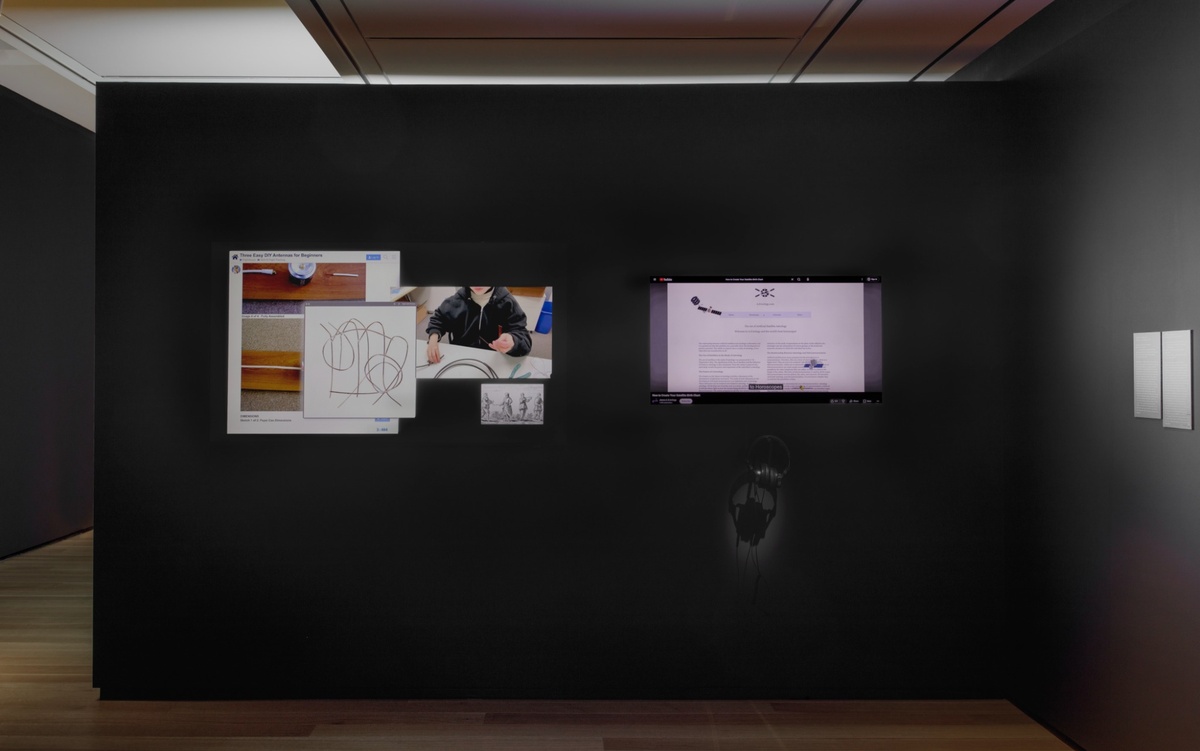 Zhanyi Chen, How to Create Your Satellite Birth Chart (from Artificial Satellite Astrology) (still), 2025. Dual-channel video: 13:36 minutes; 03:53 minutes. Courtesy of the artist.
Astrology has never merely been about predicting the future. It functions more as a narrative technology: by linking distant, invisible, untouchable systems to human destiny, it allows people to locate themselves within a larger cosmic order. Ancient societies looked to stars to understand fate. Today, our lives are equally shaped by another system suspended above us; satellites determine navigation, weather forecasting, communication, financial transactions, positioning systems, and data transmission. They have already become indispensable infrastructures of contemporary life. The difference is that modern technologies are designed to disappear. The more stable they become, the less visible they appear.
What Zhanyi Chen does is make those invisible structures perceptible again. The artist has spoken about how the work emerged from her own long-term practice of tracking satellite positions and receiving their data transmissions. Through that process, she gradually developed an unexpected intimacy with infrastructures originally designed to remain unnoticed. The sensation is subtle but uncanny: you know these are merely signals, trajectories, and data streams, yet over time they begin to feel almost celestial, as though they are quietly participating in human emotion, temporality, and everyday life.
Bruno Latour once criticized modernity’s insistence on separating rationality from myth. Modern societies, he argued, never truly eliminated mythology; they simply concealed it inside increasingly complex technological black boxes. In this sense, contemporary dependence on algorithms, satellites, and data systems may not be fundamentally different from earlier forms of belief in stars, omens, and prophecies. Human beings continue searching for signs, order, and meaning within systems they cannot fully understand.
That atmosphere becomes even more pronounced in Astrological Concrete Poetry to Clouds Written by Weather Satellites. Real-time satellite data is transformed into drifting words projected across the ceiling. Terms such as rolling, drift, appear, and reflect slowly move through the darkened gallery like fragments of weather or incantations. They no longer function fully as language or information. Instead, they resemble omens suspended in space. Sitting beneath them, viewers gradually begin to feel as though the exhibition itself has become a form of divination ritual.
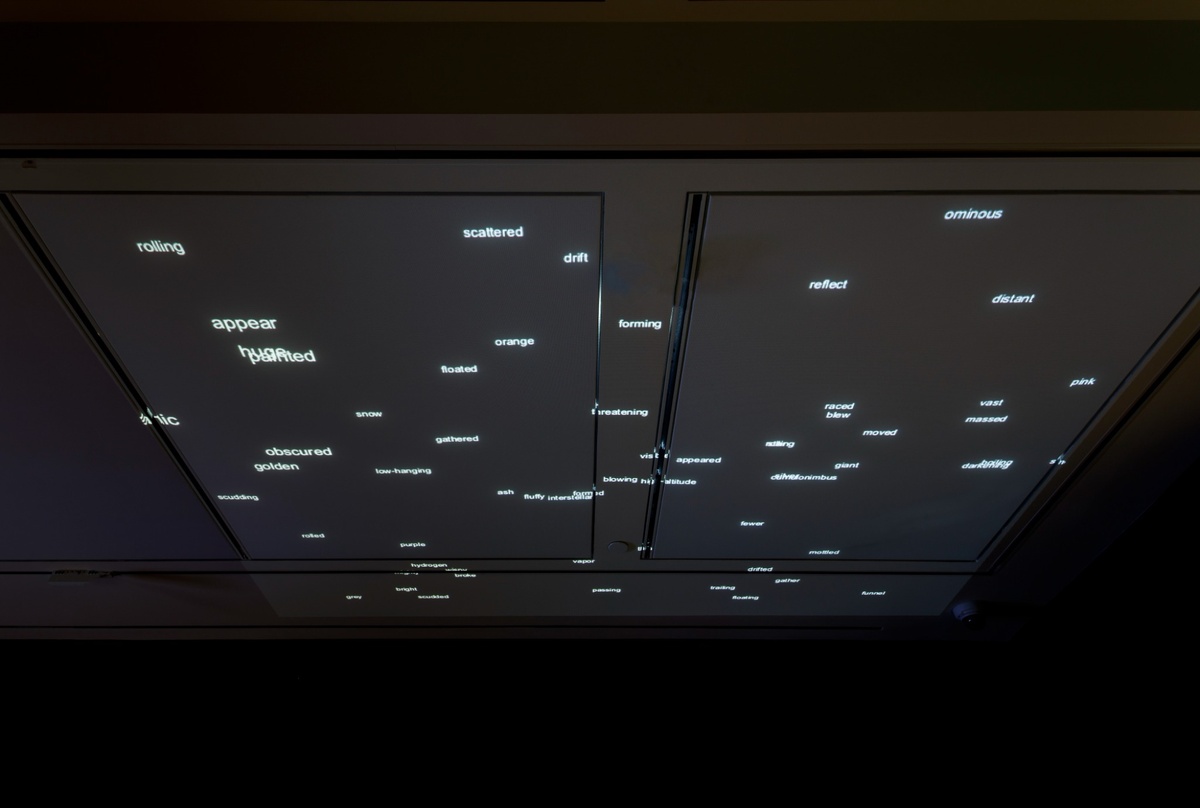 Zhanyi Chen, Astrological Concrete Poetry to Clouds Written by Weather Satellites, 2020. Projection. Courtesy of the artist.
Most importantly, Chen avoids presenting technology through the familiar language of futurist spectacle. Instead, she returns it to something closer to mystery. In her work, data is no longer simply a mechanism for calculation, prediction, or control. It becomes a medium capable of producing attunement and care.
This gives her practice a remarkably rare quality: it is deeply concerned with the internet, yet it also feels ancient. It speaks about infrastructure while simultaneously proposing a new cosmology. Satellites cease to function merely as machines and begin to resemble a new constellation system. Contemporary society may no longer look upward toward the night sky in the same way, yet we continue to live beneath another kind of atmosphere, one composed of signals, data, and orbital trajectories.

Shuhan Zhang
Shuhan Zhang is a curator and writer based in New York. Her work focuses on contemporary art, digital culture, and the politics of exhibition-making.
view all articles from this author