Whitehot Magazine
October 2026
"The Best Art In The World"
"The Best Art In The World"
October 2026
What Continues Growing Inside the Body
By SHUHAN ZHANG May 24th, 2026
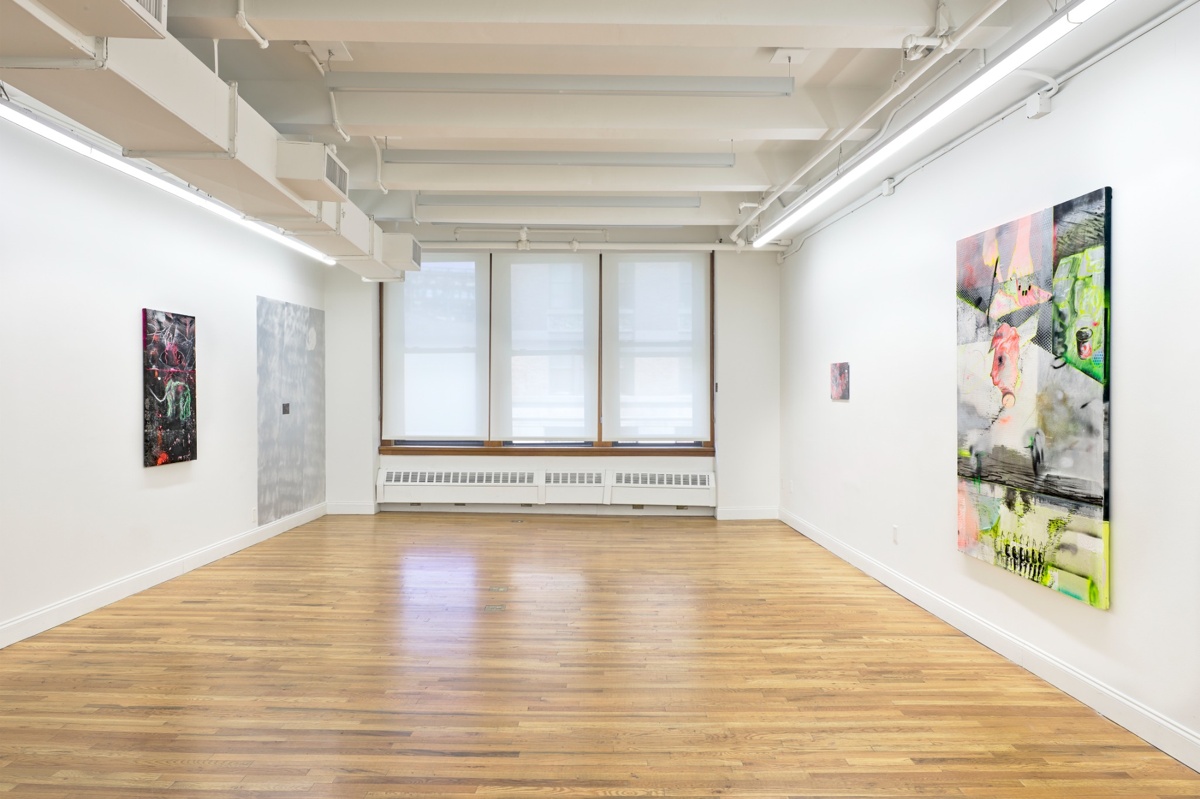 Installation view of Without Innocence. Courtesy of RAINRAIN and the artist. Photo by Max Yawney.
Walking into RAINRAIN Gallery’s Without Innocence, the first sensation is not exactly horror, but a feeling that the boundaries of the body have become unreliable. In Kosuke Kawahara’s paintings, something always seems to be leaking outward. Fluorescent lines, translucent masses of flesh, and structures resembling nerves or intestines slowly spread across dark surfaces. They appear organ-like, yet remain difficult to identify with certainty. At times, looking at the works feels like looking into the inside of a living organism, stomach lining, wounds, decaying tissue, deep-sea creatures, or cells multiplying beneath a microscope.
This ambiguity comes from the way Kawahara approaches the organ itself. He does not depict organs with the clarity or stability of anatomical diagrams. Instead, they remain in a continuous process of transformation. In How The Sausage Is Made, large gray-black structures overlap and merge into one another, resembling stitched skin or internal tissue slowly growing back together. The seams within the work feel especially important. The traces left by patched fabrics resemble scars formed during the healing of wounds. The paintings carry the feeling of having been cut open, stitched together, covered over, and forced to regenerate. They contain a sense of bodily processing.
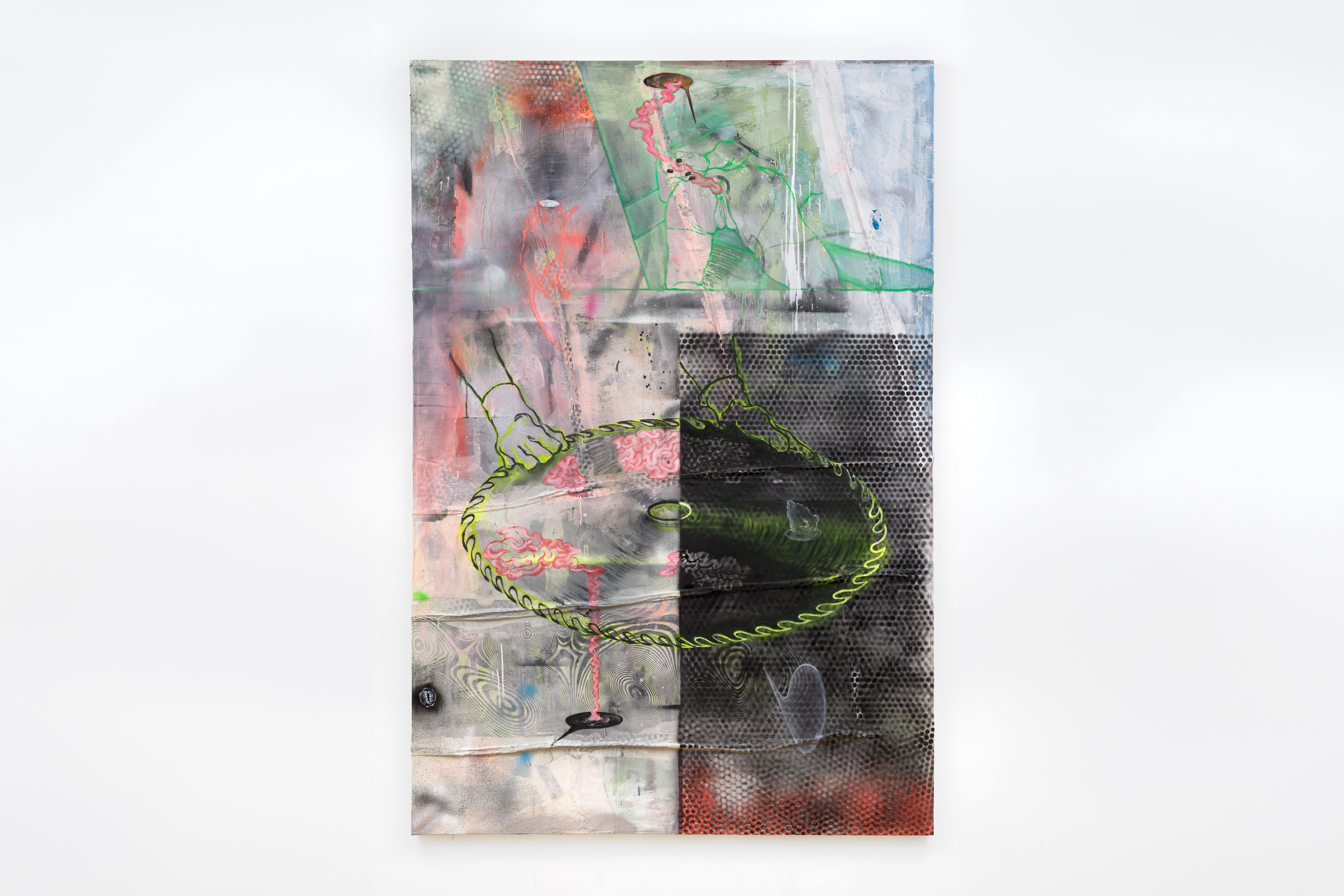 Kosuke Kawahara, How The Sausage Is Made, 2024–2026. Courtesy of the artist and RAINRAIN Gallery.
Kawahara has long kept reference images in his studio related to meat processing and slaughterhouses, meat grinders, hands cutting slabs of flesh, hooks suspending animal carcasses. These images function less as visual shock than as structural references for how bodies are processed. Animals within slaughterhouses are separated into different parts before entering separate stages of production. A complete body gradually becomes fragmented into functional, transportable, consumable sections. Kawahara’s paintings contain a similar disassembled condition: heads, mouths, teeth, intestines, cavities, and flesh drift through space without stable relationships to one another. The enormous black opening in Loophole becomes especially striking. It resembles a mouth, a wound, a cave, or an internal organ all at once. Looking at the piece makes it difficult to maintain emotional distance. The opening produces the unsettling sensation of entering the inside of the body itself.
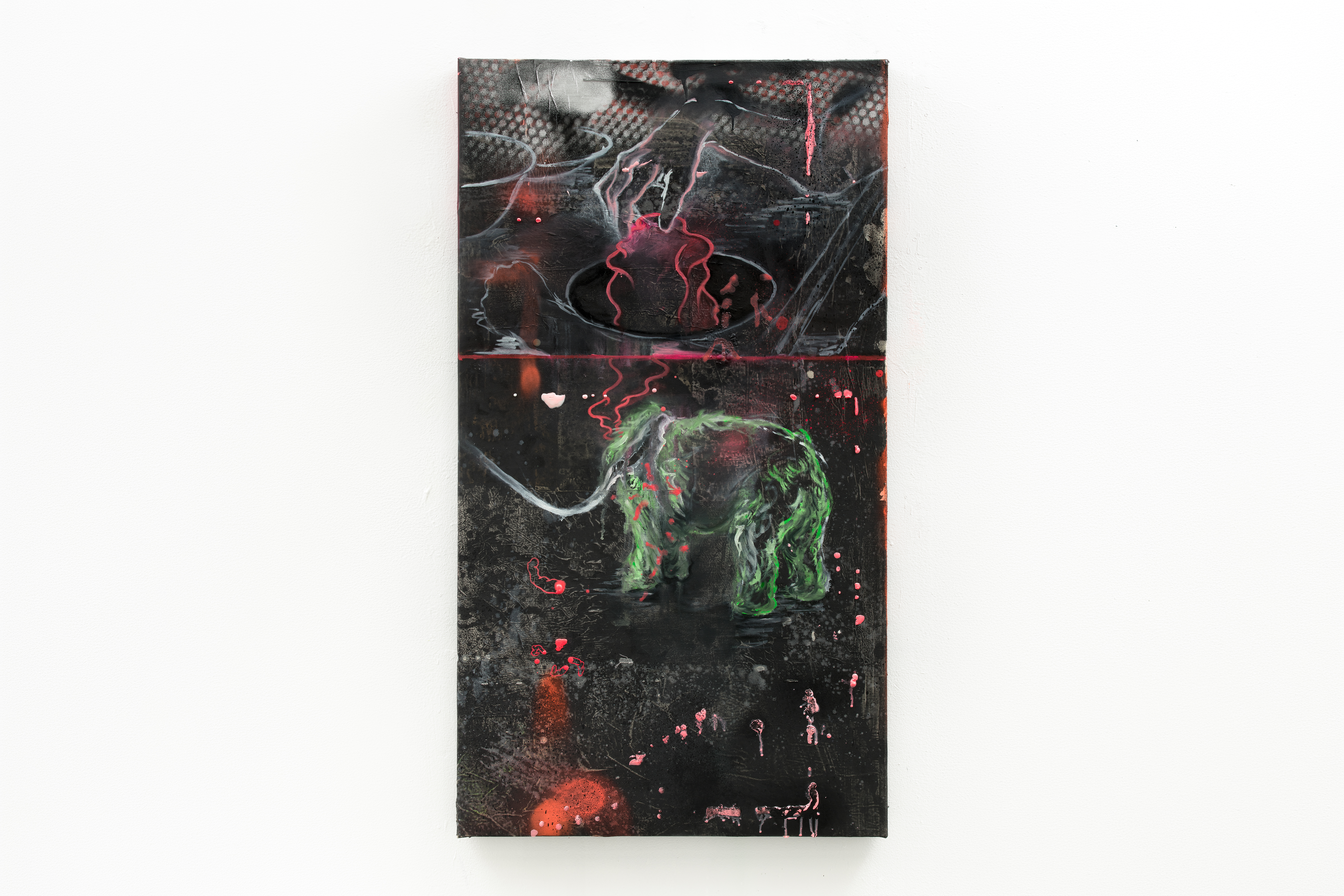 Kosuke Kawahara, Loophole, 2023–2026. Courtesy of the artist and RAINRAIN Gallery.
The organs and biological structures throughout the exhibition remain difficult to stabilize through language. One moment they resemble mouths, intestines, skin, wounds, or internal tissue; the next, they shift into deep-sea organisms, bacterial colonies, or decomposing flesh. Many of the images evoke wounds, mucus, exposed organs, or decaying tissue, and this discomfort closely relates to Julia Kristeva’s concept of “abjection.” Kristeva argues that blood, corpses, bodily fluids, and decay disturb us not because they are unfamiliar, but because they once belonged inside the body. Once the inside begins spilling outward, the stability of the self also begins to weaken. Kawahara’s works remain suspended within this condition of internal exposure: organs appear to rise out from inside the body while biological structures gradually lose stable form.
Kawahara has mentioned his interest in what happens after the body is cut open. Many of the organs within the exhibition seem strangely alive. They continue functioning, expanding, or mutating long after separation. The nerve-like and intestinal structures repeatedly spread outward across the surfaces of the paintings. As a result, the biological state within the works becomes increasingly unstable: the body loses its center while internal activity continues uninterrupted. This sensation intensifies under black light. Fluorescent pinks, greens, and purples resemble deep-sea bacteria or liquid cultures growing inside laboratory containers. The space begins to feel like a collision between nightclub lighting, laboratory environments, slaughterhouses, and the interior of the human body.
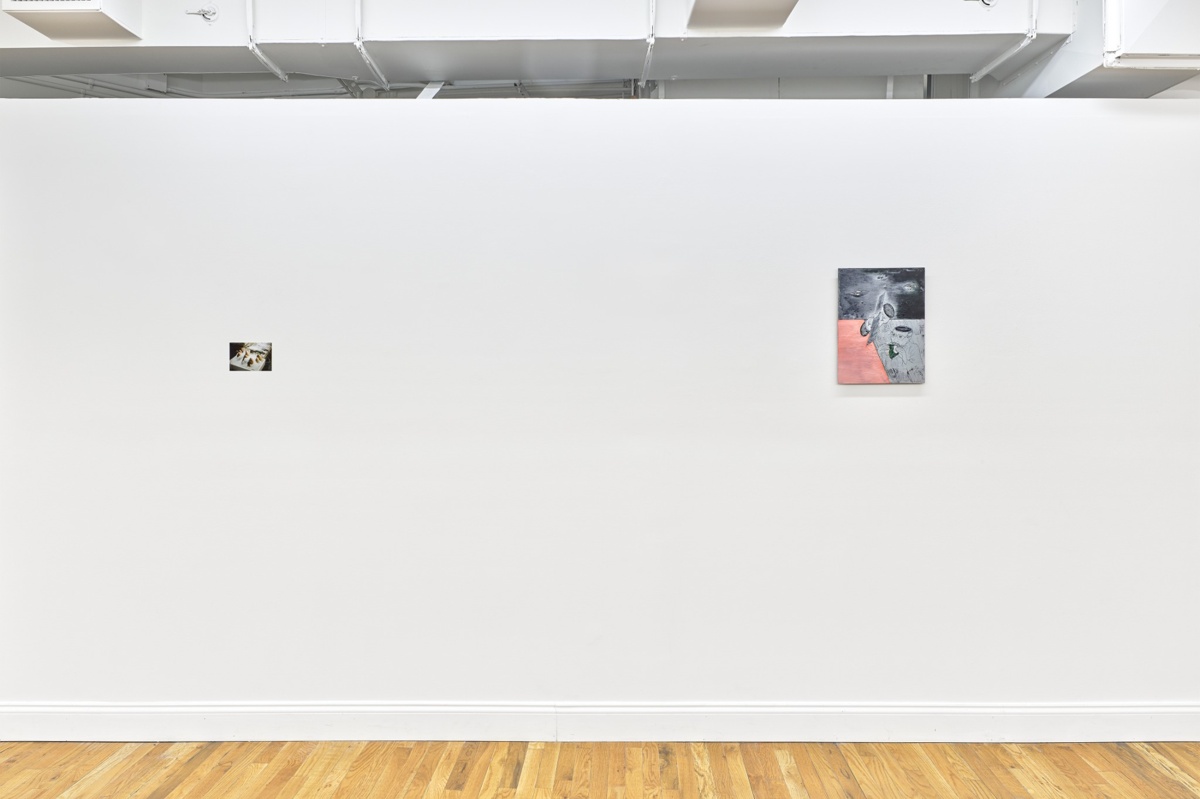 Installation view of Without Innocence. Courtesy of RAINRAIN and the artist. Photo by Max Yawney.
Many works dealing with posthumanism tend toward coldness, machinery, or digital aesthetics, yet Kawahara’s work remains intensely physical. Even when metal plates, spray paint, and industrial materials appear, the surfaces retain the tactile feeling of skin, mucus, and internal tissue. Materials are repeatedly scratched, layered, corroded, and worn down, leaving traces that resemble damaged skin. The works seem to undergo time, exhaustion, and metabolism in the same way bodies do. Kawahara also frequently uses organic materials such as animal glue, beeswax, fabric, paper, and coffee grounds. These materials age, peel, and discolor over time, allowing the paintings themselves to enter an ongoing process of transformation.
Looking at Kawahara’s paintings also brings to mind Gilles Deleuze and Félix Guattari’s concept of the “Body without Organs.” Their discussion does not concern the disappearance of organs, but the destabilization of fixed relationships between them. The hierarchy between mind, vision, language, and the body gradually loosens. Kawahara’s paintings often create the sensation that vision has become connected to the stomach. Looking turns into a process of swallowing, digestion, and metabolism. The images entering the body every day through phones—violence, pornography, disasters, endless information- begin to function like food, remaining inside the body long after consumption. This sensory condition gives the exhibition a distinctly post-digital atmosphere. Images no longer remain confined to screens. They enter the nervous system, affect emotional and sensory structures, and gradually reshape how the body understands itself.
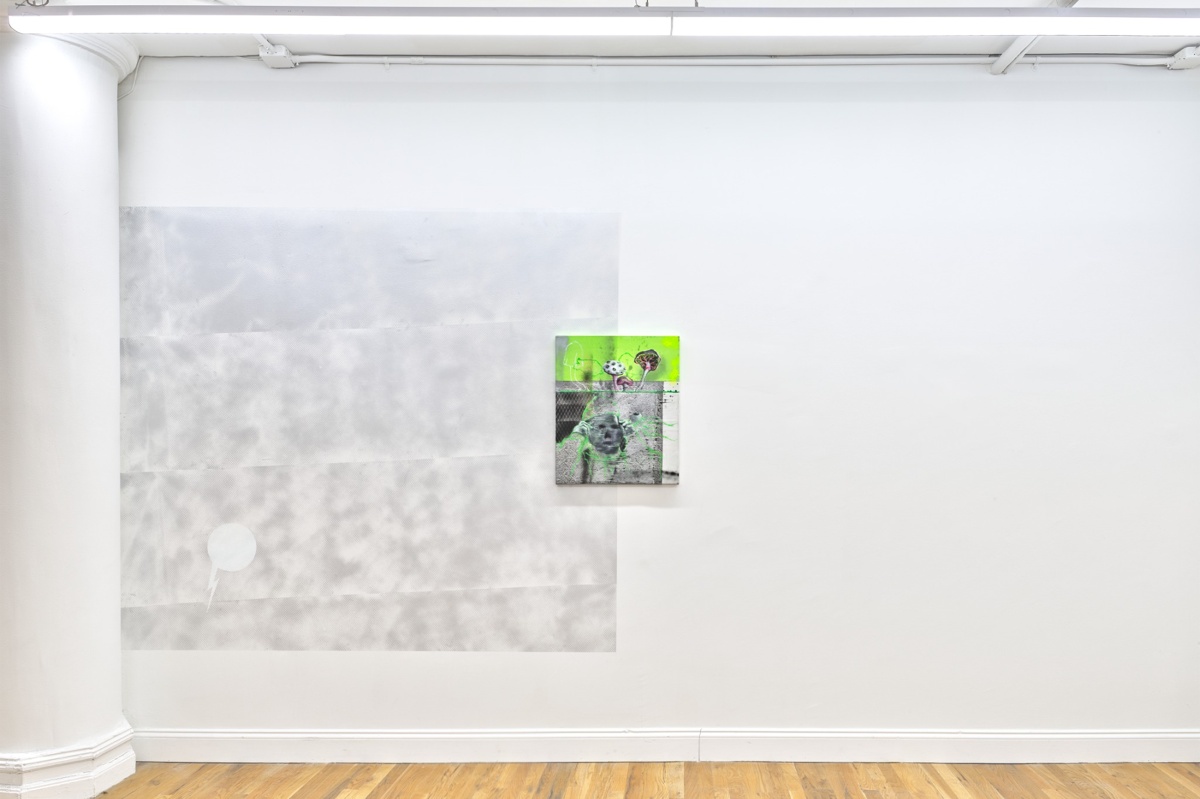 Installation view of Without Innocence. Courtesy of RAINRAIN and the artist. Photo by Max Yawney.
At the same time, Kawahara’s understanding of “environment” runs throughout the exhibition. He has repeatedly referred to the biological concept of Umwelt, the idea that every organism inhabits its own perceptual world. This interest in perceptual difference places his work somewhere between the body, the environment, and microscopic life forms. Structures resembling bacteria, nerves, tentacles, and machine components intertwine into continuously mutating networks. The body becomes an open surface through which information, matter, and images constantly circulate outward.
As a result, Without Innocence does not feel like a distant science-fiction future. It feels closer to a transformation already unfolding inside the body itself. Bodily boundaries loosen. Internal systems gradually leak outward. The sense of control over one’s own body slowly weakens. Kawahara gives this condition physical form: organs rise toward the surface, perception drifts across unstable structures, and life continues growing through fragmentation.

Shuhan Zhang
Shuhan Zhang is a curator and writer based in New York. Her work focuses on contemporary art, digital culture, and the politics of exhibition-making.
view all articles from this author