Whitehot Magazine
October 2026
"The Best Art In The World"
"The Best Art In The World"
October 2026
Sam Gilliam and Chuck Close at Pace: Two Solo Shows, Two New Ways of Seeing Two Great Artists
By LIAM OTERO April 16th, 2026
Two legendary artists who transformed Modern & Contemporary Art. Two artists whose material approaches redefined artmaking and the elasticity of medium-specific terms. The two artists in question are markedly different in their work, but yet a certain synchronicity exists in their concurrent solo exhibitions at Pace. The two artists I am referring to are Sam Gilliam (American, 1933 - 2022) and Chuck Close (American, 1940 - 2021). These artists have become household names for their ambitious projects, the monumental Draped paintings of Gilliam and the aggrandized, semi-abstracted verism of Close’s Photorealistic portraits. It is precisely those bodies of works that spring to mind when either of their names are uttered. Pace Gallery’s individual solo shows is an opportunity to uncover new and unusual directions each artist undertook at different points in their careers that, until now, have yet to be explored so closely in institutional contexts.
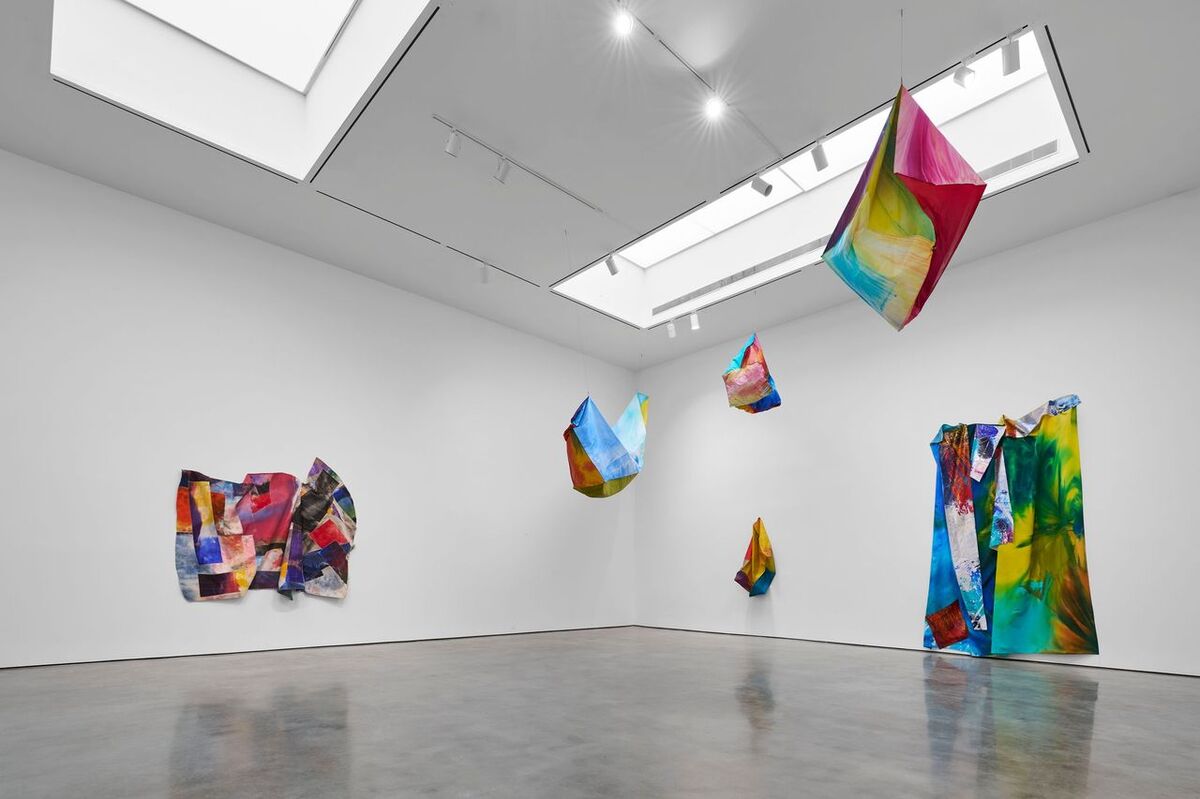 Installation view of Sam Gilliam: STITCHED at 510 West 25th Street, New York, NY 10001. March 12 - April 25, 2026. Photography courtesy Pace Gallery.
Sam Gilliam: STITCHED is the U.S. debut of an experimental series that the Washington Color School artist pursued during a residency in rural Ireland. He was accepted as the artist-in-residence for the Ballinglen Arts Foundation in 1993, one of Ireland’s most renowned residencies in which Irish and international artists create works responsive to the atmosphere of North County Mayo. However, Gilliam was dealt a predicament many artists face when transporting supplies across national boundaries: his paints were flagged as illegal due to their highly flammable petroleum ingredient. Always the creative innovator, Gilliam devised an alternative solution by shipping a sizable load of painted and stained loose canvases of an enlarged scale to the residency where he and a local seamstress tirelessly cut and restitched them into brilliant new works that blur the boundaries between painting, sculpture, and textiles. The only time these were exhibited was at the Irish Museum of Modern Art in Dublin last year.
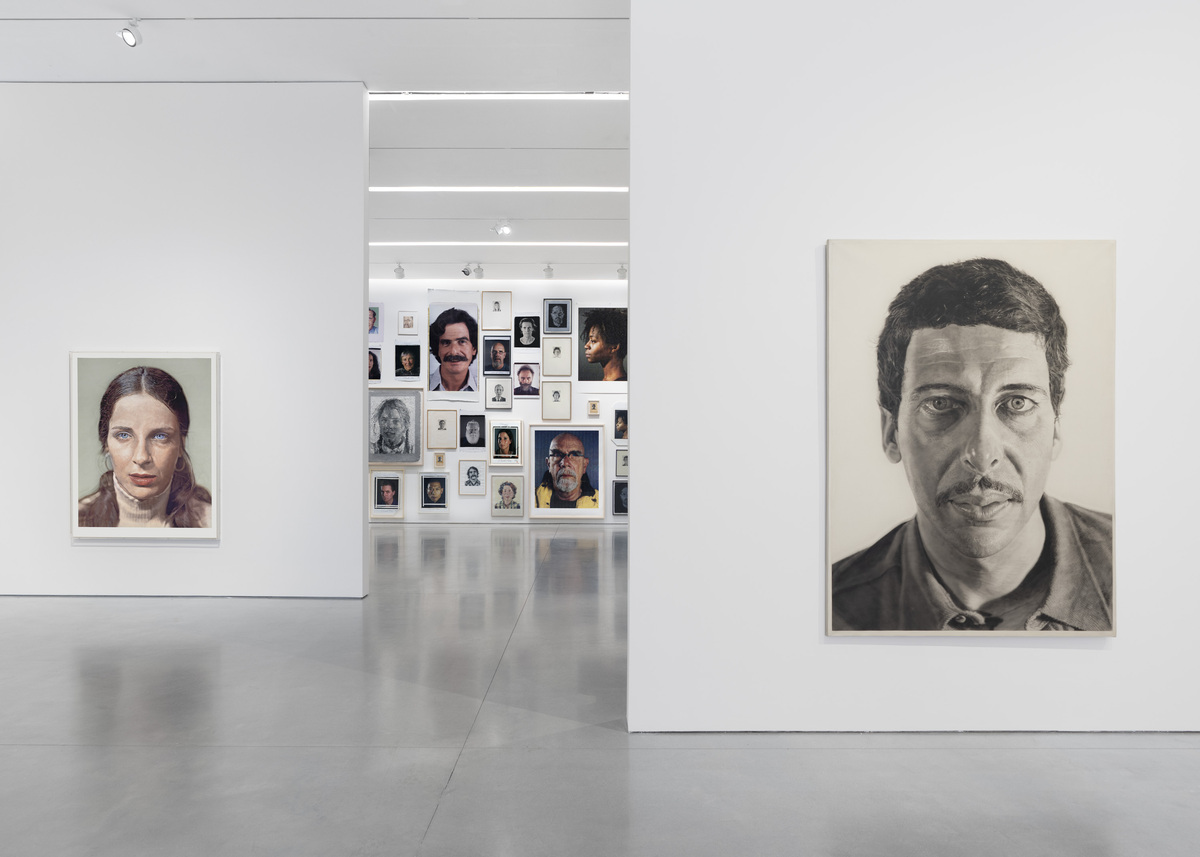 Installation view of Chuck Close: On Paper at 540 West 25th Street, New York, NY 10001. March 12 - April 25, 2026. Photography courtesy Pace Gallery.
Chuck Close: On Paper magnifies the importance of the Photorealist’s works on paper that involved a wide range of methods, including fingerprint markings (or as I referred to it, high-quality fingerpainting), air brush, and reductive surfaces. Close was a lifelong sufferer of prosopagnosia (facial blindness) which rendered him unable to distinguish or recognize other people’s faces. Yet, he became one of the most prolific portraitists whose images are celebrated precisely for their uncanny realism. Here, viewers will be able to trace how integral these works on paper were to the success of Close’s unique style and process of making through large-scale watercolors and more intimately-sized ink on paper portraits spanning the 1960s through the 2010s. Typically, such works would be the accompaniment or secondary pieces in other shows, but at Pace, these are front and center.
I opened with these brief summaries of the Gilliam and Close shows as a reminder that they are two separate exhibitions, not a two-person show. Yet, I felt compelled to discuss them in a combined review (combine review, perhaps?) instead of individually as I think their simultaneous occurrence is fortuitous timing.
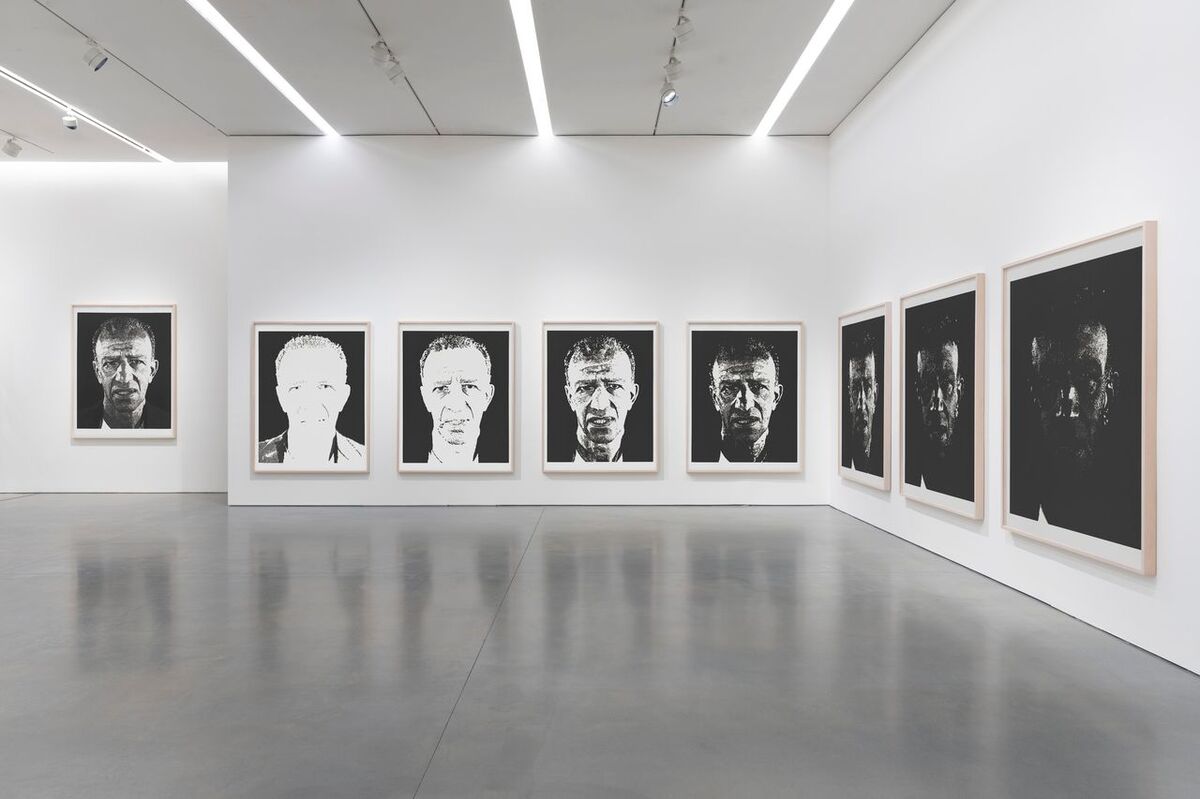
Installation view of Chuck Close: On Paper at 540 West 25th Street, New York, NY 10001. March 12 - April 25, 2026. Photography courtesy Pace Gallery.
You must brace yourself for the curatorial direction undertaken in each space as these shows feel less like visiting a gallery, but more so visiting a museum-quality exhibition. Person-to-artwork immersion is the most accurate way to describe how the works are presented. For the Close exhibition, painted and photographic portraits occupy the walls in a dynamic fashion. In the entrance spaces, these are in small groupings or columnar arrangements that build up to a awe-inspiring crescendo: an entire wall jam-packed with painted and photographic portraits of the great “Who’s Who?” of recent Art History, from Robert Rauschenberg and Roy Lichtenstein to Agnes Gund and Lucas Samaras. It would be erroneous to describe the curation as salon-style because much more nuance is at play - collaged curating, basically. Moreover, the appeal with this display is that the portrait arrangements are like a cross between a wall of family portraits or the wall of a portrait photographer’s studio, but seen on a gigantic scale.
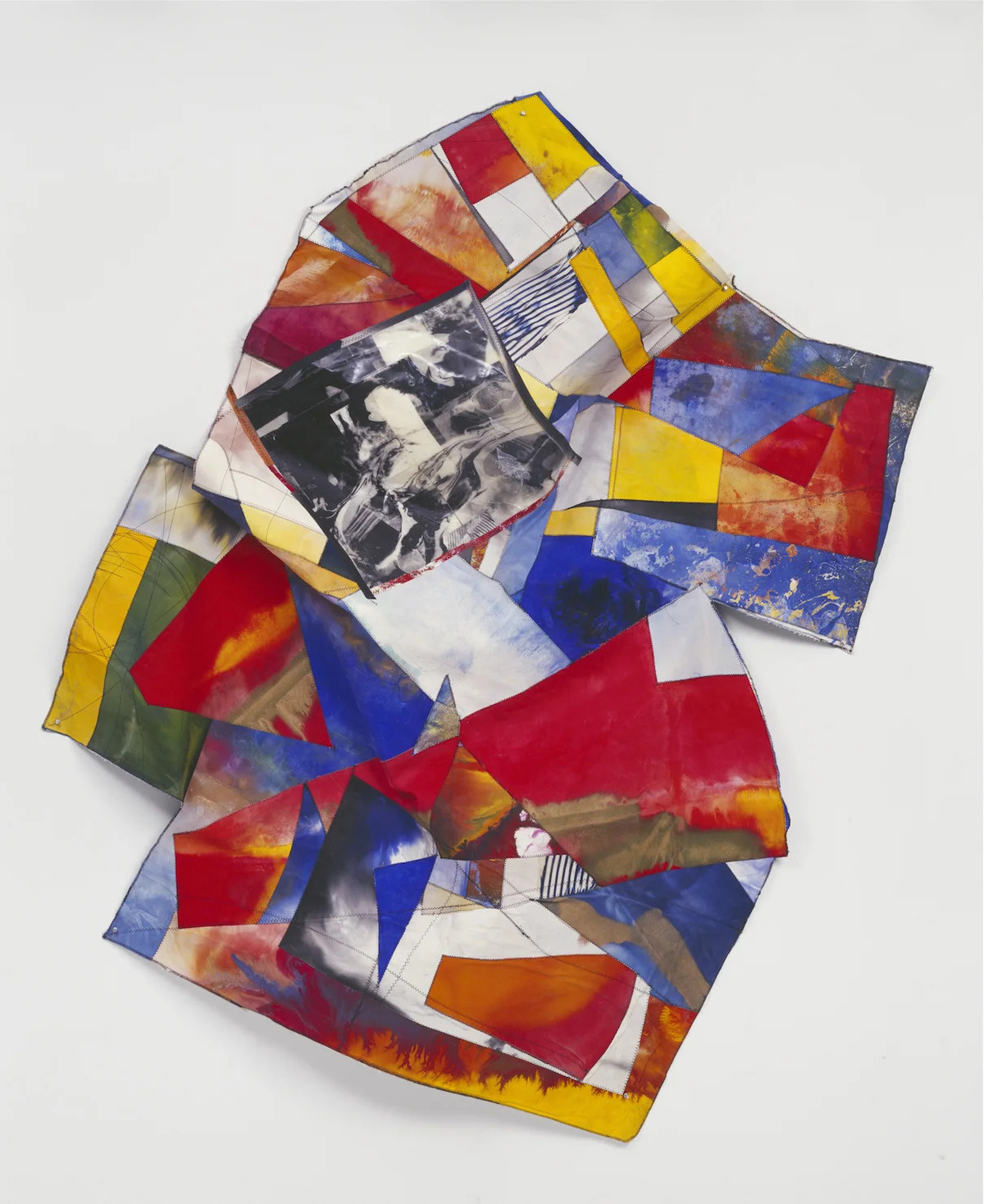 Sam Gilliam (American, 1933 - 2022), Untitled, 1994, © 2026 Sam Gilliam / Artists Rights Society (ARS), New York. Image from Pace Gallery website.
Similarly, the Gilliam exhibition is just as involved with its spatiality. Rather than being confined to the perimeters of the exhibition walls like Close, Gilliam’s canvases are festooned everywhere: they glide along the walls, float in space, hang at eye-level, or soar above our heads. Their painted and stained surfaces give off a playfulness and buoyancy. Perhaps this may speak to my age, but Gilliam’s works (especially the floating ones) made me nostalgic for the humongous rainbow parachutes used in elementary school gym classes because of the colorfully svelte tangibility of their untethered and biomorphic shapes.
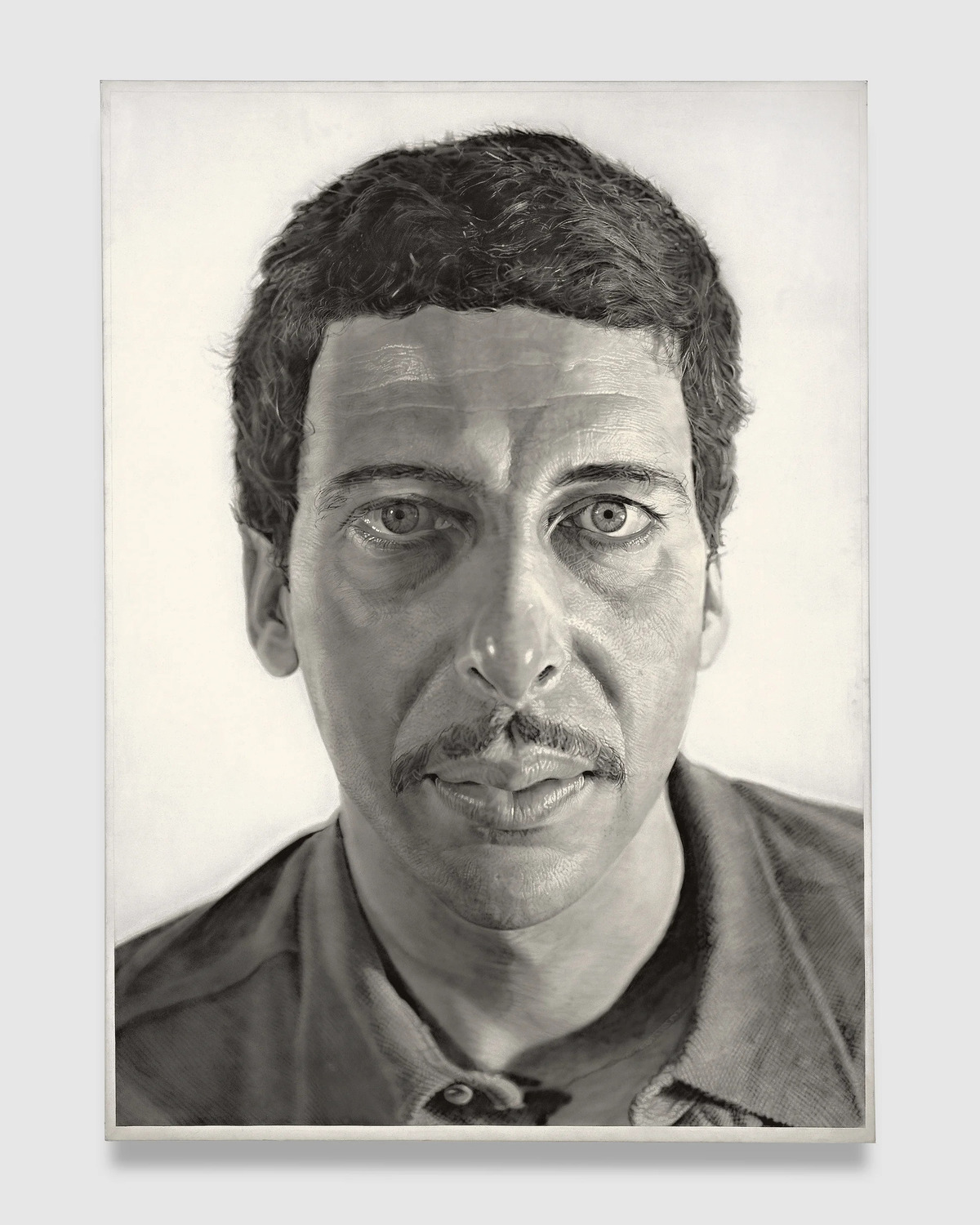 Chuck Close (American, 1940 - 2021), Klaus/Watercolor, 1976 © Chuck Close. Image from Pace Gallery website.
Close made a name for himself by pursuing a portraiture style involving an abstracted build-up to recognizable forms at a time when figuration was deemed passé. Gilliam found a way to do the unthinkable with painting by liberating the canvas from the walls and even going so far as to conceptually say “the hell with it!” to stretcher bars and just letting his unstretched canvases thrive in space. Gilliam and Close are two very different artists, but at the same time, their creative defiance has only expanded and enriched the possibilities of what art can be and how it can be created. The ways in which these are presented in the two current shows at Pace Gallery has done only justice for both artists' legacies. WM

Liam Otero
Liam Otero is a freelance art writer in NYC. He was recently named New York Editor of Whitehot Magazine.
view all articles from this author