Whitehot Magazine
November 2026
"The Best Art In The World"
"The Best Art In The World"
November 2026
Thucid Dreaming: Xin Wang at the Hill Art Foundation
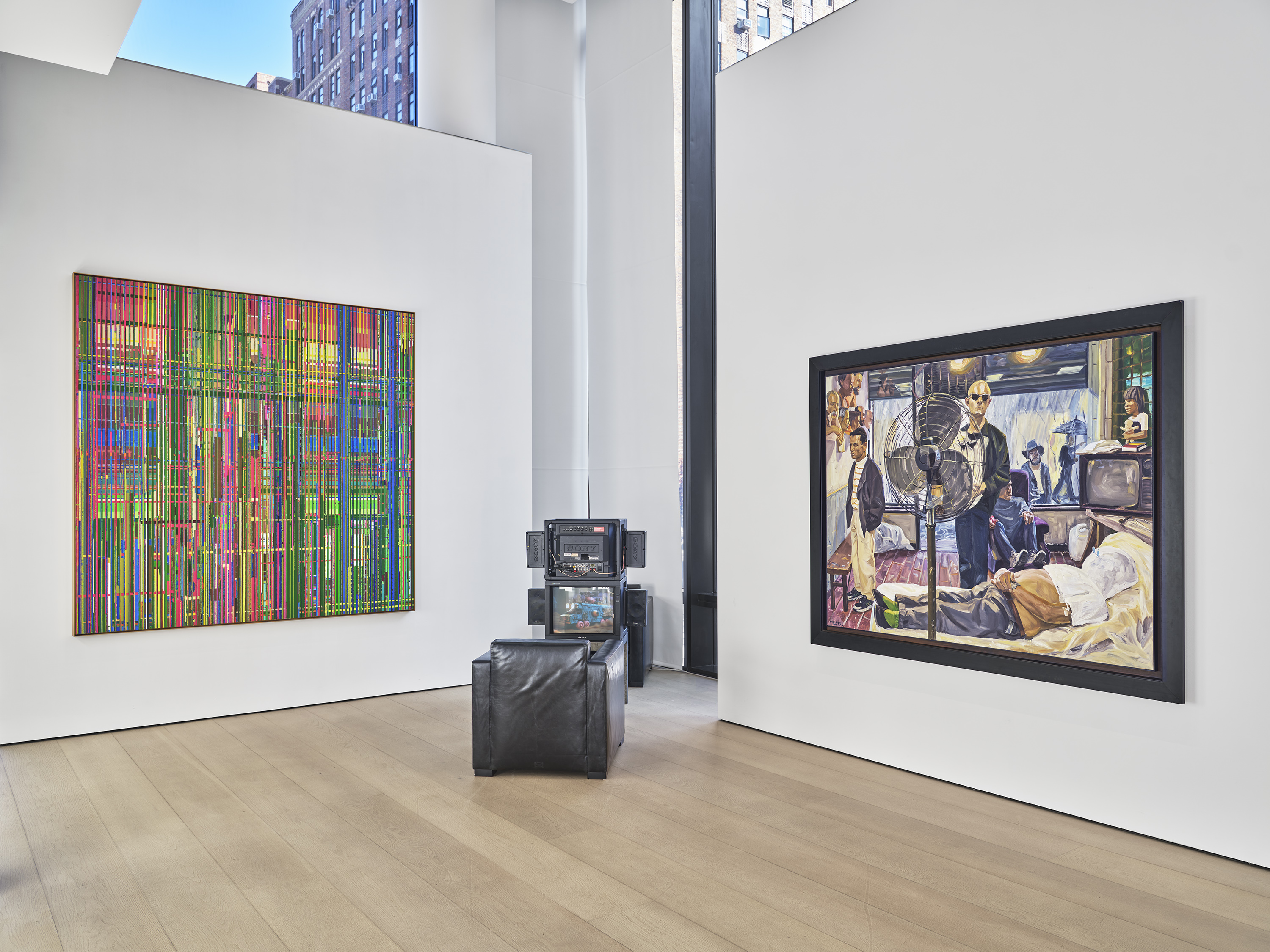
Liu Wei's Truth Dimension (2016), Wu Ziyang's New Silk Frequencies (2026) and Liu Xiaodong's Heavy Rain (1993) at Thucydides Fever Dream
MIKE MAIZELS, November 6, 2026
“The economy of the soul in the East, though, has little in common with such an anamnesic conception of time”—Yuk Hui (2016)
On view through December 19 at the Hill Art Foundation, Thucydides Fever Dream is among the most intellectually ambitious exhibitions mounted in New York this season. Organized by curator Xin Wang, who recently completed her PhD at New York University and now serves as Curatorial Director at Pace Gallery, the exhibition takes as its point of departure the increasingly fraught technological and geopolitical rivalry between the United States and China. Yet what could easily have become a didactic exercise in contemporary affairs emerges instead as something stranger, richer, and far more rewarding: a sustained meditation on systems of power, historical memory, and the unexpected ways political conflict finds expression in culture.
The exhibition borrows its title from the "Thucydides Trap," a term popularized by political scientist Graham Allison to describe the danger that emerges when a rising power challenges an established hegemon. Drawing on the ancient historian's account of the Peloponnesian War, the concept suggests that structural rivalry can make conflict increasingly likely even when neither side actively seeks it. The idea has lately reentered geopolitical discourse in striking fashion. Meeting with Donald Trump in September, Xi Jinping argued that the "Thucydides Trap can be overcome," insisting that competition between China and the United States need not culminate in military confrontation. Wang's exhibition occupies precisely this space between inevitability and contingency. While its intellectual framework is carefully engineered, Thucydides Fever Dream repeatedly exceeds its thesis, transforming geopolitical abstraction into something more elusive and human. The strange place of the Western-Classical in Chinese political thought is a sub-current to which the show returns—for example, Wang’s re-quoted description of “the Chinese government’s deliberate effort to ‘sever Plato from NATO,’ extending a lifeline to Western classics and humanities (to the bewilderment of the field’s most esteemed scholars)."These moments are irreducible in their mutual misunderstanding.
As Riley Yuen, the Hill Art Foundation's capable guide, explained during my visit, the exhibition's central argument reveals itself through a series of carefully staged juxtapositions. An example of Bernd and Hilla Becher's austere photographs of postwar German industrial architecture is installed alongside one of Chen Ronghui’s ostensibly similar, and yet considerably more lush, images of Chinese petrochemical production. At the exhibition's conclusion, a museum-quality study from Anthony van Dyck, Study of a Bearded Man (1618), finds an unlikely counterpart in Hao Liang's Red Nose (2017), a work that absorbs the techniques and visual grammar of the European classical tradition only to redirect them. Such pairings make visible one of the exhibition's deeper concerns: not simply the encounter between China and the West, but the ways ideas, images, and cultural forms circulate between them, returning altered by the journey. The Qin dynasty word for the Roman Empire, Daqin (大秦), just meant “Greater Qin.”
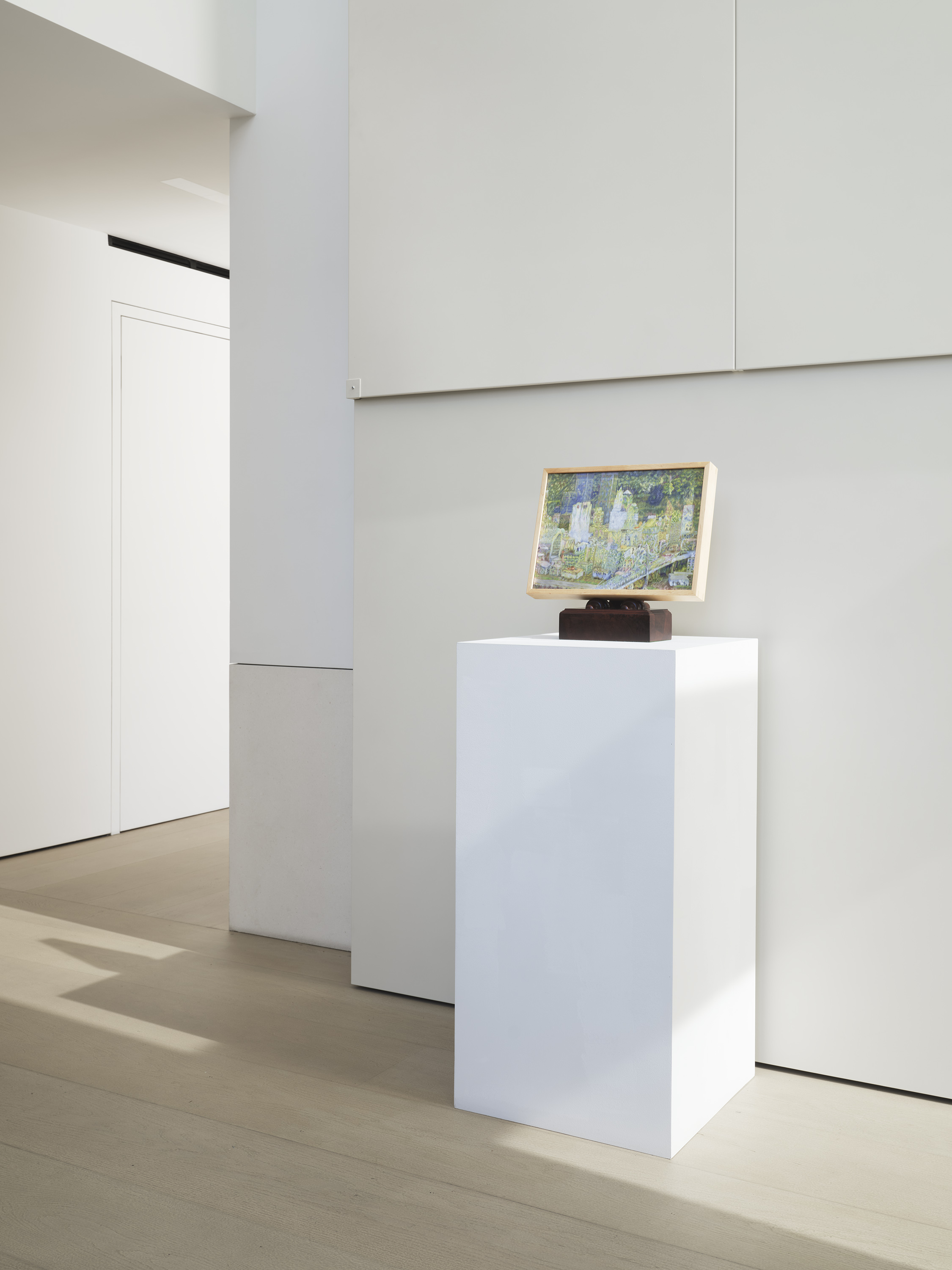 Wang Ye's Manhattan B (2021)
One of the most successful examples appears in the first gallery, where Wang Ye's Manhattan B (2021) faces Liu Wei's Truth Dimension (2016). For Manhattan B, Wang drew upon the peculiar ecosystem of Shenzhen's miniature reproductions of global landmarks, assembling an Ai re-synthesis of these simulations before translating them into silk embroidered textiles produced by artisans in their hometown. The result occupies an unstable space between image and object, reproduction and original. It resembles, at once, a low-resolution AI hallucination of Manhattan, a hand-embroidered souvenir, and a diminutive stained-glass window illuminated from within by the faintest traces of reflected light.
Installed nearby, Wei's towering Truth Dimension operates in an altogether different register. Its geometric planes evoke Mondrian, while its luminous network of lines oscillates between city grid and circuit board, urban plan and technological substrate. While the former traces translation of images across systems of labor, memory, and reproduction, the other visualizes the abstract architectures through which information, capital, and power circulate.
One gallery further to the right was the work that struck me the most. Wu Ziyang's New Silk Frequencies opens an altogether different horizon—staging a speculative encounter between China and Africa. Wu’s world is peopled by a cast of melted claymation-like figures and saturated by technological mediation; yet oddly detached from the familiar visual language of Silicon Valley and World Bank futurism. Networks of finance, infrastructure, and communication appear not as abstract systems but as everyday conditions of life. The aesthetic is playful, even whimsical, but the questions it raises are considerable: what does modernization look like when its reference point is no longer Europe or the United States?
The exhibition offers no simple answer. Instead, Wu traces the emergence of alternative circuits of technological exchange that have become increasingly consequential across the African continent. Solar power financed through mobile payment systems, Chinese-built telecommunications infrastructure, new educational and technical partnerships, and the broader legacy of the Belt and Road Initiative all hover at the edges of the work. Yet New Silk Frequencies is less interested in development as policy than in development as imagination. Kwame Anthony Appiah once observed that postcolonial societies are formed through continual processes of cultural translation rather than insulated traditions. Wu's world embodies that condition. Here, modernity arrives not as the diffusion of Western norms but as a hybrid and still-unfolding assemblage, one in which African and Chinese actors alike participate in constructing futures that neither fully inherit nor entirely reject the categories of the Atlantic world.
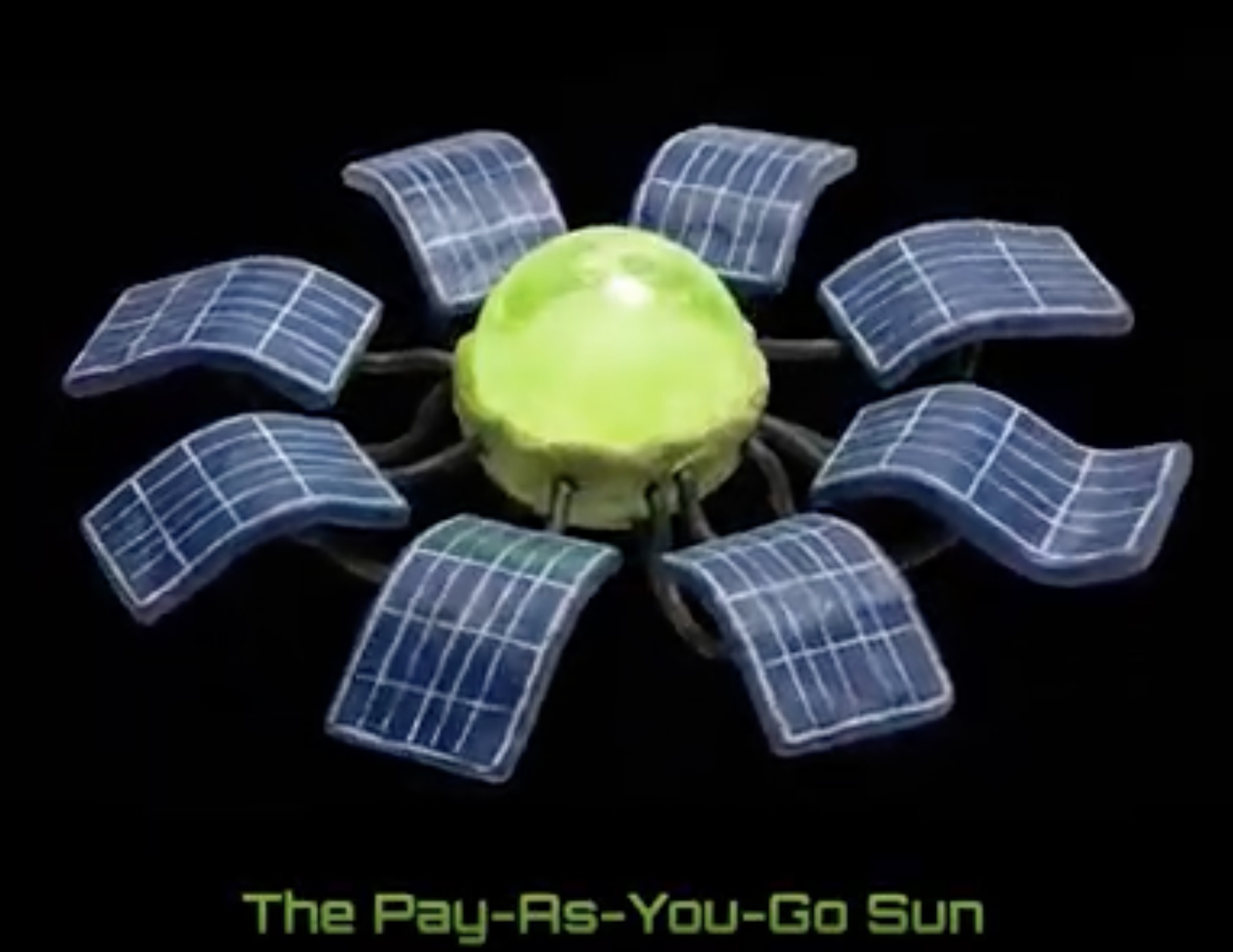
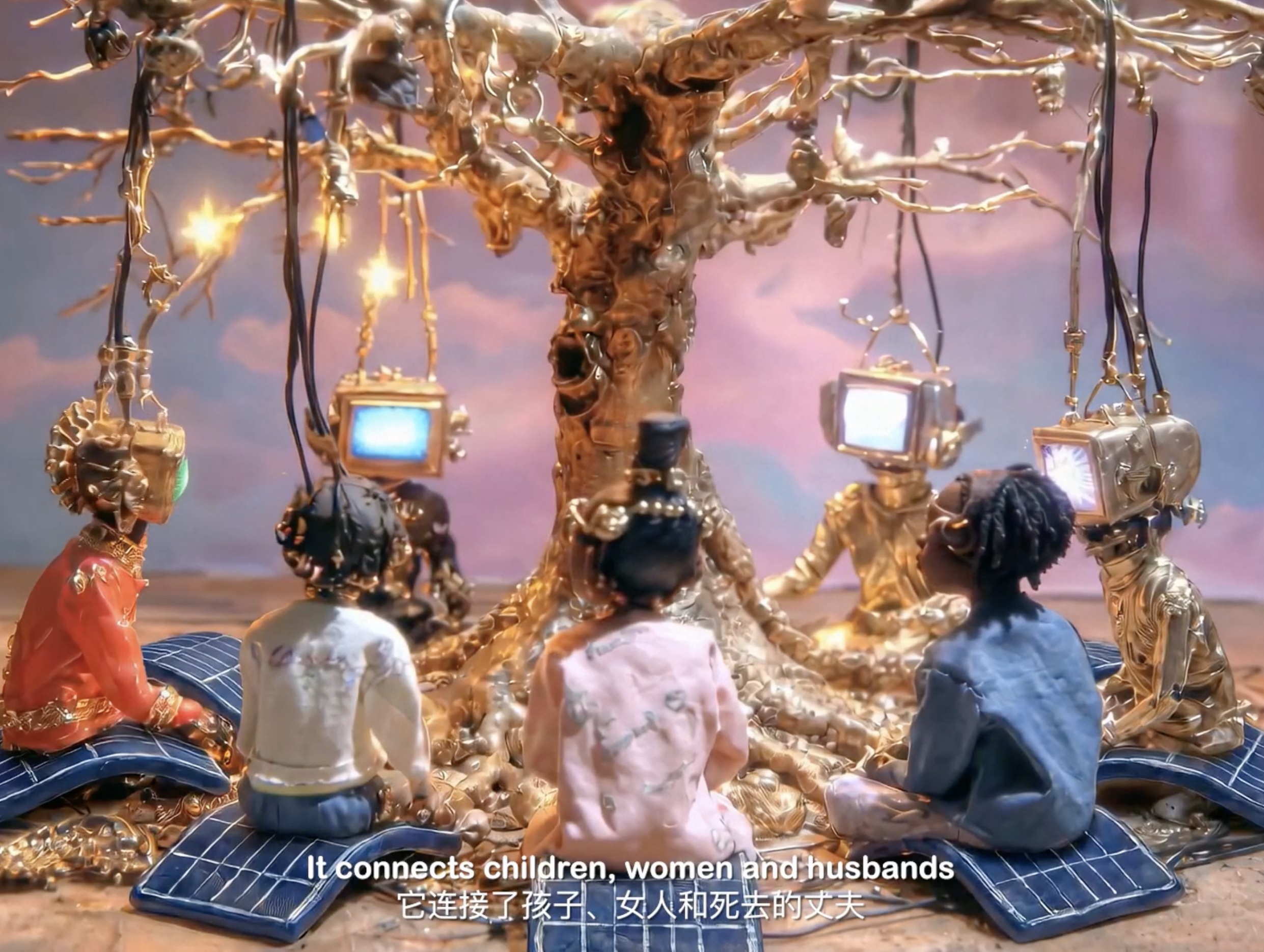
Screen captures: Wu Ziyang's New Silk Frequencies (2026)
While several works broaden the exhibition's scope beyond the United States and China, some of its most affecting passages return to that relationship in explicitly human terms. Particularly memorable is a pair of paintings by Yu Hong and Liu Xiaodong, now among the most celebrated artists of their generation. Executed in the figurative vernacular that helped define the post-Tiananmen avant-garde, the works depict scenes of intimate encounter: an artist's studio, a gathering of friends, a social world populated by recognizable figures from Beijing's emerging contemporary art milieu. Unlike the infrastructural networks and geopolitical abstractions that dominate much of the exhibition, these paintings center on people meeting people. Their atmosphere recalls a moment when cultural exchange seemed capable of softening political divides, and when the future relationship between China and the United States appeared governed less by strategic rivalry than by curiosity, experimentation, and mutual discovery.
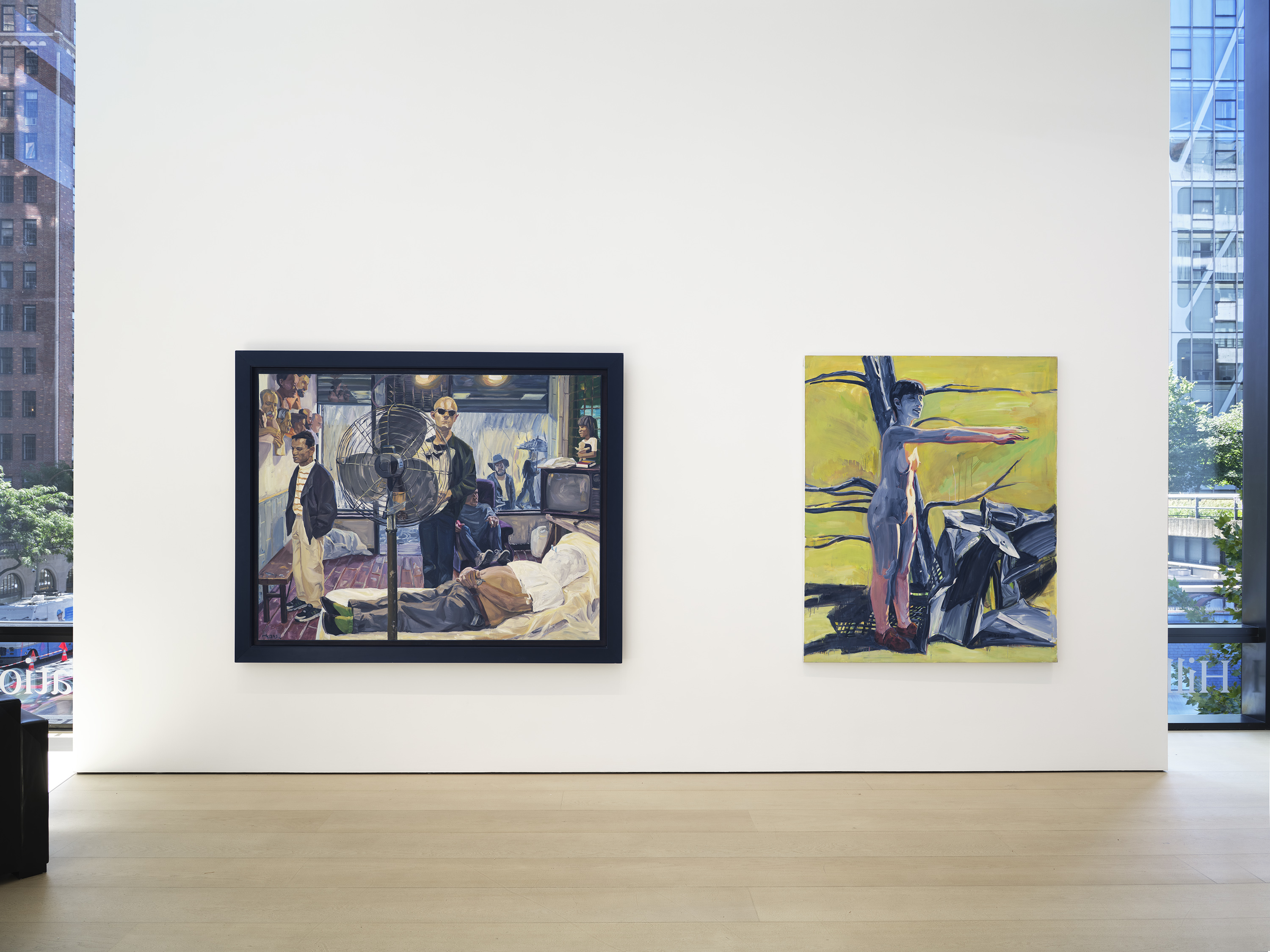
Installation view: Yu Hong, Sleepwalking (1993) and Liu Xiaodong, Heavy Rain (1993)
The historical timing is difficult to miss. Painted amid the gradual normalization of Sino-American relations that began in 1979 and culminated in China's entry into the WTO in 2001, the works belong to the same period that saw increasing numbers of Western artists, curators, and critics traveling to China and encountering a contemporary art scene that was rapidly inventing itself. As the remarkable oral histories collected in Our Own Arrows make clear, these encounters were often improvised, uneven, and marked by profound misunderstandings, but they were nevertheless animated by a genuine belief that new cultural worlds might be built through contact itself. Seen from the vantage of today's technological cold war, Yu and Liu's paintings function almost as historical documents, preserving the texture of a brief interlude during which engagement rather than decoupling appeared to define the horizon of possibility.
I have written elsewhere about the often awkward, occasionally comic, but ultimately consequential encounters between American and Chinese artists in the decades following China's reopening. As the recollections gathered in “Our Own Arrows” (later published as part of Bringing Forth the New) suggest, these exchanges were rarely characterized by mastery or clear understanding. More often they consisted of fragments: borrowed techniques, mistranslated concepts, aesthetic experiments whose significance only became apparent years later. The title of that essay was itself borrowed from a famous episode in the Chinese historical Romance of the Three Kingdoms, later reimagined by Cai Guo-Qiang in his monumental installation Borrowing Your Enemy's Arrows (1998). According to the legend, the strategist Zhuge Liang, facing a dangerous shortage of weapons, sails decoy boats shrouded in morning fog toward an enemy position. Mistaking the vessels for an attack, opposing archers unleash a barrage against straw-filled targets, unknowingly supplying their adversary with the very resources needed to prevail. Cai transformed the story into the image of a boat suspended in space and bristling with thousands of arrows, a wounded body that has converted vulnerability into strength. The metaphor resonates far beyond military strategy. Throughout the twentieth century, China repeatedly absorbed foreign ideas, technologies, and cultural forms only to redirect them toward purposes their original authors neither intended nor controlled.
Something similar seems to animate Thucydides Fever Dream. Again and again, the exhibition returns to the strange afterlives of ideas as they move across borders. Western classical forms reappear in contemporary Chinese painting. Industrial modernism travels from Germany to China and returns transformed. The aspirations of Silicon Valley are refracted through Shenzhen, Lagos, and Nairobi. What can appear, from one perspective, as imitation reveals itself on closer inspection as adaptation, translation, and reinvention. The result is a world in which influence remains real, but ownership becomes increasingly difficult to claim.
That observation also points toward the exhibition's most subtle challenge to the very geopolitical framework from which it takes its title. Henry Kissinger famously contrasted the Western game of chess, focused on decisive confrontation and victory, with the Chinese game of Go, in which advantage emerges gradually through positioning, encirclement, and the management of relationships. The "Thucydides Trap" belongs unmistakably to the former tradition, encouraging us to view history as a contest between rival powers struggling toward an inevitable reckoning. Wang's exhibition proposes something more ambiguous. The future it depicts is not one of checkmate but of continual recombination, where technologies, images, and cultural forms circulate through networks too diffuse for any single actor to command. If there is a fever dream here, it may be the persistent belief, shared on both sides of the Pacific, that such processes can ever be fully controlled. In that sense, Thucydides Fever Dream is less a meditation on conflict than on contingency, and all the unexpected futures that emerge in the space between influence and intention.

Mike Maizels
Michael Maizels, PhD is an historian and theorist whose work brings the visual arts into productive collision with a broad range of disciplinary histories and potential futures. He is the author of four books, the most recent of which analyzes the history of postwar American art through the lens of business model evolution. He has also published widely on topics ranging from musicology and tax law to the philosophy of mathematics.
view all articles from this author