Whitehot Magazine
October 2026
"The Best Art In The World"
"The Best Art In The World"
October 2026
In the Heart of the Volcano: an Interview with Brice Guilbert
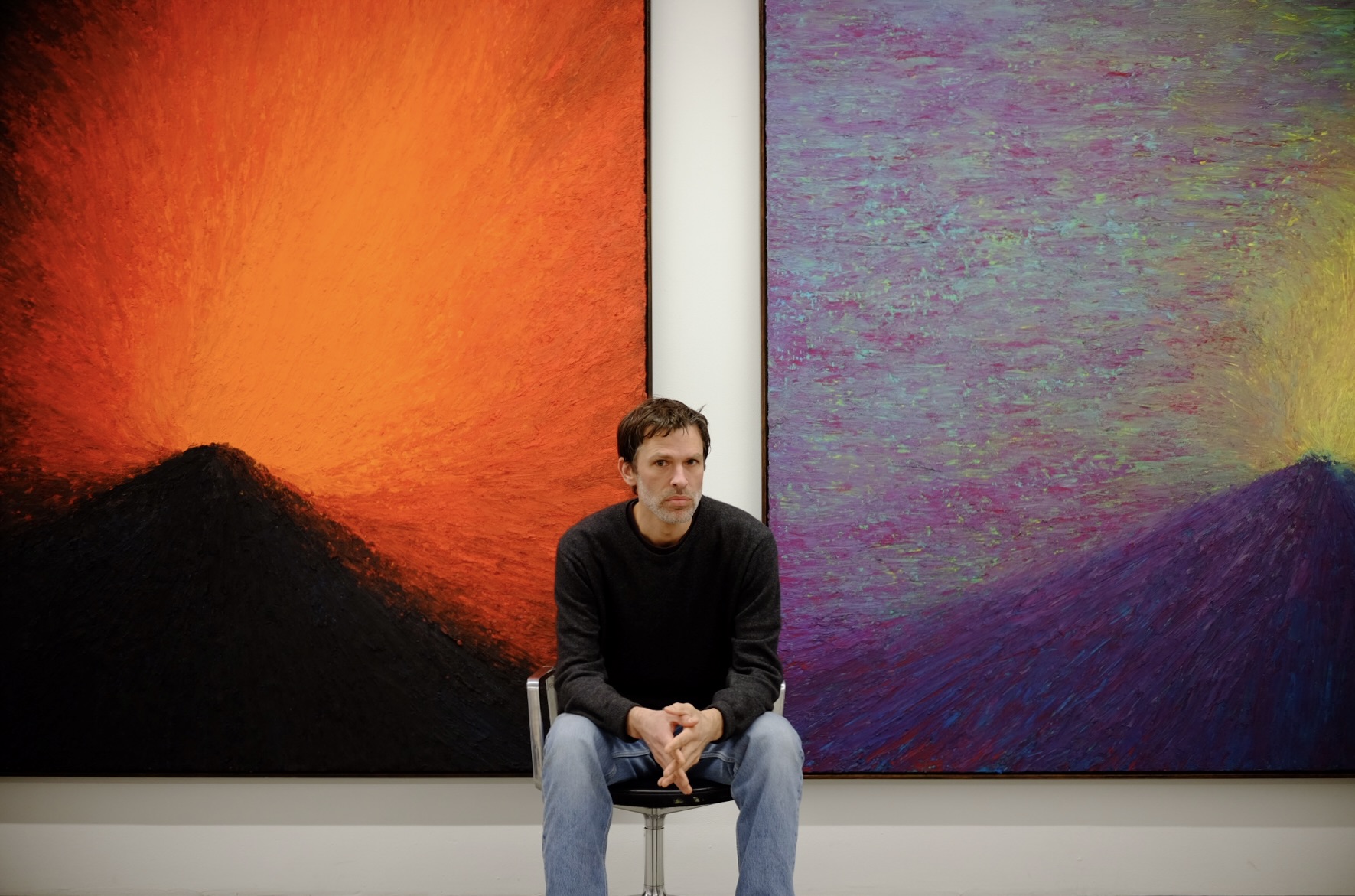 Brice Guilbert, portrait by Sara Cemin
By SARA CEMIN March 29th, 2026
I arrived at the Gratin gallery during the final touches of installation, on a sunny afternoon, to meet Talal Abillama and Brice Guilbert who are now beginning their collaboration. Like old friends, they welcomed me into a space that recognizes the artist’s arcane bond to the ineffable. The atmosphere was warm and relaxed, despite the series of huge volcanic eruptions on the walls. I almost wondered how such visceral, turbulent works could come from Brice, whose energy was so calm and positive. He was very excited to walk me through these massive tableaux of the volcano that lies on the plateau Foc-Foc in Réunion.
There is a strong sense of physicality and texture in your paintings — how long does it take for you to make these large pieces and how do you create such a rich texture?
Some of them I finished in two days, others I go back to over several weeks to add more layers. It’s definitely intense physical work. Since I’m right-handed the explosions go from left to right in one big movement. It’s like a dance almost. The texture is something I developed myself. I use my own formula of oil stick which has a high concentration of bee’s wax and I create my own colors; that’s what gives the paintings this thick texture.
Is painting an act of improvisation for you?
Yes, my subject is like my instrument. Since you already know what you're playing with, a specific subject and frame, then you can improvise freely from that starting point. It might be repetitive, but each time I try to live a new experience that corresponds to the energy I’m feeling in the moment. The idea is to finish a painting that creates a positive energy, something radiant that charges me up.
Is the energy always positive, or does the act of painting serve as a transformer of energy?
I always start from the emotion I am feeling in the moment, and then I accompany that feeling by turning it into a painting. Painting is something fragile and malleable that submits to the feelings. When I paint, I’m always searching for my identity, and through that, my Creole roots. I grew up in the Réunion. My house was at the foot of the volcano [the Piton de la Fournaise]. Most people at the Réunion don’t think twice about the volcano, because it’s just there, they see it every day, it’s just another part of the scenery. But to me it represented much more than that. I had been looking for a subject — one specific thing to paint — for a long time, and I felt there was so much variety in this subject: there are blue volcanoes, pink ones, whatever I want to imagine in the moment. It gave me a lot of freedom of expression.
Are the varying colors of the volcano directly tied to emotion?
I see painting as both an aesthetic and pleasurable act, something that must involve pleasure both to create and to look at. Every painting for me is a new act, a new discovery. I never thought I could reinvent myself so much with a single subject. I began painting the volcano in very small formats, but the more I made, the more I scaled up. I realized I was trying to resolve something deeply personal within this series. I was discovering myself as I painted, and it kept opening up something new within me every time. After some time, I stopped painting anything else; this was what satisfied me the most. People often ask me how long I think I’m going to keep painting the volcano. For me, even though it’s been ten years I’ve been exploring this subject, it feels like just the beginning.
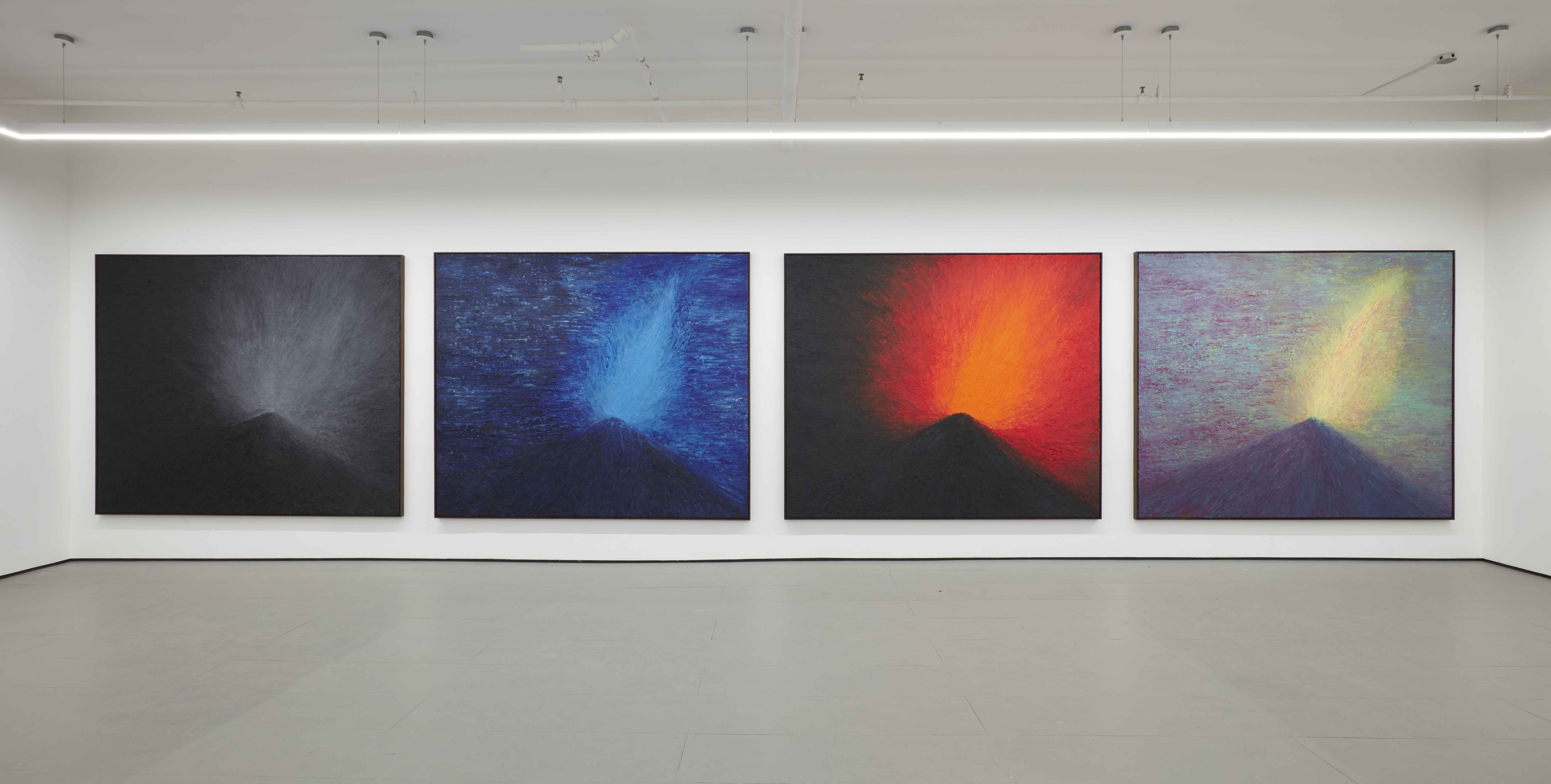 Installation view, Brice Guilbert, Foc-Foc, Gratin Gallery, New York City / Courtesy of Gratin Gallery
What unlocked this specific subject for you?
There was first the technical side of it, where I had created a specific formula for the oil-stick which I wanted to use at its full capacity. And then I also discovered some things in my family, which had turned everything upside down in my private life. Those discoveries really caused a disruption in my sense of self, what I knew about my family and my deeper identity. I felt the need to retrace the past in order to know who I really was. Even though I had been living in Belgium at the time, my mind wandered back to my childhood in the Réunion, and somehow the volcano came as the answer.
Would you say the volcano is a representation of yourself, in your different moods and colors?
You are always what you produce, so in a way yes. But I wanted to work on something you could approach from a thousand different angles. Since my subject is a landscape, you can read so many things into it: sex, life, death, rebirth, and much more. It’s something that is alive and moving, and it can be interpreted in many ways. I'm not a cynical person — I want a material that moves, that vibrates, that lives.
And yet there is a clear tension between what is fixed — the volcano, an immovable mountain — and this perpetual motion you speak of.
Yes, the volcano is paradoxical, it is rooted in the earth but it is a land in motion. And after an eruption, there is more land that is produced, the surface of the earth is changed. What I like to think about is how all earth is volcanic land, whether it is dormant or not. So everything starts from the volcano. Geologically, volcanos are the only places where you can access the center of the Earth from the outside. At the center there is a huge ball of fire, and it’s only when volcanoes erupt that we can see what’s deep underneath us. I like the idea of being able to reach what lies at the very bottom through what we see on the surface. There is something metaphysical about that.
In a way there’s something quite psychoanalytic about that too, reaching towards the depth of the soul through art. What was your relationship to the volcano when you were growing up, did it play an important role in your life?
There isn't a single meaning in this subject, I believe there are many ways in. Our house was at the foot of the volcano, but I never saw it erupt. I grew up in the Reunion with my two brothers until I was 14, and then we moved to Belgium. We hiked up the volcano often, but always when it was dormant. In fact, my father saw the volcano erupt many times, and we have hundreds of photos of those eruptions, but I guess I was too young and always sleeping when it happened. When I started this series, I was living in Belgium — a flat country, that is cold, grey, rainy, and frankly depressing. This subject allowed me to bring volume, color, texture and warmth into the urban world I was living in. In my paintings, I create my own landscape, these are all my own projections and fantasies. Of course, there are no pink or blue volcanoes in real life, they are my own fabrications.
And how did the collaboration with Talal begin, what made you want to work together?
I was at a party in Paris actually, and Talal spotted me in the crowd. It was about three years ago. He knew my work quite well, and we immediately clicked. Also, Talal is Lebanese, he speaks French, there is a mutual understanding, or I guess an energy between us that feels very familiar. I participated in a group show with him, here in New York two years ago. At the time, I was also working with Pace, so it took some time for us to develop a project together. He came to see my studio in Brussels and things just went from there.
I believe true luxury is when you can work with people who don’t make it feel like work. Talal is talented and he has a vision for art. I can tell when someone has expertise, is passionate and genuinely interested in what they do. I feel that is the case with Talal, which is why we get along so well. He is cool, warm, but also very attentive to his work. Gratin is now the main gallery representing me.
Foc-Foc runs March 20 to April 25th 2026 at Gratin Gallery, 291 Grand St 2nd floor, New York.

Sara Cemin
Sara Cemin is a writer based in New York. She holds an MA in English Literature and History from the University of Edinburgh, where she also directed several plays. After working in film production, she now manages the studio of sculptor Saint Clair Cemin and publishes a Substack newsletter which explores storytelling across film and literature and features some short fiction. Her work in literature, performance, and visual art informs a critical practice attentive to the intersections of aesthetics, history, and cultural context.
view all articles from this author