Whitehot Magazine
November 2026
"The Best Art In The World"
"The Best Art In The World"
November 2026
Power to the People: The Revolutionary Art & Vision of the Black Panther Party
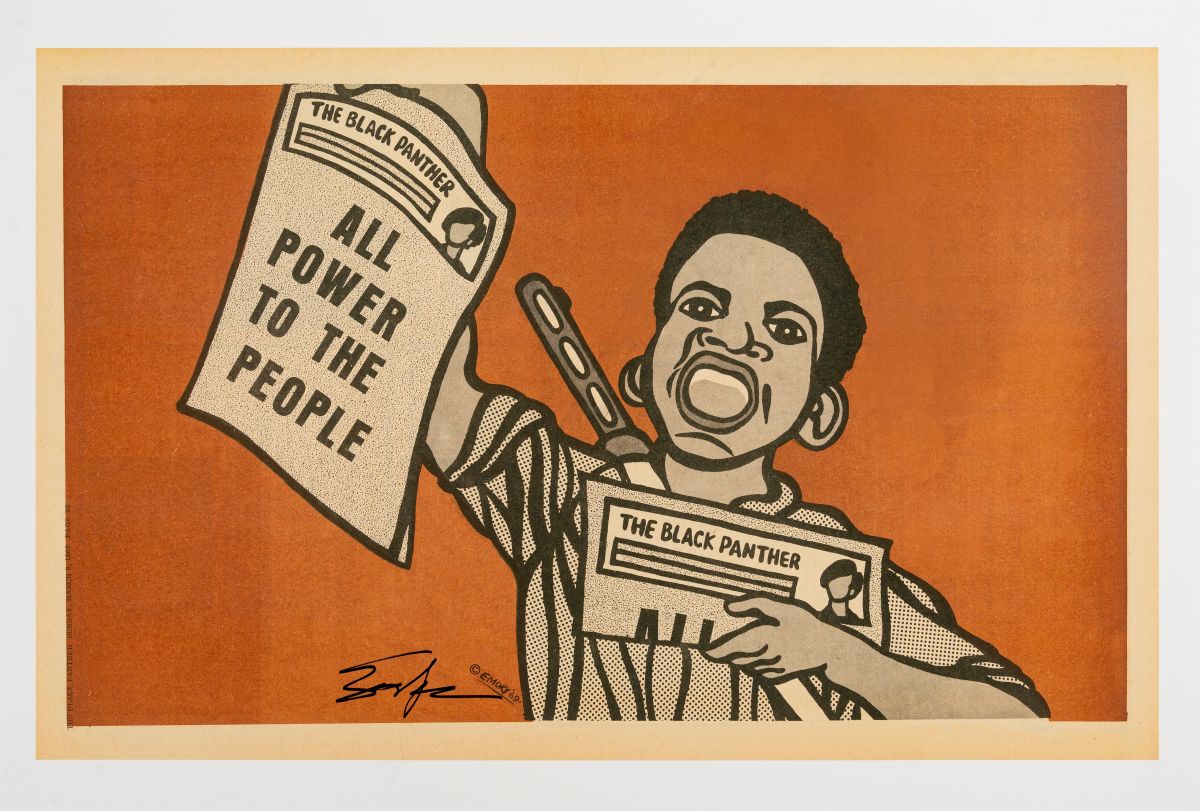 Emory Douglas, All Power to the People, 2013, Signed Art Poster , © 2026 Emory Douglas / Licensed by AFNYLAW.COM
BY RICHARD ALLEN MAY III, November 16, 2026
Before Snapchat, TikTok, Instagram, and Facebook, communities in the midst of extreme circumstances empowered themselves to respond. Their origin story did not begin with the trauma of slavery; it re-membered a time of freedom and historical accomplishments. Enter the Black Panther Party for Self-Defense.
Currently on view at the Riverside Art Museum, Power to the People: The Revolutionary Art & Vision of the Black Panther Party runs October 17, 2026, through April 11, 2027, in the Museum’s Art Alliance Gallery. The exhibition features 27 signed posters by Emory Douglas, the Party’s Minister of Culture, alongside artworks by Wadsworth Jarrell, Faith Ringgold, Gerald Williams, and Kevin A. Williams. A historical timeline spanning the mid-1960s through the late 1970s, recordings, and archival publications, including original Black Panther newspapers; editions of Ebony, Jet, and Sepia; vinyl recordings of speeches by Malcolm X (“The Ballot or the Bullet,” delivered 1964) and Dr. Martin Luther King Jr. (“Why I Oppose the War in Vietnam,” delivered 1967); and the 1969 vinyl album Seize the Time by Elaine Brown, the only woman to lead the Black Panther Party, serving as its chairman from 1974 to 1977, provide additional context. Brown’s album includes “The Meeting,” the song that became known as the Black Panther national anthem. As curator of this exhibition, I wanted visitors to look past the familiar image of the armed Panther to the Party’s political vision, its community programs, and the visual language that carried both.
Founded in Oakland in 1966 by Huey P. Newton and Bobby Seale in response to police violence against Black communities, the Black Panther Party advocated for self-determination and community empowerment. Its Ten-Point Platform called for changes in education, housing, employment, and policing. Douglas joined the Party in 1967 and shaped the visual identity of The Black Panther newspaper through bold illustration and graphic design. With his images, the Party’s ideas moved through the streets, the press, and the walls of Black neighborhoods. The 27 images by Douglas in this exhibition celebrate revolutionary solutions to oppression inflicted upon a community rather than reinterpret trauma through a twisted post-modernist explanation that only tickles the ears of the ruling class oppressor gatekeepers whose birth name is hegemony.
The image of the young person selling papers connotes community empowerment. The revolutionary in this image is a child, and the child is shouting. So here, Douglas depicts a young newspaper seller calling to passersby, announcing the latest issue. The child’s open mouth gives the image its urgency. It rises on the page as the child pushes the paper toward the street. The phrase “All Power to the People” condenses central demands of the Party’s Ten-Point Platform: self-determination, decent housing, education, an end to police brutality, and justice.
This is Directism on display: a framework for understanding art that privileges unmediated encounter, compressed meaning, and strategic visibility over contemplation, elaboration, and passive observation. A community member is depicted, a child who understands that the time has come. No flinchin’ in fear. The future of the movement is already on the corner; a young person is hollering the headline. This isn't simply about text-based art or figures that stare back. Directism names a fundamental reorientation in how artists address audiences, rooted in Black cultural practices of "keeping it real" and amplified by digital communication's demand for immediacy. It's art that gets "all up in yo grill," intentionally, strategically, with full awareness of when directness is power.
It is important to note that the Douglas posters on exhibit suggest that he built his images to be read at a glance: heavy black outlines, flat color, a few words in big letters. The paper taught as much as it reported, documenting struggles on the block and putting Black dignity on the front page week after week. The Panthers understood that changing society meant changing how people saw themselves, and Douglas gave them the pictures to do it.
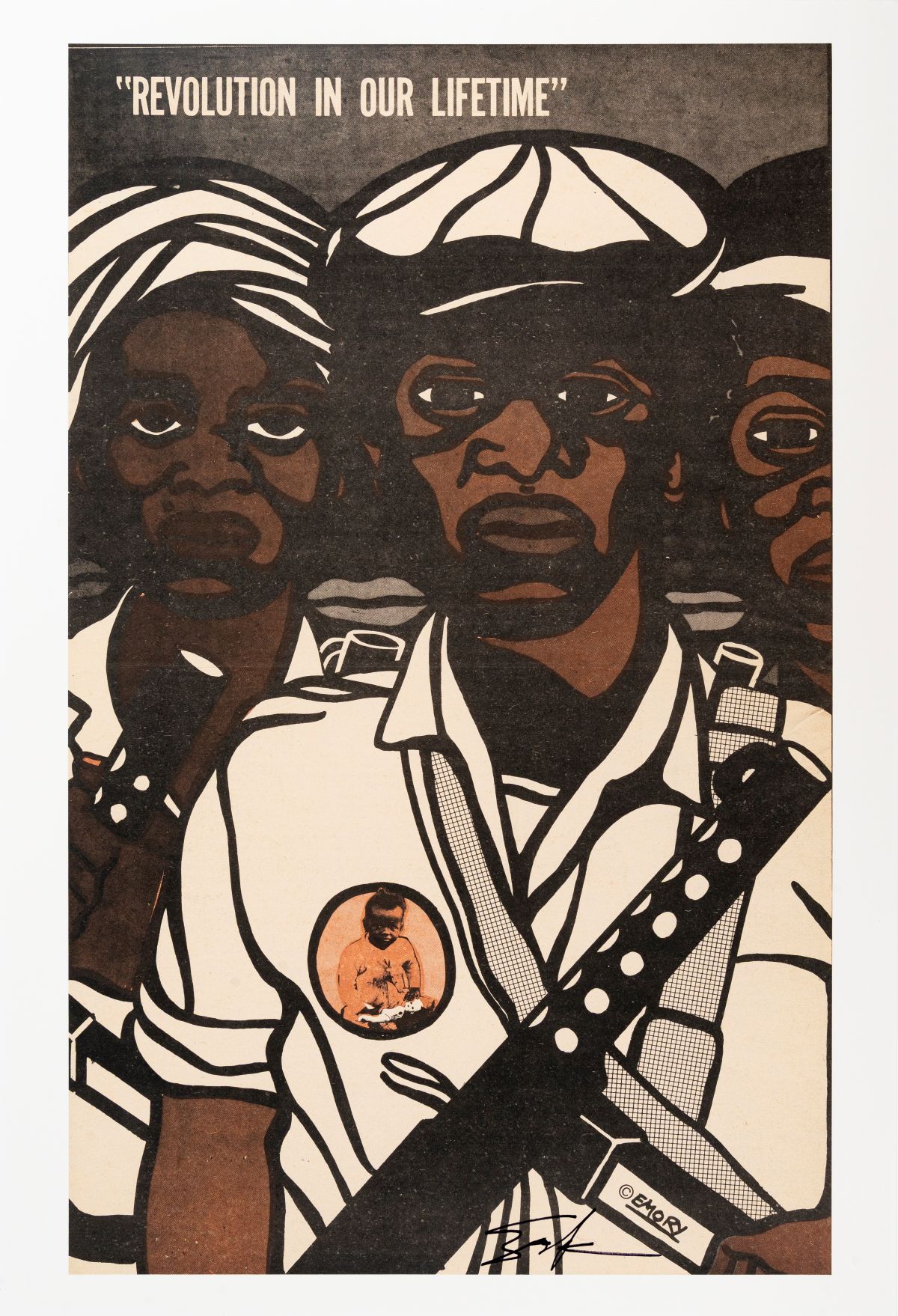 Emory Douglas,“Emory Douglas, Revolution in Our Lifetime, 2013 (originally created 11/8/1969).” “Signed Art Poster” © 2026 Emory Douglas / Licensed by AFNYLAW.COM
Moonwalking forward to Douglas’s Revolution in Our Lifetime, one cannot look away, and that is the point. The central figure holds your gaze directly. This is the anthem of Directism, sampled like a DJ spinning Chicago house on three turntables: Edwin Starr’s Contact; the School of AFRICOBRA’s Frontal Image principle inspired by African sculpture; not seeking permission to be seen and not tryin’ to help you feel comfortable. It is Nation Time: self-determination; No jivin’; No fakin’; No frontin’; No perpetratin’. It is providing for one’s community; preservation of one’s community; protection of one’s community. In 21st-century vernacular, it is FAFO: “F— Around and Find Out.”
The exhibition is visceral memory. History rhymes once again, and this time a community, with its courage and human imperfections, joined a long line of resistance and decided that enough is enough. Black communities of that era lived through what documentaries and films have since featured: the murder of Emmett Till (1955); the assassinations of Medgar Evers (1963), Malcolm X (1965), Dr. Martin Luther King Jr. (1968), and Fred Hampton (1969); the routine violence of police brutality; the economic disenfranchisement that shaped which neighborhoods got investment and which did not; and the antiwar protests against Vietnam. Douglas made Revolution in Our Lifetime inside that lived moment, for an organization targeted by COINTELPRO, the FBI program that worked to surveil, discredit, and dismantle the Black Panther Party. What the platform asked for was plain: protect the community, educate its children, feed and care for its own. The government treated those aims as a threat worth destroying. The text across the top, REVOLUTION IN OUR LIFETIME, echoes Point Ten of the Ten-Point Platform: land, bread, housing, education, clothing, justice, and peace. The Party’s daily record backs this up: free breakfast programs that fed thousands of children before school, community health clinics, and educational programs. Douglas’s image is a portrait of resistance, and it is also a portrait of the people who ran those kitchens and clinics. The figures are armed. For those who carried this history in their own bodies, Douglas’s crowd is still looking back, asking whether the work is finished.
Poplockin’ further into this exhibition is In-Directism in action, on display through the archival media that provide more context. So while Direct strategies demand immediate recognition—billboards, protest signs, declarative statements—Indirect strategies demand prolonged engagement, cultural literacy, and repeated viewing. One strategy insists you cannot look away. The other ensures you cannot be finished with what you see in a single encounter. Thus, the various archival publications, along with the vinyl recordings, are simply ephemera having conversations with each other, providing additional access points for communities to be educated for the purpose of liberating themselves.
Ultimately, Power to the People: The Revolutionary Art & Vision of the Black Panther Party is more than just an exhibition about past historical events. It invites viewers to reflect on their current political, economic, and social situation and develop practical solutions that are designed to get results. And this always begins with reading and learning from Social Justice Movement predecessors. Furthermore, it includes getting a library card so that one can go to the Lie-bury and find out where the lies are buried. WM

Richard Allen May III
Richard Allen May III is a 2025 Andy Warhol Foundation Arts Writers Grant recipient, independent curator, and educator at CSU Fullerton, CSU San Bernardino, ArtCenter College of Design, and Bowie State University, where he teaches art history. He has been a contributing writer for Artillery for over eight years and wrote the foreword to AFRICOBRA: Experimental Art Toward a School of Thought (Duke University Press, 2020).
A project supported by the Andy Warhol Foundation Arts Writers Grant.
view all articles from this author