Whitehot Magazine
October 2026
"The Best Art In The World"
"The Best Art In The World"
October 2026
Paul Fägerskiöld’s exhibition “Ergosphere,” currently on view at Peter Blum Gallery
By ALEX GRIMLEY October 14th, 2026
As luck would have it, between my seeing Paul Fägerskiöld’s exhibition “Ergosphere,” currently on view at Peter Blum Gallery, and drafting this review, a research project took me to the McDonald Observatory, the remote West Texas astronomical research outpost of my alma mater, the University of Texas at Austin. There, scientists from around the world converge upon the Hobby-Eberly Telescope, the largest segmented-mirror telescope system in North America, to chart the expansion of the universe by surveying galaxies several billion light-years away.
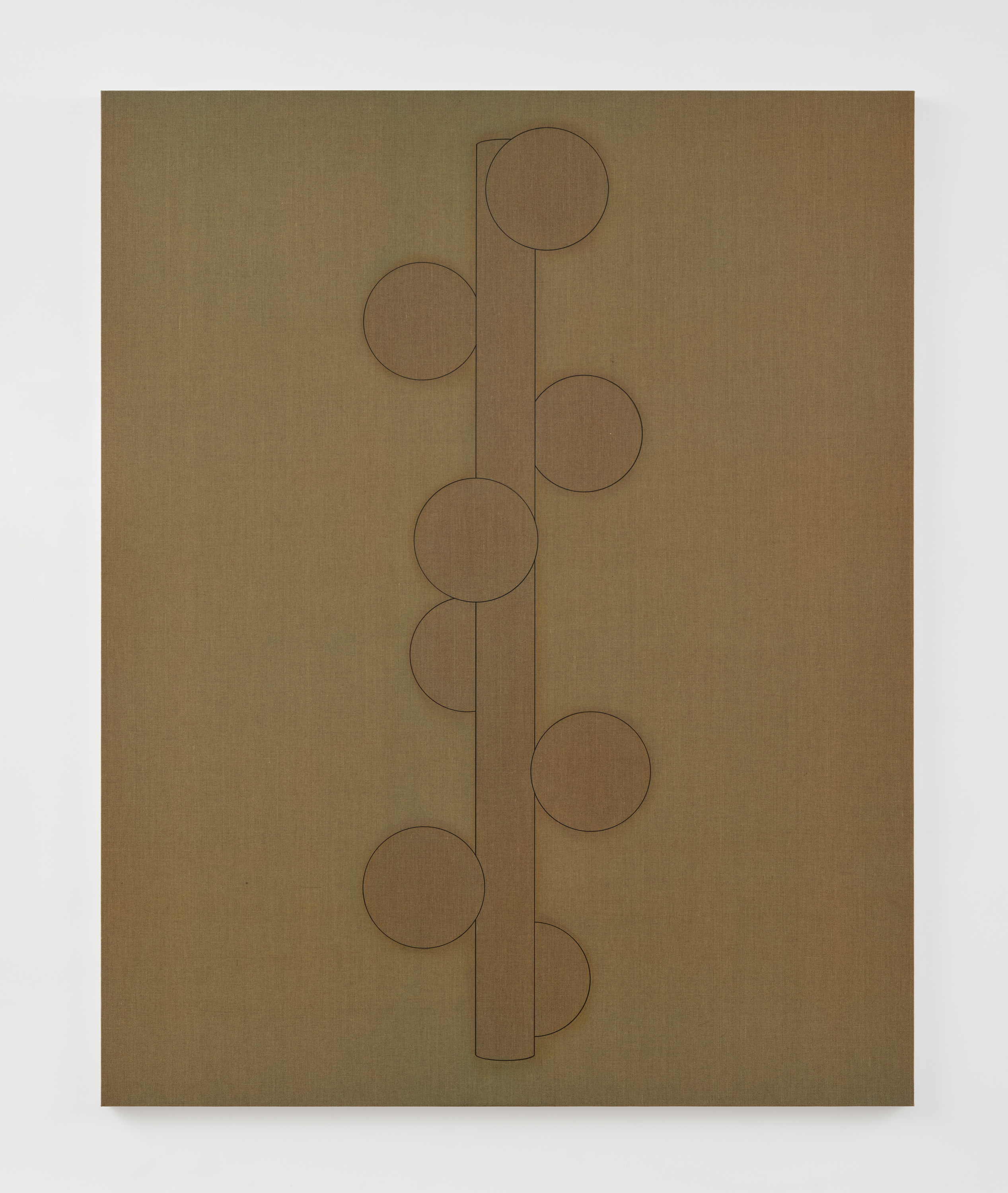 Time-Tree, 2026 Acrylic and oil on linen 78 3/4 x 63 inches (200 x 160 cm)
Bringing only a layperson’s understanding of astronomy to the mountain, I welcomed the unexpected opportunity to talk with the observatory’s scientists about Fägerskiöld’s work. Over lunch, I sit with a visiting astrophysicist and pull up one of the paintings on my laptop. He sees the name of the artwork, New York. July 1, 3586. View south towards the black hole Gaia BH1 (1,560 light years), and leans in with sudden excitement. “I was on the discovery team of Gaia BH1!” As he launches into an enthusiastic discourse on radial velocities, proper motion, and spectroscopy, I interject: “Can we start by breaking that title down, piece by piece?”
What follows is a quick lesson in celestial orientation. The title isn’t science fiction, I learn, but a literal mapping: what will be visible to a person standing in New York fifteen centuries from now, looking south toward a coordinate in the constellation Ophiuchus where the closest known black hole resides. It promises a specific view of the cosmos, though what Fägerskiöld delivers on canvas is something far more elusive…
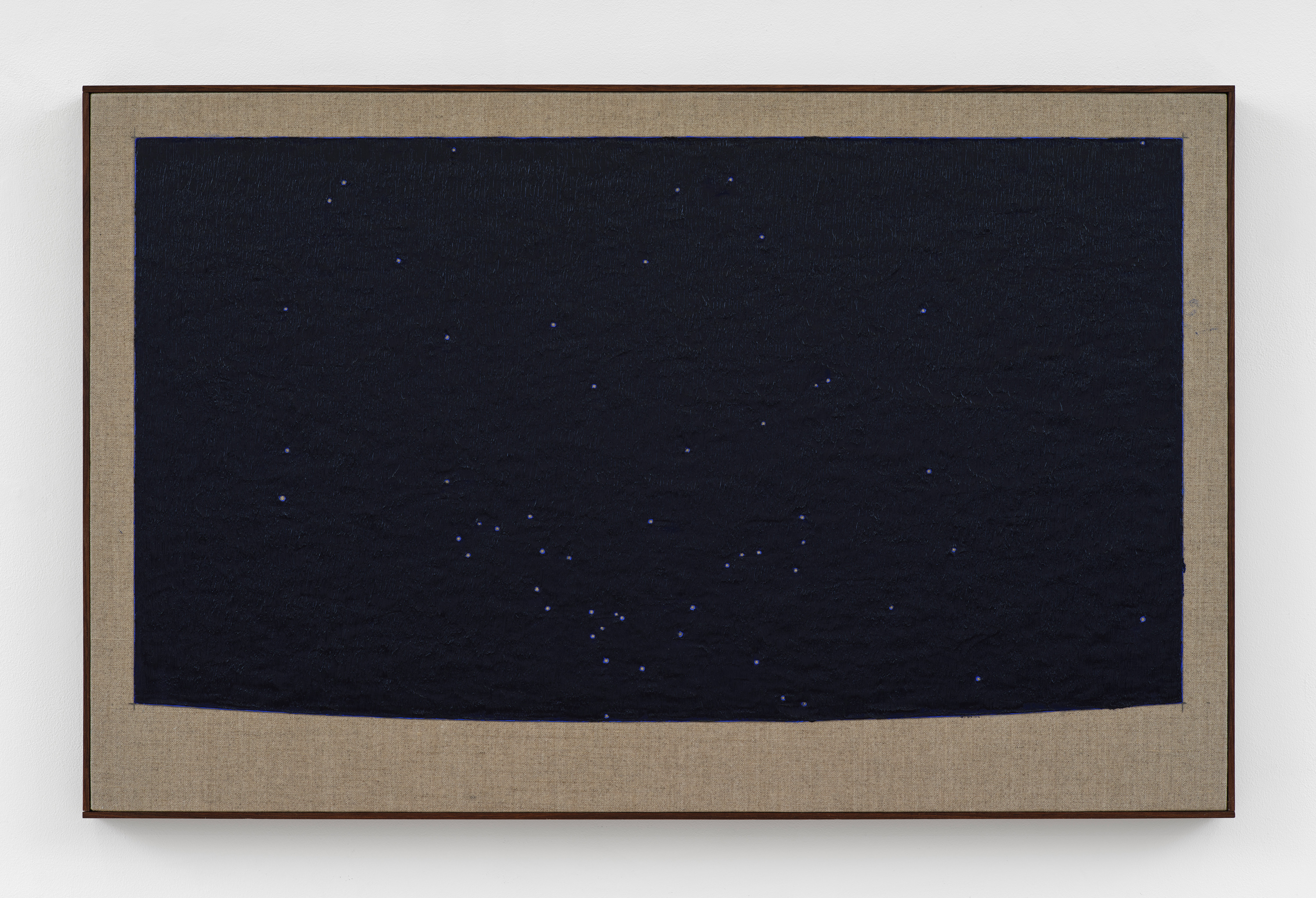 New York. July 1, 3586. View south towards the black hole Gaia BH1 (1,560 light years)., 2026 Acrylic and oil on linen 18 7/8 x 29 7/8 inches (48 x 76 cm)|
New York. July 1, 3586. View south towards the black hole Gaia BH1 (1,560 light years), a small, midnight-blue near-monochrome, is the first painting you encounter in “Ergosphere.” Its deeply colored rectangular field, which stops about an inch short of the edge of the linen support, is speckled with tiny, bright dots, not much larger than the tip of a ballpoint pen. As I draw near to examine the painting more closely, I find that these dots aren’t applied to the surface but are in fact unpainted, or, more accurately, they appear as if carved out of the heavy film of paint. Their light color is that of the linen substrate, and a faint blue halo—evidence of the accumulated shades of blue that comprise the dense surface—surrounds each.
Continuing into the gallery, I encounter works from the other series featured in the exhibition. Time-Tree (2026) features a vertical bar flanked by spiraling circles situated in the middle of the canvas, while Sphere (2026) pictures a single central circle. The two groups of work could hardly be more different. Starscapes like New York. July 1, 3586 are dark and solid, completely opaque, built up from several layers of acrylic upon which Fägerskiöld applies as many layers of oil, all the while leaving brushwork visible across their thick, glossy surfaces. The color and outlined shapes in Time-Tree and Sphere, by contrast, are transparent, and the entire painting is thinly tinted with a rusty reddish cast, which leaves the linen ground visible throughout. These works are weightless and ethereal. In the starscapes, the presence of the support is focused at the perimeter, where the border of exposed raw linen delimits the painting as an object and, counterintuitively, makes the nearly black field feel open rather than confined.
In both bodies of work, Fägerskiöld is particularly attentive to the qualities of the paint surface—its tactility, opacity, sheen, and facture—and in both series he utilizes these nuances to elicit close attention from the viewer. Each of the starscape paintings has a virtually imperceptible tonal cast, which remains most visible in the hollowed-out area surrounding each star. Despite the common configuration of those pictures, and the repetition of motifs in Fägerskiöld’s Time-Tree and Sphere paintings, the works in “Ergosphere” do not feel iterative. Two registers of scale operate throughout Fägerskiöld’s starscape paintings. In the largest examples, which measure nine and a half feet across, as well as the smallest, under two feet in each dimension, his rendering of distant stars is nearly microscopic.
The result is an oscillating sense of scale, in which the smallest pictures may feel vast and the largest intimate, or vice versa. In both cases, these paintings have an entirely immersive presence. This enveloping effect intensifies as the exhibition progresses, with the paintings’ disparate visual appearances yielding to an increasingly palpable slowness and quietude. These qualities gradually saturated my experience, and the separate paintings in the show began to feel like a single, unified work. What makes the starscape pictures compelling is the stark disparity between subject matter and visual delivery. I know of no other artworks that manage to reconcile such a rigorously determined subject with a material presence so resolutely abstract.
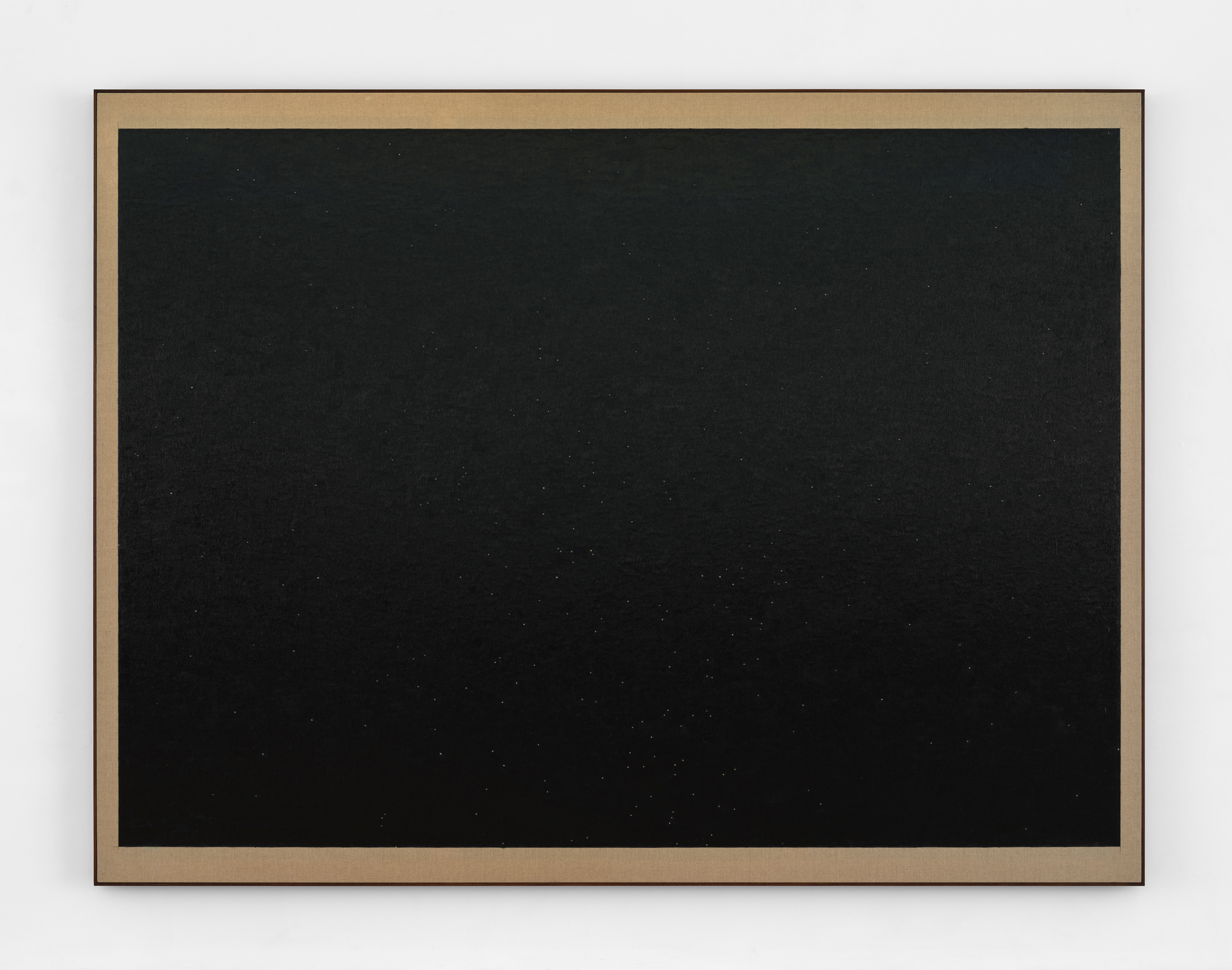 View from the Solar System towards the black hole Sagittarius A (26,000 light years). June 1, 28,000., 2026 Acrylic and oil on linen 86 5/8 x 114 5/8 inches (220 x 291 cm)
Works like View from the Solar System towards the black hole Sagittarius A (26,000 light years). June 1, 28,000 and View from the Solar System towards the black hole M87 (55 million light years). January 1, 100,000 (both 2026) present ostensibly accurate mappings of deep space, yet they register as self-referential, autonomous abstractions. These paintings invert the logic of artists like April Gornik and Tula Telfair, whose landscapes remain fully legible despite being entirely invented. One view of cosmology holds that deep space is a reminder of our own insignificance, but my parallel encounter with Fägerskiöld’s paintings and the cosmic horizons at McDonald Observatory suggested something approaching the opposite: to confront the unfathomable extent of God’s creation is not to be diminished by it, but to glimpse what it means to be made in His image and likeness, possessing a mind capable of apprehending such immensity.
What Fägerskiöld’s paintings point toward is not the silence and darkness of deep space, but rather the wonder of man’s ability to conceive of the cosmos, map its horizons, and give that vastness tangible expression.

Alex Grimley
Alex Grimley is an independent art historian specializing in postwar and contemporary art, particularly Color Field painting. His writing addresses intersections of visual art, criticism, and experimental music.
view all articles from this author